Family offices are responsible for handling more complex investment portfolios, legal entities, reporting, private investments, taxation issues, and succession plans. However, creating a larger internal workforce for all specializations is often expensive, involves inefficient work processes, and relies heavily on several employees. Outsourced family office services represent another approach where analysts, accountants, researchers, technologists, and administrators serve as the extension of the internal family office.
Thank you for reading this post, don't forget to subscribe!Outsourced Family Office Services Foundations and Operating Models
The family office is not supposed to hire external providers to cut down staff. Rather, the model of its operations should help separate strategic functions from those that can be performed efficiently by an external provider.
Outsourced Family Office Services: Foundations & Operating Models
Why Family Offices Use External Specialists
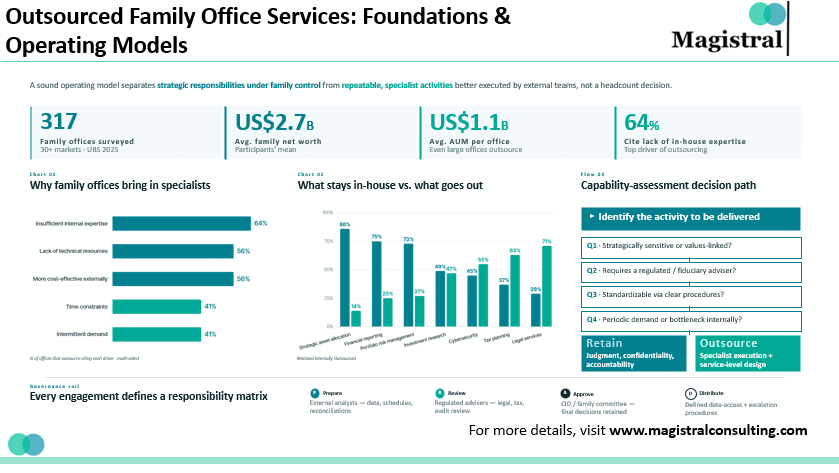
UBS conducted a survey of 317 family offices in 2025 in more than 30 markets. The families that participated had an average net worth of US$2.7 billion, and their family offices managed an average of US$1.1 billion. Of the outsourcing family offices, 64% reported that they lacked internal expertise, 56% did not have the required technical capacity, and 56% found the outsourcing of tasks more cost-efficient. Time constraints and irregular demand were reported by 41% each.
This information proves that outsourcing is not only practiced by small companies. Even large offices with a considerable amount of assets could find it difficult to provide full-time employees dedicated to the tasks of cybersecurity, complex evaluations, tax analysis, manager research, and unique transactions. Thus, the proper mandate for outsourced family office services must start from an assessment of the capabilities. It would be important to list the activities that involve strategic decisions, need regulated advisors, cause bottlenecks in operations, and have standardization procedures.
What Should Remain Under Family Control
It usually happens that the family office stays responsible for the issues connected with the values, investment philosophy, governance, privacy, and relations. Thus, according to the results provided by UBS, 86% of offices made strategic asset allocation internally, and 75% and 73% made their own financial reporting and portfolio risk management. The above-mentioned figures prove the necessity of the presence of judgment and confidentiality in the process of outsourced family office services.
Accountability need not involve doing all the supporting tasks in-house. This is because an outside team can collect portfolio data, reconcile documents, produce analytic schedules, review managers’ reports, and manage dashboards while the chief investment officer or family committee makes the calls.
Functions Commonly Suitable for Outsourcing
The best candidates for outsourcing are those that have both high technicality and episodic need. According to the UBS study, 71% of firms outsourced legal services, 63% outsourced tax planning, and 55% outsourced cybersecurity. Investment research was also about even, with 49% conducting investment research in-house and 47% using external parties, which explains why many firms currently regard outsourced family office services as a specialty overlay function instead of a substitute for in-house capabilities. In practice, outsourced family office services are most effective when the scope is clearly documented and tied to measurable deliverables.
Other possible fields include bookkeeping, entity administration, capital call management, document management, market analysis, performance attribution, company management, and direct investment support. There may be different analytical templates, valuations calendars, and risk indicators for families using private equity, venture capital, real asset, and credit strategies.
Governance and Service-Level Design
All engagements should specify ownership, deadlines, approval rights, data access policies, escalation provisions, and service level targets. Responsibility charts could clarify who is responsible for the preparation, review, approval, and delivery of each deliverable. It is also advisable for families to keep the roles of service providers and advisors separate. External analysts could prepare schedules, analysis, and models, whereas licensed lawyers, accountants, auditors, or investment professionals should be responsible for providing formal advice and approval.
Applications and Use Cases for Outsourced Family Office Services
The value of outsourced family office services varies depending on where a family office finds itself in its family office lifecycle. A startup family office may need help in establishing infrastructure and reporting, while a well-established family office with multiple generations can be in need of specialized investment research and technology integration, among others. The importance of outsourced family office services is increasing with growth in the family office industry.
Outsourced Family Office Services: Applications & Use Cases
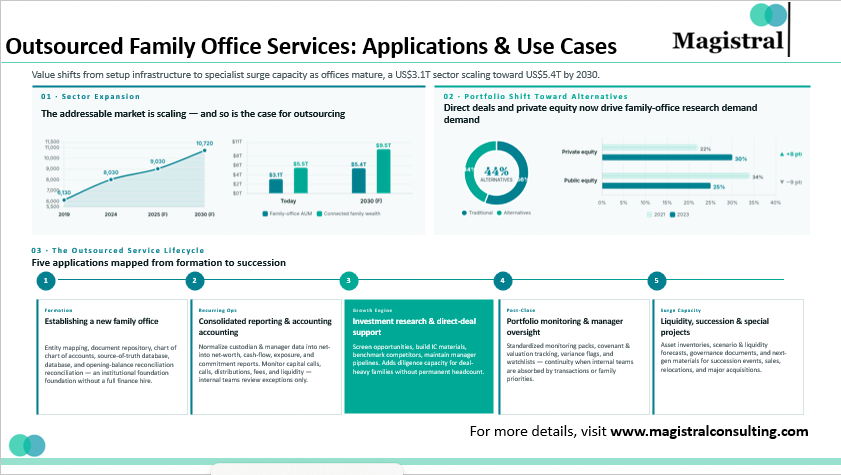
According to Deloitte, the number of single-family offices worldwide is 8,030, compared to 6,130 in 2019, and is expected to increase to 9,030 in 2025 and 10,720 in 2030. Deloitte estimates family office AUM to currently be around US$3.1 trillion and to possibly reach US$5.4 trillion in 2030, while family wealth managed through family offices is US$5.5 trillion and possibly US$9.5 trillion in 2030.
Establishing a New Family Office
The initial set of a new family office often includes assets invested with various banks, holding companies, trusts, partnerships, and even some directly owned investments. The first step before any analysis takes place is to build the entity structure, gather all relevant documentation, establish the reporting schedule, chart of accounts, and source-of-truth database. It can be done through hiring an outside team that will gather the historical documentation, establish the structure, reconcile the opening balances, and develop a management reporting tool.
It provides an institution without having to hire a whole finance and research department in the process of building an office. This approach, which works well for fund managers, can work for family offices with multiple investment vehicles as well, but the workflow should be adjusted accordingly.
Consolidated Reporting and Accounting Support
The information received by families from the custodians, administrators, private-market managers, operating companies, and advisers is usually not in standardized format. External professionals can standardize the information and create consolidated net-worth reports, cash flow reporting, exposure reporting, commitment reporting, and accounts by entities. Moreover, the provider may be monitoring capital calls, distributions, management fees, loans, tax documentation, and liquidity needs. The internal professionals may then look at the exceptions rather than spending time compiling spreadsheets. It is one of the most practical ways of using outsourced family office services, as the task is recurring, control-focused, and measurable.
Investment Research and Direct-Deal Support
Family offices actively engage in private transactions, co-investments, and direct investments into companies. UBS has reported that family offices had 56% of their portfolios allocated to traditional investments and 44% to alternatives in 2024, with equities accounting for 30%, while private equity, direct investments, and real estate dominated the alternative bucket. Private Equity has also been reported to make up 30% of the average portfolio of the survey respondents in 2023, according to Deloitte’s family office research, while public equities dropped from 34% in 2021 to 25%.
An external research team can screen opportunities, prepare company profiles, analyze industries, benchmark competitors, review financial projections, and build investment-committee materials. It may also maintain a pipeline of managers, intermediaries, co-investors, and relevant funds. For deal-heavy families, outsourced family office services can add diligence capacity without permanently increasing headcount.
Portfolio Monitoring and Manager Oversight
External analysts can convert manager reports and portfolio-company updates into standardized monitoring packs. They can flag variances against budgets, summarize board materials, and maintain watchlists. This creates continuity when internal professionals are occupied with transactions or family priorities.
Liquidity, Succession, and Special Projects
Succession events, asset sales, relocations, and major acquisitions can create temporary surges in analytical work. UBS found that only 53% of surveyed families had a formal wealth-succession plan, while just 26% involved the next generation from the outset. Campden Wealth’s 2025 operational-excellence research, based on 146 family offices, also found that 57% of families now live across borders, increasing the need for coordinated tax, estate, investment, and governance support.
External teams can prepare asset inventories, scenario analyses, liquidity forecasts, governance documents, and educational materials as a part of outsourced family office services. They should work alongside the family’s legal and tax advisers rather than replacing them.
How Magistral Consulting Helps in Outsourced Family Office Services
Magistral Consulting assists family offices in terms of being an additional part of the finance, investment, and operations departments through outsourced family office services. Such services are provided as research on investments, financial modeling, monitoring of the portfolio, reporting, assistance in transactions, CRM management, and marketing to investors.
Due to flexible staffing, outsourced family office services make it possible for family offices to expand their staff when they face busy periods without hiring permanent employees. Having a proprietary database consisting of more than 45,000 investors in LPs, GPs, angel investors, HNWIs, and other types of investors, Magistral also offers specific help with fundraising and market research.
About Magistral Consulting
Magistral Consulting has helped multiple funds and companies in outsourcing operations activities. It has service offerings for Private Equity, Venture Capital, Family Offices, Investment Banks, Asset Managers, Hedge Funds, Financial Consultants, Real Estate, REITs, RE funds, Corporates, and Portfolio companies. Its functional expertise is around Deal origination, Deal Execution, Due Diligence, Financial Modelling, Portfolio Management, and Equity Research
For setting up an appointment with a Magistral representative visit www.magistralconsulting.com/contact
About the Author

Aman is an investment-research specialist with 5+ years of experience across business and investment research, including 2+ years with Big Four firms like KPMG. A Stanford Seed alumnus with an MBA in Finance and a Bachelor of Commerce (Hons) from University of Delhi, he focuses on private equity, venture capital, and renewable energy sectors. He leads project teams at Magistral Consulting, delivering financial research, due diligence, deal sourcing, and M&A support, while driving strong process management and analytics. His blend of attention to detail, strategic thinking, and dynamic execution enables him to turn complex data into actionable investment insights.
FAQs
What functions can a family office outsource?
Which activities should remain in-house?
Is outsourcing suitable only for smaller family offices?
How can a family office protect confidential information?
How should provider performance be measured?