Valuation is one of the most contentious areas in fundraising in the current capital markets. As startups and growth-stage companies look to raise capital, the gap between their internal assessment of their business value and investors’ willingness to pay for it has grown significantly.
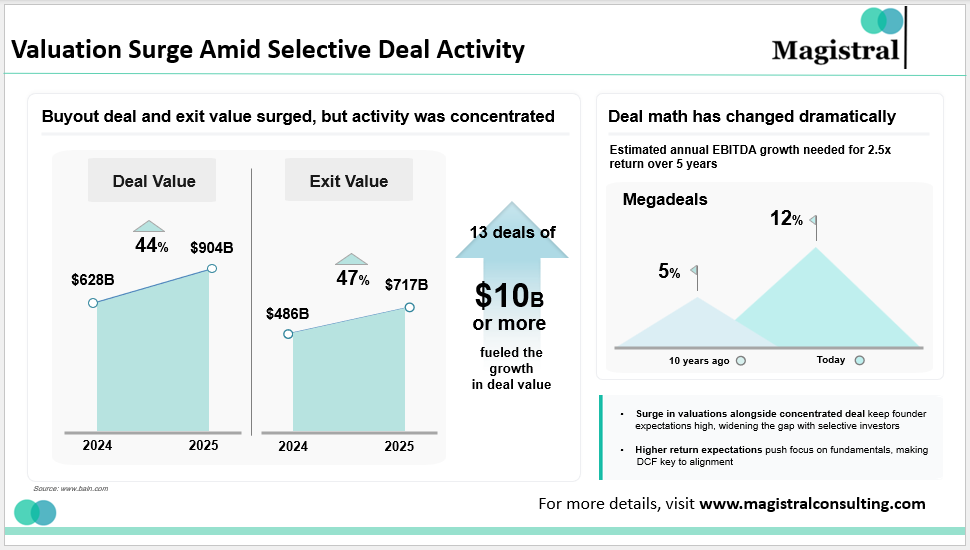
Valuation Surge Amid Selective Deal Activity
According to data from PitchBook, the median valuations for startups have fallen by 15-25% across various stages from 2022 to 2024. This is a correction after the peak funding environment in 2021. However, the gap in valuations is a result of founders’ high valuations, especially for earlier-stage companies.
The gap in valuations is not just a result of over- or under-optimism. There is a fundamental difference in approach. Founders focus on potential, while investors focus on returns. In this context, DCF modeling has re-emerged as a key framework for alignment in valuations.
Why Founders and Investors Disagree on Valuation
This is primarily due to differences in how they approach valuation. Founders usually concentrate on growth potential, market opportunity, and overall strategy, whereas investors usually concentrate on return on investment, cash flow, and overall risk. These differences become more apparent in uncertain market conditions. However, DCF modeling helps in bridging this gap by providing a common ground for both parties. It does this by quantifying risks and growth potential in terms of financial outcomes, making it easier for both parties to arrive at a more objective and less biased position.
Potential vs. Probability: A Structural Disconnect
At the core of valuation disagreements lies a difference in perspective. Founders are generally interested in valuations of potential and look at growth, scalability, and market size, whereas investors are interested in valuations of probability.
A study by McKinsey & Company indicates that currently, there is a greater focus on profitability and cash flow predictability over growth at all costs, especially in a higher interest rate environment.
In such situations, DCF modeling helps both founders and investors clearly articulate their assumptions around growth and risk, thereby bridging the fundamental gap.
Information Asymmetry in Financial Projections
Another key driver of valuation gaps is information asymmetry. Founders, being more aware of the business, make more optimistic assumptions, whereas investors make more pessimistic assumptions based on market data.
This lack of a standardized framework causes a valuation gap. With DCF modeling, both parties will be able to evaluate each other’s assumptions in a more objective and realistic way.
Market Conditions Are Widening Valuation Gaps
Resilient global economic growth with moderation in inflation rates implies that macroeconomic conditions are gradually returning to normal. Nevertheless, even with the moderation in inflationary pressures, the overall market conditions are still being dictated by relatively high interest rates, tight liquidity, and an uncertain exit scenario. These factors have led to more conservative estimates being used, especially with regard to discount rates and cash flow estimates. On the other hand, founders are using growth rate estimates based on more favorable market conditions. This is leading to an increasing expectation gap. DCF analysis is also important in this regard, as it takes into consideration the impact of macroeconomic conditions on valuations.
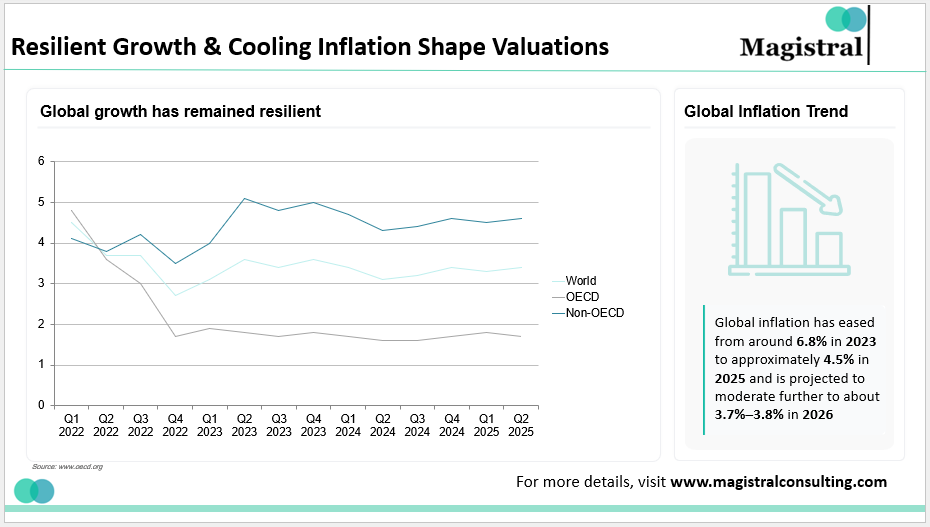
Resilient Growth & Cooling Inflation Shape Valuations
Higher Cost of Capital and Its Impact on Valuation
Rising interest rates have increased the cost of capital, directly affecting how future cash flows are valued.
Data from CB Insights indicates that global venture funding declined by over 30% in 2023, reflecting tighter liquidity and increased investor selectivity.
In DCF modeling, higher discount rates reduce the present value of projected cash flows, resulting in lower valuations. However, founders often adjust expectations more slowly, leading to persistent valuation gaps.
Exit Uncertainty and Delayed Liquidity Events
The exit markets, too, are becoming increasingly challenging. According to EY, “public listings are lower than pre-2021 levels, and private equity firms are holding assets for longer as exit conditions remain weak.”
This again adds to the divergence in DCF modeling as the founders continue to assume exit scenarios from pre-pandemic days.
Multiple Compression and Market Volatility Are Distorting Comparable-Based Valuations
Market volatility and declining valuation multiples have made comparable-based methods less reliable, as investors adjust expectations faster than founders. This has created a disconnect where historical data is not representative of current reality. In these situations, a more stable approach is offered by DCF modeling, where companies are valued on their fundamental attributes instead of multiples.
The Impact of Public Market Corrections
One of the most notable changes in the past few years has been the significant correction in the valuation levels of the public markets. Technology and growth equities saw a significant compression in valuation multiples post 2021, which has impacted the private markets.
The use of comparable company analysis, which relies on public market multiples, has been impacted by the volatility in the public markets. This has resulted in the private market valuation levels temporarily deviating from the founder and investor views.
Why Intrinsic Valuation Is Gaining Importance
Unlike market-based techniques, DCF modeling offers an intrinsic valuation approach that relies on a company’s underlying financials and cash flow projections.
For example, DCF modeling’s focus on underlying fundamentals like revenue growth, margins, and capital efficiency minimizes reliance on unstable external references. This technique becomes more relevant in a volatile market where comparable data may not be a true representation of a company’s value.
Today, DCF modeling has emerged as a popular technique that many investors use to verify or refute traditional comparable-based valuation approaches.
How DCF Modeling Bridges the Valuation Gap
Valuation gaps often arise from differing assumptions around growth, risk, and returns. DCF modeling assists in closing the gap by providing a framework wherein both the founders and the investors are able to agree upon key variables like cash flows and discount rates.
Bringing Transparency to Valuation Assumptions
One of the key benefits associated with DCF modeling is the ability to make assumptions around valuation transparent. This means items such as growth rates, margins, capital expenditures, and discount rates are all defined and can be adjusted.
This allows for a much more constructive dialogue between founders and investors as they are able to better understand the implications of changing assumptions around valuation.
Moving from Point Estimates to Scenario-Based Valuation
Rather than relying on a single valuation figure, DCF modeling allows for scenario analysis. Founders can make an upside case based on high growth assumptions, while investors can analyze downside risk based on low growth assumptions.
This takes the discussion away from a fixed valuation number and puts it towards understanding the range of outcomes, which makes DCF modeling a very effective tool for alignment during fundraising.
The Increasing Role of DCF Modeling in Institutional Investment Decisions
Institutional investors are increasingly adopting structured valuation frameworks as an integral part of their due diligence process. As capital becomes more selective, the reliance on narrative-driven valuation approaches is falling out of favor.
According to a report by Deloitte, investors are increasingly focusing on cash flow-based valuation methods, especially for private markets due to transparency issues.
In the current scenario, DCF modeling is widely used for evaluating downside risk, understanding value creation over a period of time, and making investment decisions across various industries. This is because DCF modeling has the ability to incorporate various factors under a single analytical framework.
The valuation gaps between founders and investors have widened in the current volatile market scenario due to various factors such as differing expectations, macroeconomic factors, and valuation approaches. DCF modeling can play an important role in bridging valuation gaps between founders and investors. As capital becomes more selective, adopting strong valuation approaches becomes imperative for successful fundraising and better investor alignment.
How Magistral Consulting Supports Financial Modeling
As financial modeling plays an integral role in investment decisions, fundraising activities, and valuation analysis, companies are looking for well-structured, accurate, and scalable financial models. At Magistral Consulting, we are committed to assisting our clients in developing robust financial models that clearly interpret the business assumptions into meaningful data-driven insights.
DCF modeling to assess intrinsic valuation based on projected cash flows and risk assumptions
Three-statement financial modeling integrating income statement, balance sheet, and cash flow projections
Scenario and sensitivity analysis to evaluate upside, downside, and risk-adjusted outcomes
LBO and investment modeling to support private equity transactions and return analysis
Financial model validation and audit to ensure accuracy, consistency, and investor readiness
Customized models for fundraising and M&A aligned with specific deal structures and investor requirements
About Magistral Consulting
Magistral Consulting has helped multiple funds and companies in outsourcing operations activities. It has service offerings for Private Equity, Venture Capital, Family Offices, Investment Banks, Asset Managers, Hedge Funds, Financial Consultants, Real Estate, REITs, RE funds, Corporates, and Portfolio companies. Its functional expertise is around Deal origination, Deal Execution, Due Diligence, Financial Modelling, Portfolio Management, and Equity Research
For setting up an appointment with a Magistral representative visit www.magistralconsulting.com/contact
About the Author

Nitin is a Partner and Co-Founder at Magistral Consulting. He is a Stanford Seed MBA (Marketing) and electronics engineer with 19 + years at S&P Global and Evalueserve, leading research, analytics, and inside‑sales teams. An investment‑ and financial‑research specialist, he has delivered due‑diligence, fund‑administration, and market‑entry projects for clients worldwide. He now shapes Magistral Consulting’s strategic direction, oversees global operations, and drives business‑development support.
FAQs
What are the core services offered by Magistral Consulting?
How does Magistral Consulting support data-driven decision-making?
How does Magistral Consulting help in investor communication through financial models?
Why is outsourcing financial modeling beneficial for firms?