ESG equity research outsourcing has developed from a peripheral support activity to a strategic enhancement of institutional research capabilities. For asset managers in 2026, the challenge is to deal with the growth of regulation, rating agency differences, political attention, and investor demands, in addition to the challenge of cost constraints. As ESG research goes from brand marketing to balance-sheet materiality, the research becomes more complex, data-intensive, and globally consistent, driving the need for outsourced ESG research expertise.
Global ESG Capital Continues to Reshape Equity Markets
Growth and Allocation Trends in Global ESG Investing
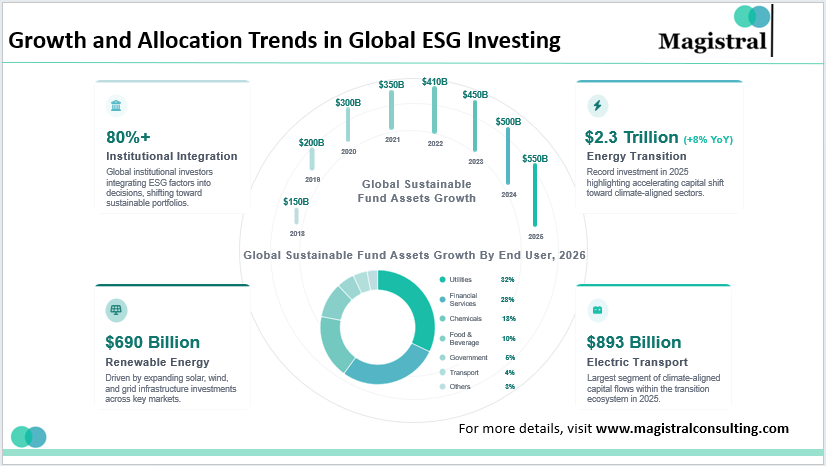
Sustainable investing remains an important part of global capital markets. The global ESG investing market was valued at approximately $39.08 trillion in 2025, and it is expected to grow to $45.61 trillion by 2026.
In terms of long-term projections, it is expected that ESG assets will be worth over $40 trillion by 2030, which is over a quarter of the global assets under management.
In terms of funds, global sustainable funds have over $3.9 trillion in assets under management by the end of 2025, which indicates that investment into ESG strategies is still sizeable despite periodic outflows.
Asset managers, therefore, have a direct research imperative, as investment theses must now show how ESG factors impact long-run earnings quality, valuation multiples, and risk profiles.
ESG equity research outsourcing helps research teams meet this demand through specialized sustainability analysis integrated into fundamental equity models.
Regulatory Expansion Is Driving Research Complexity
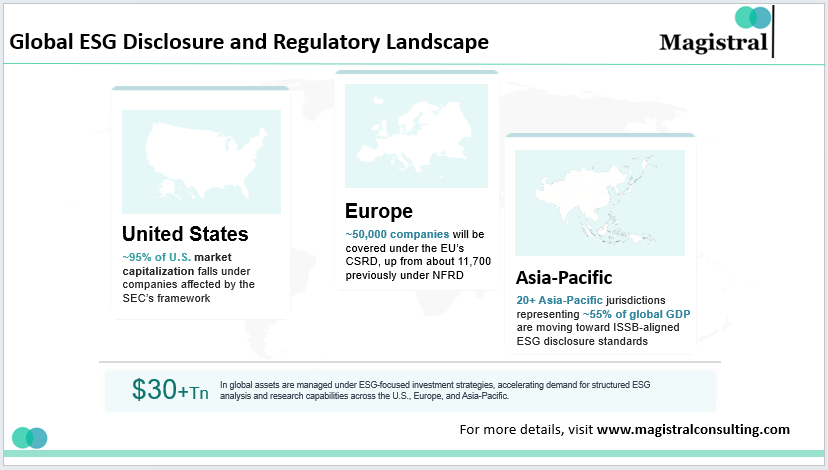
The expansion of regulatory activity in key markets is significantly increasing the depth of analysis needed for sustainability analysis from the equity research function. As the CSRD, ISSB, and climate disclosure regulations evolve, ESG equity research outsourcing is helping investment firms address the increasing complexity of regulatory data interpretation.
Global ESG Disclosure and Regulatory Landscape
CSRD and SFDR in Europe
The epicentre of regulatory-driven ESG integration remains Europe, with the Corporate Sustainability Reporting Directive (CSR D) significantly increasing the scope of mandatory sustainability reporting from around 11,000 companies to almost 50,000 companies within the EU. This will have the effect of significantly increasing the amount of standardized ESG data available to equity analysts. At the same time, the Sustainable Finance Disclosure Regulation (SFDR) remains to drive asset managers to support their Article 8 and Article 9 fund classifications with sustainability metrics.
For global investors with European exposure, ESG equity research outsourcing helps manage the technical interpretation of double materiality assessments, taxonomy alignment, and Principal Adverse Impact indicators without overextending internal teams.
US Climate Disclosure and Litigation Sensitivity
In the United States, the Securities Exchange Commission has finalized climate-related disclosure rules in 2024, requiring enhanced reporting on Scope 1 and Scope 2 emissions for several public corporations. While there are legal challenges to the implementation, institutional investors are pressuring the integration of climate risk in financial models. This has led to a higher level of scrutiny on the translation of ESG risks into revenue, capital expenditure, and cost of capital estimates.
ESG equity research outsourcing teams are increasingly supporting scenario modeling and regulatory mapping to ensure investment theses reflect evolving disclosure expectations.
Asia-Pacific Alignment with ISSB Standards
In the Asia-Pacific region, countries such as Japan, Singapore, and Hong Kong are moving towards the alignment of sustainability disclosure with the ISSB framework. This is creating a regulatory environment that is more harmonized, but it is also creating more work in terms of analysis. Investment managers are using ESG equity research outsourcing to deal with the changes in disclosure mandates.
The Data Explosion Behind ESG Research
The proliferation of ESG datasets, ratings providers, and company-level sustainability disclosures has increased the data intensity of ESG analysis. Under such circumstances, ESG equity research outsourcing helps investment firms manage the high volume of ESG data and integrate it into a structured framework of equity research.
ESG Data Sources Are Expanding Rapidly
In the last ten years, ESG data has developed into a sophisticated system that includes ratings, corporate disclosures, climate data, and alternative data. Some of the major ESG providers include MSCI, Sustainalytics, S&P Global, Refinitiv, which have developed thousands of ESG indicators that measure everything from emissions to corporate structures, labor practices, and supply chain risks.
One of the challenges that arise with ESG ratings is that they vary significantly between providers due to differences in their methodologies.
Integrating ESG Factors into Financial Models
Current trends in modern equity research show that ESG factors have an impact on financial measures such as the cost of capital, regulatory risks, and asset risk of impairment.
For instance, climate transition risk can have an impact on capital expenditure for industries that rely heavily on fossil fuels, whereas governance issues can have an impact on the valuation multiples of the firm.
ESG equity research outsourcing helps the research team create models that connect ESG factors to the financial valuation models.
Market Pressures Are Changing the Research Operating Model
The increase in the costs of research, the compression of fees in asset management, and the rise in the demand for ESG reporting are making firms rethink their conventional research models. In this new paradigm, ESG equity research outsourcing is helping investment managers to increase their scale with the benefits of cost efficiency and in-depth research.
Fee Compression and Research Scalability
The asset management industry is still under pressure to maintain margins, driven by passive investment competition and reduced management fee income. At the same time, ESG integration demands deeper research coverage and ongoing ESG risk monitoring.
Assembling fully integrated internal ESG teams, especially across industries and regions, can be resource intensive. ESG equity research outsourcing can provide a flexible business model, enabling asset managers to increase their research capabilities without necessarily growing their headcount.
Technology and AI Are Reshaping ESG Analysis
Technology is becoming an integral part of the ESG research process. For example, artificial intelligence tools are now being utilized to analyze company disclosures, detect sustainability controversies, and monitor climate risk profiles. These technologies demand data infrastructure and analytical capabilities.
In addition, external research partners may utilize their own investments in centralized analytics platforms for ESG research, which integrate regulatory data, satellite data, and alternative data sets. By leveraging ESG equity research outsourcing, asset managers gain access to advanced analytical tools without significant technology investment.
ESG Research Is Shifting Toward Financial Materiality
The most significant change in ESG investing is the shift in investment strategies from screening-based investing to financially material ESG integration. Investors are increasingly using sustainability factors based on their effects on the profitability and resiliency of the company, and capital allocation.
Climate change, transition policies, poor governance, and other issues in the supply chain and society could affect the valuation and earnings of a company. As ESG risks become financially quantifiable, equity research teams must analyze them with the same level of detail as other traditional financial metrics. In this environment, ESG equity research outsourcing functions as a strategic extension of investment research. It supports deeper sustainability analysis, improves coverage breadth, and ensures ESG insights are embedded within core equity valuation models rather than treated as standalone reporting exercises.
How Magistral Supports ESG Analysis for Investment Firms
As ESG considerations become central to equity research and portfolio construction, investment firms require structured analytics that connect sustainability indicators with financial performance. Magistral supports asset managers, hedge funds, and private equity firms by providing dedicated research capabilities that strengthen ESG integration within investment decision-making. The support focuses on transforming fragmented sustainability data into actionable insights that align with institutional investment frameworks.
ESG Data Aggregation & Normalization
Collecting and standardizing ESG datasets from multiple providers to create consistent and comparable company-level ESG profiles.
Sector-Specific ESG Materiality Analysis
Identifying financially material ESG risks and opportunities within specific industries to support deeper fundamental research.
ESG Integration in Valuation Models
Incorporating ESG metrics into financial models, including scenario analysis for climate risk, governance impact, and regulatory exposure.
ESG Benchmarking & Peer Analysis
Developing sector-based ESG benchmarking frameworks that allow investment teams to evaluate companies relative to industry sustainability performance.
Regulatory and Disclosure Alignment
Supporting analysis aligned with global sustainability frameworks such as CSRD, SFDR, and ISSB to ensure investment research reflects evolving disclosure standards.
About Magistral Consulting
Magistral Consulting has helped multiple funds and companies in outsourcing operations activities. It has service offerings for Private Equity, Venture Capital, Family Offices, Investment Banks, Asset Managers, Hedge Funds, Financial Consultants, Real Estate, REITs, RE funds, Corporates, and Portfolio companies. Its functional expertise is around Deal origination, Deal Execution, Due Diligence, Financial Modelling, Portfolio Management, and Equity Research
For setting up an appointment with a Magistral representative visit www.magistralconsulting.com/contact
About the Author

Utkarsh is a finance professional with expertise in investment research, M&A, and financial modeling. He has built and applied models including DCF, LBO, and comparable analysis, supporting investment banks, private equity, and venture capital firms across diverse sectors. Utkarsh holds an MBA in International Business & Finance from Symbiosis International University, a B.Com (Hons) from Delhi University, and has completed the Stanford Seed program at Stanford Graduate School of Business.
FAQs
How does Magistral work with investment teams?
Can Magistral support ESG-related regulatory analysis?
Can Magistral support both ongoing and project-based research requirements?
How does Magistral support ESG integration in valuation models?