Outsourced family office services are gaining traction as wealth complexity increases and operational demands expand. According to Knight Frank’s Wealth Report 2024, the global ultra-high-net-worth (UHNW) population is expected to grow steadily through 2028, driving demand for structured wealth management solutions. In parallel, PwC highlights that global assets under management are expected to approach $200 trillion by 2030, with a growing share allocated to private markets and alternative investments. Family offices are increasingly managing diversified portfolios across private equity, venture capital, real estate, and hedge funds, requiring deeper analytical and operational capabilities. However, building full-scale in-house teams remains cost-intensive, often requiring multi-disciplinary expertise across investment, reporting, and compliance functions.
Outsourced family office services address this challenge by providing scalable support across investment management, reporting, and governance. As a result, family offices can focus on strategic decision-making while maintaining operational efficiency, cost control, and access to specialized expertise.
Outsourced Family Office Services and Market Trends
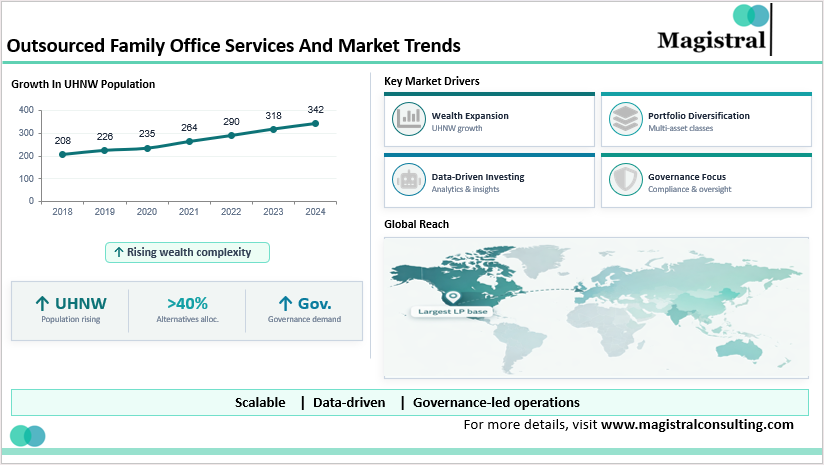
The growth of family office services is closely linked to structural shifts in wealth distribution, investment strategies, and operational complexity. These changes are measurable and continue to accelerate.
Outsourced Family Office Services
Expansion of ultra-high-net-worth population
Knight Frank estimates that the UHNW population will grow significantly over the next five years, increasing both the number and size of family offices globally. As wealth expands, governance expectations increase proportionally. Larger portfolios require structured oversight, advanced reporting, and multi-layered risk management frameworks. This creates operational pressure, particularly for smaller or newly established family offices. Outsourced family office services enable families to scale operations efficiently without building large internal teams, ensuring that governance keeps pace with wealth growth.
Increasing portfolio diversification
Family offices are allocating more capital to alternative assets such as private equity, venture capital, infrastructure, and real estate. PwC notes that alternatives now account for more than 40% of many family office portfolios, reflecting a shift toward higher-return, less liquid investments. This diversification significantly increases analytical complexity, as each asset class requires specialized valuation models, reporting frameworks, and performance tracking methodologies. Family office services provide the expertise and infrastructure required to manage these complex portfolios efficiently while maintaining consistency across reporting.
Rising demand for data-driven decision-making
MSCI highlights that institutional investors are increasingly adopting data analytics and real-time reporting tools to improve decision-making. Family offices are following a similar trajectory, requiring advanced dashboards, scenario analysis, and performance attribution capabilities. This shift toward data-driven investing requires both technology and expertise, which can be costly to build internally. Family office services help implement these capabilities by integrating analytics tools, maintaining data pipelines, and delivering actionable insights without heavy upfront investment.
Growing focus on governance and transparency
Deloitte reports that governance and transparency have become central priorities for family offices, particularly as wealth transitions across generations. Structured reporting, audit trails, and compliance processes are now essential to maintain accountability and trust among stakeholders. Inconsistent reporting or a lack of transparency can lead to inefficiencies and decision delays. Outsourced family office services ensure standardized processes, consistent reporting, and clear audit mechanisms, strengthening governance frameworks across the organization.
Outsourced Family Office Services Operating Model and Structure
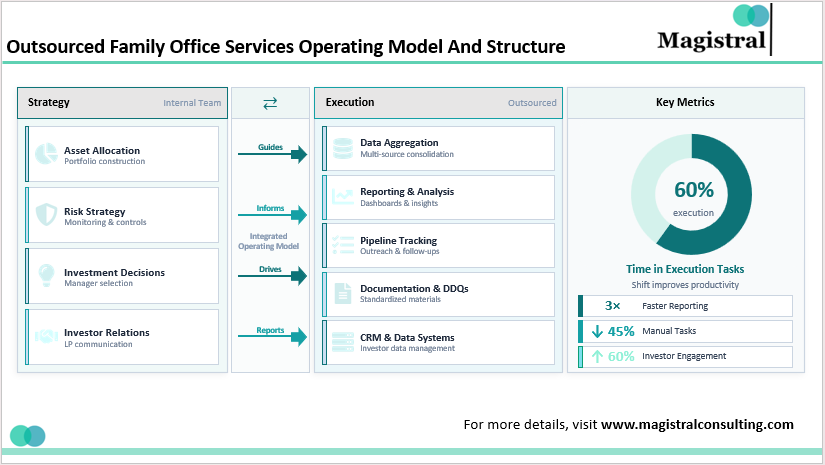
Family office services deliver maximum value when structured as an integrated operating model with clear workflows, defined roles, and measurable outputs. Execution discipline becomes critical as portfolio complexity increases.
Outsourced Family Office Services Operating Model And Structure
Separation of strategy and execution
Family principals and advisors focus on strategic decisions such as asset allocation, risk appetite, and long-term investment planning. Meanwhile, outsourced teams handle execution tasks including data aggregation, reporting, and analysis. This separation improves efficiency and ensures that high-value decision-making is not delayed by operational workload. It also allows family offices to maintain strategic control while benefiting from external expertise.
Centralized reporting and data management
A centralized data framework ensures consistency across all reporting outputs. McKinsey highlights that firms implementing centralized data systems can improve reporting efficiency by up to 30%. Outsourced family office services maintain structured data pipelines, ensuring that all investment data is consolidated, validated, and accessible in real time. This improves accuracy, reduces duplication, and enhances decision-making speed.
Standardization of reporting frameworks
Standardized reporting templates improve transparency and comparability across investments. Consistent performance reports, valuation summaries, and risk metrics ensure that stakeholders receive clear and reliable insights. Outsourced family office services enforce these standards, reducing variability and improving confidence in reported data.
Integration with investment functions
Family offices often align outsourced services with functions such as private equity and portfolio monitoring. This integration ensures that insights from investment performance are reflected in reporting and decision-making. It also enables better tracking of portfolio performance across different asset classes and investment cycles.
Technology-enabled operations
Modern family offices rely on digital tools such as portfolio management systems, data visualization dashboards, and secure data rooms. These tools improve efficiency but require ongoing management and expertise. Family office services integrate and maintain these systems, enabling real-time access to information and improving collaboration across stakeholders.
Outsourced Family Office Services: Benefits and Performance Impact
Outsourcing of family office services delivers measurable improvements across efficiency, cost management, and investment performance. These benefits are increasingly quantifiable.
Cost optimization and scalability
Building an in-house family office team involves high fixed costs, including salaries, technology infrastructure, and compliance systems. Deloitte indicates that outsourcing can significantly reduce operational costs by converting fixed expenses into variable costs. ThisFallows family offices to scale services based on portfolio size and complexity, improving cost efficiency without compromising quality.
Improved reporting accuracy and timeliness
Dedicated analytical workflows reduce errors and ensure timely reporting. Accurate and consistent reporting is critical for effective decision-making, particularly in volatile markets. Outsourcing of family office services ensures that reports are delivered on time and aligned with standardized formats, improving overall governance.
Enhanced risk management capabilities
Advanced analytics and scenario modelling improve risk visibility across portfolios. PwC notes that risk management has become a central focus for family offices, particularly as market volatility increases. Outsourcing of family office services provides tools and expertise to conduct stress testing, liquidity analysis, and scenario modelling, enabling proactive risk management.
Access to specialized expertise
Outsourcing provides access to professionals with expertise in ESG analysis, tax structuring, alternative investments, and financial modelling. This expertise is often difficult and expensive to build internally. Outsourcing of family office services enables family offices to leverage specialized knowledge without long-term hiring commitments.
Improved operational efficiency
By streamlining workflows and reducing manual processes, outsourced family office services improve overall efficiency. Automation of reporting, centralized data management, and structured workflows reduces administrative burden, allowing family offices to focus on strategic priorities.
Outsourced Family Office Services, Governance, and Control Mechanisms
As outsourcing becomes integral to family office operations, governance frameworks play a critical role in ensuring control, security, and compliance.
Data security and confidentiality
Family offices manage highly sensitive financial information. Robust security measures such as encryption, role-based access control, and audit trails are essential. PwC highlights that data security is a top concern for wealth managers adopting outsourcing models. Strong security frameworks ensure that sensitive information remains protected.
Quality control and reporting accuracy
Structured review processes ensure that all reports and analyses meet required standards. This reduces errors, improves consistency, and enhances trust in the data used for decision-making.
Regulatory compliance
Family offices must comply with evolving regulatory requirements across jurisdictions. Outsourced family office services ensure that all processes align with compliance standards, reducing the risk of regulatory breaches.
Process discipline and monitoring
Regular performance reviews, pipeline tracking, and workflow monitoring prevent inefficiencies and ensure alignment with objectives. Structured processes improve accountability and maintain operational consistency.
Long-term value creation
Outsourced family office services evolve into a strategic capability over time. By building repeatable processes, scalable systems, and structured workflows, family offices can improve efficiency, enhance governance, and maintain consistent performance across generations. This long-term approach transforms outsourcing from a cost-saving measure into a core operational advantage.
About Magistral Consulting
Magistral Consulting has helped multiple funds and companies in outsourcing operations activities. It has service offerings for Private Equity, Venture Capital, Family Offices, Investment Banks, Asset Managers, Hedge Funds, Financial Consultants, Real Estate, REITs, RE funds, Corporates, and Portfolio companies. Its functional expertise is around Deal origination, Deal Execution, Due Diligence, Financial Modelling, Portfolio Management, and Equity Research
For setting up an appointment with a Magistral representative visit www.magistralconsulting.com/contact
About the Author

Dhanita is a BD and Marketing professional with 6+ years’ experience in sales strategy, growth execution, and client acquisition; credentials include Stanford Seed (Stanford GSB), an MBA from USMS–GGSIPU, and a B.Com (Hons) from the University of Delhi. Expertise spans market research and opportunity mapping, sales strategy, CRM, brand positioning, integrated campaigns, content development, lead generation, and analytics; currently oversees business development calls and end-to-end marketing operations
FAQs
What are outsourced family office services?
Why are family offices outsourcing services?
What functions can be outsourced?
How do outsourced services improve decision-making?
Are outsourced family office services secure?