Investment management firms are fundamentally looking at the way in which the research and analysis function is organized in response to the changing nature of markets, which are becoming more data-intensive, dynamic, and interconnected. Nevertheless, the completely in-house model is also facing increasing challenges from the rise of structured and alternative data, changing regulations, and the need for faster and more insightful decision-making. In addition, the challenges facing fee structures and margins make it hard for firms to maintain large and sophisticated research and analysis functions across asset classes and geographies. Accordingly, investment management firms are seeking more flexible and hybrid operating models to leverage external analytical capabilities. Within this context, the outsourced investment analyst model has emerged as a strategic enabler to drive scalability, access to specialized skills and expertise, and speed, while allowing the in-house teams to maintain a high-value focus on investment decisions and portfolio strategy.
Structural Shift in Investment Research Models
Investment research is currently undergoing a significant structural shift as organizations are looking to break away from the conventional in-house model and instead adopting a more flexible approach. This is because organizations are looking for a cost-efficient approach in line with increasing research requirements, thus necessitating a more flexible approach in terms of investment research function operating models, which involves the inclusion of the external resource of outsourced investment analyst models.
Rising Complexity of Investment Analysis
Investment research today involves processing much larger volumes of information across asset classes, geographies, and regulatory structures. From the integration of alternative data to ESG factors and scenario-based analyses, the burden on investment research has increased substantially.
This change, like investment research, has been a part of the larger trend in the outsourcing industry. The middle office outsourcing market was valued at about $9.2 billion in 2025, largely because of the rising need for reporting and portfolio analytics in investment firms.
As a result, firms are increasingly leveraging an outsourced investment analyst model to manage high-volume analytical tasks without overextending internal teams.
Cost Pressures and Operating Model Optimization
Asset management and private equity firms are having to adapt to fee compression and the rise in operating costs. Maintaining in-house research capabilities has become less scalable, especially for mid-sized and emerging managers.
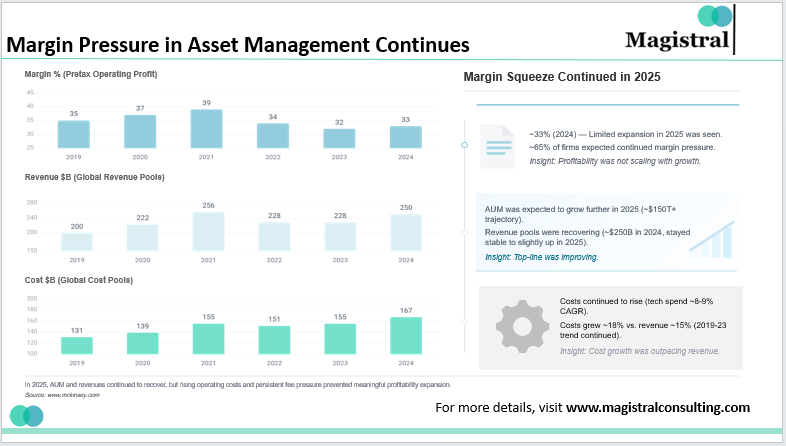
Margin Pressure in Asset Management Continues
The outsourcing market size is expected to grow to a total of $880.5 billion by 2026. This demonstrates the adoption rate of outsourcing in the industry and the desire to reduce costs and increase efficiency.
The outsourced investment analyst model represents a flexible approach to research scaling without the burden of fixed costs.
The Expanding Role of Outsourced Investment Analyst
The outsourced investment analyst model is gradually becoming an integral part of the structure of investment operating models. This is because of the increased competition in capital markets, which is characterized by high dispersion in returns. This has led to a change in the way investment firms view outsourcing, where it is no longer just about scaling capacity but about building strength in research operations.
Beyond Cost Arbitrage to Strategic Support
The role of an outsourced investment analyst has changed dramatically from the basic task of data collection to the more valuable role of analysis. Currently, the outsourced teams are involved in various activities, including financial modeling, valuation analysis, market research, and investment thesis.
This is due to the changing industry trend where outsourcing is no longer considered a cost-reducing activity but a major business strategy.
Supporting End-to-End Investment Workflows
The outsourced investment analyst model is now an integral part of various stages of the investment lifecycle. From investment screening and due diligence to portfolio monitoring and reporting to investors, outsourcing teams now provide support to functions that were previously entirely internally managed.
Meanwhile, the practice of outsourcing continues to grow in the case of trading and portfolio management. Industry figures show a rising trend in the adoption of external support models to attain scale without adding infrastructure.
Market Drivers Accelerating Adoption
The growing complexity gap between analytical requirements and the availability of specialized resources is driving the trend towards the outsourced investment analyst model. This is because investment activities require not only deep domain knowledge but also time-consuming analysis. This is where investment teams are increasingly separating their core investment activities from their supporting functions. This enables investment teams to free up bandwidth to focus on deal-making and strategic decisions.
Demand for Specialized Skills and Data Capabilities
Investment analysis is also becoming more specialized in terms of skills in data science, industry-specific research, and sophisticated financial modeling.
The cost of internally developing and retaining skills in these specialized areas can be high.
Outsourced investment analyst helps firms access specialized skill sets on demand, especially in areas where there is a constraint in terms of talent availability.
Focus on Core Investment Functions
Investment firms are increasingly focused on high-value activities such as deal-making, portfolio strategy, and investor relations. Outsourcing research-intensive and time-consuming tasks to outsourced analysts will enable the internal teams to focus on the core decision-making functions.
This trend in the financial industry mirrors the larger outsourcing trend.
The Future of Outsourced Investment Research
Outsourced investment research is no longer just seen as a cost efficiency tool but is rapidly becoming a key driver of investment performance. This is largely because of the increased adoption of AI and other forms of advanced analytics, which is expected to drive the AI in asset management market at over 23-27% CAGR (as per Precedence Research, Global Market Insights, SNS Insider). This is because the outsourced investment analyst model is helping firms process large datasets from multiple sources at faster speeds and higher accuracy, which is already being seen in the adoption of AI/ML by over 50% of financial institutions (as per Reanin).
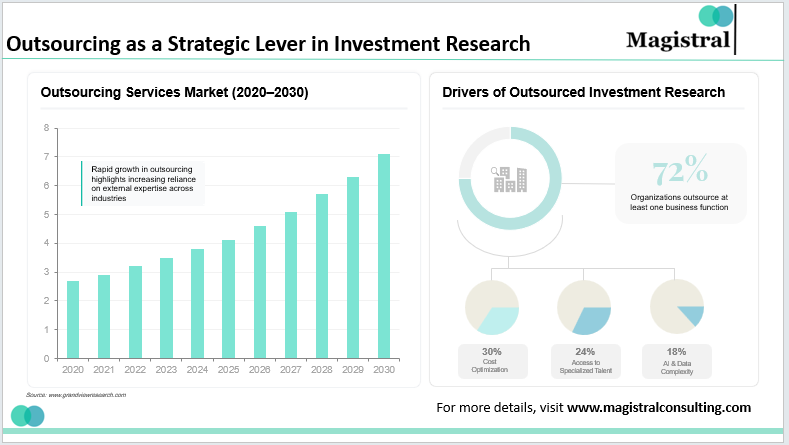
Outsourcing as a Strategic Lever in Investment Research
At the same time, the trend is shifting towards the adoption of a new paradigm of research, i.e., a hybrid approach that involves investment judgment and external analysis with the help of technology. This is being driven by the increasing investments in enterprise AI, with the overall AI market growing by over 20% CAGR (as highlighted by Grand View Research). Outsourced research teams have been playing an important role in this transition by allowing organizations to provide continuous research coverage, faster turnaround times, and better analysis without increasing their cost structure.
How Magistral Supports Investment Research
Investment research today requires both analytical depth and execution speed. This means that firms have to strike a balance between these two requirements. Magistral enables investment research functions by providing high-quality analysis and results, thereby extending internal teams.
Equity & Industry Research
Providing in-depth sector research, company research, and competitive benchmarking to facilitate investments and idea generation.
Financial Modeling & Valuation
Providing in-depth financial models and financial valuation methodologies to facilitate investments.
Deal Screening & Company Analysis
Providing deal screening support services such as business model analysis and company positioning.
Market Mapping & Data Analysis
Providing market identification support services such as market sizing and data analysis to facilitate deal origination.
Investment Memo & Pitch Support
Providing support in the creation of investment memorandums, pitches, and presentations.
Portfolio Monitoring & Reporting
Providing support in tracking investments and reporting to investors.
By combining an AI + human analyst model, Magistral delivers scalable and specialized support through the outsourced investment analyst approach, enabling investment firms to enhance research quality, accelerate turnaround time, and focus on high-value investment decisions.
About Magistral Consulting
Magistral Consulting has helped multiple funds and companies in outsourcing operations activities. It has service offerings for Private Equity, Venture Capital, Family Offices, Investment Banks, Asset Managers, Hedge Funds, Financial Consultants, Real Estate, REITs, RE funds, Corporates, and Portfolio companies. Its functional expertise is around Deal origination, Deal Execution, Due Diligence, Financial Modelling, Portfolio Management, and Equity Research
For setting up an appointment with a Magistral representative visit www.magistralconsulting.com/contact
About the Author

Tanya is an investment-research specialist with 6 + years advising venture-capital, private-equity and lending clients worldwide. A Stanford Seed alumnus with an MBA and an Economics (Hons) degree, she heads project teams at Magistral Consulting, delivering financial modelling, due-diligence and deal support on 3,000 + mandates. Her blend of rigorous analytics, sharp project management and clear client communication turns complex data into actionable investment insight.
FAQs
How does Magistral ensure quality in investment research deliverables?
How flexible is Magistral’s engagement model?
How does Magistral help improve turnaround time in investment research?
How does Magistral integrate with internal investment teams?