Global private equity activity has rebounded in value but not in volume. According to the 2025 Global Private Markets Report by McKinsey, global buyout value reached about $1.8 trillion, a sharp increase of almost 20% from the previous year, although the number of deals was low. KPMG also stated that total PE investment in 2025 was about $2.1 trillion, a four-year high, led mainly by bigger deals and not by the number of deals. Reinforcing the growing importance of rigorous PE fund due diligence to safeguard concentrated capital and validate return assumptions.
This shift in capital allocation to fewer, but bigger, deals have a profound effect on risk management. With bigger equity checks and the cost of capital still higher than the pre-2022 levels, the focus is on the accuracy of underwriting. In this scenario, investment in PE fund due diligence is not a process; it is a risk management practice that is an integral part of capital allocation.
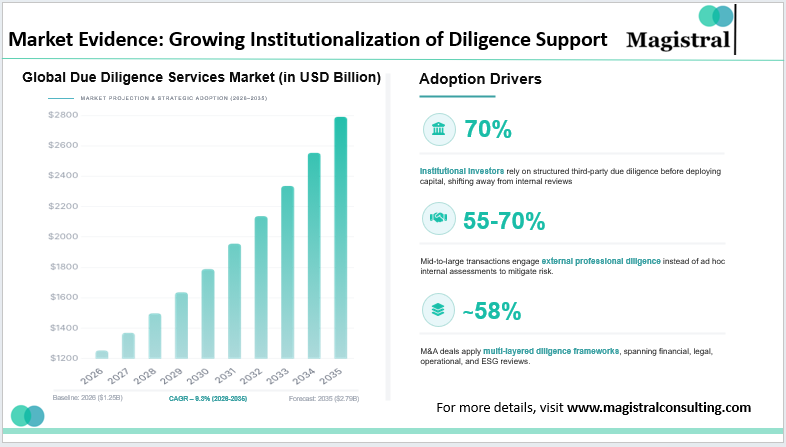
Market Evidence: Growing Institutionalization of Diligence Support
Why Due Diligence Has Become a Performance Lever
Due diligence has become a performance lever because rigorous due diligence directly improves underwriting accuracy, protects downside risk, and enhances long-term investment returns.
Higher Cost of Capital Amplifies Earnings Sensitivity
With debt pricing no longer at historic lows, sponsors are becoming increasingly sensitive to the durability of EBITDA and the reliability of free cash flow. Small variances in margin assumptions are now having a profound impact on debt service coverage ratios and equity IRR. This has forced funds to look beyond the quality of earnings analysis and into stress testing of revenue and working capital cyclicality.
Exit Timelines Are Less Predictable
Exit markets are gradually reopening, although IPO opportunities are still sporadic. Consequently, the average holding period has increased for some strategies, including sponsor-to-sponsor deals and continuation funds. With capital tied up for extended periods, errors in underwriting are magnified. PE fund due diligence is now the only protection against potential subpar performance.
LP Scrutiny Has Intensified
Institutional investors are increasingly looking at underwriting discipline as a criterion in fundraising rounds. More than 70% of institutional capital allocators demand structured due diligence documentation before committing capital, which is a sign of the growing importance of risk governance and validation frameworks. Sound diligence practices are now a criterion for both transactions and fundraising.
The Analytical Architecture of Modern PE Fund Due Diligence Support
Effective PE fund due diligence support today operates across interconnected analytical layers that determine whether a deal compounds value or introduces structural risk.
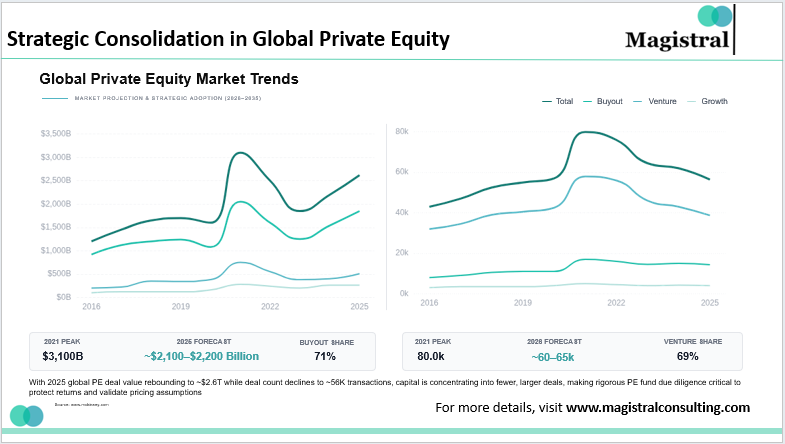
Strategic Consolidation in Global Private Equity
Earnings Reliability and Cash Flow Sustainability
Contemporary diligence work reconstructs normalized EBITDA on various downside outcomes instead of focusing on management-adjusted figures. Analysts review revenue concentration risk, sensitivity to customer churn, contract renewal risk, pricing flexibility, and cost pass-through constraints.
The importance of cash conversion analysis has also risen. Sponsors now review working capital volatility over cycles, supplier risk, and capital expenditure intensity. In leveraged transactions, small differences in cash flow resilience assumptions can significantly impact refinancing risk and covenant compliance models.
Structural Defensibility of the Business Model
In 2025, Technology, Media, and Telecommunications (TMT) and industrial companies drive a significant amount of PE deal value, giving PE fund due diligence more edge, as KPMG’s sector analysis indicates. In these sectors, due diligence is highly focused on intellectual property defensibility, switching costs, risks of technological obsolescence, and competitive barriers.
In the case of consumer and healthcare companies, regulatory risk, reimbursement risk, and the sustainability of margins in the face of pricing pressures are key to due diligence. Structural defensibility analysis helps assess the viability of multiple expansions or whether it is purely speculative.
Feasibility of Value Creation Plans
Investment committees are now requiring detailed models of value creation before close. Cost optimization assumptions are compared to industry peers, not to general efficiency metrics. As part of PE fund due diligence, transformation timetables are rigorously stress-tested against management bandwidth, execution capability, and integration complexity.
This forward-looking validation separates analytical due diligence from a compliance review. It challenges whether a modeled IRR is operationally feasible, not simply mathematically correct.
Market Evidence: Growing Institutionalization of Diligence Support
The global due diligence services market was valued at around $970 million in 2025 and is expected to grow at a compound annual rate of around 9% during the early 2030s. This growth is driven by the increasing demand for independent verification in mid-to-large transactions, especially cross-border and carve-out transactions, where data asymmetry is a major risk factor.
Over 50% of mid-to-large corporate transactions now involve specialized third-party diligence vendors, especially in financial and operational due diligence streams. The United States remains the largest contributor to private equity deal volumes worldwide, solidifying its position as the leading market for structured diligence engagement.
These data point to a paradigm shift: PE fund due diligence is no longer a periodic advisory service but is now a form of infrastructure.
Technology-Enabled Diligence: Speed Without Compromising Depth
Automation and AI-powered document analysis are significantly impacting transaction timelines. Today, sophisticated technology helps with contract abstraction, anomaly identification in financial data, and revenue trend analysis.
But the use of technology is complementary, not substitutive. While machine learning helps accelerate data processing, the analysis of structural risk, competitive advantage, and execution feasibility still requires sector knowledge and financial acumen. The best PE fund due diligence tools leverage technology with seasoned analytical review.
Strategic Implications for Private Equity Firms
In the current market for concentrated deals, where the average size of transactions is large, and the choice of exit opportunities is selective, the importance of PE fund due diligence has become significant. The impact of underwriting errors is proportionate to the size of the transaction, and a misvalued platform purchase can have a disproportionately adverse effect on portfolio performance.
Full-service PE fund due diligence assistance can minimize volatility in the downside, improve defenses against valuation challenges in negotiations, and increase investor confidence.
In 2026, PE fund due diligence has evolved from a process-oriented to a precision-oriented discipline. Investment committees now demand that assumptions be rebuilt rather than reiterated, growth be validated rather than projected, and downside outcomes be crafted with the same attention to detail as base-case analysis. With capital increasingly discriminating and exits increasingly sensitive to timing, the level of analytical insight has become a direct driver of conviction and speed of deal.
Sound PE fund due diligence in the current environment weaves together commercial validation, earnings quality analysis, operational viability, and realistic exit due diligence into a single, cohesive investment narrative. With fewer blind spots before capital is committed and greater confidence in a world where the margin for error is substantially lower than in the previous cycle.
How Magistral Supports Private Equity Firms
Magistral partners with private equity firms across the investment lifecycle, from origination to exit, providing analytical depth, execution bandwidth, and investment-committee-ready outputs.
Deal Origination & Pipeline Support
Identification and profiling of targets aligned with the fund’s thesis, development of sector-focused longlists and shortlists, thematic research, and buyer mapping to strengthen proactive sourcing strategies.
Investment Screening & Commercial Analysis
Industry benchmarking, competitive landscape assessments, bottom-up and top-down market validation, customer concentration diagnostics, and revenue model analysis to test the commercial strength of potential investments.
Financial Modeling & Valuation
Development of fully integrated three-statement models, detailed LBO models with debt structuring, IRR and MOIC sensitivity analysis, valuation benchmarking, and structured downside scenario modeling tailored for investment committee review.
Due Diligence Analytics
Data room analysis, quality of earnings support, working capital normalization, margin bridge assessments, pricing and cohort analysis, and identification of operational or financial red flags to improve underwriting precision.
Investment Committee & Fundraising Materials
Preparation of IC memos, structured risk-reward analysis, investment teasers, CIM support, LP presentations, and track record performance analytics for institutional communication.
Portfolio Monitoring & Value Creation Support
KPI dashboards, variance analysis models, cost optimization diagnostics, operational efficiency assessments, and add-on acquisition evaluation models to support active portfolio management.
Exit Preparation & Transaction Support
Vendor due diligence analytical assistance, exit-ready financial model refinement, buyer universe mapping, carve-out analysis, and IPO or secondary transaction preparation to enhance exit outcomes.
About Magistral Consulting
Magistral Consulting has helped multiple funds and companies in outsourcing operations activities. It has service offerings for Private Equity, Venture Capital, Family Offices, Investment Banks, Asset Managers, Hedge Funds, Financial Consultants, Real Estate, REITs, RE funds, Corporates, and Portfolio companies. Its functional expertise is around Deal origination, Deal Execution, Due Diligence, Financial Modelling, Portfolio Management, and Equity Research
For setting up an appointment with a Magistral representative visit www.magistralconsulting.com/contact
About the Author

Nitin is a Partner and Co-Founder at Magistral Consulting. He is a Stanford Seed MBA (Marketing) and electronics engineer with 19 + years at S&P Global and Evalueserve, leading research, analytics, and inside‑sales teams. An investment‑ and financial‑research specialist, he has delivered due‑diligence, fund‑administration, and market‑entry projects for clients worldwide. He now shapes Magistral Consulting’s strategic direction, oversees global operations, and drives business‑development support.
FAQs
How does Magistral integrate with client teams?
What types of clients typically engage Magistral?
Does Magistral assist with portfolio monitoring?
How does Magistral support exit preparation?