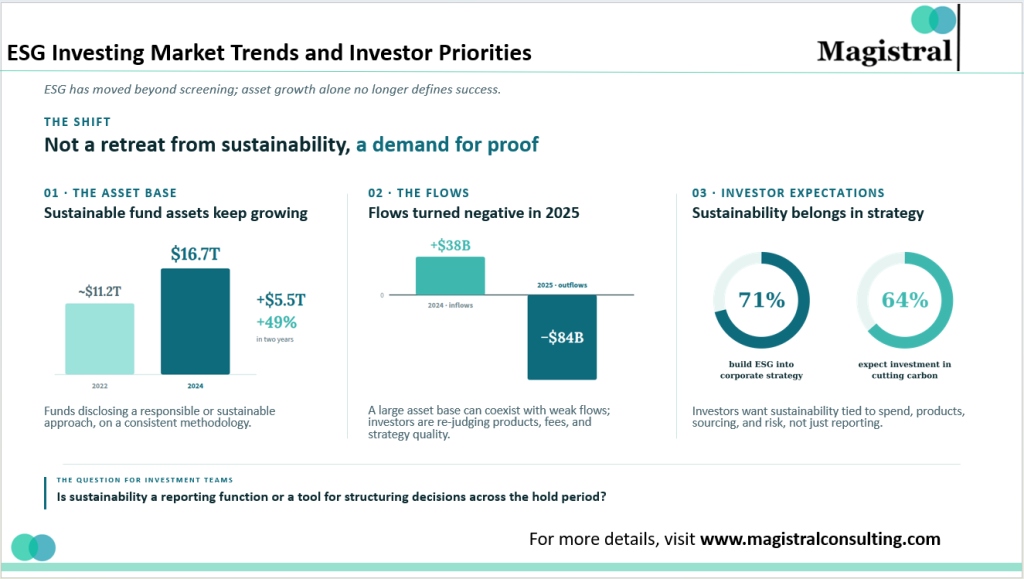
Investors have expanded their use of ESG factors beyond screening. They rely on information about the environmental, social, and governance aspects of a company to identify risks that might not be reflected in conventional accounting frameworks. Simultaneously, there is a higher level of selectivity observed on the market. As stated by the Global Sustainable Investment Alliance, funds disclosing a responsible or sustainable investment approach totaled $16.7 trillion as of the 2024 review, growing by about $5.5 trillion over two years using a consistent methodology based on Morningstar data. Moreover, there is increasing volatility observed in sustainable fund flows. Investors do not retreat from the principles of sustainability; rather, they require more proof of effectiveness in this regard.
Thank you for reading this post, don't forget to subscribe!ESG Investing Market Trends and Investor Priorities
ESG investing is moving toward a more mature phase, where growth in asset volume will not be sufficient to assess success anymore. Investors want clear financial value addition, disclosure, and an approach resilient to regulatory changes and economic developments. This trend can be seen in public markets, private assets, and global funds, which include sustainability alongside liquidity, valuation, governance, and portfolio risk.
ESG Investing Market Trends and Investor Priorities
Sustainable assets remain significant despite changing flows
According to the GSIA report, fund assets of responsible or sustainable investing approached $16.7 trillion, showing an increase of 49% over two years on a comparable data basis. At the same time, according to Morningstar, global sustainable funds experienced $84 billion of net outflows in 2025 compared to $38 billion inflows in 2024. This comparison is essential since a substantial asset base can coexist with weak flow performance, meaning that investors may be reconsidering the nature of products, fees, performance, regulatory aspects, and quality of strategy rather than refusing the sustainability analysis.
Investors increasingly connect sustainability with corporate strategy
According to PwC’s 2024 Global Investor Survey, 71% of the respondents surveyed thought that corporations should build ESG and sustainability into their strategies, while 64% expected corporations to invest moderately or heavily in lowering their carbon footprint. The question for the investment team, therefore, is whether the management looks at sustainability as a mere reporting function or as a tool for structuring the expenditure, designing the products, sourcing materials, and managing risks. In private equity, this becomes even more relevant since investors can analyze operational decisions throughout the hold period.
ESG Investing Data Quality and Financial Materiality
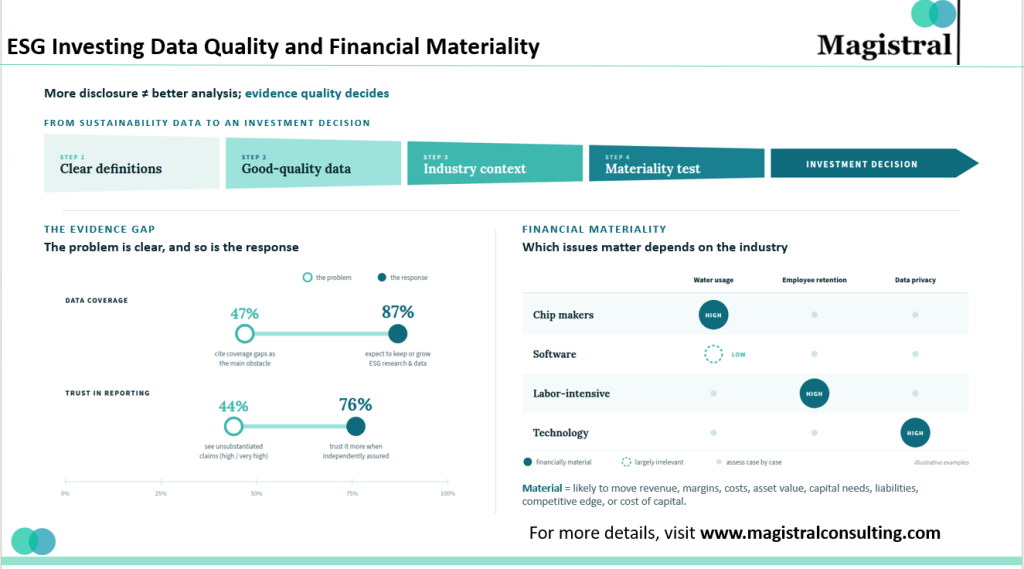
The success of ESG investing lies in the quality of evidence used for each investment decision. Greater disclosure does not necessarily translate into better analysis. It will still be necessary to have proper definitions, good-quality data, industry background, and financial materiality assessments prior to turning the sustainability information into investment decisions.
ESG Investing Data Quality and Financial Materiality
Data gaps remain a practical obstacle
In a 2025 State of ESG Data Survey conducted by Morningstar Sustainalytics, 47% of survey respondents noted data coverage gaps within different asset classes and regions as the primary problem with the use of sustainable investment strategies. At the same time, 87% of respondents anticipated either the continuation or increase of their ESG investing research and data over the coming year.
Assurance can improve confidence in sustainability information
According to PwC, 44% of surveyed investors perceived that corporate sustainability reporting included unsubstantiated claims to a high or extremely high degree. At the same time, 76% stated their higher trust in sustainability information when it was independently assured. It is therefore beneficial for investment groups to contrast management communications against external verification, performance measures, filing documents, and industry standards. A properly conducted due diligence can assist in distinguishing those figures that are financially meaningful from those that have little analytical significance.
Materiality matters more than the volume of disclosure
A sustainability matter becomes material to investments if it is likely to affect a company’s revenue, margins, operational expenses, asset valuation, capital needs, liabilities, competitive advantage, or cost of capital. Water usage could be financially material for chip makers but irrelevant to many software companies. Employee retention would be more critical for labor-intensive industries, while privacy issues would be most important for the tech sector. The point is not to assign similar importance to all ESG investing metrics but to recognize the ones that will influence financial results.
ESG Investing Strategies for Portfolio Construction
ESG investing is more effective when investors incorporate relevant sustainable factors within their research process, as opposed to using the factors as another scorecard. Teams of portfolio managers can use fundamental analysis, scenario analysis, engagement, risk monitoring, and valuation to assess whether the environmental, social, or governance factor affects the expected return on, or the downside risk of, the investment.
Financial analysis should come before labels
A good framework evaluates how a sustainability factor impacts the expected cash flow. A company that invests heavily in energy efficiency may reduce its operating costs, whereas poor governance may result in increased litigation and reputation risks. The 2025 MSCI research on sustainability also pointed out the increasing role of private capital in the energy transition. It revealed that a private market peer set of low-carbon solutions had generated cumulative returns of 123% in the past five years, while the equivalent public market peer set was only able to generate 57% returns in the same period until October 2024. It is important to note that the above performance results do not forecast future performance.
Portfolio monitoring should track change rather than static scores
A sensible ESG investing approach would be one that considers both direction and position. For example, an entity that has an average sustainability profile but improving governance, emissions intensity, or supply chain controls could present itself with a different risk path compared to an entity that is highly rated but with declining performance. Digital platforms can assist analysts in tracking controversies, regulatory filings, operational metrics, and shifting risks. Increasing adoption of AI in portfolio management can assist analysts in processing big data; however, human analysis will still be required when evaluating whether a given signal is materially important.
Engagement can create information that databases cannot capture
Investor engagement provides insight into reported data. Engaging with management allows one to understand the implications of climate change initiatives on capital expenditures, whether there are any workforce-related issues, and whether the board is managing emerging risks. According to PwC, 40% of investors who were surveyed regularly engaged with their investee companies and 45% engaged when there was a given concern.
How Magistral Supports ESG Investing Decisions
ESG investing increasingly requires research teams to combine financial analysis, sustainability information, market intelligence, and rigorous review without allowing data volume to slow decision-making. Magistral can support investment teams with research, company analysis, portfolio monitoring, valuation support, and due diligence workflows that integrate material sustainability factors into broader investment processes. This approach is relevant to asset managers as well as venture capital teams that need scalable analytical capacity across growing portfolios.
Research support can turn fragmented information into usable evidence
Sustainability data often comes from annual reports, regulatory filings, company presentations, third-party datasets, industry research, and news sources. A research workflow can organize these inputs around financially material questions, compare companies with appropriate peers, and document the evidence behind investment judgments. This is especially useful when teams cover many companies or markets and need consistent analysis without reducing every issuer to a single ESG rating.
Portfolio support can strengthen recurring monitoring
Magistral’s broader investment research and portfolio support capabilities can help teams maintain structured monitoring, refresh relevant datasets, and connect changing sustainability signals with operating performance and valuation. In this way, ESG investing analysis becomes part of an ongoing investment process rather than an occasional reporting exercise.
About Magistral Consulting
Magistral Consulting has helped multiple funds and companies in outsourcing operations activities. It has service offerings for Private Equity, Venture Capital, Family Offices, Investment Banks, Asset Managers, Hedge Funds, Financial Consultants, Real Estate, REITs, RE funds, Corporates, and Portfolio companies. Its functional expertise is around Deal origination, Deal Execution, Due Diligence, Financial Modelling, Portfolio Management, and Equity Research
For setting up an appointment with a Magistral representative visit www.magistralconsulting.com/contact
About the Author
Aman is an investment-research specialist with 5+ years of experience across business and investment research, including 2+ years with Big Four firms like KPMG. A Stanford Seed alumnus with an MBA in Finance and a Bachelor of Commerce (Hons) from University of Delhi, he focuses on private equity, venture capital, and renewable energy sectors. He leads project teams at Magistral Consulting, delivering financial research, due diligence, deal sourcing, and M&A support, while driving strong process management and analytics. His blend of attention to detail, strategic thinking, and dynamic execution enables him to turn complex data into actionable investment insights.
FAQs
What is ESG Investing?
Does ESG analysis guarantee higher investment returns?
Why is ESG data quality important?
How can investors reduce greenwashing risk?
How does technology support sustainable investment research?