Managing an investment fund has become much more operationally demanding than it was a decade ago. Managers now oversee larger datasets, increasingly diverse investor groups, tighter reporting timelines, complex fund structures, and expanding regulatory expectations, often while trying to keep internal teams lean. Outsourced fund operations offer an operating model in which specialist providers support administration, accounting, reporting, data management, and related processes while the investment team concentrates on capital deployment and portfolio performance.
Thank you for reading this post, don't forget to subscribe!The market backdrop makes this model increasingly relevant. The projection for global assets under management in 2028 is $171 trillion, according to PwC, of which $27.6 trillion is projected to be alternative assets. However, Northern Trust discovered that a shortage of staff and technology still contributes to managers’ need for outside operating help.
Market Forces Reshaping Outsourced Fund Operations
Fund managers are no longer evaluating operating models only through the lens of labor cost. Growth in private assets, new investor segments, more complex vehicles, and rising expectations for timely data are changing the economics of fund administration. The result is a greater focus on outsourced fund operations as scalable operating infrastructure that can expand without forcing every increase in assets or investor activity to produce a similar increase in fixed headcount.
Market Forces Reshaping Outsourced Fund Operations
Alternative Assets Are Expanding the Operational Workload
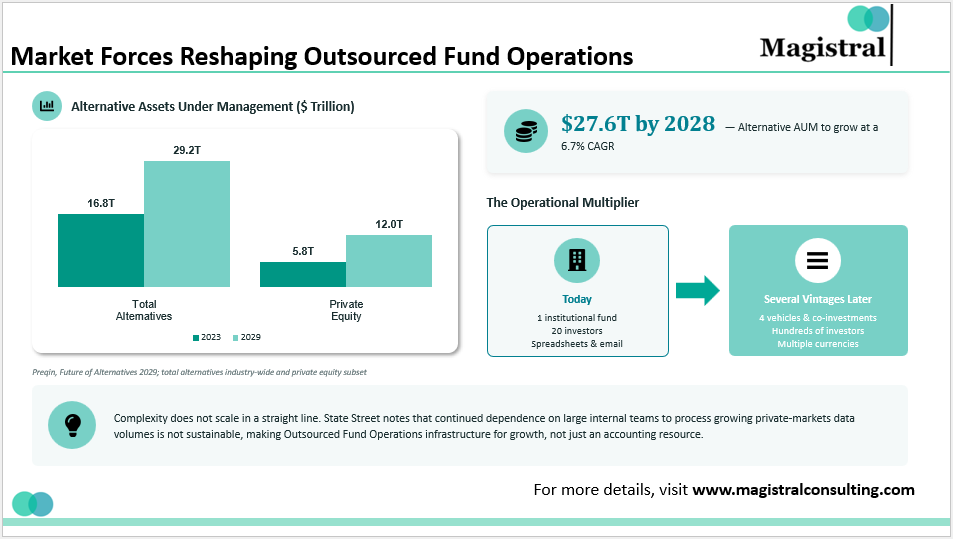
Alternative investment markets continue to grow even after a period of slower fundraising and challenging exits. PwC expects alternative assets under management to increase at a compound annual growth rate of 6.7% and reach $27.6 trillion by 2028. Preqin offers a similar long-range perspective, forecasting the broader alternatives industry to increase from $16.8 trillion at the end of 2023 to $29.2 trillion by 2029. It expects private equity assets alone to rise from approximately $5.8 trillion at the end of 2023 to around $12 trillion by 2029.
Growth at that scale creates an operational multiplier. A manager does not simply record additional assets. New investments create more entities, valuations, capital activity, investor records, management fee calculations, financial statements, and reporting requirements. A growing universe of funds can therefore make a process that worked comfortably at launch increasingly difficult to manage several vintages later, making outsourced fund operations a practical way to maintain consistency.
Imagine a firm that begins with one institutional fund and twenty investors. The team may handle most reporting through spreadsheets, email reviews, and a relatively small finance function. Now imagine the same business managing four vehicles, separate accounts, co-investment structures, hundreds of investors, and multiple currencies. The investment strategy may be familiar, but the operating environment has changed completely.
Complexity Does Not Grow in a Straight Line
The operational challenge becomes particularly visible in private markets because each additional structure can introduce its own allocation rules, fee terms, reporting commitments, and cash flow requirements. State Street has highlighted the difficulty of obtaining accurate and timely holdings-level information across private assets and notes that continued dependence on large teams to process growing data volumes is not sustainable.
For this reason, outsourced fund operations increasingly function as infrastructure for growth rather than simply an external accounting resource. The objective is to create an operating capacity that can absorb additional investors, vehicles, transactions, and reporting demands while maintaining consistent processes.
Outsourcing Is Shifting from Cost Reduction to Capability Access
Cost still matters, but industry evidence suggests that expertise and technology are becoming equally important, which is why outsourced fund operations are increasingly evaluated as a capability decision rather than only a cost decision.
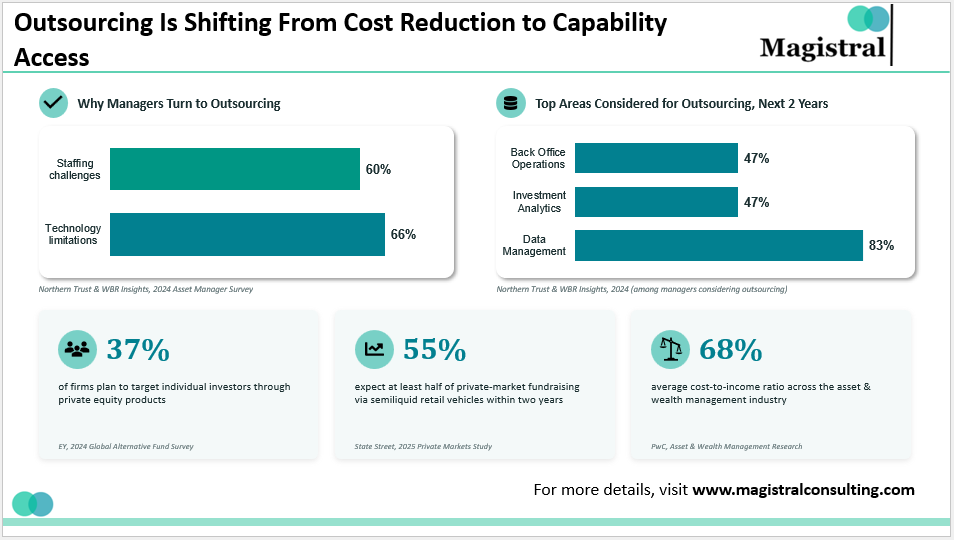
Northern Trust and WBR Insights reported in their 2024 research that 66% of surveyed asset managers experienced technology limitations and 60% faced staffing challenges that pushed them toward outsourcing solutions. Among managers who considered outsourced fund operations during the following two years, 83% identified data management, 47% investment analytics, and 47% back-office operations as potential areas for external support.
Outsourcing Is Shifting From Cost Reduction to Capability Access
These findings highlight a practical issue. Building specialist capability internally can require hiring accountants, data analysts, operations professionals, technology specialists, and control personnel before the fund has achieved enough scale to use that capacity efficiently.
External providers can convert part of that fixed infrastructure into a more flexible operating model. Through outsourced fund operations, the manager still retains oversight and accountability, but specialized workflows can sit with teams that perform them repeatedly across multiple portfolios and structures.
Investor Expectations Are Raising the Service Standard
Fund operations now influence the investor experience more directly than before. There is an increasing need among investors for information related to capital account statements, notices, documentation, communication, and portfolio performance visibility, making outsourced fund operations relevant to both operational delivery and investor servicing.
EY’s 2024 Global Alternative Fund Survey, involving 224 alternative fund managers and 200 institutional investors, showed that there are managers who are aggressively expanding their base of investors. For example, 37% of the surveyed firms planned to approach individual investors through private equity products. EY also identified trust, transparency, technology, and talent as essential capabilities for firms pursuing new investor segments.
This expansion has clear implications for private equity managers. A finance process designed mainly for a limited group of large institutions may struggle when a manager adds wealth channels, new feeder vehicles, or structures designed for smaller investors. More accounts mean more onboarding, documentation, allocations, communications, and investor inquiries.
State Street’s 2025 Private Markets Study reinforces the direction of travel. Based on a survey of nearly 500 senior executives, 55% of respondents expected at least half of private market fundraising to come through semi-liquid retail-style vehicles within the following two years.
The operational model therefore becomes part of the product itself. A strong investment thesis may attract capital initially, but dependable servicing through outsourced fund operations helps determine whether the manager can deliver a professional experience at scale.
Margin Pressure Makes Operating Leverage More Valuable
An increase in assets does not necessarily mean a commensurate increase in profitability.
According to PwC, the cost-to-income ratio in the asset and wealth management sector stayed around 68%, which shows that operating costs still take up a large percentage of the income. Its research argues that traditional cost reduction alone has struggled to address the pressure because expansion into new asset classes and markets also creates complexity.
McKinsey similarly reported that global asset management assets reached a record $147 trillion by the end of June 2025 while margins remained under pressure as operating costs increased. The industry may therefore have more assets to administer without enjoying equivalent improvements in operating leverage.
A flexible operating structure gives managers another lever. Instead of repeatedly adding internal capacity for every new fund or reporting requirement, the firm can use outsourced fund operations to align portions of its operating expense more closely with actual business volume.
How Magistral Consulting Supports Outsourced Fund Operations
Magistral Consulting provides outsourced fund operations services to fund managers and investment companies through end-to-end solutions that serve as an extension to their internal teams throughout the fund life cycle. The services provided by Magistral include fund accounting, investor and portfolio reporting, capital call and distribution services, NAV and performance monitoring, cash flow and reconciliation services, portfolio management services, and operational due diligence. In addition to the above-mentioned services, Magistral Consulting also helps with investor onboarding, maintenance of fund records, and preparation of management reports and LP reports. Through a combination of financial professionals, processes, quality control, and technology-enabled workflows, Magistral Consulting helps fund managers to enhance operational accuracy and streamline fund operations.
About Magistral Consulting
Magistral Consulting has helped multiple funds and companies in outsourcing operations activities. It has service offerings for Private Equity, Venture Capital, Family Offices, Investment Banks, Asset Managers, Hedge Funds, Financial Consultants, Real Estate, REITs, RE funds, Corporates, and Portfolio companies. Its functional expertise is around Deal origination, Deal Execution, Due Diligence, Financial Modelling, Portfolio Management, and Equity Research
For setting up an appointment with a Magistral representative visit www.magistralconsulting.com/contact
About the Author

Dhanita is a BD and Marketing professional with 6+ years’ experience in sales strategy, growth execution, and client acquisition; credentials include Stanford Seed (Stanford GSB), an MBA from USMS–GGSIPU, and a B.Com (Hons) from the University of Delhi. Expertise spans market research and opportunity mapping, sales strategy, CRM, brand positioning, integrated campaigns, content development, lead generation, and analytics; currently oversees business development calls and end-to-end marketing operations
FAQs
What are Outsourced Fund Operations?
Which fund activities can be outsourced?
Why are investment managers increasing operational outsourcing?
Does outsourcing remove a fund manager's responsibility for controls?
How should a manager select an operating partner?