Investment decisions today rest on more than gut instinct or a broker’s tip sheet. Asset managers, hedge funds, and institutional investors are increasingly building their own research capabilities rather than relying solely on external providers. This shift has a name: buy-side research. Unlike research produced to sell trading ideas, it is built for one purpose, to support the decisions of the very firm producing it. Regulatory changes such as MiFID II, tighter cost scrutiny, and a growing demand for differentiated insight have all pushed investors toward this model. As markets grow more complex, the practice is no longer a back-office function. It has become a competitive necessity for firms that want conviction, not consensus.
Thank you for reading this post, don't forget to subscribe!Why Buy-Side Research Is Gaining Ground Today
Investors are moving away from generic, one-size-fits-all reports. Instead, they want analysis tailored to their own portfolios, mandates, and risk appetite. Buy-side research answers that demand directly, and its growth reflects a broader rethink of how conviction is built. Firms that once outsourced almost every analytical task are now asking a harder question: which insights are worth owning outright?
Regulatory Pressure Reshaped Research Economics
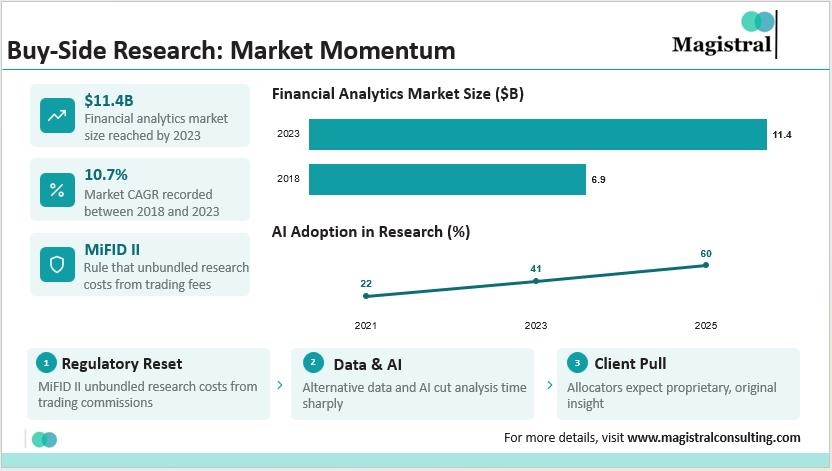
MiFID II forced asset managers in Europe to unbundle research costs from trading commissions. As a result, firms had to justify every research expense on its own merit. Many concluded that building internal capabilities delivered better value than paying for broad external coverage.
Investors Want Differentiated Insight
Generic reports rarely produce an edge, since every competitor reads the same material. Proprietary analysis, by contrast, reflects a firm’s specific thesis, data sources, and analytical framework, which is far harder for rivals to replicate. Over time, this originality becomes part of a firm’s brand with its own investors.
Cost Discipline Across Asset Management
Fee compression has squeezed margins across the industry. Consequently, firms are scrutinising every dollar spent on external providers and asking whether an in-house team could do the job more efficiently and at lower long-term cost.
Data Availability Has Changed the Equation
Alternative data, satellite imagery, transaction-level datasets, and web-scraped information are now widely accessible. Therefore, internal teams can build independent views that once required expensive external subscriptions.
Key Drivers Behind the Growth of Buy-Side Research
Several structural forces are accelerating this shift across asset classes, from public equities to private credit and real assets. Together, they explain why the shift feels less like a trend and more like a permanent reset.
Buy-Side Research: Market Momentum
Technology and AI Adoption
Over 60% of financial institutions now use artificial intelligence within their research and analytics processes. AI tools can process earnings calls, filings, and news sentiment almost instantly, letting analysts cover more ground with fewer resources. The financial analytics market itself is projected to grow from roughly $11.4 billion in 2025 to nearly $19 billion by 2030, reflecting how central data-driven analysis has become to investment operations. Firms that adopted these tools early are already seeing shorter research turnaround times.
Talent Migration from Sell Side to Buy-Side Research
Experienced analysts increasingly prefer roles closer to capital allocation decisions rather than trade generation. This migration has strengthened the depth and credibility of internal research desks.
Private Markets Demand Independent Views
Private equity, venture capital, and private credit rarely offer the same volume of public coverage as listed markets. As a result, internal research has become essential for sourcing, underwriting, and monitoring private investments where public analyst coverage simply does not exist. This gap only widens as allocations to private markets keep increasing.
Client Expectations Have Risen
Limited partners and institutional allocators now expect asset managers to demonstrate original thinking. A manager that merely repackages third-party notes struggles to justify its fees, while a strong internal process supports a clearer value proposition to clients. Due diligence questionnaires increasingly probe how a manager’s insights are actually generated.
Portfolio Construction Has Grown More Complex
Multi-asset mandates, factor tilts, and thematic sleeves all require analysis that generic coverage rarely provides. As portfolios have become more intricate, the case for a dedicated internal desk has grown correspondingly stronger. Cross-asset views also demand analysts who can connect signals across otherwise siloed markets.
How Buy-Side Research Differs from Traditional Models
Understanding this distinction matters, because the incentives, outputs, and audiences of buy-side research diverge sharply from conventional sell-side coverage. Confusing the two often leads firms to underinvest in the capability they actually need.
Sell-Side vs. Buy-Side Research
Purpose and Audience
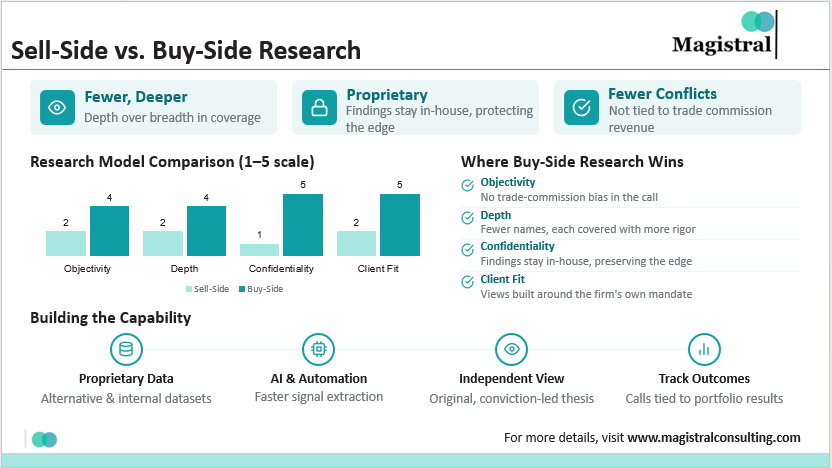
Sell-side research is produced to generate trading commissions and is distributed broadly to many clients at once. This model, on the other hand, is produced internally and consumed by portfolio managers, risk teams, and investment committees within the same organisation. The reporting lines and review process reflect that narrower, more accountable audience.
Who Actually Uses the Output
A sell-side note might reach hundreds of institutional inboxes on the same morning. An internal report, by contrast, typically informs a single investment decision, which changes how it is written, reviewed, and archived.
Objectivity and Incentive Alignment
Because internal analysis is not tied to trade execution revenue, it tends to carry fewer conflicts of interest. The analyst’s job is to be right, not to generate volume or drive commissions. That alignment tends to show up directly in the accuracy of a firm’s calls over time.
Depth Versus Breadth
External coverage often spans hundreds of names at a surface level. This model, in contrast, tends to go deeper into fewer positions, since the goal is conviction rather than broad, shallow coverage across a sector. This depth is precisely what supports larger, higher-conviction position sizing.
Confidentiality and Proprietary Value
Its outputs are rarely published externally, and that confidentiality protects the firm’s edge. Sell-side notes, by comparison, are designed for wide circulation across the market, which limits how much of an advantage any single reader can extract from them. Access controls and internal governance around these documents have therefore become a real priority.
Challenges Facing Buy-Side Research Teams
Building strong internal capability is not without friction. Firms must navigate resource constraints, information overload, and the need to prove value to stakeholders. None of these obstacles are unique to this discipline, but they do carry higher stakes here.
Information Overload
Analysts are flooded with data from filings, alternative sources, management calls, and news feeds. Sorting signal from noise has therefore become one of the biggest challenges facing modern research desks. Without clear filtering criteria, teams risk spending more time gathering data than interpreting it.
Resource and Budget Constraints
Smaller and mid-sized firms often lack the headcount to replicate the coverage of larger competitors. Consequently, many are turning to outsourced or blended models to extend their buy-side research capacity without a permanent hiring commitment. This flexibility also helps firms scale coverage up or down as mandates change.
Demonstrating Value Internally
Portfolio managers sometimes question whether an internal function justifies its cost compared to external alternatives. Teams must therefore track their contribution to performance more rigorously than in the past, tying specific calls to portfolio outcomes. A clear attribution record makes that conversation far easier at budget time.
Keeping Pace with Technology
AI and automation are evolving quickly, and teams that fail to adapt risk falling behind peers who use these tools to cover more ground with the same headcount and budget. Staying current increasingly requires ongoing training, not a one-time tooling decision.
Balancing Automation with Judgment
Even the best models cannot replace an analyst’s judgment on management quality, governance, or competitive positioning. As a result, the strongest teams treat automation as a way to free up time for deeper qualitative work, rather than a substitute for it.
How Magistral Consulting Supports Buy-Side Research
Magistral Consulting, works with asset managers and institutional investors to strengthen their buy-side research capabilities without the overhead of building large internal teams. Drawing on experience across investment banking, private equity, and financial research outsourcing, Magistral’s analysts support fundamental analysis, sector benchmarking, financial modelling, and data room preparation, all of which feed directly into stronger research output. For firms weighing whether to build, buy, or outsource this function, Magistral offers a flexible extension of the team, helping investors move from raw data to investment-ready conclusions faster and at a lower cost than scaling headcount alone.
About Magistral Consulting
Magistral Consulting has helped multiple funds and companies in outsourcing operations activities. It has service offerings for Private Equity, Venture Capital, Family Offices, Investment Banks, Asset Managers, Hedge Funds, Financial Consultants, Real Estate, REITs, RE funds, Corporates, and Portfolio companies. Its functional expertise is around Deal origination, Deal Execution, Due Diligence, Financial Modelling, Portfolio Management, and Equity Research
For setting up an appointment with a Magistral representative visit www.magistralconsulting.com/contact
About the Author

Dhanita is a BD and Marketing professional with 6+ years’ experience in sales strategy, growth execution, and client acquisition; credentials include Stanford Seed (Stanford GSB), an MBA from USMS–GGSIPU, and a B.Com (Hons) from the University of Delhi. Expertise spans market research and opportunity mapping, sales strategy, CRM, brand positioning, integrated campaigns, content development, lead generation, and analytics; currently oversees business development calls and end-to-end marketing operations
FAQs
What is buy-side research?
How is buy-side research different from sell-side research?
Why are more firms investing in buy-side research?
What role does technology play in buy-side research?
Can smaller firms build effective buy-side research capabilities?