Consider the scenario where an investment committee evaluates two promising businesses. They both generate increasing revenues, have competent management and solid market positions. Some years back, the evaluation could have been based mostly on valuation, funding needs and optimism about market growth.
Thank you for reading this post, don't forget to subscribe!The analysis becomes more difficult today.
With private equity firms making investments at higher levels and retaining them for extended periods, and using operational gains more often than a positive market environment to make profits, the key question in the boardroom has evolved from “Is this a good business?” to “What exactly can we do with this business?”
This trend is transforming the importance of due diligence for private equity.
Due Diligence for Private Equity: Where Conviction Is Won Before the Deal Closes
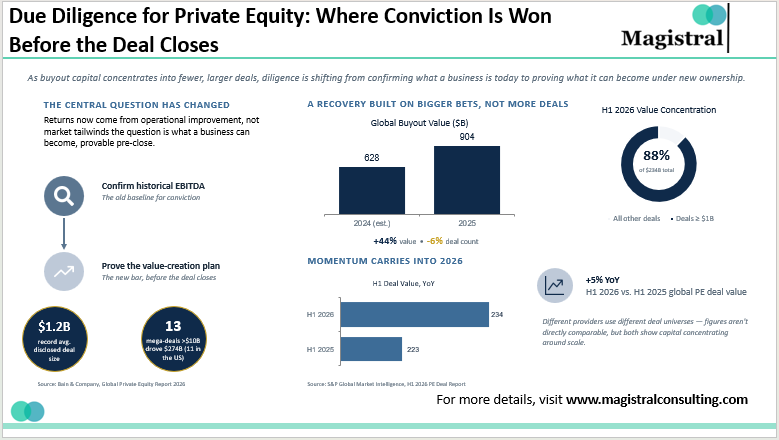
According to Bain & Company, the total value of global buyout investments grew by 44% to reach $904 billion in 2025 despite a drop in deals by 6% to reach 3,018 deals. The average value of disclosed deals set another record of $1.2 billion. Thirteen deals worth more than $10 billion comprised $274 billion of growth in the global value of buyouts.
In other words, due diligence for private equity is not just becoming busier; it is becoming more concentrated in bigger deals.
A Recovery Built on Bigger Bets
On the surface, 2025 seemed like a strong recovery for due diligence for private equity. Beneath the recovery lay a more telling trend.
Deal value rose sharply ahead of deal volume.
The $904 billion buyout figure from Bain rose by 44%, yet the volume of deals fell. Concentration was especially pronounced in the U.S., where 11 out of the 13 buyouts valued at more than $10 billion took place in the U.S.
The same trend prevailed in 2026.
S&P Global Market Intelligence estimated that in the first six months of 2026, there was $234.05 billion of due diligence for private equity deal volume recorded globally, up 5% compared with the same six-month period last year. However, 88% of deal volumes were transactions valuing above $1 billion.
There is no one-size-fits-all approach here since research providers employ various methodologies and different deal universes. However, they give a similar message – capital is increasingly concentrating on scale and quality.
This shifts the purpose of diligence.
When a private equity firm undertakes a multibillion-dollar buyout transaction, it starts with verifying the historical EBITDA. However, it is not enough. Teams of investors should understand customer stickiness, pricing power, market dynamics, technology protection moats, operating leverage, and the path forward towards growing the business post-acquisition.
Due diligence for private equity is gradually turning into pre-acquisition value creation planning.
At 11.8x EBITDA, the Future Matters More Than the Past
This adds even greater importance to this change.
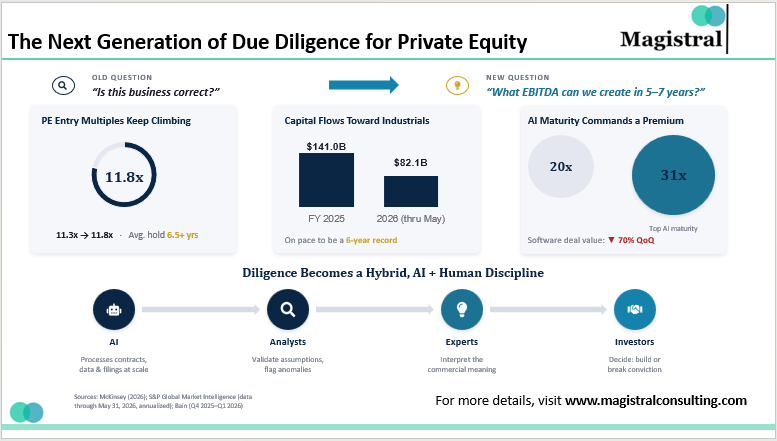
The purchase multiple of the median private equity deal in terms of EBITDA rose from 11.3x in 2024 to 11.8x in 2025, according to McKinsey. Moreover, the holding period of the portfolio has surpassed six and a half years.
The logic is quite simple.
The higher the multiple that the investor is paying, the smaller the scope for the entry price to make a contribution to the profit. Furthermore, the longer the investment stays in the portfolio, the more the burden is on the company.
The Next Generation of Due Diligence for Private Equity
This is exactly the reason why the discussion of the diligence process is shifting from:
“Are the financial statements correct?”
To:
“What additional EBITDA can be created in this business within five to seven years?”
Private equity firms are already restructuring around that question. According to a study by McKinsey, the average size of operating teams in PE firms has more than doubled from 2021 to date, with operating teams becoming involved in investments earlier on.
As a result, due diligence for private equity focuses on the optimization of prices, sales force productivity, procurement, working capital management, organizational effectiveness, technology architecture, and margin expansion prior to the transaction taking place.
Diligence does not stop at listing out observations. It builds an economic bridge between today’s business and tomorrow’s investment thesis.
Follow the Capital: Industrials Are Back in Focus
This trend becomes especially evident in observing which direction private capital is flowing.
Industrial stocks are receiving renewed interest.
According to S&P Global Market Intelligence, due diligence for private equity and venture capital investments into global industrials amounted to $82.06 billion by May 31, 2026, while in 2025, the total amount was $140.99 billion. At such a rate, the coming year will break the record for annual investment levels in the industry over at least six years.
The drivers of the trend appear especially obvious- growth of data center infrastructure, reconfiguration of supply chains and logistics, growing military spending, and interest in hard asset businesses in an environment of technological uncertainty.
That requires going beyond just forecasting market growth for diligence teams.
An industrial investment case may revolve around asset utilization rates, production capacities, CAPEX requirements, customer concentration, buying economics, and supply chain risks. A slight shift in either utilization or cost can result in substantial differences in EBITDA.
The challenge is becoming more about identifying teams able to make these connections.
Then AI Changed the Software Diligence Question
Nowhere has the definition of diligence evolved more quickly than in the tech sector.
Years of successful investments into software have proven that software businesses offer recurring revenues, good margins, and scalable operational models. The arrival of AI technologies has complicated that picture.
According to Bain, deal values in the technology sector plunged by 70% from Q4 2025 to Q1 2026 as uncertainty over disruption via AI reduced confidence in software business valuations. According to MSCI figures quoted by Bain, valuation of software in private equity portfolios dropped by about 8% in Q1 2026.
As a result, standard SaaS diligence questions are no longer sufficient.
Now, the private equity investor must ask himself: Is there any part of the product’s function which could be duplicated by AI? Is there some kind of proprietary data, which other competitors cannot duplicate? Would customers be willing to pay the same amount of money even if costs associated with performing the same function would drop significantly through AI?
In other words, AI should not only be evaluated in the due diligence for private equity process, but it can also generate value for the company.
An analysis done by McKinsey on 471 PE-backed companies shows that there is a possibility to do so. The median revenue multiple of companies, that fall into the top category of AI maturity, was 31 times during the 2023-2025 periods, while it was 20 times for those in the next lower category. Furthermore, McKinsey found a material difference in revenue efficiency of the most AI-mature companies.
This does not mean that AI would automatically generate premium valuations for companies. McKinsey has found correlation within a certain sample, not a cause-and-effect relationship. Still, the message is that investors require a method to distinguish narrative AI from economically significant AI.
This becomes a new diligence discipline.
The Next Generation of Due Diligence for Private Equity
Another kind of transformation is happening on the backstage level.
AI starts changing how diligence is being done.
Big amounts of contracts, accounting documents, market data, consumer data and internal paperwork become possible to review and structure with the help of technology. However, even faster processing of information doesn’t remove the necessity for judgment.
It simply redefines the place where human judgment becomes particularly important.
Thus, the new model turns out to be hybrid:
AI makes the process wider and quicker. Analysts prove assumptions and check anomalies. Experts understand the commercial meaning of numbers. Investors determine whether those results build or destroy the conviction.
This combination is important as a diligence process is, ultimately, not a document-gathering one. The reason why the diligence process takes place is to lessen uncertainties about an investment thesis.
Conclusion: Due diligence for private equity is gradually becoming the initial step towards value creation
The world of private equity is becoming one in which simply purchasing a good company is not sufficient anymore.
The question that the firm asks before an acquisition is consequently being transformed.
It is not just:
“What is the value of this company?”
What is increasingly becoming the more important question is:
“What will be the value of this company under our ownership?”
This is where the new generation of due diligence in private equity starts.
Services offered by Magistral Consulting for Due Diligence for Private Equity
The following are the services provided by Magistral Consulting for Due Diligence for Private Equity:
Financial Due Diligence
Financial evaluation of historic performance, revenues, gross profits and margins, cash conversion cycle and cash flow, working capital and quality of earning.
Commercial Due Diligence
Market assessment of market size and growth drivers, competitive analysis, competitor pricing and dynamics and other related aspects.
Operational Due Diligence
Operations process evaluation of capacity utilization, cost structure, purchasing and logistics.
Financial Modelling & Valuation
Financial modelling of the business, Discounted Cash Flow modelling, comparable company valuation, precedent transactions and LBO valuation.
Market Research
Research of market, competitor analysis, customer segment research and growth opportunities identification.
Preparation of Investment Memorandum
Preparation of memos to the investment committee and other decision-support material.
Post-Acquisition Value Creation Analysis
Opportunities for creating value at the post-acquisition stage via various levers: pricing, cost optimization, working capital.
About Magistral Consulting
Magistral Consulting has helped multiple funds and companies in outsourcing operations activities. It has service offerings for Private Equity, Venture Capital, Family Offices, Investment Banks, Asset Managers, Hedge Funds, Financial Consultants, Real Estate, REITs, RE funds, Corporates, and Portfolio companies. Its functional expertise is around Deal origination, Deal Execution, Due Diligence, Financial Modelling, Portfolio Management, and Equity Research
For setting up an appointment with a Magistral representative visit www.magistralconsulting.com/contact
About the Author

Nitin is a Partner and Co-Founder at Magistral Consulting. He is a Stanford Seed MBA (Marketing) and electronics engineer with 19 + years at S&P Global and Evalueserve, leading research, analytics, and inside‑sales teams. An investment‑ and financial‑research specialist, he has delivered due‑diligence, fund‑administration, and market‑entry projects for clients worldwide. He now shapes Magistral Consulting’s strategic direction, oversees global operations, and drives business‑development support.
FAQs
What is due diligence for private equity?
Why is due diligence becoming more important for PE firms?
What areas are covered in private equity due diligence?
How is AI changing private equity due diligence?
How does due diligence support value creation?