Money left untouched rarely grows on its own. It needs direction, discipline, and a strategy that evolves as markets shift and life circumstances change. That is precisely where Investment Management Services come in. They combine research, risk assessment, and ongoing portfolio oversight to help individuals and institutions build wealth with intention rather than guesswork. Global assets under management crossed $147 trillion in 2025, a sign that more investors than ever are choosing professional guidance over a do-it-yourself approach. However, not all services are built the same way. Some providers still rely on static, one-size-fits-all models, while others are moving toward strategies that respond in real time to changing conditions.
Thank you for reading this post, don't forget to subscribe!As portfolios grow more complex and markets more unpredictable, the smartest firms are rethinking how these services should actually work for the people they serve, blending human expertise with sharper data and faster feedback loops.
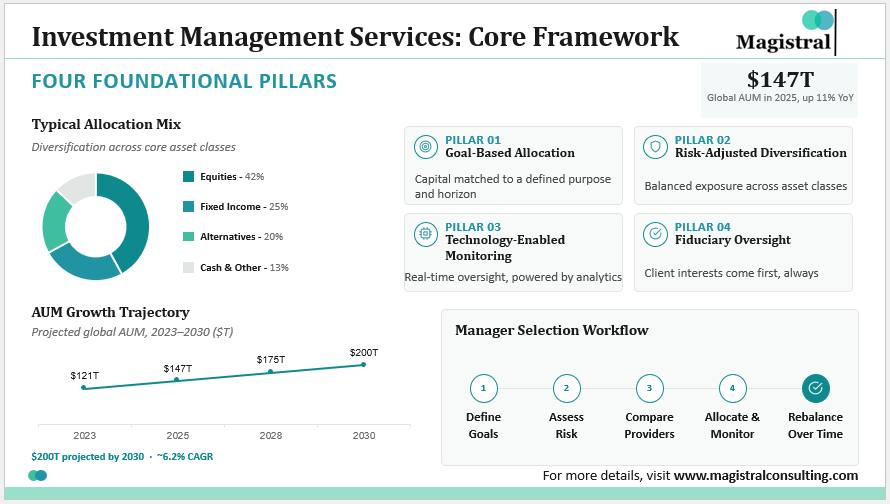
Investment Management Services: Core Framework
Investment Management Services: The Foundation of Wealth Growth
Every strong portfolio starts with a clear plan, not a lucky guess. Investment Management Services provide that plan by aligning capital allocation with an investor’s goals, timeline, and appetite for risk. Done well, this foundation supports every decision that follows. It also gives investors a benchmark to measure progress against, rather than reacting to every market headline.
Defining Goals Before Deploying Capital
A well-structured strategy begins with a candid conversation about what the money is actually for. Retirement, education, or business expansion each demand a different mix of assets and time horizon. Without this clarity upfront, even a technically sound portfolio can end up working against an investor’s real priorities. Revisiting these goals periodically also matters, since life events like a career change or inheritance can shift priorities overnight.
Risk Assessment as a Starting Point
Before any capital moves, managers evaluate how much volatility an investor can genuinely tolerate, not just how much they say they can handle on paper. This step prevents panic-driven decisions later, when markets inevitably turn choppy. It also shapes everything from the equity-to-bond ratio to the use of hedging instruments. A realistic risk profile, revisited annually, keeps the strategy grounded rather than aspirational.
Asset Allocation Across Classes
Equities, fixed income, real estate, and alternatives each behave differently under pressure. Therefore, spreading capital thoughtfully across these classes reduces the odds of a single downturn derailing long-term progress. Institutional investors, in particular, are increasingly adding private markets and real assets to this mix for diversification; private markets revenue alone is projected to reach $432.2 billion by 2030 as allocations grow. Correlation between asset classes also shifts over time, so allocation isn’t a one-time exercise.
Continuous Rebalancing
Markets drift, and so do portfolios. Periodic rebalancing keeps allocations aligned with original targets, ensuring that a winning asset class doesn’t quietly turn into an outsized risk. Left unchecked, even a well-designed strategy can drift into territory the investor never actually agreed to. Most managers set clear trigger thresholds, so rebalancing happens on discipline rather than emotion.
How Investment Management Services Adapt to Market Cycles
Markets rarely move in a straight line, and a rigid strategy can quickly lose relevance. Modern Investment Management Services build in flexibility so portfolios scan respond to shifting conditions without losing sight of long-term objectives. This adaptability is often what separates steady long-term compounding from a portfolio that stalls out during a rough patch. Industry-wide organic growth has hovered near just 2% a year for most of the past decade, underscoring how much cycle-awareness matters for outperformance.
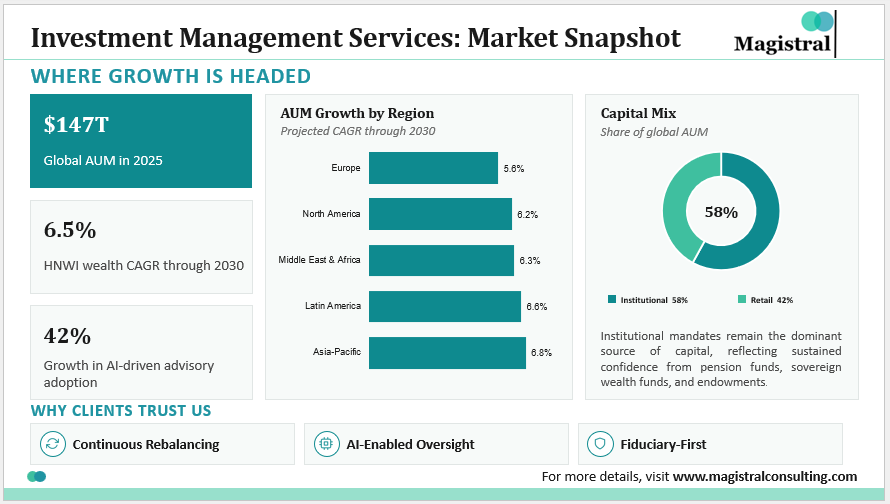
Investment Management Services: Market Snapshot
Reading Macro Signals
Interest rate changes, inflation trends, and geopolitical events all influence asset prices. Skilled managers track these signals closely and adjust positioning before, not after, the market reacts. Central bank commentary, in particular, has become a leading indicator that few portfolios can afford to ignore.
Defensive Positioning in Downturns
When volatility spikes, protecting capital becomes the priority. Moving toward quality bonds, cash reserves, or low-beta equities can cushion a portfolio during turbulent stretches. This shift also preserves dry powder for opportunities that often emerge once prices overcorrect.
Capturing Growth in Bull Markets
Conversely, favourable conditions call for a different posture. Increasing exposure to growth equities or emerging sectors allows portfolios to capture upside when momentum is strong. Timing this shift well often makes a bigger difference to returns than the initial allocation itself.
Sector Rotation Strategies
As economic cycles progress, certain sectors outperform others. Rotating exposure accordingly – from cyclicals to defensives, for instance – helps maintain steady returns across changing conditions. Getting the timing wrong is a real risk, which is why disciplined signals matter more than gut instinct.
Technology and Investment Management Services: A Smarter Partnership
Data now drives decisions that once relied purely on instinct. Investment Management Services increasingly lean on analytics, automation, and AI-assisted research to sharpen accuracy and speed up response times; AI – driven advisory adoption is estimated to be growing by around 42% across firms. Firms that fail to modernize this layer risk falling behind competitors offering faster, more transparent Investment Management Services.
AI-Driven Portfolio Analysis
Machine learning models can process years of market data in seconds, spotting correlations that human analysts might overlook. As a result, decision-making becomes both faster and more evidence-based. These models are refined continuously as new data arrives, so their accuracy tends to improve over time.
Real-Time Reporting Dashboards
Investors today expect transparency on demand. Live dashboards showing performance, allocation, and risk exposure have become a baseline expectation rather than a premium feature. This visibility also builds trust, since investors no longer have to wait for a quarterly statement to understand where they stand.
Automated Risk Monitoring
Algorithms can flag unusual portfolio drift or concentration risk long before it becomes a problem. This constant vigilance adds a layer of protection that manual reviews simply cannot match. Alerts can trigger within minutes of a threshold breach, giving managers time to act before losses compound.
Predictive Market Modelling
Forward-looking models help anticipate potential scenarios rather than merely reacting to past performance. Consequently, portfolios can be positioned more proactively for what lies ahead. These models are probabilistic rather than certain, so they work best alongside human judgment, not in place of it.
Choosing the Right Investment Management Services Provider
Not every provider offers the same depth of expertise or transparency. Selecting the right partner for Investment Management Services can meaningfully influence long-term outcomes, so due diligence matters. High-net-worth wealth is projected to grow at a 6.5% CAGR in the coming years, so a mismatched provider can quietly cost more in missed opportunities than in fees alone.
Track Record and Transparency
A provider’s historical performance, fee structure, and communication style all deserve scrutiny. Ask for documented results rather than relying on marketing claims alone. Consistency across market cycles, not just a single strong year, is usually the better indicator of skill.
Fiduciary Responsibility
Providers acting in a fiduciary capacity are legally bound to prioritize client interests. This distinction alone can significantly reduce conflicts of interest in recommendations. Investors should always confirm this status directly, rather than assuming it applies by default.
Customization Versus Standardization
Some firms offer templated portfolios, while others tailor strategies to individual circumstances. Institutional and high-net-worth investors, in particular, often benefit more from bespoke approaches. However, customization should never come at the cost of clear, comparable performance reporting.
Fee Structures and Value Alignment
Flat fees, AUM-based fees, and performance-linked structures each create different incentives. Understanding these nuances helps investors judge whether costs genuinely align with the value delivered. Small differences in fee structure can compound significantly over a multi-decade investment horizon.
How Magistral Consulting Supports Investment Management Services
Magistral Consulting, works alongside private equity firms, hedge funds, family offices, and asset managers to strengthen the operational backbone behind Investment Management Services. The firm’s offerings span investment research, financial modelling, portfolio monitoring, and fund accounting, including NAV calculation and capital account support. By handling these research-intensive and back-office functions, Magistral allows investment teams to focus on decision-making rather than data processing. Its analysts also support due diligence and reporting across multiple geographies, helping firms onboard faster while keeping accuracy consistent from the very first cycle. For firms seeking to scale their investment operations without scaling costs proportionally, this kind of specialist support has become an increasingly practical choice.
About Magistral Consulting
Magistral Consulting has helped multiple funds and companies in outsourcing operations activities. It has service offerings for Private Equity, Venture Capital, Family Offices, Investment Banks, Asset Managers, Hedge Funds, Financial Consultants, Real Estate, REITs, RE funds, Corporates, and Portfolio companies. Its functional expertise is around Deal origination, Deal Execution, Due Diligence, Financial Modelling, Portfolio Management, and Equity Research
For setting up an appointment with a Magistral representative visit www.magistralconsulting.com/contact
About the Author

Prabhash Choudhary is the CEO of Magistral Consulting. He is a Stanford Seed alumnus and mechanical engineer with 20 + years’ leadership at Fortune 500 firms- Accenture Strategy, Deloitte, News Corp, and S&P Global. At Magistral Consulting, he directs global operations and has delivered over $3.5 billion in client impact across finance, research, analytics, and outsourcing. His expertise spans management consulting, investment and strategic research, and operational excellence for 1,200 + clients worldwide
FAQs
What exactly do Investment Management Services include?
Are Investment Management Services only for high-net-worth individuals?
How are fees usually structured for these services?
How often should a portfolio be reviewed under professional management?
Can technology fully replace human judgment in managing investments?