Investor Profiling has become a practical growth tool for fund managers, founders, investment banks, and capital-raising teams. The market is no longer short of capital. It is short of well-matched capital. PwC’s 2025 Global Asset & Wealth Management Report projects global AUM to rise from US$139 trillion in 2024 to US$200 trillion by 2030, at a 6.2% CAGR. It also expects total investable wealth to exceed US$481 trillion by 2030.
Thank you for reading this post, don't forget to subscribe!In that environment, targeting, timing, and relationship intelligence matter more than broad outreach. Imagine pitching a climate infrastructure strategy to a family office that only backs late-stage software. The conversation may be polite, but it will not move. Strong investor profiling prevents that mismatch by connecting mandate, risk appetite, ticket size, geography, sector preferences, and decision-making behavior before outreach begins.
Investor Profiling and the Changing Capital Market
The process helps teams understand who is likely to invest, why they may invest, and when they are ready to engage. It turns fundraising from a volume game into a relevance game.
Investor Profiling and the Changing Capital Market
Why investor profiling now matters more
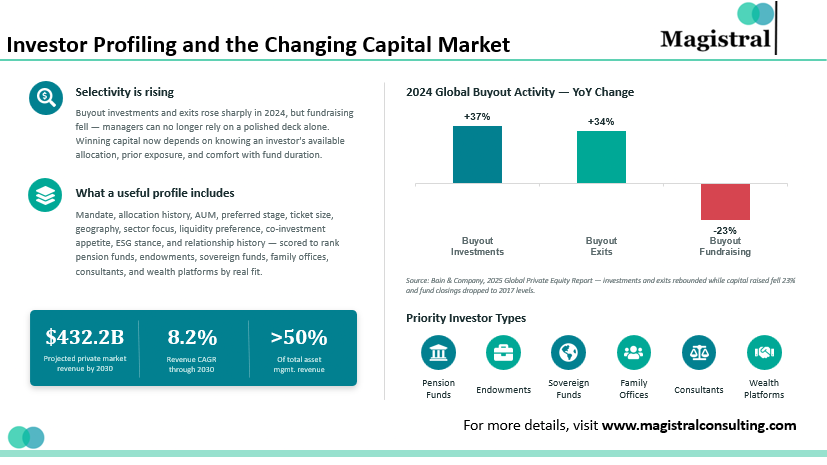
Private markets remain active, but investors have become more selective. Bain’s 2025 Global Private Equity Report noted that global buyout investments and exits rose 37% and 34%, respectively, in 2024, reversing two years of declines. Fundraising moved in the opposite direction: buyout funds raised 23% less capital globally than in 2023, and fund closings dropped to 2017 levels. In this environment, a manager cannot rely only on a polished deck. They need to know whether the target investor has available allocation, prior exposure to the asset class, and comfort with the fund’s duration.
Thoughtful investor profiling also protects senior team bandwidth. Instead of chasing every institution, teams can prioritize pension funds, endowments, sovereign funds, family offices, consultants, and wealth platforms based on real fit.
What a useful profile includes
A strong profile usually captures mandate, allocation history, assets under management, preferred investment stage, ticket size, geography, sector focus, liquidity preference, co-investment appetite, ESG stance, and relationship history. For example, an infrastructure fund may rank insurers higher if they favor long duration cash flows, while a growth equity fund may prefer family offices that already understand software scaling risk.
The role of private market growth
PwC expects private markets to become one of the most important revenue engines in asset management. Its 2025 report projects private market revenues of US$432.2 billion by 2030, growing at an 8.2% CAGR and delivering more than half of total asset management industry revenues. That growth raises the cost of weak targeting. If more managers compete for the same capital pools, a generic email feels invisible. Precise profiles make outreach feel informed.
Investor Profiling for Segmentation and Prioritization
Investor segmentation and prioritization strengthen investor profiling by ranking prospects according to fit, readiness, and strategic value. The best teams do not simply ask, “Who has capital?” They ask, “Who has the right capital for this strategy now?”
Investor Profiling for Segmentation and Prioritization
Segmentation by mandate and allocation
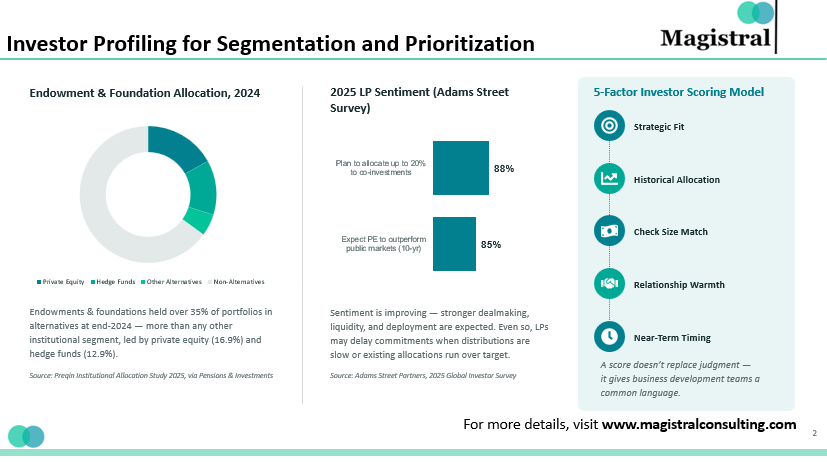
Preqin’s Institutional Allocation Study 2025 shows that investor segments behave differently across alternatives. In 2024, endowments and foundations allocated a higher percentage of AUM to alternatives than any other institutional investor segment. Pensions & Investments, citing Preqin’s study, reported that endowments and foundations had more than 35% of their portfolios in alternatives at the end of 2024, led by private equity at 16.9% and hedge funds at 12.9%. That matters because a hedge fund, secondaries vehicle, or infrastructure strategy may resonate differently with each segment.
Managers raising funds should therefore avoid one static investor list. A better approach ranks prospects by asset class exposure, recent commitments, liquidity pressure, and manager concentration.
Segmentation by stage and strategy
A venture investor that backs seed-stage fintech will not automatically fit a late-stage healthcare fund. Likewise, a buyout-focused pension mandate may not align with venture secondaries. This is where private equity and venture capital databases need qualitative review, not just keyword filters.
Practical scoring criteria
Teams can do investor profiling using five simple factors: strategic fit, historical allocation, check size match, relationship warmth, and near-term timing. A score does not replace judgment, but it gives business development teams a common language.
Prioritization by timing
Timing often separates strong prospects from polite maybes. Adams Street Partners’ 2025 Global Investor Survey reported improving sentiment in private markets, with respondents expecting stronger dealmaking, liquidity, and capital deployment. The survey also found that 85% of LPs expected private markets to deliver higher returns than public markets over the next decade, while 88% planned to allocate up to 20% of capital to co-investments. However, an investor may still delay commitment if distributions are slow or existing allocations are over target.
Investor Profiling Data, Technology, and AI Adoption
The approach now depends on clean data, enriched signals, and disciplined interpretation. AI can speed up research, but human review remains essential because capital allocation decisions are relationship-driven.
Data sources that improve accuracy
Useful inputs include regulatory filings, investment consultant notes, fund commitment databases, conference attendance, portfolio disclosures, press releases, CRM history, and public interviews. Deloitte has also highlighted alternative data as a way for investment managers to improve decision-making when used with proper governance.
For capital teams, this means a profile should not be a static spreadsheet. It should evolve as new commitments, leadership changes, allocation shifts, and market views emerge.
AI in research workflows
The global AI market was valued at about US$390.9 billion in 2025 and is projected to reach about US$3.50 trillion by 2033, according to Grand View Research. North America accounted for 35.5% of global AI revenue in 2025, while services represented the largest component share at 36.3%. This broader adoption is changing investor research as well. AI can summarize filings, flag mandate changes, cluster similar investors, and identify lookalike LPs.
Still, the final judgment should stay human. A model may identify an investor as relevant, but only an experienced analyst can judge whether the mandate truly fits the fund’s risk, liquidity, and return profile.
Why data quality matters
Bad data creates false confidence. A stale contact, outdated allocation, or wrong sector tag can waste weeks. Teams should therefore verify profile fields through at least two sources where possible. This is especially important for capital raising, where first impressions often shape the rest of the relationship.
Investor Profiling in Outreach and Relationship Management
Investor research becomes valuable only when teams use it to shape messaging, meeting preparation, and follow-up. The profile should answer a simple question before every interaction: “What matters most to this investor?”
Personalized outreach
A family office may care about founder access and co-investments. A pension fund may focus on governance, risk controls, and benchmark discipline. A wealth platform may need education, operational simplicity, and product structure clarity. When outreach reflects these differences, conversations become sharper.
Better meeting preparation
Before a meeting, teams should review the investor’s recent commitments, known consultants, prior manager relationships, investment committee cycle, and potential objections. For valuation-sensitive investors, linking strategy assumptions to DCF logic can make the discussion more credible.
Tracking relationship signals
Investor interest is rarely binary. A prospect may attend a webinar, ask for a track record, request a diligence call, then pause for six months. Strong investor profiling tracks these signals and helps teams decide when to re-engage.
How Magistral Supports Investor Profiling
Investor Profiling works best when research, analytics, and relationship context come together. Magistral supports investment teams by building investor databases, enriching profiles, mapping mandates, preparing outreach lists, and creating research-backed fundraising intelligence.
Research and database building
Magistral enables teams to find investors based on asset class, geography, sectors, ticket size, investment strategy preferences, and historical commitments. This decreases research efforts and provides fund managers with a better initial angle for engagement.
Profile enrichment and qualification
The team can enrich investor profiles by providing allocation history, recent activity, decision makers, consultant connections, and contact relevance. This helps clients separate high-priority prospects from broad market names.
Fundraising support and reporting
Magistral also supports CRM updates, meeting briefs, investor tear sheets, and market maps through its broader services. The result is a more disciplined process where every outreach decision has evidence behind it.
About Magistral Consulting
Magistral Consulting has helped multiple funds and companies in outsourcing operations activities. It has service offerings for Private Equity, Venture Capital, Family Offices, Investment Banks, Asset Managers, Hedge Funds, Financial Consultants, Real Estate, REITs, RE funds, Corporates, and Portfolio companies. Its functional expertise is around Deal origination, Deal Execution, Due Diligence, Financial Modelling, Portfolio Management, and Equity Research
For setting up an appointment with a Magistral representative visit www.magistralconsulting.com/contact
About the Author

Tanya is an investment-research specialist with 6 + years advising venture-capital, private-equity and lending clients worldwide. A Stanford Seed alumnus with an MBA and an Economics (Hons) degree, she heads project teams at Magistral Consulting, delivering financial modelling, due-diligence and deal support on 3,000 + mandates. Her blend of rigorous analytics, sharp project management and clear client communication turns complex data into actionable investment insight.
FAQs
What is Investor Profiling?
Why is Investor Profiling important for fundraising?
What data is used in investor profiles?
How does AI improve investor research?
Who needs investor profiling support?