It has become even more crucial to have pitch deck support due to the increasingly selective, speed-oriented, and evidence-driven nature of today’s fundraising landscape. Attractive slides will not do anymore as investors seek a tight narrative, reliable figures, a clear path for spending money, and the indication that the founder knows when to enter the market. According to CB Insights, $469 billion worth of venture funding was invested worldwide in 2025, an increase of 47% year over year compared to 2024, whereas AI-related companies secured $226 billion and took 48% of the total venture funding. Meanwhile, Carta claimed that only 1,122 financing rounds were closed by startups on the platform during Q1 2025 – the lowest Q1 figure since 2018.
Thank you for reading this post, don't forget to subscribe!Pitch Deck Support Market Trends and Investor Expectations
There is an active fundraising market, but one that is not equally open to all entrepreneurs. Money continues to flow to teams and AI categories that can articulate their traction in a rigorous way. Pitch deck support can help founders navigate this market and articulate their story using current market data.
Pitch Deck Support: Market Trends and Investor Expectations
Capital is available, but investors filter harder
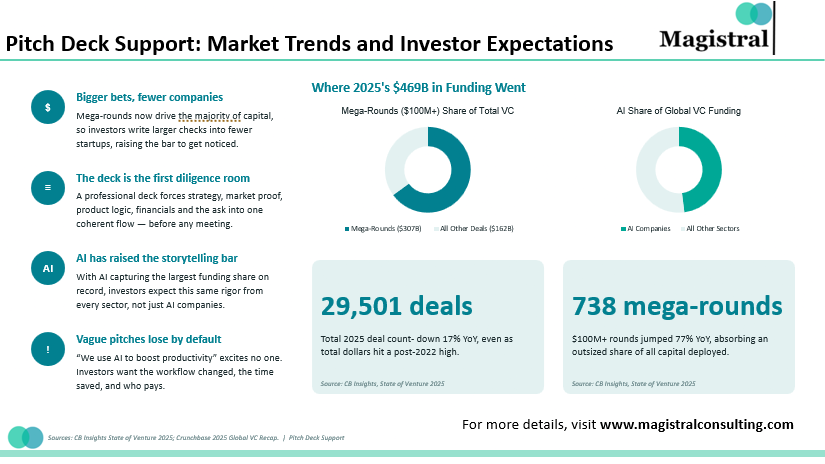
In 2025, venture funding started to bounce back after years of decline. According to CB Insights, global venture funding reached a record $469 billion in 2025, the highest number since 2022, while the number of deals dropped 17% to 29,501. Mega-rounds grew 77% to 738 and accounted for $307 billion, or 65% of total venture funding. Pitch deck support is important in such market conditions, as investors are making bigger bets on fewer companies.
AI has raised the storytelling bar
According to CB Insights, artificial intelligence firms were behind $226 billion of fundraising in 2025, which constituted 48% of total venture investments, representing the largest share ever recorded. Crunchbase also noted that AI-related companies got about 50% of the global venture capital invested in 2025. This change in investors’ behavior cuts across all sectors, not just AI. Investors expect a high standard of data rooms, technical prowess, rapid adoption, and differentiation. Poor pitching will leave the best venture looking disoriented.
Speed has become a design constraint
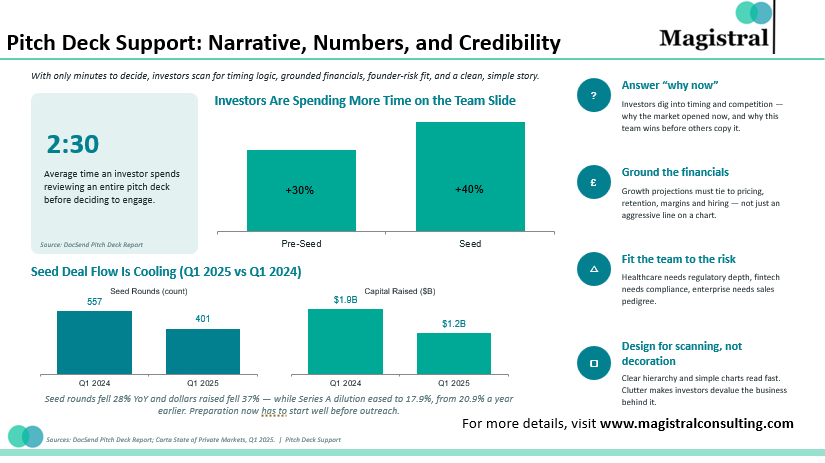
The metrics used in DocSend’s pitch deck demonstrate that, most times, investors only take an average of two minutes and thirty seconds to review a startup’s pitch deck. Recent statistics also indicate more interest shown by investors in the team section of the pitch deck. It doesn’t mean the investors are reckless. They look for quick signals and make decisions based on what they can find in them.
This, therefore, implies that the opening slides need to be designed like a well-signposted airport terminal where the reader gets to know the destination, the route, and why one should continue walking. Problem, Solution, Market, Traction, Business Model, and Ask should work hand in hand.
Early-stage rounds need sharper proof
According to Carta, seed deal flow in Q1 2025 on its platform fell compared to the same period in 2024, recording 401 seed rounds, a 28% decline year over year, and $1.2 billion raised, a 37% drop. It also recorded lower dilution rates at various stages, including a median Series A dilution rate of 17.9% in Q1 2025 compared to 20.9% a year earlier. Pitch deck support assists founders in getting ready for this more selective environment by ensuring consistency of the deck, financial model, valuation perspective, investor list, and diligence responses before outreach.
This is why capital-raising preparation can’t be started a week before outreach. The deck should incorporate the financial model, the list of investors, the valuation perspective, and the diligence responses before even sending the first email.
Pitch Deck Support for Narrative, Numbers, and Credibility
A deck wins attention when the story and numbers support each other. Pitch deck support turns scattered founder knowledge into a structured investment argument that an investor can understand quickly.
Pitch Deck Support: Narrative, Numbers, and Credibility
The narrative should answer why now
A strong investor story does not simply describe a company. It explains timing. Why has the market opened now? Why is the current solution inadequate? Why can this team win before others copy the idea? DocSend’s 2023 seed research found that investors spent more time on sections such as “Why now” and competition as they looked for sharper market context in a crowded environment.
Financials must feel connected to operations
Investors aren’t expecting your early-stage financial projections to be completely accurate. They are expecting them to make sense. Projections about revenue should tie into your prices, marketing, sales ability, retention rates, gross margins, and recruiting plans. When your financial slide shows aggressive growth without showing how that’s going to happen, you lose all credibility.
The financials of startups need to address three key questions. How much money is required? What milestones will that money allow you to hit? What is required for your next financing or exit? This seems easy, but it’s not always obvious.
The team slide has become more important
According to Dropbox DocSend, in December 2024, investors spent 40% more time on seed-stage team slides and 30% more time on pre-seed team slides compared to the previous year. Amid a crowded marketplace full of similar statements, investors are starting to pay more attention to the founders who will be implementing the plan.
The team slide should tie the experience of the founders to the specific risk of the company. The founders of a healthcare business may need experience in regulatory affairs, while those in fintech require compliance expertise. Enterprise software founders need experience selling to large customers. Pitch deck support ties these things together explicitly for the investor.
Visual design should reduce cognitive load
A good design is not ornate. It is simple, avoids distractions, and supports visual hierarchy and rapid scanning. A clear chart, a concise revenue bridge, or a well-crafted market map communicates more effectively than a cluttered paragraph. Investors review hundreds of pitches per week. If every slide is difficult to process, investors will automatically devalue the offering. If the deck flows smoothly, an investor can focus more on the business than on the slide design.
Pitch Deck Support Strategies and Best Practices for Founders
The best decks are not one-size-fits-all. The best decks vary depending on stage, industry, funding round, type of investor, and fundraising goal. Pitch deck support also enables founders to tell the same essential story from various perspectives.
Match the deck to the round
A pre-seed deck should highlight problem clarity, founder insights, initial validation, and a sound learning approach. A seed deck should demonstrate traction, usage, early revenue logic, and the next milestone. A Series A deck should highlight repeatability, market expansion, unit economics, and the ability to lead.
Build around investor questions
Investors have typical questions. What’s the market size? Why does the customer care? What’s the evidence? How does the business work? What makes the approach defensible? What could disrupt the model? A good deck doesn’t wait until the Q&A session to provide answers to the typical questions.
Keep the ask specific
An ambiguous ask undermines the close. Investors need to know how much money you’re raising, for what purpose, how long the funding will last, and what milestones you are going to achieve prior to the next funding round. The funding request should resemble a disciplined capital-allocation plan rather than a speculative spending wish list. In venture capital, a specific request also helps investors assess whether the opportunity fits their investment criteria. Some venture firms care about ownership stakes. Others care about stage, check sizes, reserves, or even board seats. The clearer the ask, the quicker the good investor says “yes” and the sooner the bad one says “no.”
How Magistral Provides Pitch Deck Support for Fundraising Teams
Magistral Consulting helps founders, investors, and their portfolio companies by providing pitch deck support using research that covers market size, competition, financial modeling consistency, and investor-content presentation. We make sure that the market opportunity, financials, allocation of proceeds, and milestone achievements are aligned and backed up by reliable figures. Apart from developing the pitch decks themselves, we help in conducting investor research, reaching out to investors, benchmarking, answering diligence questions, and preparing other materials.
About Magistral Consulting
Magistral Consulting has helped multiple funds and companies in outsourcing operations activities. It has service offerings for Private Equity, Venture Capital, Family Offices, Investment Banks, Asset Managers, Hedge Funds, Financial Consultants, Real Estate, REITs, RE funds, Corporates, and Portfolio companies. Its functional expertise is around Deal origination, Deal Execution, Due Diligence, Financial Modelling, Portfolio Management, and Equity Research
For setting up an appointment with a Magistral representative visit www.magistralconsulting.com/contact
About the Author

Tanya is an investment-research specialist with 6 + years advising venture-capital, private-equity and lending clients worldwide. A Stanford Seed alumnus with an MBA and an Economics (Hons) degree, she heads project teams at Magistral Consulting, delivering financial modelling, due-diligence and deal support on 3,000 + mandates. Her blend of rigorous analytics, sharp project management and clear client communication turns complex data into actionable investment insight.
FAQs
What makes a good investor deck?
How long should a startup deck be?
Why do investors spend so little time reviewing decks?
What should founders prepare before sending a deck?
How does professional support improve fundraising?