Though fundraising documents may seem alike from afar, the investor uses each of them differently in a fundraising deal. The pitch deck starts the discussion, the CIM builds the business and financial case, and the PPM supports the legal documentation during private offerings. This is why it is essential to distinguish between pitch deck vs CIM vs PPM prior to approaching any angel investor, venture capital fund, family office, or institutional buyer. With an increasing number of investors in any market, it is crucial to use the right fundraising tool; otherwise, negotiations will drag on, confusion will arise, and the level of credibility of the company in question will suffer greatly.
Thank you for reading this post, don't forget to subscribe!According to recent figures, global buyout investment increased by 37%, while exit value increased by 34% in 2024. Nevertheless, despite positive dynamics, the amount of global buyout fundraising decreased by 23% that year. In turn, startup fundraising on leading private marketplaces reached approximately 120 billion dollars in 2025, growing 17% annually; however, the overall number of rounds dropped to a six-year low. In practical terms, understanding pitch deck vs CIM vs PPM helps founders choose the right document at the right point in the process.
Pitch deck vs CIM vs PPM for fundraising purposes
The key difference lies in the requirements of the investors for the various stages of the financing process. While a pitch deck contains a concise and visual description of a business idea, the company’s progress towards achieving its goals, market potential, traction, business model, and capital requirements, it should attract investors’ attention within several minutes. A CIM, which stands for Confidential Information Memorandum, presents investors with a deeper analysis of the company in terms of its financial standing, sources of income, operations, market situation, concentration of customers, business growth, and rationale behind the sale. Thus, it is located somewhere between the preliminary meeting and the due diligence process.
And lastly, the PPM, or Private Placement Memorandum, is a formal document required for a private placement offering. Unlike a pitch deck and a CIM, the primary purpose of this document is to disclose certain details regarding the conditions, risks, fees, and suitability of the investors. A clear view of pitch deck vs CIM vs PPM makes it easier to match the material to the investor’s expectations.
Pitch deck vs CIM vs PPM in content depth and investor use
It is important to recognize that the difference between these documents lies not only in their length but also in how investors use them. In other words, documents would become easier to organize when each one of the documents is used for its corresponding stage of the financing funnel.
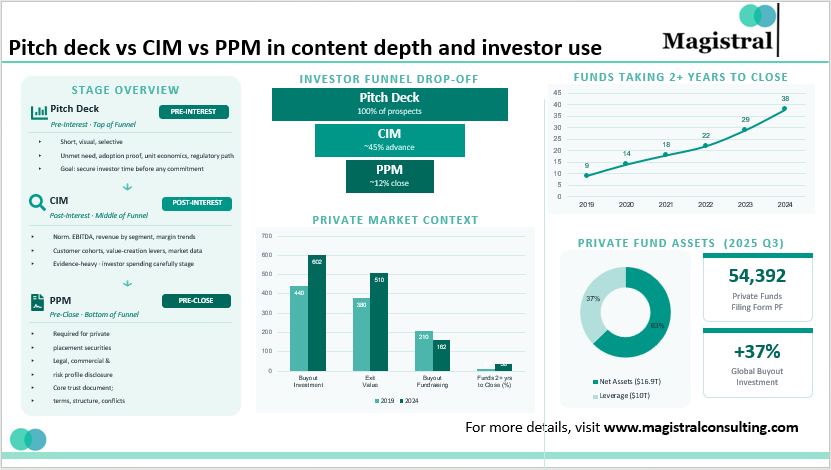
Pitch deck vs CIM vs PPM in content depth and investor use
When investors read a pitch deck
Before an investor makes the decision to spend his or her time on further evaluation, he or she looks at the pitch deck. This document should be short, visual, and targeted. The fact that it tries to provide all information in detail is contrary to the purpose of this document.
For example, consider a founder of a health-tech startup raising Series A funds. The investor needs information about the unmet need, adoption proof, unit economics, regulatory pathway, and reasons why the current round helps grow the business fast. He or she doesn’t need the whole paragraph about legal risks. This is one of the clearest examples of pitch deck vs CIM vs PPM in practice.
When investors request a CIM
This kind of CIM should contain EBITDA, revenues per segment, margin evolution, market growth, customer cohorts, advantages, and value creation. This is critical since investors are being prudent with their resources. For instance, in 2024, the amount of investments for buyouts across the world grew by 37% to reach almost 602 billion dollars, while the amount of exit value climbed 34%, but buyout fundraising dropped 23% across the globe. The second observation by Bain & Company was that the number of funds that took two years or even more to be finalized went up to 38% compared to 9% back in 2019.
In simple words, there is an improvement in deals faster than the improvement in fundraising, meaning that managers require better materials. In this stage, documents becomes especially relevant because investors now expect more depth and diligence support. reference
When a PPM becomes necessary
PPM is needed when there is an offer to buy and sell securities through the private placement of such securities. It provides a detailed description to help informed investors evaluate the offer.
The extent of the market of private placements also highlights the importance of good-quality disclosure. According to the statistics for Q3 2025, 54,392 private funds have reported on their investments using Form PF. These private funds hold $16.9 trillion worth of net assets and $26.9 trillion worth of gross assets. At such a magnitude of private placements, the PPM is an important document for evaluating the deal. This is why one should consider a PPM as opposed to pitch decks or CIMs. From a compliance perspective, pitch deck vs CIM vs PPM is not just a messaging choice but also a legal and procedural one.
Pitch deck vs CIM vs PPM for startups, companies, and funds
Startups, established companies, and private funds use different fundraising documents depending on the stage and complexity of the transaction. Early-stage startups usually rely on pitch decks to communicate vision, traction, and growth potential to angel investors and VCs. As companies mature and raise larger rounds, investors often expect additional materials such as financial models, investor memos, data rooms, and sometimes PPM disclosures for private securities offerings. Established companies pursuing growth capital or M&A transactions typically use CIMs to provide detailed information on financial performance, operations, market position, and valuation.
Private funds often require all three: a pitch deck to introduce the strategy, a CIM or investment memorandum to explain track record and portfolio construction, and a PPM to disclose fund terms, risks, fees, and compliance details. With private markets expanding rapidly and investors demanding deeper diligence, the quality and depth of pitch deck vs CIM vs PPM documentation have become increasingly important. For founders and fund managers alike, pitch deck vs CIM vs PPM should be planned as part of a broader fundraising workflow rather than as isolated deliverables.
Pitch deck vs CIM vs PPM best practices for fundraising success
The key to success is having your fundraising materials as a cohesive set. The question you should be asking yourself is not which of these is better but rather when you should use each material and how consistently they should back up the investor’s experience. A smart approach to pitch deck vs CIM vs PPM improves both investor communication and process efficiency.
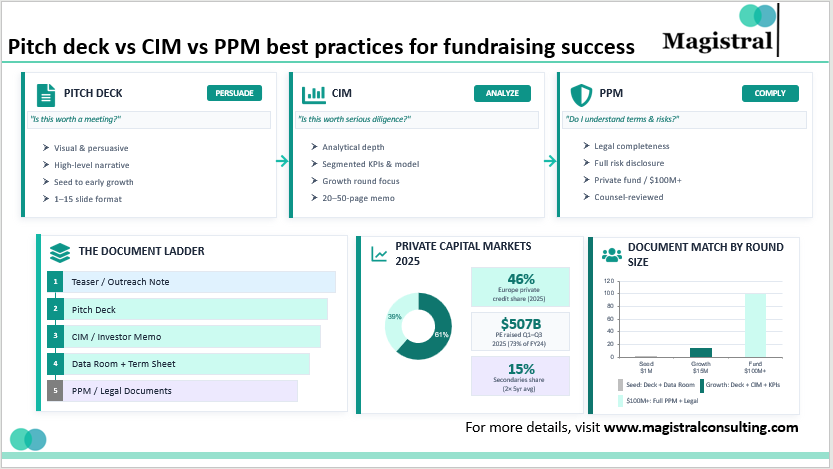
Pitch deck vs CIM vs PPM best practices for fundraising success
Keep the message consistent
When an investor gets conflicting messages from your pitch deck and sees something different in the CIM, then notices new risk factors that weren’t mentioned before in the PPM, the trust will be broken. You need to go deeper into the story but not change its course.
That’s what a professional fundraising consultant can do for you. Strong consistency across pitch deck vs CIM vs PPM helps reinforce credibility with sophisticated investors.
Match the document to the round size and investor type
When deciding how to use pitch deck vs CIM vs PPM, the right way is to choose one based on the size and nature of the fundraising process. In the case of raising $1 million for a seed, you may only need an effective deck with the right data room. For 15 million dollars in the growth stage, you might need a more complete investor memo, KPIs, and projections. As for raising 100 million dollars for your private fund or making a private placement, you’ll probably have to prepare a precise PPM together with a subscription package.
A pitch deck can be convincing. A CIM should be analytical. But a PPM has to be very careful and detailed. Mixing up these approaches can cause some issues.
For instance, risk factors are not supposed to play a main role during the initial meetings with investors. Nevertheless, they shouldn’t be forgotten in the end offering. Mature and balanced communication is always highly appreciated by investors.
Use data without overloading the reader
Your fundraising documents will include many facts, including figures, but those figures must be used in an appropriate context. According to Preqin, 46 percent of fundraising for private credit in Q1 to Q3 was allocated to European funds, which represents an increase from the 23 percent seen in 2024, and 61.5 percent of the capital raised went to direct lending.
Also, according to Preqin, the number of dollars raised in Q1 to Q3 of 2025 by private equity reached 507 billion dollars, representing 73 percent of what was seen throughout the year 2024, and secondaries represented 15 percent of fundraising, more than twice the figure over the past five years. These types of figures can be useful for explaining when it’s a good time to raise. Used well, they also strengthen the narrative around pitch deck vs CIM vs PPM without overwhelming the reader.
Create a document ladder, not isolated files
Exceptional fundraising teams very seldom view each of these documents individually. They create a document ladder – from teaser/contact letter, through pitch deck, memo / CIM, data room, term sheet negotiation, and ending with PPM / final documentation if required. Viewing documents in such a light allows entrepreneurs and managers to avoid two pitfalls – putting too much into a pitch deck and underpreparing the final document.
Fundraising documents always aim at a single investor’s question.
Pitch deck – is this even worth a conversation?
CIM – Is this investment worth my time?
PPM – Do I know enough about the terms and risks?
This framework is often the easiest way to understand documents across the full investor journey.
How Magistral supports fundraising documentation
Magistral Consulting provides fundraising documentation, investment due diligence research, financial modeling, market research, and presentation preparation services to start-ups, privately held companies, funds, and investment management firms. On its fundraising page on the website of Magistral Consulting, it is mentioned that standard fundraising documents typically consist of a pitch deck, CIM/PPM, valuation, and a one-pager.
For issuers looking to prepare investor documents, Magistral Consulting will help to align the story, figures, diligence support, and outreach process. Other services provided by the company include due diligence services, deal structuring and execution, financial modeling, valuation, fundraising, deal sourcing, portfolio management, ESG analysis, fund administration, research, marketing, and investor relations.
An efficient process makes the difference between PIM vs CIM vs PPM from just a document decision into a strategic fundraising process where documents come at the appropriate time and with the right content. In advisory work, such documents are often central to deciding what to prepare first and how to sequence investor materials.
About Magistral Consulting
Magistral Consulting has helped multiple funds and companies in outsourcing operations activities. It has service offerings for Private Equity, Venture Capital, Family Offices, Investment Banks, Asset Managers, Hedge Funds, Financial Consultants, Real Estate, REITs, RE funds, Corporates, and Portfolio companies. Its functional expertise is around Deal origination, Deal Execution, Due Diligence, Financial Modelling, Portfolio Management, and Equity Research
For setting up an appointment with a Magistral representative visit www.magistralconsulting.com/contact
About the Author

Tanya is an investment-research specialist with 6 + years advising venture-capital, private-equity and lending clients worldwide. A Stanford Seed alumnus with an MBA and an Economics (Hons) degree, she heads project teams at Magistral Consulting, delivering financial modelling, due-diligence and deal support on 3,000 + mandates. Her blend of rigorous analytics, sharp project management and clear client communication turns complex data into actionable investment insight.
FAQs
What is the main difference between pitch deck vs CIM vs PPM?
Does every fundraiser need all three documents?
Is a CIM legally the same as a PPM?
Can a pitch deck replace a CIM?
Who prepares these fundraising documents?