Alternative investment managers face mounting pressure to prove accuracy, speed, and transparency in how they report performance. Fund Accounting Services sit at the centre of that pressure, converting complex portfolio activity into NAV calculations, capital account statements, and investor-ready reports. As private equity, venture capital, and hedge fund portfolios grow larger and more cross-border, in-house teams often struggle to keep pace with reporting deadlines and shifting compliance rules.
Thank you for reading this post, don't forget to subscribe!As a result, many fund managers are now turning to specialized providers of Fund Accounting Services to strengthen controls and reduce operational risk. This article looks at why demand for these services is rising, what the function typically covers, the benefits of outsourcing, and how to choose the right partner.
The Growing Demand for Fund Accounting Services
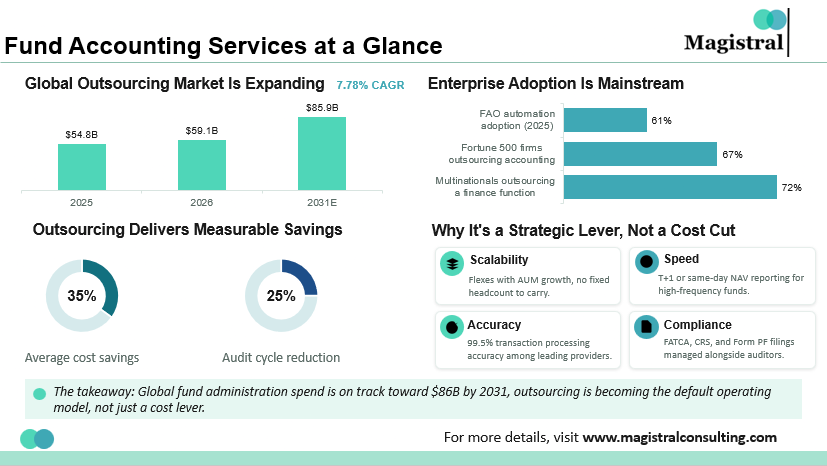
Global fund administration spending is climbing steadily, and Fund Accounting Services form the largest share of that spend. The market is forecast to grow at roughly 11% annually through 2034, driven largely by alternative fund managers who no longer view outsourcing as optional. Several forces are pushing this shift, from rising portfolio complexity to investor demands that internal teams simply cannot absorb alone. Together, these pressures are reshaping how funds staff and structure their back-office operations.
Fund Accounting Services at a Glance
Private Capital Expansion Drives Volume
Private equity and venture capital funds keep raising larger vehicles with more limited partners, more portfolio entities, and more currencies to track. Every additional fund structure multiplies the reporting workload, which strains lean finance teams. As deal counts rise, so does the volume of capital calls, distributions, and valuation updates that must be processed on tight timelines.
Regulatory and Investor Reporting Pressure
Institutional investors now expect faster, more detailed disclosures. Meanwhile, regulators continue tightening requirements around tax filings, ILPA reporting templates, and cross-border compliance, leaving little room for manual error. A single missed filing deadline can trigger penalties or, worse, damage a fund’s standing with limited partners during future raises.
Talent Shortages Push Firms Toward Outsourcing
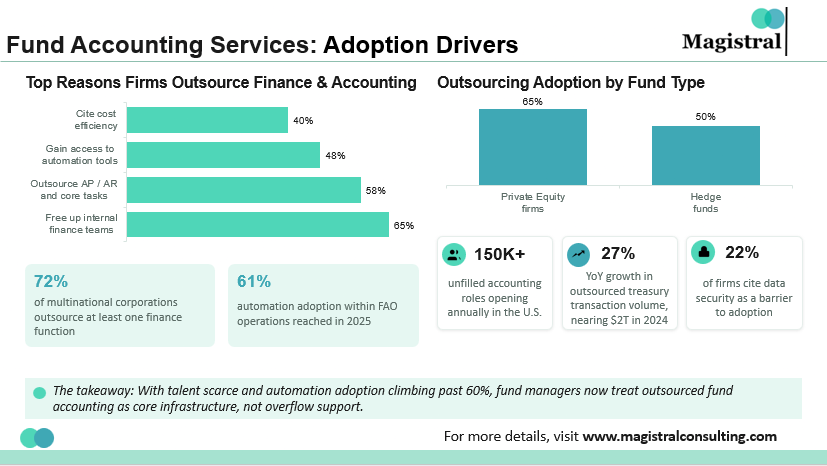
Experienced fund accountants are increasingly hard to hire and retain. Industry surveys point to well over 150,000 unfilled accounting roles annually in the U.S. alone, prompting firms to look outward for qualified capacity. Declining CPA enrolment adds further strain, pushing recruitment timelines out even for well-funded managers.
Technology Expectations Are Rising
Investors expect real-time dashboards, not quarterly PDFs. Providers offering cloud-based reporting tools can meet this expectation far more easily than teams still working from spreadsheets. Automated reconciliation and portals also cut down the back-and-forth that used to slow investor queries.
Core Components of Fund Accounting Services
Whatever the fund type, Fund Accounting Services generally cover a consistent set of tasks that keep the books accurate and investors informed. However, the depth and frequency of each component can vary by strategy and fund size. Understanding these building blocks helps managers decide how much of the function to hand over and how much to keep in-house.
NAV Calculation and Portfolio Valuation
Accurate net asset value calculation anchors every other reporting output. Providers reconcile positions, apply valuation policies, and flag discrepancies before they reach investors. This step also feeds directly into performance metrics, so any error here ripples through capital account statements and investor communications.
Financial Statement Preparation
Monthly and quarterly statements prepared under GAAP or IFRS give management and auditors a consistent, audit-ready trail throughout the fund’s life. Standardized formatting also makes it easier to compare performance across reporting periods and portfolio entities.
Investor Reporting and Capital Accounts
Capital call notices, distribution statements, and individual capital account tracking must stay precise, since even small errors erode investor confidence quickly. Timely, well-formatted statements also reduce the volume of ad hoc investor queries that fund managers must field directly.
Compliance and Tax Filings
Regulatory filings such as FATCA, CRS, and Form PF, along with investor tax documents like Schedule K-1, are typically coordinated alongside external tax advisors and auditors. Keeping these filings on schedule protects the fund’s regulatory standing and spares limited partners last-minute tax surprises.
Benefits of Outsourcing Fund Accounting Services
Outsourcing does more than fill a staffing gap; it changes how funds operate day to day. Cost savings are often the first driver, but the advantages extend well beyond the balance sheet. Managers frequently find that the added structure and oversight also improve how their teams handle audits and investor due diligence.
Fund Accounting Services: Adoption Drivers
Meaningful Cost Savings
Firms outsourcing finance functions typically report savings between 25% and 45% compared to running an equivalent team in-house, freeing up budget for investment activities instead of back-office overhead. These savings compound over time as funds avoid the recurring costs of recruiting, training, and retaining specialized staff.
Improved Accuracy and Audit Readiness
Specialized providers apply standardized processes and quality checks, which shortens audit cycles and reduces the restatement risk that plagues under-resourced internal teams. Independent review layers built into these processes also give auditors greater confidence in the numbers from the outset.
Scalability Without Fixed Headcount
Outsourced Fund Accounting Services flex with fund size. A firm launching a new vehicle or closing a large round does not need to hire and train staff on short notice. This flexibility also helps managers avoid the cost of carrying idle capacity during quieter fundraising cycles.
Access to Better Technology
Providers invest in automation, reconciliation software, and reporting platforms that would be costly for a single fund to license and maintain independently. Shared infrastructure across multiple clients also means upgrades reach fund managers faster than if they built and maintained these systems alone.
Choosing the Right Fund Accounting Services Provider
Not every provider fits every fund strategy, so selection deserves the same diligence funds apply to any vendor relationship. A mismatched partner can create more friction than it removes. A short evaluation checklist can help managers compare candidates on equal footing before signing a long-term contract.
Track Record Across Fund Structures
Look for demonstrated experience with your specific strategy, whether that is private equity, venture capital, real estate, or hedge fund structures, since reporting nuances differ significantly. Ask for references from funds of similar size, as smaller and larger vehicles often place very different demands on a provider’s team.
Technology and Data Security
Ask how the provider handles cloud infrastructure, encryption, and access controls. Data sensitivity in fund operations makes this a non-negotiable checkpoint. Request evidence of regular security audits and clear data-handling policies before sharing sensitive investor or portfolio information.
Turnaround Time and Communication
Fast, clear communication during capital calls, distributions, and audits often matters as much as raw accuracy. Confirm response times before signing. A provider with a dedicated point of contact and defined escalation paths tends to resolve issues far more smoothly than one relying on generic support queues.
Scope of Services and Pricing Structure
Some providers bundle Fund Accounting Services with broader fund administration, while others offer modular, à la carte support. Match the scope to what your internal team actually needs. Clarify pricing structures upfront, since flat-fee and per-fund models can produce very different costs as assets under management grow.
How Magistral Consulting Strengthens Fund Accounting Services
Magistral Consulting, based in Noida, India, supports private equity, venture capital, hedge funds, family offices, and real estate sponsors with end-to-end Fund Accounting Services, including NAV calculation, capital account statements, financial reporting, and coordination with auditors and tax advisors. Its teams also assist with regulatory filings such as FATCA, CRS, and Form PF, giving fund managers a single partner for both compliance and investor communication. By combining offshore delivery with sector-specific expertise across asset classes, Magistral helps fund managers reduce cost, tighten reporting timelines, and scale operations without adding fixed headcount.
The team has supported private equity, venture capital, and real estate mandates across multiple geographies, adapting reporting formats to each fund’s structure and investor base. This hands-on experience across asset classes allows Magistral to onboard new clients quickly while keeping reporting accurate from the very first cycle.
About Magistral Consulting
Magistral Consulting has helped multiple funds and companies in outsourcing operations activities. It has service offerings for Private Equity, Venture Capital, Family Offices, Investment Banks, Asset Managers, Hedge Funds, Financial Consultants, Real Estate, REITs, RE funds, Corporates, and Portfolio companies. Its functional expertise is around Deal origination, Deal Execution, Due Diligence, Financial Modelling, Portfolio Management, and Equity Research
For setting up an appointment with a Magistral representative visit www.magistralconsulting.com/contact
About the Author

Dhanita is a BD and Marketing professional with 6+ years’ experience in sales strategy, growth execution, and client acquisition; credentials include Stanford Seed (Stanford GSB), an MBA from USMS–GGSIPU, and a B.Com (Hons) from the University of Delhi. Expertise spans market research and opportunity mapping, sales strategy, CRM, brand positioning, integrated campaigns, content development, lead generation, and analytics; currently oversees business development calls and end-to-end marketing operations
FAQs
What are Fund Accounting Services?
Why do fund managers outsource Fund Accounting Services instead of hiring in-house?
Are outsourced fund accounting solutions suitable for smaller funds?
How do Fund Accounting Services differ from general fund administration?
How often are NAV calculations updated under this type of outsourcing arrangement?