M&A deal origination is having a moment. After a record 2025, dealmakers are entering 2026 with sharper focus on how opportunities reach the table before a formal auction begins. Every dollar of deal value traces back to an origination decision made months, sometimes years, earlier. As megadeals concentrate value and competition for quality mid-market targets intensifies, firms winning the best assets are rethinking pipeline-building: fewer cold blasts, more thesis-driven research, and increasingly, artificial intelligence layered over relationship data. This article covers where origination stands today, the channels driving deal flow, and how technology is reshaping the deal funnel’s earliest stage.
Thank you for reading this post, don't forget to subscribe!The Shifting Landscape of M&A Deal Origination in 2026
Global deal activity rebounded sharply through 2025 and into 2026, but the recovery is uneven. Understanding where value and volume are concentrating is essential, since it determines which sectors and deal sizes deserve attention.
The Shifting Landscape of M&A Deal Origination in 2026
Market Momentum and Megadeal Concentration
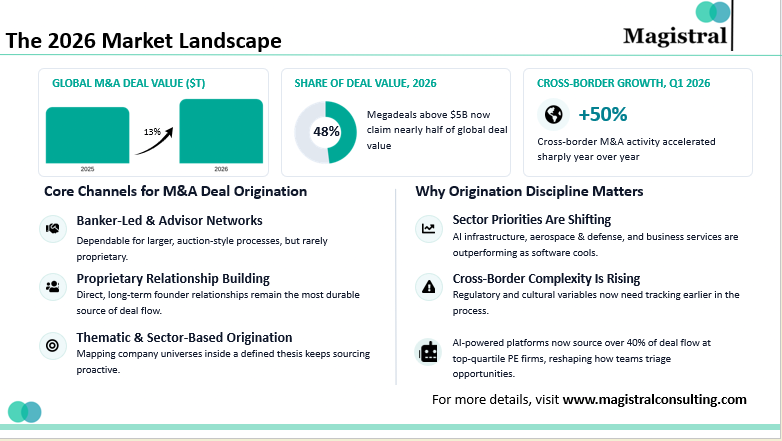
Global M&A deal origination value is on pace to reach roughly four trillion dollars in 2026, a thirteen percent rise from 2025, according to PwC’s mid-year deals outlook. However, transactions above five billion dollars now make up nearly half of that total value, up from under a third two years ago. Strip out megadeals, and underlying value actually declined slightly, meaning teams chasing average-sized deals face a narrower opportunity set than headline numbers suggest.
Sector Hotspots Reshaping Origination Priorities
AI infrastructure, power, and data-centre adjacent assets have become the clearest magnets for origination activity, while software has cooled as buyers reassess disruption risk. Advisors surveyed by Capstone Partners and IMAP expect aerospace, defence, and business services to outperform in 2026, reinforcing that priorities are shifting toward recession-resilient and AI-enabled sectors simultaneously.
Cross-Border Origination Gains Ground
Cross-border M&A deal origination rose sharply in early 2026, with deal value up nearly fifty percent year over year according to LSEG data. European buyers are moving into the United States, and American acquirers are pursuing global consolidation in scale-driven sectors, adding jurisdictional complexity that teams must track earlier in the process.
Middle-Market Origination Under Pressure
Lower middle-market transaction activity softened in 2025, according to Within Intelligence, tightening the pipeline that historically fed larger buyout funds. As a result, firms are building relationships with target companies well before they formally come to market, treating deal origination as a continuous, relationship-first discipline rather than a reactive response to banker outreach.
Core Channels for M&A Deal Origination
No single channel delivers complete deal flow. Effective origination programs blend several sourcing channels, each with different strengths, costs, and levels of exclusivity.
Banker-Led and Advisor Networks
Investment banks and boutique advisors remain a dependable channel for larger, auction-style processes, though teasers reaching many buyers simultaneously rarely produce proprietary access.
Proprietary Relationship Building
Direct, long-term relationships with founders and management teams remain the most durable source of differentiated deal flow. Firms that invest in simplifying and strengthening their deal origination process, reaching out with genuine industry insight rather than generic interest, tend to earn a seat at the table before a company formally explores a sale.
Thematic and Sector-Based Origination
Rather than waiting for opportunities to appear, leading teams define a focused M&A deal origination strategy inside long-term trends such as AI adoption or energy transition, then map the company universe and engage selectively over time. This keeps origination proactive, and compounds as more data feeds back into each thesis.
Marketplaces and Off-Market Platforms
Transaction marketplaces connect buyers with boutique advisors representing smaller, typically lower middle-market sellers. Because listings are visible to many subscribers at once, these platforms function more as shared market access than a proprietary edge.
Corporate Development and Direct Outreach
Strategic acquirers increasingly run their own outreach programs targeting a specific capability gap, a channel that works best with disciplined tracking, since informal outreach easily gets lost.
How AI Is Transforming M&A Deal Origination
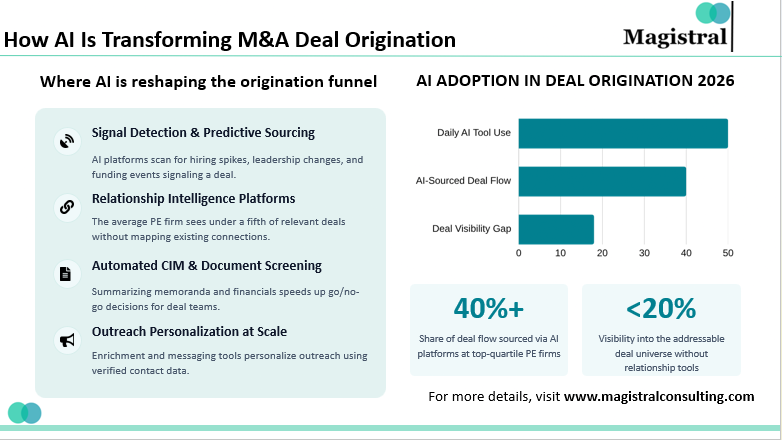
Artificial intelligence is now central to how competitive firms approach AI-powered M&A deal origination. Top-quartile private equity firms reportedly source over forty percent of their deal flow through AI-powered platforms, and nearly half of dealmakers use AI tools daily.
How AI Is Transforming M&A Deal Origination
Signal Detection and Predictive Sourcing
AI platforms continuously scan company universes for early signals, such as hiring spikes, leadership changes, or funding events, suggesting a company may be preparing for a transaction. Moreover, this shifts origination from periodic list-building toward an always-on monitoring process.
Choosing Proprietary vs. Shared-Access Tools
Not every data platform creates a competitive edge. Broad databases used by hundreds of thousands of subscribers deliver the same list to every firm, while AI-driven discovery tools focused on off-market signals are more likely to surface opportunities competitors have not yet found.
Relationship Intelligence Platforms
The average private equity firm reportedly sees under a fifth of the relevant deals in its addressable universe. Relationship intelligence tools address this gap by mapping the strength and recency of a firm’s existing connections across email, calendars, and meeting history, turning dormant relationships into active leads.
Automated CIM and Document Screening
AI tools that synthesize CIM, financials, and news into concise summaries are part of a broader shift in AI in private equity, helping deal teams reach a go or no-go decision faster and freeing analysts from hours of manual document review during origination.
Outreach Personalization at Scale
Once a target list is built, AI-driven enrichment and messaging tools help teams personalize outreach based on current company news and verified contact data, improving response rates over generic, templated outreach.
Building a Repeatable M&A Deal Origination Strategy
Technology alone does not fix a weak origination process. Therefore, firms that consistently win the best assets treat origination as a system with clear inputs, owners, and metrics, not a collection of ad-hoc habits.
Define a Clear Investment Thesis
A tightly defined thesis, covering target sectors, size ranges, and value-creation levers, gives origination teams a filter for triaging the flood of inbound and AI-surfaced opportunities. Teams without clear criteria tend to close whichever deals are easiest, not the ones that best fit their strategy.
Institutionalize Thematic Research
Investment themes often live only in partner notebooks and old offsite slides. Moving those themes into a shared, continuously updated data model ensures new signals connect back to the firm’s stated priorities instead of depending on any one person’s memory.
Track Origination Metrics That Matter
Measuring opportunities surfaced per week, time-to-triage, and the eventual close rate of AI-sourced leads as they move into deal execution gives leadership a clear, evidence-based view of which channels and themes, including deal origination outsourcing, actually produce results, rather than relying on anecdote.
Balance Technology with Human Judgment
Even the most sophisticated platforms still depend on experienced judgment to interpret signals, structure due diligence, and navigate sensitive conversations with founders. Firms that pair strong data infrastructure with disciplined relationship-building are best positioned to keep winning proprietary deals as competition intensifies, making disciplined origination one of the clearest sources of competitive advantage today.
About Magistral Consulting
Magistral Consulting has helped multiple funds and companies in outsourcing operations activities. It has service offerings for Private Equity, Venture Capital, Family Offices, Investment Banks, Asset Managers, Hedge Funds, Financial Consultants, Real Estate, REITs, RE funds, Corporates, and Portfolio companies. Its functional expertise is around Deal origination, Deal Execution, Due Diligence, Financial Modelling, Portfolio Management, and Equity Research
For setting up an appointment with a Magistral representative visit www.magistralconsulting.com/contact
About the Author

Dhanita is a BD and Marketing professional with 6+ years’ experience in sales strategy, growth execution, and client acquisition; credentials include Stanford Seed (Stanford GSB), an MBA from USMS–GGSIPU, and a B.Com (Hons) from the University of Delhi. Expertise spans market research and opportunity mapping, sales strategy, CRM, brand positioning, integrated campaigns, content development, lead generation, and analytics; currently oversees business development calls and end-to-end marketing operations
FAQs
What is M&A deal origination?
How is AI changing M&A deal origination?
What is the difference between proprietary and shared-access deal sourcing?
Why is middle-market M&A deal origination getting harder?
What metrics measure deal origination success?