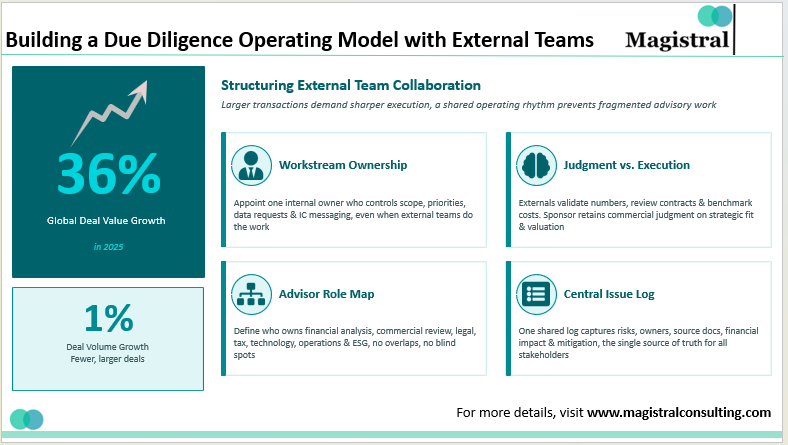
A due diligence workstream can quickly become messy when internal teams, advisors, consultants, legal teams, and finance specialists all work on the same transaction without a shared operating rhythm. The pressure is real: PwC reported that global deal values rose by 36% in 2025, while deal volumes increased by only 1%, meaning fewer, larger transactions are demanding sharper execution from deal teams. A structured due diligence workstream helps buyers move faster without losing control of risk, data quality, or investment judgment. It also helps external teams contribute with clarity instead of creating extra coordination work.
Thank you for reading this post, don't forget to subscribe!Building a Due Diligence Operating Model with External Teams
A solid operating model gives each participant a kind of defined role, timing, and escalation route. If not, external support can end up feeling fragmented even if the advisors are genuinely top tier. reference
Building a Due Diligence Operating Model with External Teams
Define the workstream owner early
The buyer should name one internal owner to steer the workstream, even when external teams end up doing most of the digging and analysis. That person should manage scope, priorities, data requests, and the final investment committee narrative, so the effort does not drift into advisor-led mode.
Separate judgment from execution
External teams can do the heavy lifting: gather information, validate figures, scrutinize contracts, benchmark costs, and turn risks into clear summaries. But the sponsor, or acquirer, must keep the commercial judgment. This split matters because the end decision hinges on strategic fit, valuation comfort, and integration confidence, not just on the quality of the inputs.
Build a role map for every advisor
Make a clean role map so it is obvious who owns financial analysis, commercial review, legal review, tax, technology, operations, and ESG. For instance, if a buyer is using outside investment banking support, they should be explicit about whether the team drives valuation modeling, maintains buyer-facing materials, runs data room tracking, or prepares management question packs.
Use one central issue log
Have one shared issue log that captures risks, owner names, source artifacts, financial impact, mitigation actions, and status. It becomes the single source of truth when partners, CFOs, legal counsel, and consultants need to scan progress quickly and not argue about “which version” is correct.
Structuring the Due Diligence Timeline and Information Flow
The timeline should convert a broad transaction goal into weekly and daily actions. In a competitive process, the team that learns faster often negotiates better.
Start with a scoped request list
The first request list should be about documents that really support valuation, risk assessment, and transaction structure.
Create weekly decision gates
These decision gates should show the moments where the buyer confirms whether to proceed, pause, renegotiate, or widen the review. Deloitte’s 2025 M&A Trends Survey showed that 79% of corporate leaders and 87% of private equity leaders expected deal volume to increase, which is exactly why disciplined gating matters for teams juggling multiple opportunities.
Keep data room discipline tight
Every external advisor should follow a naming convention, a document tracker, and a version control system. This sounds basic, but it prevents the usual mess: duplicate questions, missed uploads, and conflicting interpretations of the same material.
Link findings to valuation
The workstream needs to connect every material finding to price, deal terms, indemnities, integration cost, or go/no-go decisions. For buyers in private equity, this becomes extra important because due diligence findings must translate into underwriting assumptions and value creation plans, not just sit in a folder somewhere.
Managing External Teams During Due Diligence Reviews
Managing outside teams during due diligence reviews somehow works way better when they get real context. Not only the tasks. The buyer should lay out the deal thesis, the risk appetite, the timing pressure, and what “good” looks like in terms of output before any analysis starts.
Run a short kick-off session
That kick-off should cover the target profile, the reason behind the transaction, where the scope stops, the communication protocol, the deliverable format, and the actual timeline. It should also make it clear which topics need immediate escalation, and which can wait until the weekly review, without causing extra churn.
Standardize deliverable formats
External teams should stick to a shared structure for their findings. Think issue + evidence + impact + recommendation, plus open questions. Having that in place helps you merge financial, legal, commercial, and operational points into one management snapshot, rather than a stack of separate narratives.
Ask for synthesis, not data dumps
A solid advisor does more than recite what’s in the documents. They should explain what changed, why it matters, and what the buyer should do next. In venture capital deals, for example, this might include customer concentration, founder dependency, product scalability, and cash runway analysis.
Protect confidentiality and access
The buyer should grant external teams only the access they truly need. Deloitte’s 2025 GenAI in M&A survey reported that 67% of respondents saw data security as a top concern when using GenAI in dealmaking, so it basically confirms the need for controlled access and very clear data-handling rules.
Using Technology to Improve Due Diligence Speed and Quality
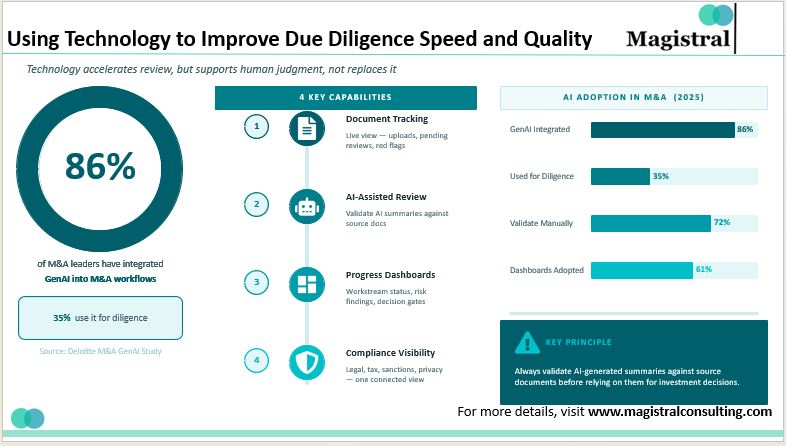
Technology can speed up the whole review, but it really should back up human judgment, not fully take its place. The best arrangement kind of mixes automation with expert review and, yes, clear accountability too.
Using Technology to Improve Due Diligence Speed and Quality
Automate document tracking
Deal teams can lean on workflow tools to follow uploaded documents, unanswered questions, items sitting in pending reviews, and those red flag bits. It cuts down the manual follow-ups, and leadership gets this live kind of picture of process health.
Apply AI carefully
Deloitte said 86% of the corporate and private equity leaders they surveyed had already added GenAI to M&A workflows, and 35% of those users were doing due diligence with it. But buyers should keep validating AI-generated summaries against the source documents before they trust them, period.
Use dashboards for senior updates
A dashboard should show movement by workstream, the high-risk findings, any unresolved requests, and what decision gates are coming up. That way, sponsors can concentrate on the decisions instead of going through long status emails all day.
Keep compliance visible
Legal, data privacy, sanctions, employment, tax, and regulatory issues should not live in separate little silos. A connected view of compliance helps the buyer see whether a risk touches closing, price, integration, or post-deal remediation.
How Magistral Supports Due Diligence Workstreams with External Teams
Magistral supports buyers, funds, corporate development teams, and advisors by adding structure, analysis, and execution support across transaction workflows. The team assists with request lists, trackers, operating models, target summaries, and management questionnaires to streamline deal preparation.
Magistral also supports financial and commercial due diligence through revenue review, margin analysis, market mapping, competitor benchmarking, and valuation support. In parallel, the team helps coordinate across legal, financial, tax, and operational advisors by maintaining trackers, summarizing findings, and preparing decision-ready materials.
The objective is to help internal teams move faster, maintain quality control, and translate due diligence findings into clear investment decisions, valuation considerations, and post-close action plans.
About Magistral Consulting
Magistral Consulting has helped multiple funds and companies in outsourcing operations activities. It has service offerings for Private Equity, Venture Capital, Family Offices, Investment Banks, Asset Managers, Hedge Funds, Financial Consultants, Real Estate, REITs, RE funds, Corporates, and Portfolio companies. Its functional expertise is around Deal origination, Deal Execution, Due Diligence, Financial Modelling, Portfolio Management, and Equity Research
For setting up an appointment with a Magistral representative visit www.magistralconsulting.com/contact
About the Author

Himank is an investment and financial analysis specialist with experience across private equity, investment banking, and research-driven engagements. An MBA (Tech) in Finance and BTech in Computer Science graduate from Narsee Monjee Institute of Management Studies, he focuses on financial modeling, valuation, and investment research. He supports project teams at Magistral Consulting, delivering LBO and DCF models, due diligence, investment memorandums, and deal origination support. His blend of analytical thinking, problem-solving ability, and structured approach enables him to translate complex financial data into actionable insights.
FAQs
What is the best way to start a due diligence workstream with external teams?
How should external advisors report findings?
How often should workstream meetings happen?
What mistakes slow down external teams?
Can AI replace external diligence teams?