The private placement memorandum is one of the key documents of a private capital fundraising. It discloses details about the company and the offering itself. It covers such aspects as company overview, deal terms, risks, uses of proceeds, and the legal structure of the offering. For company management, fund managers, RE sponsors, and private market issuers, it may be viewed as a structured presentation of the investment opportunity. For investors, it may be considered a risk map.
Thank you for reading this post, don't forget to subscribe!According to the U.S. Securities and Exchange Commission (SEC), private placements offer a limited number of disclosures compared to registered offerings; therefore, investors should examine all the information before making investments. The good PPM cannot guarantee successful funding; however, it can make it easier by providing greater transparency, reducing false statements, and presenting investment opportunities in an organized manner.
What is a PPM in private capital raising?
It is a disclosure document utilized during private offerings. It presents the issuer and provides information necessary for evaluating the opportunity. Practically, it allows bringing together the issuer, management, counsel, and investors’ representatives for due diligence purposes.
Core meaning and purpose
Private placements are not public offerings. They are typically made to a select group of accredited investors. As per SEC rules, private offerings made under Rule 506(b) of Regulation D can offer an unlimited amount of money, must not use any form of general solicitation, may sell to any number of accredited investors, and can have up to 35 sophisticated non-accredited investors under the exemption’s requirements.
A PPM is often the document that combines all the disclosures, risk factors, and mechanics of the offering. This is why it is relevant. This is because it brings together all aspects of the transaction, such as risks involved, assumptions being made, deal structure, and conflict of interest. For instance, in a private equity fundraising process, this document helps Limited Partners understand how the money raised will be used.
Why investors ask for it
Prior to investing their funds, investors prefer transparency by seeking the company’s legal structure, the size of its offer, the minimum amount of investment, the experience of its management, financial projections, an exit strategy, and associated risks. Additionally, the SEC notes that private placements might include insufficient disclosures and restrictive securities, making the document’s accuracy more crucial. As such, an elaborate PPM provides investors with information required to evaluate risk, profit potential, liquidity, and corporate governance.
Where it fits in the fundraising process
The Private Placement Memorandum typically comes after teaser documents, pitch decks, and first interactions with the investors. The document will be used alongside subscription agreements, investor questionnaires, Form D, and other due diligence paperwork.
Why a PPM matters for issuers and investors
It helps minimize uncertainties. It does not eliminate business risks; rather, it exposes the risks, making it easier to communicate about the risks.
Why a PPM matters for issuers and investors
Compliance and disclosure discipline
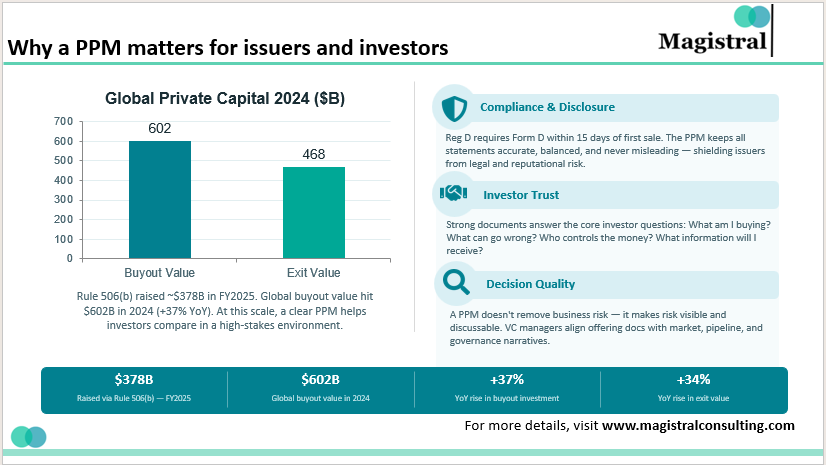
Under Regulation D, the issuance of securities requires the completion of Form D within 15 days of the first sale of securities. It may not be mandatory in some exemptions, yet issuances under this category are still required to observe the anti-fraud rules of business. This means that any information stated on the document should not only be accurate but also complete.
Market scale makes documentation more important
Today, private capital is no longer an anomaly within the capital markets. According to the SEC’s Office of the Advocate for Small Business Capital Formation, during the fiscal year 2025 reporting period, private companies had raised around $378 billion via Rule 506(b) private placements. In addition, Bain has stated that global buyout investment value jumped 37% year over year to $602 billion in 2024, while the exit value was 34% higher at $468 billion. When dealing with a market of such magnitude, having a good PPM is important since people will have to choose between competing offerings.
Investor trust and decision quality
The right documents enable investors to compare offers. Even venture funds, real estate syndications, and credit vehicles might differ greatly, but investors’ concerns remain the same: What do I get? What risks do I face? Who manages the cash flow? What information will be provided to me afterwards? That is one of the reasons why venture capital managers try to coordinate their documents with comprehensive market, pipeline, and governance narratives.
What a PPM usually includes
A PPM is where legal, commercial, financial, and operational matters are packaged together in one document. The format will depend on the issuer, jurisdiction, exempt status, and asset class.
Offering terms
This chapter will describe the kind of security issued, the size of the offering, minimum amount, investor qualifications, closing conditions, transfer restrictions, and subscriptions. It needs to be clear enough for non-lawyers but specific enough for lawyers.
Business and investment strategy
Here, the issuer explains its plan for creating value. In the case of an operating company, this could include product development, hiring, acquiring customers, and increasing margins. In the case of a fund, it could involve sourcing investments, portfolio construction, decision making by the investment committee, and exits.
Risk factors
The risk factors discussion need not read like standard legalese. Rather, the risks should be relevant to the particular business. A fund focused on a specific sector will have different risks than a diversified portfolio. These days, a comprehensive private placement memorandum discusses liquidity risks, valuation approach, cyber vulnerability, key man risks, leverage, concentration caps, and macroeconomic concerns. The stronger the risk disclosure, the clearer it will be to investors what could hurt performance and how management will respond.
Financials and valuation assumptions
A financial discussion may include historical results, financial projections, capital structure, use of funds, and sensitivity analysis. If assumptions are material, sponsors should highlight them. Good valuation documentation will help investors know if revenues, margins, leverage, multiples, or exits drive expected returns.
How to prepare a PPM that investors can use
A PPM should never appear to be a legal text attached to a marketing presentation. Instead, it should anticipate investors’ concerns before those turn into objections.
How to prepare a PPM that investors can use
Start with the investor lens
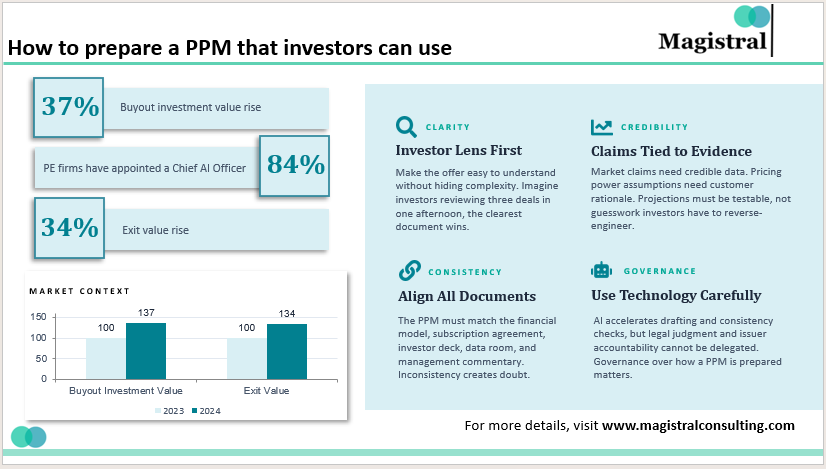
Suppose an investor evaluates three offers within one afternoon. The best way would be to explain the offer comprehensively, while making sure that there is no ambiguity about the story, its economics, risks, and the systems controlling the process.
Keep claims tied to evidence
If you mention a growing market, provide proof. If you claim that your company has an edge in the sourcing process, explain how that works. If financial projections rely on pricing power, describe the reasons why customers will be ready to pay extra money for your products or services. Bain’s 2025 Private Equity Outlook reported that the value of the investments made in the year of 2024 grew by 37%, and the value of the exits grew by 34%. However, the study also noted that fundraising was weak in such unstable markets and advised issuers against making unrealistic assumptions.
Align legal, finance, and operations
The document needs to align with the model, subscription agreement, investor presentations, data room, and management commentary. Discrepancies raise suspicions. Most issuers also link the PPM with the investor reporting process, due diligence, and fund administration prior to launching the product.
Use technology carefully
AI can aid drafting, research, and consistency, but it does not replace human judgment or legal responsibility. As an example, EY found that 84% of private equity funds believed that AI would have a major transformational effect on their business. This is relevant as expectations about how data is managed, processed, and provided for diligence purposes increase significantly.
How Magistral supports PPM preparation and investor readiness
Magistral’s contributions to preparing a successful PPM and making investors ready
It becomes even more valuable when backed up with proper research, clean financials, and an organized investor communication process. Issuers and fundraisers can turn to Magistral Consulting for assistance in conducting research, building financial models, drafting documents, and preparing investor-related materials. All of these services will make it more effective by bringing consistency to its narrative, numbers, and due diligence materials.
Research and market benchmarking
Helping a team create market research, competitor analysis, trends and investor-ready narratives is particularly important when a raise relies on an established thesis about, say, healthcare growth, artificial intelligence infrastructure, fintech development or regional expansion.
Financial model and data room support
An investor never looks only at a document itself. He always requests additional information like models, cap tables, diligence files, and other schedules. Magistral’s investment banking experience helps issuers put all of those pieces together.
Investor communication readiness
Effective documents minimize iterations. Investors need to see enough details to move from the stage of interest to diligence. Effective PPM, backed by accurate data and consistent messaging, may be used by sponsors to secure funding.
About Magistral Consulting
Magistral Consulting has helped multiple funds and companies in outsourcing operations activities. It has service offerings for Private Equity, Venture Capital, Family Offices, Investment Banks, Asset Managers, Hedge Funds, Financial Consultants, Real Estate, REITs, RE funds, Corporates, and Portfolio companies. Its functional expertise is around Deal origination, Deal Execution, Due Diligence, Financial Modelling, Portfolio Management, and Equity Research
For setting up an appointment with a Magistral representative visit www.magistralconsulting.com/contact
About the Author

Tanya is an investment-research specialist with 6 + years advising venture-capital, private-equity and lending clients worldwide. A Stanford Seed alumnus with an MBA and an Economics (Hons) degree, she heads project teams at Magistral Consulting, delivering financial modelling, due-diligence and deal support on 3,000 + mandates. Her blend of rigorous analytics, sharp project management and clear client communication turns complex data into actionable investment insight.
FAQs
What is the main purpose of this document?
Is it legally required for every private placement?
Who prepares it?
How is it different from a pitch deck?
Can investors rely only on it?