A CIM, or Confidential Information Memorandum, is one of those documents that kind of becomes the backbone of a sell-side M&A process. In 2026, it matters even more because buyers are moving faster, using AI-enabled review tools, and they expect clearer financial and market evidence before they even submit bids. With global M&A activity picking up again and dealmakers expecting higher transaction volume, sellers need a piece of writing that clearly lays out the business, supports the valuation narrative, and builds buyer trust with the first read, not after several rounds of questions.
Thank you for reading this post, don't forget to subscribe!What is a CIM in 2026?
It is a confidential document shared with selected buyers after they sign an NDA. It gives them a structured view of the company, the business model, the financial results, the competitive position, the risks, and the growth outlook, so they can decide whether to stay in the process or step back.
Meaning of a Confidential Information Memorandum
A Confidential Information Memorandum basically presents the company’s story in a professional, buyer-ready format. It covers what the company does, how revenue is generated, where it competes, who runs the operation, and why this opportunity deserves attention, without overcomplicating it.
Why buyers rely on it
Buyers rely on the document because it helps them determine if the opportunity matches their investment criteria. In a busy 2026 M&A market, investors want quick clarity on size, growth, profitability, customer strength, and strategic alignment, before they spend time on deeper diligence.
What the document should not do
The memorandum should not dump every sensitive detail or include unrestricted confidential information. It should also avoid stating a fixed asking price, since sellers often want buyers to build their own valuation through a competitive bidding process, instead of locking everyone into one number too early.
A practical way to think about it
Think of it like a kind of guided tour, before the full inspection. The seller walks the buyer through the company’s overall layout, strengths, performance, and likely growth path, but keeps the more detailed papers for later diligence stages. So, it’s not, like, everything up front. More of a careful preview.
Why does CIM matter in the 2026 M&A market?
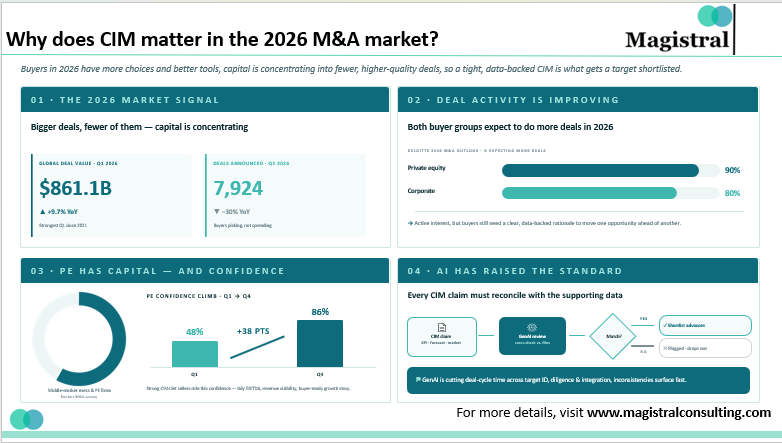
It matters because buyers in 2026 have more choices and, frankly, better tools. S&P Global said global M&A deal value hit $861.1 billion in Q1 2026, up 9.7% from Q1 2025, and it was the strongest first quarter since 2021. Still, only 7,924 deals were announced, down 30% year over year. That mix usually means buyers are concentrating capital into fewer, higher-quality transactions rather than spreading it around.
Why does CIM matter in the 2026 M&A market?
Deal activity is improving
Deal activity is getting better in 2026, but the market is still picky. Deloitte reported that 90% of private equity respondents and 80% of corporate respondents expect their organizations to do more deals in 2026. That’s exactly why document quality stays important, because even with active interest, buyers still need a solid data-backed rationale for why one opportunity should jump ahead of another.
Private equity has capital to deploy
Private equity has real capacity to deploy, but they stay disciplined. Reuters noted that 58% of surveyed middle market executives and private equity firms expect M&A volume to rise in 2026, while private equity confidence climbed to 86% in Q4 from 48% in Q1. Strong CIM preparation helps sellers support that confidence with tidy EBITDA discussion, revenue visibility, and a buyer-ready growth narrative.
AI has raised the standard
AI tools now help buyers review documents faster, compare claims with backup files, and identify inconsistencies. McKinsey’s 2026 M&A research says generative AI is helping deal teams reduce costs and accelerate deal cycles by improving target identification, due diligence, and integration workflows. This means every market claim, KPI, and forecast in the CIM must match the supporting data.
Key Sections Every CIM Should Include
A CIM should be comprehensive but also easy to steer through. The best docs kind of move in a clean path from the company story and market opening to financial performance and transaction readiness.
Executive Summary
Give a short overview of the business, investment highlights, growth potential, and the transaction rationale. Sum up key financial and operational strengths, so a reader gets the core idea fast.
Company Overview
Describe the business model, history, products, services, locations, and customer base. Keep the explanation clear and accessible to all buyers.
Ownership and Corporate Background
Outline the ownership structure, company evolution, and any significant acquisitions, restructurings, or leadership changes.
Market Overview
Cover market size, what’s driving growth, competitive dynamics, industry trends, and regulatory considerations, using data that’s credible and current.
Products and Services
Describe the offerings, how revenue is generated, and the key differentiators. Also, point out the things that support sustained growth and customer pull over time.
Customers and Revenue Quality
Show the strength and stability of revenue through customer diversification, retention rates, contract terms, and recurring business patterns.
Recurring Revenue
Clearly categorize recurring revenue sources such as subscriptions, service contracts, maintenance agreements, and repeat customer purchases.
Financial Performance
Present historical financial results, profitability metrics, cash flow performance, and projections. Link financial performance to valuation potential.
Management Team
Highlight the experience, capabilities, and organizational depth of the leadership team. Demonstrate the company’s ability to operate successfully after a transaction.
Founder Dependency
Address the extent of founder involvement and explain succession plans, leadership depth, and customer relationship transition strategies.
How does CIM quality affect valuation and diligence?
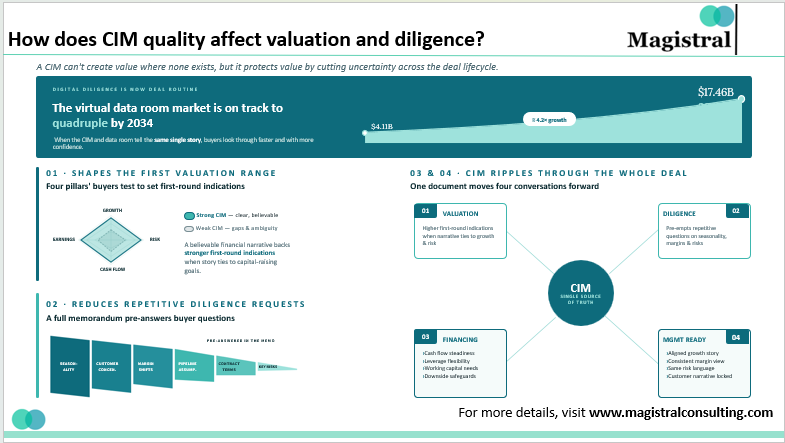
A CIM can’t really create value where none exists, but it can protect value by cutting down uncertainty. Fortune Business Insights estimates the global virtual data room market will grow from $4.11 billion in 2026 to $17.46 billion by 2034, and it kind of underlines how digital diligence has become part of the deal routine. When the CIM plus the data room tell the same, single-story buyers can look through things faster, with more confidence too.
How does CIM quality affect valuation and diligence?
It shapes the first valuation range
Buyers build early valuation ideas from growth, risk, earnings quality, and cash flow. A clear, believable document can back up stronger first-round indications, mainly when the financial narrative connects well to capital raising goals or specific transaction aims.
It reduces repetitive diligence requests
A full memorandum covers the typical questions before buyers even ask. It spells out seasonality, customer concentration, margin shifts, pipeline assumptions, contract language, and the key risks, and that usually saves time as well as improves buyer assurance.
It supports debt and financing conversations
Quite a few buyers need lenders involved to fund the acquisition, so the document should also reflect cash flow steadiness, leverage flexibility, working capital needs, and downside safeguards. A tight financial storyline makes the financing talk less messy and faster to move forward.
It prepares management for buyer meetings
Putting the memorandum together makes the leadership line up on the business story before any buyer meetings. That makes it easier for the team to answer questions in a consistent manner around growth direction, margins, risks, customers, and operational priorities.
How Magistral supports CIM preparation?
Magistral sort of supports deal teams in a messy but effective way, with market research, competitive analysis, financial modelling, and diligence prep. The group also helps craft buyer-driven CIMs, using things like market sizing, competitor mapping, revenue analysis, adjusted EBITDA schedules, and those “what if” financial scenario models.
On top of that, Magistral takes a hand with data room organization, diligence trackers, KPI reporting, customer write-ups, and management Q&A prep, like making sure people can answer clean. And because they tailor the materials for different investor types, it ends up improving buyer relevance, cutting down errors, reinforcing confidentiality, and getting the whole transaction more ready.
About Magistral Consulting
Magistral Consulting has helped multiple funds and companies in outsourcing operations activities. It has service offerings for Private Equity, Venture Capital, Family Offices, Investment Banks, Asset Managers, Hedge Funds, Financial Consultants, Real Estate, REITs, RE funds, Corporates, and Portfolio companies. Its functional expertise is around Deal origination, Deal Execution, Due Diligence, Financial Modelling, Portfolio Management, and Equity Research
For setting up an appointment with a Magistral representative visit www.magistralconsulting.com/contact
About the Author

Tanya is an investment-research specialist with 6 + years advising venture-capital, private-equity and lending clients worldwide. A Stanford Seed alumnus with an MBA and an Economics (Hons) degree, she heads project teams at Magistral Consulting, delivering financial modelling, due-diligence and deal support on 3,000 + mandates. Her blend of rigorous analytics, sharp project management and clear client communication turns complex data into actionable investment insight.
FAQs
What does CIM mean in M&A?
Who prepares a Confidential Information Memorandum?
How is it different from a teaser?
Does the document include valuation?
Why does the document matter more in 2026?