General partner profiling has emerged as a critical component of investment decision-making because institutional investors face challenges in selecting the right managers, managing risk, and achieving consistent returns on investment. General partner profiling is not simply a matter of reviewing performance metrics. Limited partners (LPs) must understand a manager’s investment discipline, leadership capabilities, operational expertise, and ability to deliver returns across different business environments. The McKinsey Global Private Markets Report 2026 states that total capital raised by closed-end private equity funds worldwide declined by 17% to $616 billion in 2025, whereas deal value increased by 19% to $2.6 trillion. With liquidity declining and holding periods lengthening, investors are being prompted to scrutinize fund managers more closely.
Thank you for reading this post, don't forget to subscribe!General Partner Profiling: Market Trends and Growing Importance
Competition in private capital markets has been growing, making general partner profiling increasingly important to institutional investors. Changing fundraising dynamics, limited liquidity, longer holding periods, and evolving LP expectations require investors to assess fund managers on past performance alone.
General Partner Profiling: Market Trends and Growing Importance
Changing Fundraising Dynamics
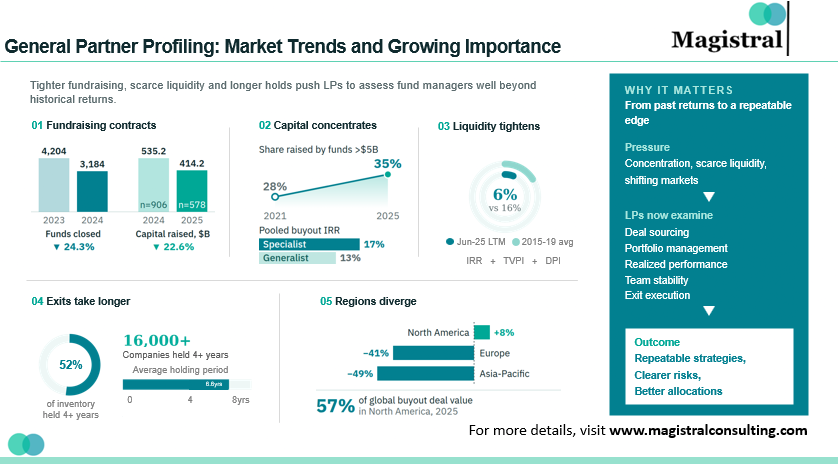
The fundraising environment has deteriorated because of higher financing costs and slower distributions of proceeds. According to Preqin, 3,184 funds closed in 2024, compared with 4,204 in 2023, representing a decline of 24.3%. In 2025, PitchBook data showed that 578 funds raised $414.2 billion, compared with $535.2 billion raised by 906 funds in 2024. Regional dynamics also differed: according to McKinsey research, fundraising activity grew by 8% in North America in 2025 but declined by 41% in Europe and 49% in Asia-Pacific.
Increasing Fundraising Concentration
More capital is flowing to managers with established track records. McKinsey reports that funds over $5 billion raised 35% of all fundraising in 2025 versus 28% in 2021. Smaller specialist managers differentiate themselves through focused expertise: McKinsey found that specialist buyout funds achieved an aggregated IRR of 17% versus 13% of generalists. LPs therefore need to assess whether a manager’s size, sector focus, or specialization provides a sustainable competitive advantage.
Greater Focus on Liquidity and Performance Metrics
LPs are placing greater emphasis on exits and capital returns rather than on valuations alone. McKinsey estimates that DPI as a proportion of AUM was just 6% during the year to June 2025 versus the average 16% during the 2015-19 period. This indicates that LPs should consider IRR, TVPI, and DPI when assessing both investment performance and the return of capital.
Longer Holding Periods and Exit Challenges
Another important factor in assessing fund managers is the extended time before an exit. As per McKinsey, there have been 16,000 portfolio companies worldwide that have had an investment tenure greater than four years, which constitutes 52% of the inventory that has been funded through buyouts. The average holding period reached 6.6 years in the year 2025. LPs must therefore analyze how GPs manage portfolio companies during extended holding periods and how they address exit planning, valuations, and conflicts of interest.
Regional Differences and Investment Opportunities
A manager’s geographic exposure should be assessed. North America accounted for 57% of the global deal value of buyouts in 2025. Europe offers opportunities in industrial consolidation, infrastructure, and the energy transition, while APAC offers opportunities linked to consumption growth and technological innovation. Investors should determine whether a GP has the regional capabilities required to execute its strategy.
Why These Trends Matter for Investors
Fundraising concentration, liquidity concerns, and shifts in the business environment have complicated fund manager selection. Past returns remain important, but investors increasingly evaluate deal-sourcing capabilities, portfolio management, historical performance, personnel stability, and exit processes. A structured general partner profiling approach can help limited partners identify managers with repeatable strategies, recognize possible risks, and make better allocation decisions.
General Partner Profiling: Core Evaluation Framework
Proper general partner profiling involves not only the financial performance of the fund but also the evaluation of its leadership, investment approach, governance, and operational capabilities. This comprehensive analysis enables investors to identify the strengths and possible risks associated with the manager.
Investment Track Record and Performance Attribution
A fund manager’s past performance is a useful starting point, although it never tells the whole story. LPs should evaluate performance on a deal-by-deal basis and consider metrics such as valuation at entry, leverage, value creation, holding periods, multiples of exit, and performance realized. Losses, write-offs, and performance relative to comparable funds also help distinguish skill from luck.
Sources of Value Creation
Understanding how a manager creates value is essential. LPs should evaluate the historical roles of leverage, multiple expansion, and operational improvements in a fund’s performance. Sources of return that worked well in the past may become less effective as market conditions change, increasing the importance of operational capabilities.
Leadership Experience and Team Stability
The experience and stability of the investment team affect fund performance. LPs should investigate the backgrounds of the senior leaders, the responsibility of the investment committee, employee turnover, succession plans, and whether they depend too much on certain individuals. LPs should also check whether the people who made the investments in the past work at the firm now.
Investment Strategy and Portfolio Construction
Investors need to determine whether a fund’s stated investment philosophy is consistent with its historical investments and demonstrated capabilities. Key considerations include target sectors and geographies, transaction size, sourcing capabilities, use of leverage, and portfolio concentration. Any change in investment philosophy should be supported by relevant experience and the capability to execute the revised strategy.
Governance and Alignment of Interests
Good governance contributes significantly to accountability and the alignment of interests between GPs and LPs. The evaluation process should consider management fees, carried interest, GPs’ contribution towards capital, conflicts of interest, valuations, and investment committees, among other factors. Investors should also assess co-investments and reporting procedures when evaluating alignment of interests.
Operational and Regulatory Oversight
A manager’s operational capabilities should form part of the assessment. These capabilities include fund administration, financial reporting, cybersecurity and information protection, compliance and valuations, and risk management.
Reputation and Stakeholder Relationships
References from current investors, portfolio company management, former staff members, lenders, and advisory firms can provide insights beyond past financial performance. Well-structured reference checks allow LPs to evaluate a manager’s communication, decision-making, integrity, and handling of difficult situations throughout the investment process.
A comprehensive general partner profiling process enables investors to look beyond past financial performance by assessing a manager’s investment approach, leadership, governance, operational capabilities, reputation, and stakeholder relationships.
General Partner Profiling: Technology and Analytical Strategies
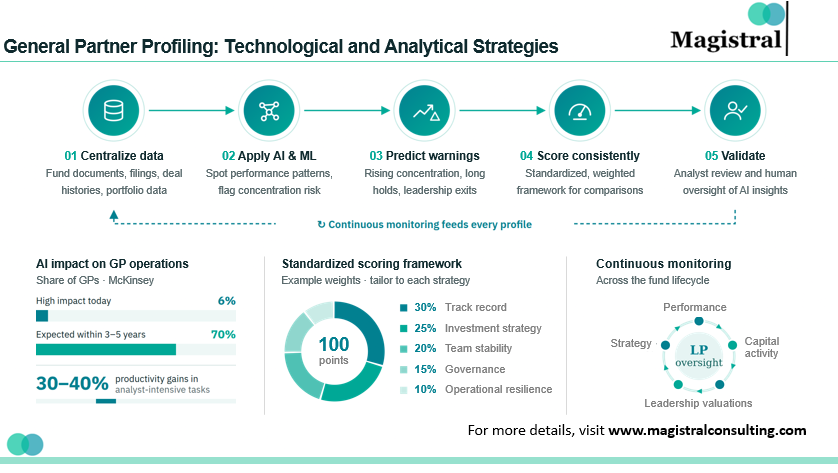
Tools and technologies such as AI, machine learning, and centralized investment databases can make general partner profiling faster, easier, and more efficient. Investment databases allow LPs to combine fund documentation, regulatory disclosures, transaction history, and other portfolio-related information when conducting thorough manager evaluations.
General Partner Profiling: Technological and Analytical Strategies
Artificial intelligence can identify patterns in investment results, detect concentration risks, and generate insights from large volumes of investment data. According to McKinsey, only 6% of general partners consider the use of artificial intelligence to have a high impact on their business processes at the moment, but 70% of GPs expect high impact within the next 3-5 years, and a 30%-40% increase in productivity is reported in analyst work.
Predictive analytics can help identify warning signs such as portfolio concentration growth, holding period growth, and leadership transitions. Standardized scoring models based on criteria including track record (30%), investment philosophy (25%), team stability (20%), governance (15%), and operational flexibility (10%) can help LPs compare managers effectively, although different investment strategies may require different weightings. Analysts should always oversee and validate AI-supported analysis.
How Magistral Consulting Supports General Partner Profiling
Successful general partner profiling requires well-structured research, financial analysis, and continuous monitoring. Magistral Consulting supports investment teams through manager mapping, investment strategy research, performance record analysis, portfolio and financial performance comparisons, and due diligence assistance. Its analytical services also include organizing manager data, assessing risks, identifying information gaps, and creating performance dashboards and monitoring reports.
About Magistral Consulting
Magistral Consulting has helped multiple funds and companies in outsourcing operations activities. It has service offerings for Private Equity, Venture Capital, Family Offices, Investment Banks, Asset Managers, Hedge Funds, Financial Consultants, Real Estate, REITs, RE funds, Corporates, and Portfolio companies. Its functional expertise is around Deal origination, Deal Execution, Due Diligence, Financial Modelling, Portfolio Management, and Equity Research
For setting up an appointment with a Magistral representative visit www.magistralconsulting.com/contact
About the Author

Tanya is an investment-research specialist with 6 + years advising venture-capital, private-equity and lending clients worldwide. A Stanford Seed alumnus with an MBA and an Economics (Hons) degree, she heads project teams at Magistral Consulting, delivering financial modelling, due-diligence and deal support on 3,000 + mandates. Her blend of rigorous analytics, sharp project management and clear client communication turns complex data into actionable investment insight.
FAQs
What is General Partner Profiling in private equity?
Why do limited partners evaluate general partners?
Which metrics are most important when evaluating a fund manager?
How can artificial intelligence improve manager evaluation?
How often should investors review existing fund managers?