AI technologies are affecting various aspects of corporate due diligence, transaction evaluation, creation of financial models and risk assessment by investment banks. Activities which were traditionally performed manually and required many hours can now be assisted by AI technologies which are able to analyse financial data and generate insights.
Thank you for reading this post, don't forget to subscribe!Nowadays, investment banks are trying to use AI to enhance efficiency without sacrificing the high level of financial advisory services. Nevertheless, implementation of AI is not only related to substitution of manual processes by automatic ones but also to integration of technologies and professional knowledge in finance.
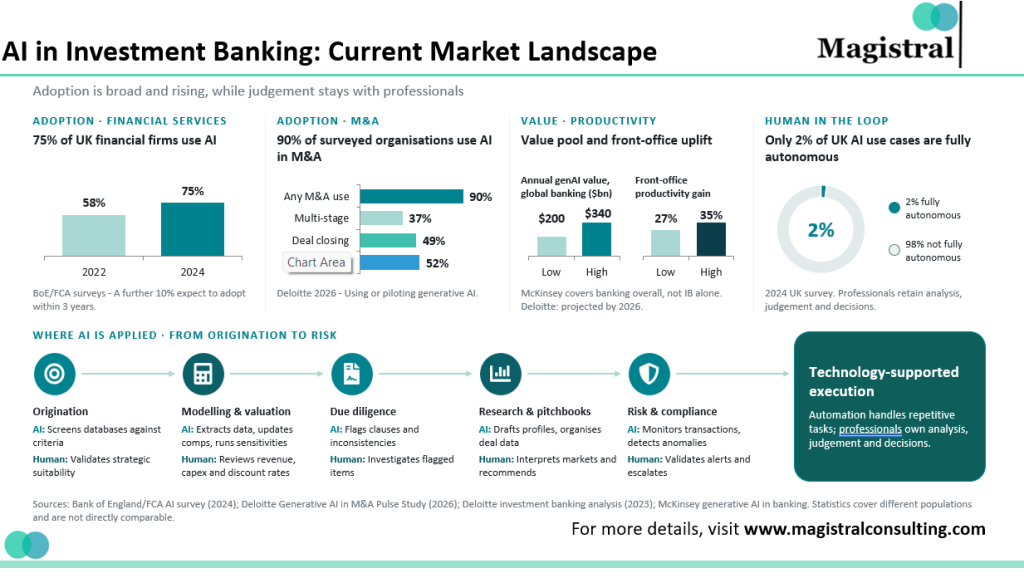
According to the McKinsey research, generative AI can bring between $200 billion and $340 billion in annual value to the whole global banking industry with a focus on improving productivity, which does not include the area of investment banking.
Use of AI in Investment Banking shows a trend towards technological assistance in execution when automation performs routine tasks whereas professionals are responsible for analysis, decisions, etc.
AI in Investment Banking: Current Market Landscape
Implementation of AI in the financial services industry is moving past being an experiment and onto more mainstream usage. The results of the Bank of England and Financial Conduct Authority 2024 survey showed that 75% of the participating organisations were using AI technology, up from 58% from their survey done two years prior. Furthermore, another 10% said that they expect to be implementing AI within three years.
AI in Investment Banking: Current Market Landscape
Deloitte’s 2026 study on the use of Generative AI in M&A processes offers additional proof for this change in practice. It was discovered that 90% of the participating organisations were using AI in M&A, out of which 37% applied AI throughout various stages of the process.
Key Applications of AI in Investment Banking
Investment banking is another area where the use of AI technologies will transform processes related to efficiency in origination, financial modelling, M&A due diligence, investment research, and risk management. Artificial intelligence allows banking firms to identify prospective M&A target companies and investors by using analysis of databases, markets, and finances of organisations. Besides that, AI provides assistance in the area of financial modelling and evaluation as it allows for data collection, model forecast updates, and sensitivity analysis. Regarding M&A due diligence, tools using AI technologies will assist in reviewing contracts, financial statements, and documents connected with a transaction. Deloitte’s report suggest, 49% of the surveyed population were currently using or piloting generative AI in deal closing while 52% were involved in post-close integration.
How AI in Investment Banking Improves Productivity
The commercial attractiveness of AI in Investment Banking is largely dependent upon reducing the time consumption spent on recurring analytical and documentation activities.
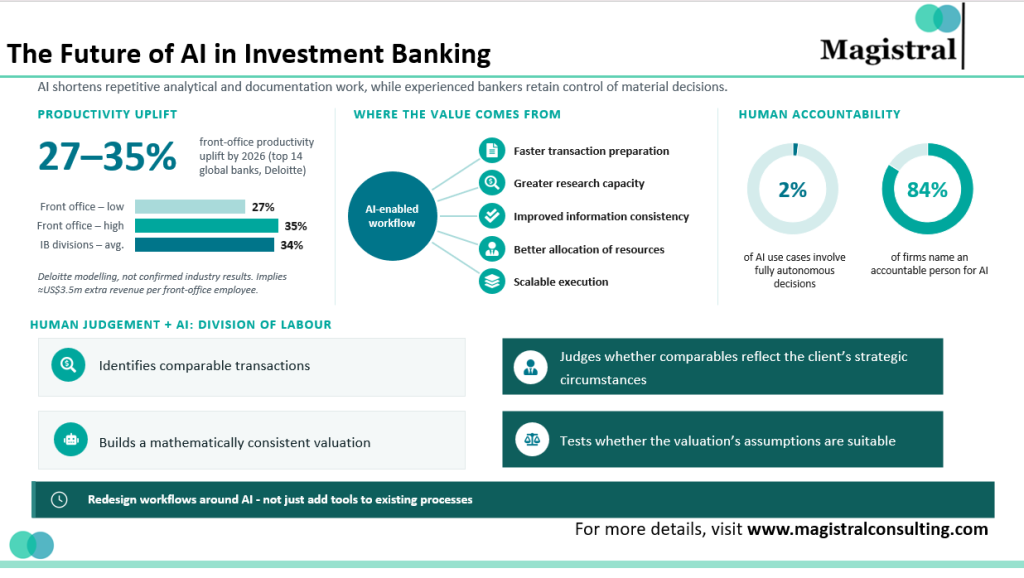
According to Deloitte estimates, generative AI can help improve investment banking front-office productivity up to 27-35% by 2026. The productivity increase estimated was to be about 34% in the case of investment banking divisions specialising in M&A advisory and capital markets activities.
As was mentioned above, these are forecasted percentages provided by Deloitte based on its modelling but not real productivity improvement achieved by the whole industry.
In the case of investment banks, the advantages are not limited to faster execution.
Accelerated process of transaction preparation: With the use of AI in Investment Banking, preliminary deal information can be prepared faster and easier.
Increased analytical capabilities: The number of analysed firms and markets can be increased while maintaining the same manual labour volume.
Information uniformity: It will become easier to ensure uniform information format and coverage of financial reports.
Improved allocation of resources: Skilled professionals will have enough time for valuation and discussion of transactions.
Flexibility of implementation: Automation and analytics teams will help the firms to adjust to volatile deal pipeline volumes.
Human Expertise and AI: Finding the Right Balance
While automation has many advantages, investment banking still relies on expert judgement.
An AI system may recognise similar transactions, but the AI is not able to conclude by itself whether the similar transactions represent the situation in which a certain client finds itself.
In turn, AI’s valuation may be mathematically sound, but may be based on wrong presumptions.
This fact can also be observed from regulatory findings. As per the Bank of England’s report in 2024, less than 2% of all use cases of AI technology were autonomous.
Investment banks should therefore follow the principle of using AI for better analytics while having control of their experienced bankers.
The Future of AI in Investment Banking
In the next phase of adoption, there will be more integration of tools like research tools, financial databases, modelling tools, and transaction management.
The Future of AI in Investment Banking
Agentic AI will enable coordination of multiple tasks in a workflow and hence can change how investment banks conduct analysis, updates, and documentation.
Nevertheless, full automation will depend on access to reliable data, necessary security measures and accountability of the results generated.
Technology combined with expertise in the analysis will position investment banks well in increasing their execution capabilities without compromising on accuracy and secrecy.
Finally, the success of AI in Investment Banking will not depend on the number of tools being used but on how such tools are utilised in transaction operations.
Services Provided by Magistral Consulting for AI in Investment Banking
Magistral Consulting has integrated investment analysis and research along with AI-driven processes that can assist investment bankers in managing research, modelling, and deal-related work. Magistral Consulting offers various AI-driven services in the form of different functions.
- AI-driven Financial Modelling and Valuation
Magistral allows the creation of DCF, LBO, comparable company and transactions’ valuation models. AI-aided procedures assist in organising financial information, updating inputs for the model and conducting sensitivity analyses in addition to the manual analysis done by the analyst.
- AI-driven Deal Origination and Target Identification
Magistral can help banks identify acquisition targets, potential investors and relevant transactions. AI-driven market screening can assist in creating targeted lists of companies depending on industry, location, financial and transactional criteria.
- AI-driven Due Diligence
Magistral facilitates financial and commercial due diligence by assisting in reviewing documents, analysing finances, identifying risks and structuring reports. AI assists in organising huge amounts of data, while the analyst investigates those requiring professional understanding.
- AI-driven Investment Research and Market Intelligence
Magistral facilitates company profiling, industry research, competitor benchmarking and monitoring of the market. AI-powered information gathering helps researchers cover wider sets of information while keeping the analysis intact.
- AI-driven Pitchbooks and Transactions Documentation
Magistral helps create pitchbooks, confidential information memorandums, investor presentations and transaction documentation. AI-aided procedure helps speed up initial content creation while the analyst perfects financial information, transaction story and presentation quality.
About Magistral Consulting
Magistral Consulting has helped multiple funds and companies in outsourcing operations activities. It has service offerings for Private Equity, Venture Capital, Family Offices, Investment Banks, Asset Managers, Hedge Funds, Financial Consultants, Real Estate, REITs, RE funds, Corporates, and Portfolio companies. Its functional expertise is around Deal origination, Deal Execution, Due Diligence, Financial Modelling, Portfolio Management, and Equity Research
For setting up an appointment with a Magistral representative visit www.magistralconsulting.com/contact
About the Author
Nitin is a Partner and Co-Founder at Magistral Consulting. He is a Stanford Seed MBA (Marketing) and electronics engineer with 19 + years at S&P Global and Evalueserve, leading research, analytics, and inside‑sales teams. An investment‑ and financial‑research specialist, he has delivered due‑diligence, fund‑administration, and market‑entry projects for clients worldwide. He now shapes Magistral Consulting’s strategic direction, oversees global operations, and drives business‑development support.
FAQs
How is AI used in investment banking?
Can AI replace investment bankers?
What are the main benefits of AI in investment banking?
What risks does AI create for investment banks?
How can investment banks adopt AI effectively?