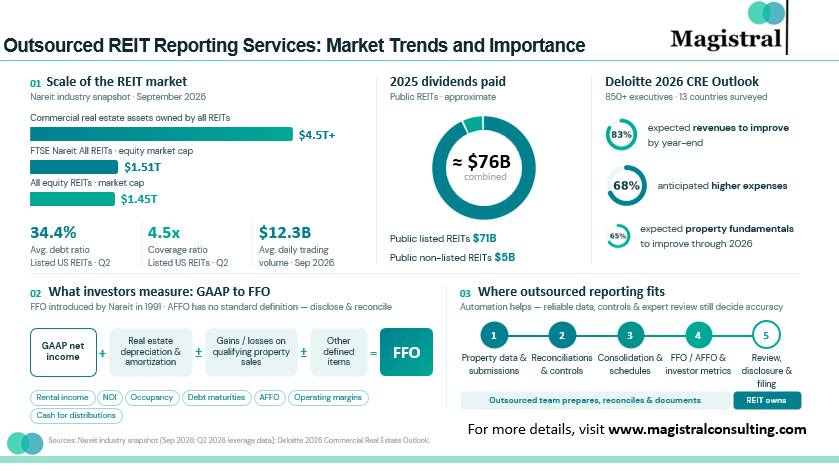
Real Estate Investment Trusts (REITs) operate in a challenging financial environment that requires effective disclosure, performance tracking, and communication with investors. With increased diversity in their asset classes and geographical coverage, the task is becoming even harder. Outsourced REIT reporting services allow investment managers to achieve the above requirements by consolidating financial statements, compliance documentation, portfolio analysis, and investor reports in a controlled process. According to Nareit, the FTSE Nareit All REITs Index includes 180 REITs valued at $1.51 trillion as of September 30, 2026. Also, Nareit estimated the value of all equity REITs at $1.45 trillion and NYSE REITs at $1.28 trillion.
Thank you for reading this post, don't forget to subscribe!Outsourced REIT Reporting Services: Market Trends and Importance
In the world of REITs, there are ever-evolving investor demands, complex financial structures, and a need for transparency in the reporting. Outsourced REIT reporting services assist REIT organizations in coping with growing amounts of information and reporting requirements without a proportional increase in internal workforce.
Outsourced REIT Reporting Services: Market Trends and Importance
Expanding REIT Market and Reporting Complexity
The REIT market is spread out across residential, industrial, retail, health care, hotel, and infrastructure assets. Based on Nareit’s September 2026 Industry Snapshot, FTSE Nareit All REITs had an equity market capitalization of $1.51 trillion, which includes $1.45 trillion in all equity REITs. Together, listed and unlisted public and private equity and mortgage REITs have more than $4.5 trillion in commercial real estate assets.
Key industry benchmarks include:
- $1.51 trillion in FTSE Nareit All REITs Market Capitalization by September 2026 and $1.45 trillion in all equity REITs
- The Q2 2026 debt ratio of 34.4% and coverage ratio of 4.5x for listed US REITs
- The average daily dollar trading volume of $12.3 billion in September 2026
- The dividend payments of approximately $71 billion for publicly listed REITs and approximately $5 billion for public non-listed REITs in 2025
For outsourced REIT reporting services, all the above benchmarks emphasize the importance of proper consolidation of financial data, management of leverage, analysis of distributions, and preparation of reports for investors. As properties perform differently based on occupancy, rental demand, costs of financing, and valuations, the reporting teams must describe both financial performance and factors influencing it.
Growing Demand for Financial Transparency
Today, investors evaluate the performance of REITs with such indicators as rent revenue, net operating income, occupancy, maturity of debt, Funds from Operations (FFO), and cash available for distributions.
Created by Nareit in 1991, FFO is a supplementary indicator of equity REIT operating performance. In most cases, it is adjusted from GAAP net income for real estate depreciation and amortization, gain/loss from qualified property, and other defined items.
REITs may be analyzed using Adjusted FFO (AFFO), operating margins, and leverage, which would give insight into the financial performance and stability of a company. As there is no standardization for AFFO, a company should disclose its calculation methodology for this measure.
These procedures are also related to real estate financial modeling and include property cash flow projections, debt calculations, valuations, and performance assessments.
Technology Adoption in Real Estate Reporting
Technology becomes more relevant in commercial real estate reporting. Deloitte’s Commercial Real Estate Outlook for 2026, based on a survey of more than 850 executives in 13 countries, showed that:
- 83% of respondents believed that revenues would improve by year-end.
- 68% expected increases in expenses.
- 65% believed that fundamentals of properties under consideration would get better through 2026.
These facts show why outsourced REIT reporting services require timely asset-level reporting and information management. Automated reconciliations, centralized databases, and document processing can minimize the workload. Still, the accuracy of the report will be dependent on the source data, the control documentation, and experienced personnel reviews of abnormal entries.
Regulatory Requirements and Reporting Deadlines
Publicly held U.S. REITs are subject to SEC reporting regulations, including Forms 10-K and 10-Q. The timelines usually vary between 60, 75, and 90 days post-year-end filing for Form 10-K and 40 or 45 days for Form 10-Q, depending on the filer type.
REIT Qualification Requirements consist of the following:
- No less than 75% of assets should be real estate assets and cash.
- Gross income is required to have no less than 75% from real estate activity.
- Gross income needs to be at least 95% from real estate activity, interest, and dividends.
- Distribution of at least 90% of taxable income is required.
Outsourced REIT reporting services can help satisfy the needs in schedule preparation, reconciliation, and control mechanisms to manage the requirements stated above, whereas the responsibility lies with management and tax professionals.
The Importance of Documentation and Review
Reporting accuracy depends on proper classification of accounts, reconciliations, and schedules. Transactions like property acquisitions might bring new accounting issues, such as leases, debt structure, transaction expenses, and ownership structure, among others.
Providers of outsourced REIT reporting services may assist in preparing financial schedules, reconciling property information, documentation, and review coordination with management and auditors. It enhances the process of reporting while ensuring that there is still statutory accountability for disclosure to the management of the REIT.
Outsourced REIT Reporting Services: Quantitative Reporting Benchmarks and Risk Indicators
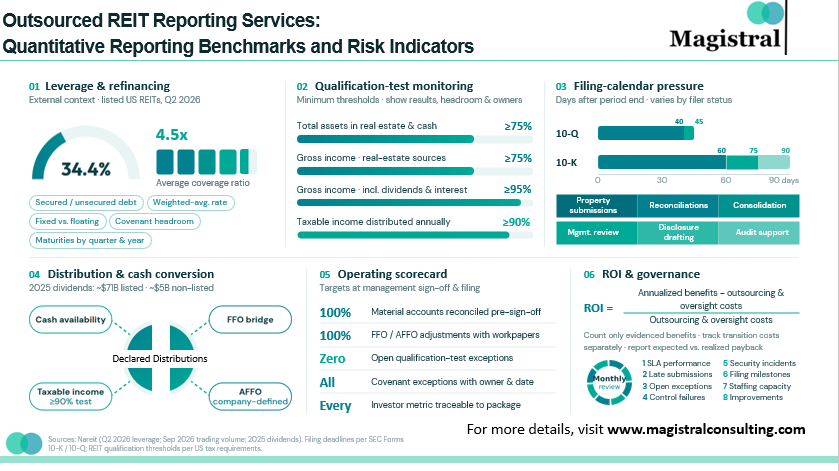
Outsourced REIT reporting services must not be judged on how many mundane tasks they take up; the performance of such outsourcing should be gauged based on financial and regulatory metrics which it can provide on a consistent basis. The metrics for listed US REITs at present are a debt ratio of 34.4% and coverage ratio of 4.5x in Q2 2026, and a dollar volume of $12.3 billion in September 2026. Those numbers show how important it is for a reporting system to link property-level data to information about leverage, liquidity, distribution, and disclosures.
Outsourced REIT Reporting Services: Quantitative Reporting Benchmarks and Risk Indicators
Leverage and refinancing surveillance
For outsourced REIT reporting services, monthly reporting should identify secured and unsecured debt levels, weighted interest rates on debt, fixed-versus-variable rate positions, covenant headroom, and maturity schedules by quarters and years. While the 34.4% debt ratio of listed US REITs and the 4.5x coverage ratio serve as external yardsticks, individual REITs need their own threshold levels reflecting their capital structure and financing arrangements.
Distribution and cash-conversion analysis
Publicly listed REITs distributed approximately $71 billion in dividends in 2025; publicly non-listed REITs distributed approximately $5 billion. Outsourced REIT reporting services should then bridge declarations to cash, taxable income, FFO, and company-defined AFFO, with clear bridges for recurring and non-recurring adjustments.
Qualification-test monitoring
Status as a REIT hinges on quantified levels: minimum of 75% of total assets held in real estate assets and cash, a minimum of 75% of gross income from real estate assets, a minimum of 95% from real estate assets and dividends or interest, and distributions annually of at least 90% of taxable income. Reporting schedules must present current numbers, future margins, deviations, ownership, and correction dates for each qualification test.
Filing-calendar pressure
The Form 10-K filing deadline is typically 60, 75, or 90 days from fiscal year-end based on the filer’s qualifications; the Form 10-Q deadline is usually 40 or 45 days. Backsolving from these deadlines makes outsourcing a quantified close process with deadlines for property data, reconciliations, consolidations, management reviews, disclosure preparation, and audit assistance.
Suggested operating scorecard
- 100% material balance sheet account reconciliation completed before management approval.
- 100% of FFO and AFFO adjustment reconciliations backed up by signed-off work papers and bridges.
- Zero outstanding exceptions from qualification tests at the time of filing approval.
- Covenant and debt maturity exceptions all assigned an owner and resolution target.
- All investor reporting metrics tied back to the signed-off consolidation package.
Return-on-investment calculation
A realistic return on investment model is calculated as annualized benefits less annualized outsourcing and supervision costs, divided by annualized outsourcing and supervision costs. The benefits included must be based on real savings or release of capacity for more valuable tasks. A separate category should be maintained for transition expenses, and management should disclose both the estimated payback period and outcome after stabilization.
Governance dashboard
The monthly governance meeting needs to review SLA adherence, late or erroneous reporting, outstanding exceptions, control issues, security threats, pending deadlines for filing, staff capacity, and other improvement activities. By doing so, the outsourced REIT Reporting Services are changed from a simple delegation to a controlled process.
How Magistral Consulting Supports Outsourced REIT Reporting Services
Magistral Consulting offers outsourced REIT reporting services by assisting REITs and managers of real estate investments with their financial reporting, consolidation, modeling, and portfolio analysis. The services provided by this company include analysis of the financial performance of the properties, account reconciliations, rent roll modeling, debt analysis, investment performance forecasts, and management dashboards.
About Magistral Consulting
Magistral Consulting has helped multiple funds and companies in outsourcing operations activities. It has service offerings for Private Equity, Venture Capital, Family Offices, Investment Banks, Asset Managers, Hedge Funds, Financial Consultants, Real Estate, REITs, RE funds, Corporates, and Portfolio companies. Its functional expertise is around Deal origination, Deal Execution, Due Diligence, Financial Modelling, Portfolio Management, and Equity Research
For setting up an appointment with a Magistral representative visit www.magistralconsulting.com/contact
About the Author

Dhanita is a BD and Marketing professional with 6+ years’ experience in sales strategy, growth execution, and client acquisition; credentials include Stanford Seed (Stanford GSB), an MBA from USMS–GGSIPU, and a B.Com (Hons) from the University of Delhi. Expertise spans market research and opportunity mapping, sales strategy, CRM, brand positioning, integrated campaigns, content development, lead generation, and analytics; currently oversees business development calls and end-to-end marketing operations
FAQs
What are outsourced REIT reporting services?
Why do REITs outsource financial reporting?
What financial metrics should REIT reporting include?
How can outsourcing improve REIT compliance?
How should a REIT select a reporting outsourcing partner?