Mergers and acquisitions involve assessing the worth of a business before making significant investments. One such document used in the process is the Confidential Information Memo, which highlights the financial performance of the business, its operations, competition, and future potential. The document assists the potential purchaser in understanding the investment opportunity while highlighting key areas that should be assessed in-depth.
Thank you for reading this post, don't forget to subscribe!As per PwC’s 2026 Global M&A Industry Trends Outlook, the global transaction value increased by 36% in 2025; however, deal volumes increased by only 1%. Such trends illustrate the fact that it is the bigger deals that now dominate the scene. Given this situation, it is imperative for investors to have correct information about the investment versus risky business.
What Is a Confidential Information Memo and Why Do Buyers Need It?
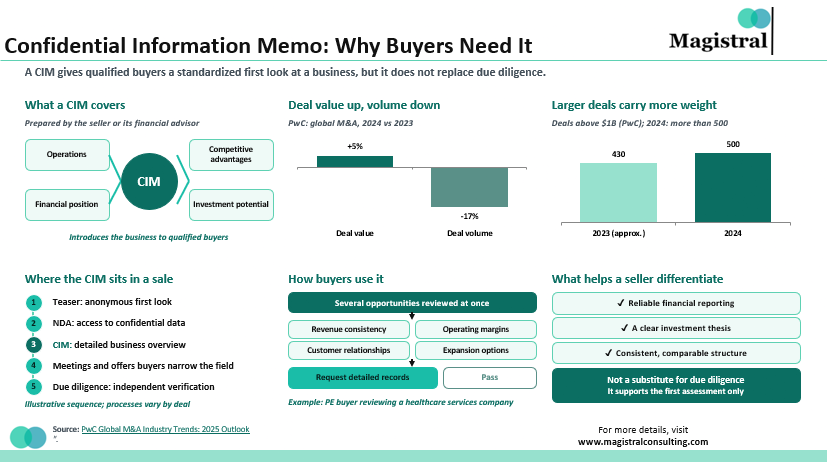
The Confidential Information Memo is a comprehensive document drawn up by the seller or a financial advisor to present the business to potential buyers. This document is used to describe how the business operates, its financial standing, and other benefits the company offers, which help potential buyers decide on acquiring the company.
Confidential Information Memo: Why Buyers Need It
Understanding Its Role in M&A Transactions
Buyers tend to look at several business options at the same time. Without uniform information, the comparison of firms will take a long time and be inefficient. An effectively structured memorandum will provide investors with the information needed to determine the strategic fit, financial position, and risks associated with the firm. For instance, a private equity investor looking into a health care services business will look at the consistency of revenues, operating margins, customer relations, and growth potential before seeking any documentation.
Why Market Conditions Increase Its Importance
According to PwC, the total value of M&A deals was up 5%, while the volume was down 17% during 2024. There were also more mega-deals above $1 billion in 2024 than in 2023, going from about 430 to over 500. This is an example of how deal-making was becoming more concentrated around bigger deals. From the perspective of sellers reaching out to private equity firms, accurate financial reporting and a compelling investment thesis can set a deal apart.
What Information Should Buyers Expect in a Confidential Information Memo?
The Confidential Information Memo needs to provide enough information to enable the buyers to know how the business makes its money, how it sustains profitability and plans to grow. Financial information needs to be tied to the realities of operations.
Business Overview and Competitive Position
In the business overview, the business’s history, products, organizational structure, customer categories, and operational processes are highlighted. The investor should also be aware of the competitive position of the business, such as market share, customer relations, dependence on suppliers, and barriers to entry. For instance, subscription income is lucrative for a software firm, but customer acquisition and retention determine the sustainability of the business model.
Financial Performance and Valuation
Financial statements are the backbone of acquisition analysis. Acquirers usually look at past revenues, EBITDA, cash flows, working capital, debt commitments, and capital expenditures.
Evaluating Financial Forecasts
Projections by management need to link future revenues with realistic assumptions regarding pricing, demand, costs, and investments. Management forecasts of a large increase in profit need an explanation of how that will be accomplished. DCF analysis can assist investors in assessing how the projected cash flows and discount rate impact the valuation of the business. But projections are nothing more than assumptions.
Growth Opportunities and Business Risks
Other considerations include expansion plans, possible acquisitions, business efficiencies, and new markets. Just as significant are risks associated with customer concentration, regulations, competitive pressures, and logistics dependence. Disclosure that is balanced enhances credibility since knowledgeable investors understand that businesses experience difficulties.
How Do Buyers Evaluate a Confidential Information Memo Before Making an Offer?
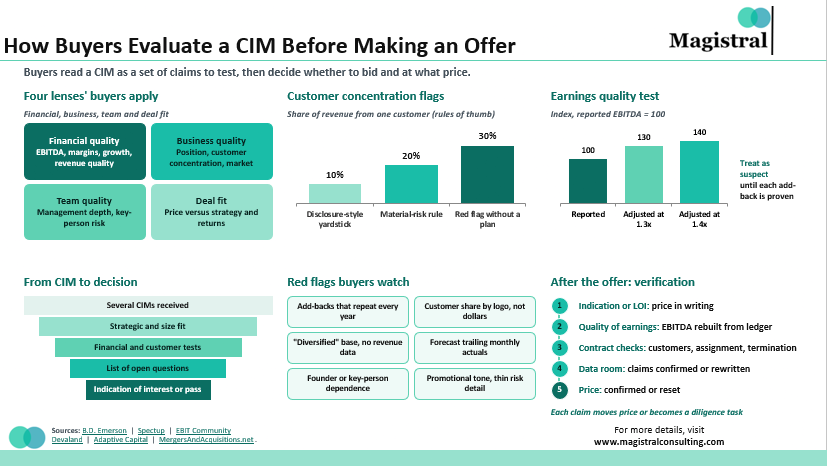
Buyers will evaluate the Confidential Information Memo by checking if the financial performance, investment opportunity, and risks of the business meet their criteria. The memo serves as a screening tool that enables the investor to select a potential project before doing any further financial, commercial, and legal investigations.
How Do Buyers Evaluate a Confidential Information Memo Before Making an Offer?
Assessing Earnings Quality and Cash Flow
The first question to be addressed is whether the reported earnings truly reflect the recurring operating results. The firm might have high EBITDA but poor cash flow due to delays in payment by clients or the rising need for inventory. This means that the buyer analyze the connection between profitability, working capital, and cash flow. He or she also looks at how the income statement has been adjusted.
Evaluating Strategic Fit and Investment Returns
The financial sponsors may be interested in sustainable growth, management skills, leverage ability, and exit options. The strategic buyers may be interested in market growth, product diversification, client base, and operational synergy. There should therefore be value for the buyer in terms of their specific goals.
Identifying Potential Red Flags
Examples of such red flags may be unexplained changes in accounting, inconsistencies in revenues, optimistic forecasts, and exposure to customers. To check if there are sufficient resources to support forecasted growth, investors might perform due diligence on operations. In the case of a manufacturer projecting significant production increases, one must evaluate if there is enough capacity or if additional investments would be required.
How Can Companies Prepare a Confidential Information Memo That Attracts Serious Buyers?
An effective Confidential Information Memo is not only a matter of good writing. A company must be able to deliver accurate data, a believable story for its investors, and coherence between financial and strategic projections. A great document answers investors’ possible questions while allowing them to find evidence easily.
Build a Reliable Financial Information Base
Preparation involves obtaining the company’s financial statements, management reports, customer data, performance data, and other relevant information from the past. All major financial figures need to match the supporting evidence. It is important for management to have uniform reporting periods and make any accounting adjustments clear. This avoids any discrepancy at the time of transaction discussion.
Develop a Realistic Investment Narrative
The compelling investment thesis provides reasons as to why the firm is an attractive investment opportunity and how growth will be possible. In the case of a logistics firm, there will be reasons provided regarding rising customer demand and operational efficiencies. Such reasons should relate to actual measures like capacity utilization and customer retention.
Use Technology Without Compromising Accuracy
According to Deloitte’s 2025 M&A Trends Survey, 97% of the responding corporate and private equity firms have started utilizing generative AI or analytics in their deal-making processes. Technology can help speed up research, financial review, and documentation. But the experts must validate the technology-generated outputs and safeguard confidential business information.
Maintain Confidentiality Throughout the Process
Generally, firms provide thorough transaction documentation once potential buyers execute the necessary non-disclosure agreements. Proper access control and storage of documents, along with version control, can be used to safeguard confidential information. Firms seeking to raise capital must ensure that their investment pitch is consistent across all documents.
How Can Magistral Consulting Support Confidential Information Memo Preparation?
Magistral Consulting provides investment research, financial modeling, and transaction documentation support to investment banks, private equity firms, and other financial services organizations. Its published services include customized investment memorandums, financial model preparation and validation, industry research, company profiling, and transaction-related documentation.
Investment Research and Financial Modeling
Magistral assists clients in preparing financial models, evaluating assumptions, and researching relevant industries. These activities can improve the consistency between a company’s historical financial performance, projected results, and investment narrative. For example, a financial model showing significant revenue growth should reflect corresponding assumptions about customer acquisition, operating expenses, and working capital. Reviewing these relationships helps identify inconsistencies before investors begin detailed analysis.
Transaction Documentation and Deal Support
Magistral’s investment banking service offerings include confidential information memo preparation, buyer profiling, comparable company analysis, transaction analysis, and financial benchmarking. Specialized investment banking support can help advisory teams manage research and documentation requirements while concentrating internal resources on transaction strategy and investor relationships.
Improving Investor Readiness
Deloitte’s 2025 survey also found that 85% of respondents expected increased interest in acquiring foreign businesses during the following year. This was a survey expectation, not a measure of completed acquisitions. Cross-border opportunities can introduce additional financial reporting, market analysis, and operational considerations. Structured research support can help present these differences clearly to prospective investors.
Ultimately, the effectiveness of a confidential information memo depends on reliable information, defensible assumptions, and transparent communication. Combining internal business knowledge with specialized analytical support helps sellers prepare more credible transaction materials and enables buyers to make better-informed investment decisions.
About Magistral Consulting
Magistral Consulting has helped multiple funds and companies in outsourcing operations activities. It has service offerings for Private Equity, Venture Capital, Family Offices, Investment Banks, Asset Managers, Hedge Funds, Financial Consultants, Real Estate, REITs, RE funds, Corporates, and Portfolio companies. Its functional expertise is around Deal origination, Deal Execution, Due Diligence, Financial Modelling, Portfolio Management, and Equity Research
For setting up an appointment with a Magistral representative visit www.magistralconsulting.com/contact
About the Author

Tanya is an investment-research specialist with 6 + years advising venture-capital, private-equity and lending clients worldwide. A Stanford Seed alumnus with an MBA and an Economics (Hons) degree, she heads project teams at Magistral Consulting, delivering financial modelling, due-diligence and deal support on 3,000 + mandates. Her blend of rigorous analytics, sharp project management and clear client communication turns complex data into actionable investment insight.
FAQs
Who typically prepares an investment memorandum?
When is a Confidential Information Memo shared with buyers?
How can consulting improve the Confidential Information Memo?
What Is Magistral Consulting?