Tag Archives: Value Creation in Investments

Mergers and acquisitions consulting has evolved significantly and is now recognized as a key strategic advantage. One of the reasons is the drastic changes in capital markets, which, along with interest-rate fluctuations and geopolitical tensions, prompted the need for tighter financial discipline and a broader operational perspective to scrutinize deals. The top consulting firms are now leveraging numerous sectoral insights, AI-powered analytics, and an extensive global research network. It enables clients to achieve the highest level of accuracy in underwriting transactions. The 2024 report of PwC suggests that the upswing of deal activity is confined to the buyers who take advantage of the two pillars of Mergers and Acquisitions consulting. This includes advanced diligence frameworks and data-backed valuation models.

The Growing Importance of Mergers and Acquisitions Consulting in a Volatile Market

Mergers and acquisitions consulting has become a necessity for dealmakers who are facing timelines that are shorter than before, and the additional stress that comes with the valuation process. The role of consultants has evolved into that of partners with the ability to structure intelligence in such a way as to bear all the necessary economic signs, macro, sector, and financial into one big agreement or a whole deal thesis.
The Growing Importance of Mergers and Acquisitions Consulting

The Growing Importance of Mergers and Acquisitions Consulting

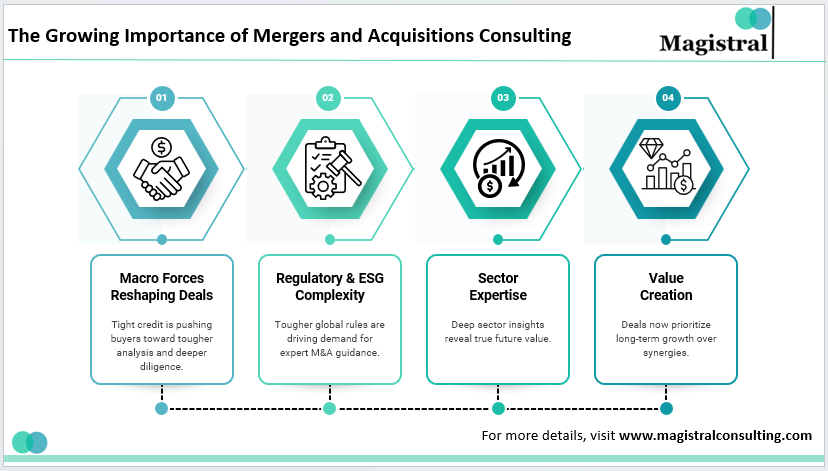
Macro Forces Reshaping Dealmaking

In a scenario with credit being tight and money lending being very selective, buyers would have no option but to make the case for acquisitions by putting them through a very rigorous process of scenario analysis. Deloitte’s M&A Trends shows that more than 60% of corporates consider strategic acquisitions necessary for maintaining their competitive edge. The condition of the market is also leading investment funds to employ extensive diligence frameworks to justify the price they offer.

Regulatory and ESG Complexity Driving Advisory Demand

The regulatory agencies in the US, EU, and APAC have started monitoring closely the areas of antitrust, data governance of companies, and ESG disclosures. The firms that specialize in Mergers and acquisitions consulting provide support to companies in trying to manage the expectations of the regulators, calculate the exposures, and come up with mitigation strategies. These strategies will minimize the potential of the companies being impacted by delays in the granting of approvals and the resulting adjustments in valuations.

Sector Expertise as a Differentiator

Top-notch experts analyse extremely niche indicators such as the pharmaceutical development pipeline, risk during transition to cleaner energy, vulnerability of the supply chain, and digital readiness that have an impact on the value of the enterprise. This know-how empowers the buyers to go beyond the numbers and grasp the future strength of an economic model.

Value Creation Extends Beyond Synergies

The new rules of the game when it comes to deals have no longer focused on synergies but on the sustainable value creation that is modern and is to be done with the help of consultants. They are the ones who guide the buyers to articulate the growth-oriented strategies, etc.

Core Components of High-Quality Mergers and Acquisitions Consulting

An elaborate Mergers and Acquisitions Consulting method combines financial correctness, operational review, strategic vision, and progressive analytics. This will eliminate uncertainty transversely through the whole transaction process.

Target Screening and Deal Origination Intelligence

The consultants in Mergers and Acquisitions Consulting are utilizing steady frameworks to analyse the trends of sector consolidation, competitive dynamics, and the emergence of new disruptors. The teams are increasingly using AI-powered deal origination tools. This allow them to spot targets way before they come into conventional projects. The early information gives acquirers better positions in terms of price and the benefits of secrecy.

Multidimensional Due Diligence

The best diligence practice now incorporates financial, operational, commercial, ESG, human capital, and digital factors. One common operational due-diligence technique tests the target under different market conditions. This approach supports more accurate downside pricing.

Financial Modeling and Valuation Precision

The consulting firms that specialise in Mergers and Acquisitions consulting make connected models. These models consider market flexibility, cost structure sensitivity, revenue seasonality, and changes in capital intensity. Often, these models use DCF methods combined with industry standards. By applying valuation principles, consultants help clients assess both short-term fluctuations and long-term value drivers. This approach helps clients avoid the risk of overpaying in changing deal environments.

Term Sheet Structuring and Negotiation Strategy

Advisors support negotiation by conducting detailed synergy quantification, earn-out simulation, and risk allocation analysis. Their contribution helps to make certain that the deal is designed for a balance of interests before and during the integration phase.

Post-Merger Integration (PMI) Execution

Bain research shows that about 70% of deal value is set in the first 100 days. Consultants build integration plans across culture, financials, technology, and operations to deliver synergies.

Technology and Analytics Transforming Mergers and Acquisitions Consulting
Advanced analytics is transforming M&A work. It speeds up transactions and improves accuracy. Technology is already reshaping the future of M&A consulting in both areas. The consultants have begun using data analytics and artificial intelligence in combination with their expertise to provide more in-depth insights and to accelerate the process of execution.

Technology and Analytics Transforming Mergers and Acquisitions Consulting

Technology and Analytics Transforming Mergers and Acquisitions Consulting

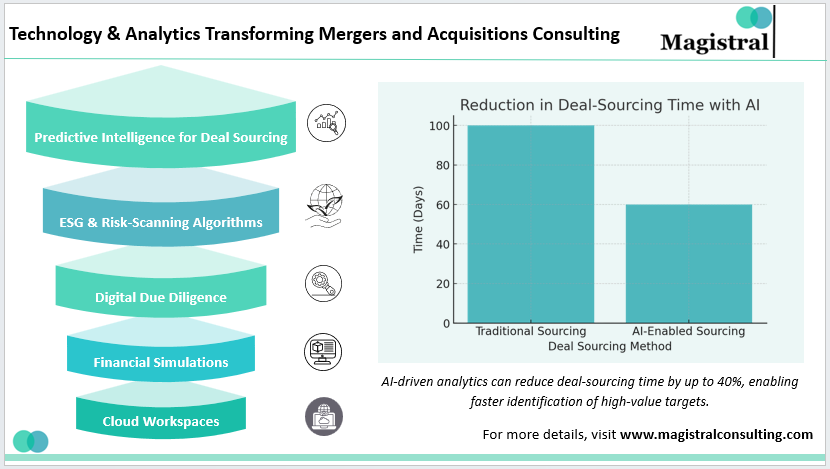
Predictive Intelligence for Deal Sourcing

The early acquisition signals, such as industry growth, hiring, product launch, and regulatory filing, can be recognized by a certain data-driven methodology. This will allow the experienced consultants to see the next big target earlier than others. AI-supported sourcing has been stated by McKinsey to potentially cut the sourcing times by 40%.

Advanced Financial Simulations

The platforms powered by AI conduct the testing of multiple financial scenarios at the same time in an integrated manner with the real-time market input. Such synchronization results in more accurate valuations and better capital-allocation decisions.

ESG and Risk-Scanning Algorithms

With ESG becoming a major factor in determining valuations, consultants resort to technological means. This is to dig out data regarding carbon emissions, ethical standards in supply chains, resource dependency, and how sustainability practices would be in future settlements. Such information is becoming more decisive in favour of the lenders and in gaining regulatory approvals.

Digital Due Diligence and Cyber Audits

M&A transactions can take significant advantage of the digital diligence tools. These will be able to carry out penetration-testing simulations, identify IP risks, and assess the digital maturity. All these aspects now have an impact on the determination of the deal value and, consequently, the deal pricing.

Integrated Cloud Workspaces

The consulting and client collaboration through integrated cloud platforms make deal execution easier, as they centralize documentation, workflow tracking, and risk logs.

How Magistral Consulting Enables Stronger Mergers and Acquisitions Outcomes

Magistral Consulting is a partner of extended intelligence with an objective to support the entire M&A lifecycle by means of scalable teams, advanced analytics, and research capabilities aligned with the sector.

Comprehensive Deal Origination Support

The analysts keep an eye on global happenings to identify companies with high potential. This makes pipeline creation for corporates and investors of a better quality.

High-Fidelity Financial Modeling

The company develops interconnected valuation structures by using strong forecasting logic, sensitivity testing, and scenario modeling. The investment banking research enhance the accuracy of pricing decisions across mid-market and large-scale transactions.

Diligence Frameworks Anchored in Sector Reality

The diligence methodology of Magistral evaluates the commercial viability, cost structures, operational bottlenecks, and future scalability.

About Magistral Consulting

Magistral Consulting has helped multiple funds and companies in outsourcing operations activities. It has service offerings for Private Equity, Venture Capital, Family Offices, Investment Banks, Asset Managers, Hedge Funds, Financial Consultants, Real Estate, REITs, RE funds, Corporates, and Portfolio companies. Its functional expertise is around Deal origination, Deal Execution, Due Diligence, Financial Modelling, Portfolio Management, and Equity Research

For setting up an appointment with a Magistral representative visit www.magistralconsulting.com/contact

About the Author

Prabhash Choudhary is the CEO of Magistral Consulting. He is a Stanford Seed alumnus and mechanical engineer with 20 + years’ leadership at Fortune 500 firms- Accenture Strategy, Deloitte, News Corp, and S&P Global. At Magistral Consulting, he directs global operations and has delivered over $3.5 billion in client impact across finance, research, analytics, and outsourcing. His expertise spans management consulting, investment and strategic research, and operational excellence for 1,200 + clients worldwide


FAQs

What is the primary role of mergers and acquisitions consulting?

It provides structured intelligence, financial rigor, and operational insight across the deal lifecycle, from target screening to valuation, due diligence, negotiation, and post-integration.

Why do companies rely on consultants during complex transactions?

Consultants bring cross-sector expertise, analytics capabilities, and benchmarking knowledge that help companies price deals accurately, identify risks early, and accelerate execution.

How does technology enhance M&A advisory quality?

AI and analytics improve deal sourcing, automate due diligence, enhance valuation modelling, and provide predictive insights, reducing uncertainty and strengthening decision-making.

What makes Magistral Consulting a strong partner for M&A?
Magistral brings deep research capabilities, scalable delivery teams, advanced modeling tools, and sector-driven diligence frameworks that support strategic and operational decisions.


In today’s complex deal landscape, operational due diligence is a must for investors. The due diligence process is critical to establishing a forward-looking assessment of processes, people, technology, and sustainability, while uncovering potential hidden liabilities and potential levers for increasing value. It ensures wireless transactions early on, allowing for smooth integrations, accelerating the capture of synergies, and sustainable performance gains.

Objectives

Operational due diligence evaluates whether a target’s operations can support the investment thesis and drive returns, assessing systems, staffing, facilities, and potential constraints. It identifies improvement opportunities, plans for growth, and mitigates hidden costs, while fostering alignment through co-creation workshops. The process informs integration plans, covenants, and earn-outs, ensuring assumptions are validated and post-close value is maximized.

Validating Operational Sustainability

Deal teams simulate stress scenarios to test whether current technology platforms and production processes can sustain forecast volumes. As a result, they quantify capex requirements and prevent costly surprises during integration.

Uncovering Critical Investment Needs

The teams identify unknown dependencies and funding requirements through deeper process mapping and working-capital modelling. These findings can help ensure pricing for the bid reflects true cash-flow dynamics, and no cash flow deficits occur post-close.

Securing Stakeholder Alignment

In workshops with senior management, they have become engaged in taking individual and collective ownership of the findings. When organizational leaders are involved in the hypothesis development and solution design process, they are also more likely to be advocates and execution champions for operational improvements and to speed up implementation.

Informing Transaction Structure

The detailed understanding of transactional and related operational risk and upside opportunities gives deal teams greater negotiating power to shape earn-outs and covenants that protect value while incentivizing performance.

Prioritizing Value Levers

Once the operational due diligence effort ranks possible initiatives in order of expected impact and complexity of implementation, there is a clear roadmap of the efficiency and growth projects, creating clarity and action to maximize expected return on diligence investment while speeding up synergy delivery.

Stages of the Operational Due Diligence Process

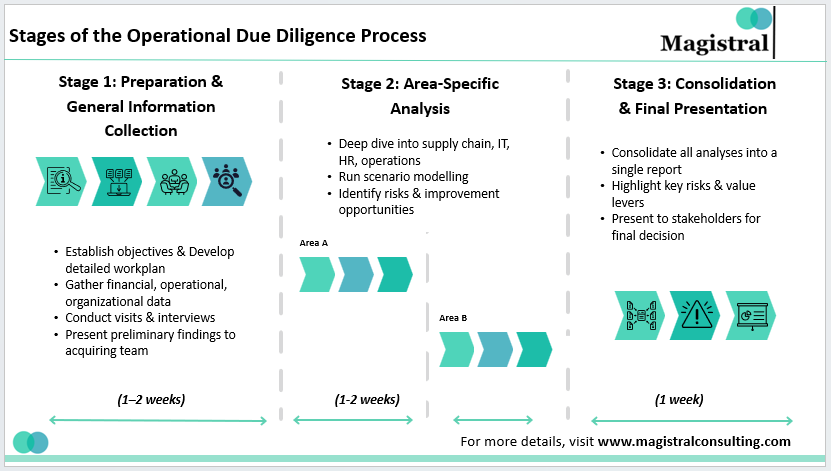
The ODD process is structured to ensure teams stay focused on the needs of the acquiring team and have a completed analysis within a specific timeframe.

Preparation & General Information Collection (1–2 weeks)

During this phase, teams establish objectives, curate experts, and outline a detailed work plan. They compile financial, operational, and organizational information, test their initial hypotheses via visits and interviews with management, and finalize phase 2 plans after presenting their preliminary findings to the acquiring team.

Area-Specific Analysis (1–2 weeks)

Deal teams will then commence their “deep dive” into the critical functions of supply chain, IT, HR, and operations. They will continue their collection of data, transition into completing their current state assessments and scenario modelling on their area-specific analysis and identify potential risks and improvement opportunities in these areas. The Interim Insight sessions would continue to check in with stakeholders and ensure intuition is managed and actions are grounded for subsequent stages.

Consolidation & Final Presentation (1 week)

The consolidations and synthesis of all analyses would lead the team to produce a singular report that reflects key risks, value-creating levers, and required resources. A 100-day integration journey with KPIs would be delivered, and a presentation would be provided to stakeholders to support their final decision to commit.

Stages of the Operational Due Diligence Process

Stages of the Operational Due Diligence Process

Harnessing Advanced Technologies in Operational Due Diligence

Organizations are utilizing technology to help further their operational due diligence efforts in both depth and speed. For instance, AI-powered risk analytics, when applied to tens of thousands of data points, lead to the identification of risks and document review timeframes dropping from weeks to hours, if not minutes. Also, predictive maintenance algorithms extract patterns from sensor records, permitting teams to prioritize their capital investment and all while reducing unplanned downtime by an average of 50 percent. Natural-language processing tools significantly enhance risk reviews and identification of non-compliance related to complex contracts and obligations, allowing for the mapping of ESG performance on the same cost-to-benefit basis as traditional cyber security red-team exercises and data-privacy auditing.

AI-Powered Risk Analytics

Advanced AI model performance helps compress review windows by establishing relationships between risk weaknesses and anomalies across massive sets of operational data within suitable boundaries.

Predictive Maintenance Modelling

The application of machine learning algorithms to equipment sensor and maintenance records allows teams to identify and prioritize capital investments; this simple exercise reduces unplanned downtime by fifty percent as a rule of thumb!

Automated Contract Review

The use of natural-language processing tools allows a team of lawyers to ingest complex agreements into algorithms and flag non-standard clauses or compliance gaps in hours, whereas a complete contracting process could take weeks, if not months.

ESG Performance Mapping

Ensuring that traditional and cost-focused operational KPIs also include sustainability scoring or ESG helps ensure environmental and social risks are not ignored, as a sustainability commitment is assessed on a simple cost-ton basis.

Cybersecurity and Compliance Integration

Aspects of operational due diligence include performing red-team exercises, data-privacy audits, and similar due diligence exercises to evaluate the manager’s cyber resilience, including data protection obligations like GDPR or CCPA.

Operational Due diligence Compared to Other Types of Due diligence

Even while financial, commercial, tax, and legal reviews are a backward-looking examination to preserve existing value, operational due diligence is a forward-looking process to generate value. ODD has a unique, continuous, and iterative approach that relies on hypothesis-led deep dives co-developed with management, rather than standard checklists performed by independent advisors to assess past performance. This collaborative approach ensures insights are practical, targeted, and directly tied to operational realities. Consequently, ODD goes beyond identifying potential deal-breakers—it highlights precise operational improvements, efficiency opportunities, and strategic priorities that can materially enhance performance, strengthen competitive advantage, and drive superior returns post-close.

Key Highlights:

Focuses on future performance and value creation, not just past performance.

Uses hypothesis-led deep dives in partnership with management.

Goes beyond risk identification to deliver clear, actionable improvements.

Aligns operational changes with investment thesis and long-term growth goals.

Driving Value Creation Through Operational Due Diligence

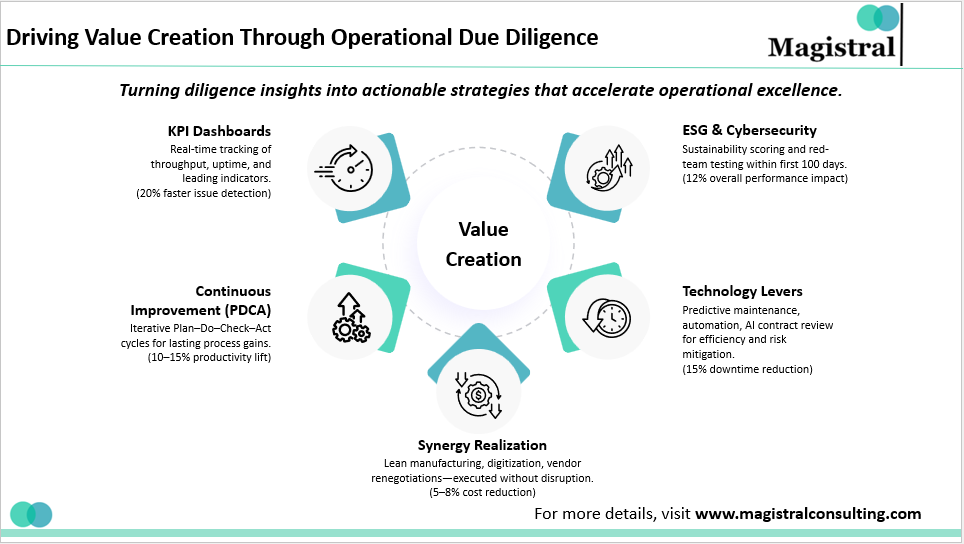
Implementing diligence insights into action creates tangible performance benefits and advantages:

KPI Dashboards

Incorporate leading indicators (e.g., throughput rates, uptime) automation into real-time monitoring tools.

Continuous Improvement (PDCA)

Run Plan-Do-Check-Act iterative cycles to cement process improvements.

Synergy Realization

Performing lean manufacturing, digitization, and vendor renegotiations in a controlled way without disrupting the business.

ESG & Cybersecurity Enhancements

Execute sustainability scoring and red team exercises in Day 1 – 100 days to action plan.

Technology Levers

Automation of sequential processes, predictive-maintenance analytics, and AI contract reviews to offset efficiency and coverage risk.

Driving Value Creation Through Operational Due Diligence

Driving Value Creation Through Operational Due Diligence

About Magistral Consulting

Magistral Consulting has helped multiple funds and companies in outsourcing operations activities. It has service offerings for Private Equity, Venture Capital, Family Offices, Investment Banks, Asset Managers, Hedge Funds, Financial Consultants, Real Estate, REITs, RE funds, Corporates, and Portfolio companies. Its functional expertise is around Deal origination, Deal Execution, Due Diligence, Financial Modelling, Portfolio Management, and Equity Research

For setting up an appointment with a Magistral representative visit www.magistralconsulting.com/contact

About the Author

Nitin is a Partner and Co-Founder at Magistral Consulting. He is a Stanford Seed MBA (Marketing) and electronics engineer with 19 + years at S&P Global and Evalueserve, leading research, analytics, and inside‑sales teams. An investment‑ and financial‑research specialist, he has delivered due‑diligence, fund‑administration, and market‑entry projects for clients worldwide. He now shapes Magistral Consulting’s strategic direction, oversees global operations, and drives business‑development support.


FAQs

What is operational due diligence, and why does it matter?

It's a forward-looking review of a target's core operations—including processes, technology, people, ESG, and vendor networks—that validates deal assumptions and uncovers both risk-mitigation and value-creation opportunities before closing.


When should it begin in the transaction timeline?

The review should kick off alongside financial and legal due diligence—ideally within the first two weeks of bid acceptance—to align integration planning and nip execution risks in the bud.


How much time does the process require?

For mid-market deals, plan on three to four weeks. More complex or cross-border transactions often extend to six to eight weeks to allow for thorough site visits and deep dives.


Who takes part?

A cross-functional team—supply-chain analysts, cybersecurity auditors, ESG specialists, and seasoned deal professionals—brings both technical rigor and strategic insight to the table.


How are findings translated into action?

Key performance indicators are built into post-deal governance dashboards, each initiative is given a clear owner, and progress is monitored through regular steering-committee reviews.