Private equity trends entered 2026 with stronger deal momentum than in previous years. Transaction sizes have rebounded, large deals are returning, IPO markets are reopening, and alternative liquidity options are expanding rapidly. However, the recovery is increasingly selective, with capital flowing towards larger deals, established managers, and companies offering clear opportunities for operational improvement.
Thank you for reading this post, don't forget to subscribe!This latest set of Private equity trends, then, indicates a maturing industry where cheap leverage and multiple expansion will play less of a role in providing returns and where operational value creation, artificial intelligence, specialised strategies, sound entry valuation and liquidity management are increasingly critical.
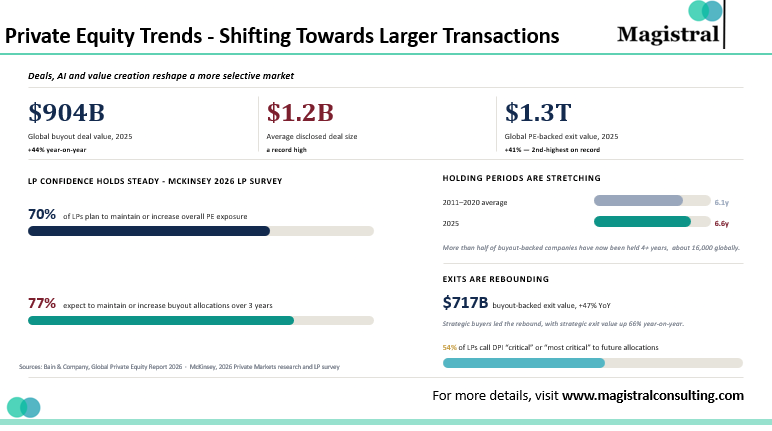
The confidence of investors in the asset class is strong, nonetheless. According to McKinsey’s research from 2026, about 70% of surveyed global Limited Partners (LPs) expect to keep or even increase their investment in private equity. Moreover, 77% expect to keep or increase their allocations to buyout strategies over the next three years.
Private Equity Trends Are Shifting Towards Larger Transactions
One of the most evident private equity trends is the growing concentration of capital into bigger deals.
Private Equity Trends – Shifting Towards Larger Transactions
The average disclosed transaction size came to an all-time high of $1.2 billion. There were just 13 deals valued at more than $10 billion, which accounted for almost $274 billion of global deal value during the year.
Likewise, McKinsey reported that buyout and growth transactions worth more than $500 million increased 44% to more than $1 trillion during 2025, setting a record high in terms of these types of deals.
These private equity trends show how the investment committees have become increasingly selective. Instead of putting money into several companies, the sponsors are now putting all their focus on the few companies which have the potential.
Exit Markets Are Recovering, but Liquidity Remains a Priority
The recovery in exit activity is another significant development.
According to McKinsey, the global exit value supported by private equity trends increased by nearly 41% to $1.3 trillion in 2025, marking its second-best year ever. There was also strong growth in PE-backed IPO activity.
Global exit values supported by Bain’s data on buyouts experienced an increase of 47% reaching $717 billion. Strategic buyers also became very active with the strategic exit value growing by 66% year-on-year.
Nevertheless, growth of exit value does not help the industry in terms of liquidity needs.
The average holding periods in 2025 stood at around 6.6 years versus 6.1 years from 2011 to 2020. Over 50% of portfolio companies backed by buyouts were held for more than four years. Moreover, there has been a growth in the number of companies held for four years or more, approximately 16,000 globally.
Therefore, LPs have started focusing increasingly on actual cash returns rather than unrealised portfolio valuations.
McKinsey research has shown that DPI, or distributions to paid-in capital, is now viewed as a critical or most critical measure by 54% of LPs and is one of the most significant indicators for LPs.
Exit Markets Are Recovering, but Liquidity Remains a Priority
The recovery in exit activity is another significant development.
According to McKinsey, the global exit value supported by private equity trends increased by nearly 41% to $1.3 trillion in 2025, marking its second-best year ever. There was also strong growth in PE-backed IPO activity.
Global exit values supported by Bain‘s data on buyouts experienced an increase of 47% reaching $717 billion. Strategic buyers also became very active with the strategic exit value growing by 66% year-on-year.
Nevertheless, growth of exit value does not help the industry in terms of liquidity needs.
The average holding periods in 2025 stood at around 6.6 years versus 6.1 years from 2011 to 2020. Over 50% of portfolio companies backed by buyouts were held for more than four years. Moreover, there has been a growth in the number of companies held for four years or more, approximately 16,000 globally.
Therefore, LPs have started focusing increasingly on actual cash returns rather than unrealised portfolio valuations.
McKinsey research has shown that DPI, or distributions to paid-in capital, is now viewed as a critical or most critical measure by 54% of LPs and is one of the most significant indicators for LPs.
Secondaries Are Becoming a Mainstream Liquidity Solution
The quick evolution of private equity trends and secondaries is one of the biggest in the world of private equity in 2026.
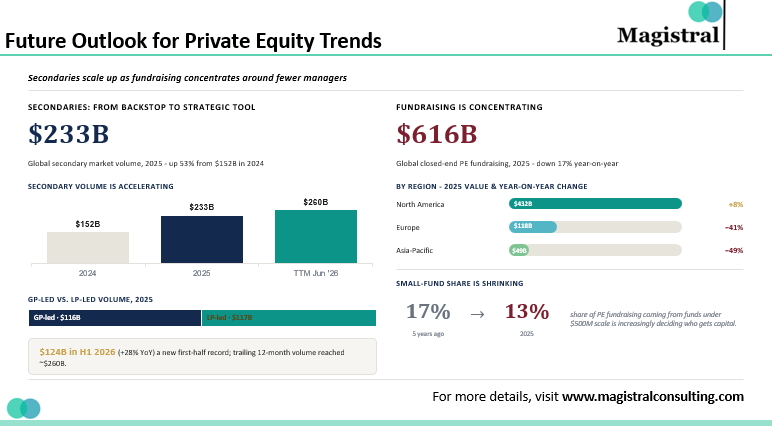
According to Lazard, the volume of transactions conducted in the global secondary market amounted to approximately $233 billion in 2025, which is a 53% increase from $152 billion reported in 2024. Among them, the volume of GP-led transactions accounted for about $116 billion, while LP-led transactions totalled approximately $117 billion.
The trend did not stop in 2026.
The volume of secondary transactions in the first half of 2026 was estimated at approximately $124 billion, a 28% increase compared with the corresponding period, and a new first-half record. The trailing 12-month volume reached approximately $260 billion by June 2026.
Continuation vehicles are especially important. Through them, sponsors can keep control over selected portfolio companies, while existing investors have an opportunity to realise liquidity.
Secondaries have thus moved from being a tool for addressing the problems of distressed investors to becoming a strategic management instrument for GPs and LPs.
Fundraising Is Becoming More Concentrated
There is also the matter of fundraising markets, which are experiencing a shift in their structure.
In 2025, global fundraising via closed-end private equity funds declined by 17% to $616 billion, according to McKinsey. Fundraising across regions experienced different results. In North America, fundraising was up by 8% to $432 billion, whereas Europe saw its fundraising decline by 41% to $118 billion and Asia-Pacific by 49% to $49 billion.
Size is becoming an increasingly critical factor.
Deal sizes below US$500 million represented 13% of private equity funds raised in 2025, down from 17% five years ago. At the other end of the market, size became an increasingly valuable asset, with established large firms garnering more of the institutional capital.
GPs have increasingly been required to demonstrate an ability to consistently deliver returns and allocate capital. High IRRs are still valued, but DPI, operational capabilities, industry expertise, and co-investing options are becoming increasingly important.
Artificial Intelligence Is Reshaping Private Equity Trends
AI has advanced from being an experimental technology to being a key factor to be considered at all stages of the investment process.
Private equity firms are integrating AI into deal sourcing, market analysis, commercial due diligence, document processing, financial modelling, portfolio management and value creation planning.
According to McKinsey’s research in 2026, only 6% of GPs find that AI has a significant effect on their internal workings and investment processes, while 70% believe that its effect will be significant in 3-5 years’ time. Productivity gains in analyst-heavy functions of 30-40% have been reported by some firms.
The assets receiving capital allocation are also affected by AI.
Healthcare, technology and energy registered some of the most significant increases in the value of buyouts in 2025. In deals worth more than $500 million, the value of deals has increased by 173% in healthcare, 70% in energy and 61% in financial services.
Capital is also being allocated to data centres, power generation, electricity transmission, semiconductors and digital infrastructure, which are needed as physical infrastructure for the growth of AI.
Future Outlook for Private Equity Trends
Private equity trends are approaching a period where scale will no longer automatically ensure good performance.
Future Outlook for Private Equity Trends
Structural advantages of the industry are still very strong. As much as 70% of surveyed LPs plan to maintain stable or increased commitments, valuations have improved, secondaries are offering extra liquidity, and technological disruption is creating new investment opportunities.
But how the returns were created in the past is beginning to change.
The key to the success of the next generation of top-performing private equity firms will be their ability to specialise in sectors, source deals consistently, create value in operations, leverage AI technologies, plan for exits early, monitor portfolios carefully and communicate with LPs effectively.
The Defining private equity trends of 2026 suggest that the industry is not going to return to its previous cycle. Private equity trends are becoming more institutionalised and operations-oriented.
As for the investors, the main challenge will shift from leveraging good market conditions to picking those managers and companies that can create tangible value in their businesses.
Private Equity Services Offered by Magistral Consulting
Services offered by Magistral Consulting include helping private equity firms during the entire investment process, including deal generation, due diligence, portfolio management, valuations, fundraising, and exiting the investments. This is aimed at helping the PE team build their execution capabilities while allowing senior people to concentrate on investing and creating value.
Deal Sourcing and Target Screening
Magistral assists PE firms in identifying targets, market mapping, company profiling, contact research, and acquisition pipeline preparations based on sectors, geographies, revenue, EBITDA, and investment parameters.
Commercial and Financial Due Diligence
The team will help in doing research on the industry, analysing competition, analysing the financial statements, KPIs, business models, market size, and other due diligence processes necessary before making the investment.
Financial Modelling and Valuation
The Magistral team creates and maintains three-statement models, LBO models, DCF models, comparable company analysis, precedent transaction analysis, scenario models, and sensitivity analysis.
Investment Committee and Deal Materials
Support is provided in preparing investment committee memoranda, company profiles, summary of deals, market research, valuation, presentations, and all other documentation that is necessary for deal evaluation.
Portfolio Monitoring and Performance Analysis
Magistral provides assistance to private equity firms in monitoring portfolio companies’ finances, KPIs, budgets, valuations, industry insights, and performance trends via regular dashboards and analysis reports.
About Magistral Consulting
Magistral Consulting has helped multiple funds and companies in outsourcing operations activities. It has service offerings for Private Equity, Venture Capital, Family Offices, Investment Banks, Asset Managers, Hedge Funds, Financial Consultants, Real Estate, REITs, RE funds, Corporates, and Portfolio companies. Its functional expertise is around Deal origination, Deal Execution, Due Diligence, Financial Modelling, Portfolio Management, and Equity Research
For setting up an appointment with a Magistral representative visit www.magistralconsulting.com/contact
About the Author

Nitin is a Partner and Co-Founder at Magistral Consulting. He is a Stanford Seed MBA (Marketing) and electronics engineer with 19 + years at S&P Global and Evalueserve, leading research, analytics, and inside‑sales teams. An investment‑ and financial‑research specialist, he has delivered due‑diligence, fund‑administration, and market‑entry projects for clients worldwide. He now shapes Magistral Consulting’s strategic direction, oversees global operations, and drives business‑development support.
FAQs
What are the major private equity trends in 2026?
Why are secondaries becoming more important in private equity?
How is AI being used in private equity?
Why is operational value creation becoming more important?
Which sectors are attracting private equity investment?