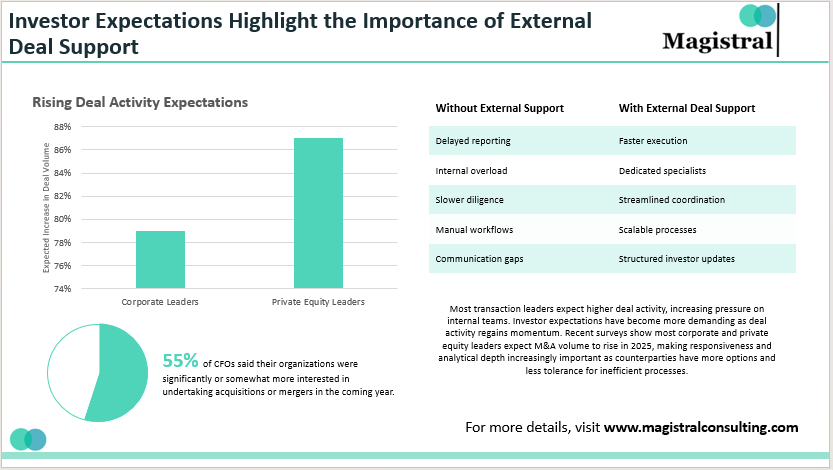
M&A, fundraising activities, and investment deals are becoming much more information-heavy than in previous years. The business world currently finds itself facing the demand for rapid decision-making, thorough evaluation, and higher compliance standards. Consequently, the internal teams find it difficult to coordinate each step of the deal process without experiencing organizational stress. This is where external deal support can help. The validity of such claims is confirmed by market trends, according to which 79% of corporate executives and 87% of private equity executives surveyed in Deloitte’s 2025 M&A Trends Survey expect the volume of deals to rise within the next twelve months, and nearly three-quarters see increases in deal value.
Thank you for reading this post, don't forget to subscribe!Operational Bottlenecks Signal the Need for External Deal Support
With increasing deal size and sophistication, internal teams often find themselves under operational strain. The simultaneous handling of investor relations, compliance analysis, valuations, and financial reporting results in decreasing efficiency. It may be time to consider external deal support if there is a pattern of delays or inefficiencies within the company.
Overloaded Internal Teams Reduce Deal Efficiency
Finance and strategy internal teams are usually responsible for forecasting and other operational tasks. With the added burden of transaction work, there tend to be issues related to execution. There are usually delays in the preparation of documents, diligence responses, and updates provided to investors involved in current deals.
The above issue is quite prevalent among expanding companies backed by private equity investments, whose reporting requirements expand considerably following expansion. External parties can handle the additional work load of analytics and administrative tasks, leaving the management teams free to negotiate and make strategic decisions.
Financial Modeling Delays Affect Investor Confidence
Precise models are important when doing acquisitions, raising capital, and restructurings. Yet, it is common for firms to lack the expertise and manpower that would be able to undertake sophisticated sensitivity analyses, scenario planning, and adjustments to valuation.
Businesses which utilize DCF modeling in their valuation process frequently have to make changes during negotiations. These changes will affect investor confidence if the firm lacks capacity to complete this task. Outside experts are able to provide the capacity required for precise modeling.
Increased Demand for Real-Time Analytics
Current transactions place emphasis on forecasting and scenario modeling. It is now more common for buyers and potential investors to demand customized operating scenarios, downside sensitivity models, and liquidity modeling before negotiations continue.
This capacity enables organizations to respond rapidly with their reporting. This may become an advantage in bidding scenarios.
Compliance and Documentation Become Difficult to Manage
The regulatory environment remains increasingly stringent within the global financial landscape. Organizations undertaking acquisitions or raising capital through institutions usually handle many legal documents, investor disclosures, and compliance requirements at once. Regulatory and documentation pressures significantly impact implementation. In recent 2024 market analysis, it is evident that significant deals require extended closing periods due to increased regulatory complexities and thorough deal reviews, emphasizing the importance of effective coordination, documentation, and approval management. This situation underscores the rationale behind why organizations often rely on outside professionals to control their diligence processes, stakeholder communications, and transaction timelines.
Stakeholder Communication Starts Breaking Down
Communication issues may arise when various advisors, investors, lenders, and executives are engaged in the same transaction process. Failure to keep all parties up-to-date could undermine stakeholder trust.
Entities involved in capital-raising activities would especially find investor communication assistance invaluable. Transaction teams from outside organizations guarantee consistent communication, financial information updates, and diligent responses throughout the negotiation process.
Increasing Transaction Complexity Requires External Deal Support
Contemporary transactions entail greater analysis than transactions did even just ten years ago. Before sealing any deal, businesses consider such aspects as the synergy of operations, cybersecurity challenges, environmental, social, and governance (ESG) issues, and international compliance. Firms finding themselves unable to align all these factors in their transaction process could consider using external deal help in order to maintain transaction momentum.
Cross-Border Transactions Introduce Additional Risks
A cross-border deal entails such factors as taxation, regulations, different accounting practices, and foreign exchange risk. The increase in cross-border transactions makes it necessary for firms to seek external help in ensuring effective and efficient execution. According to McKinsey, an increasing level of integration complexity caused by growing cross-border transactions is one of the reasons why large acquisitions are being postponed. Additionally, Deloitte’s 2025 M&A Trends Survey indicates that 88% of corporate executives and 81% of private equity respondents have seen changes in their target selection strategies in the past two years.
Due Diligence Has Become More Extensive
Today’s transactions assess things like resilience, technology platform strength, ESG issues, and labor stability besides finances. External deal support will help with data room management, validation, and due diligence work.
Data Room Management Requires Dedicated Resources
Virtual data rooms have thousands of financial, legal, and operational documents. The external deal support team will assist with organizing these documents, handling access, and responding to questions by investors.
Technology Deals Require Specialized Expertise
In technology acquisitions, the focus is on assessing IP, doing cybersecurity checks, and analyzing software scalability capabilities. External experts offer special technological skills that are lacking in finance departments.
Rapid Expansion Creates Integration Challenges
Organizations growing quickly through acquisitions may run into problems with post-acquisition integration. The external deal support team helps manage integration to ensure maximum deal value preservation.
Investor Expectations Highlight the Importance of External Deal Support
Investors’ expectations include the requirement for higher transparency and speed in the reporting process as well as more comprehensive analyses during the transaction process. Failure to satisfy those expectations could be detrimental to business valuation and lead to loss of investor confidence.
Investor Expectations Highlight the Importance of External Deal Support
Investors Expect Faster Reporting Cycles
Lenders, private investors, and other partners often require real-time reporting during dealmaking. Failure to produce reports could cause investors to worry about internal readiness.
Investor expectations have been becoming more strict in light of the growing interest in deal making. According to Deloitte, 55% of CFOs stated in its 4Q 2024 CFO Signals survey, released in January 2025, that they were either much more or somewhat more interested in acquiring or merging within the next year. In Deloitte’s 2025 M&A Trends Survey, 79% of corporate executives and 87% of private equity executives also predicted higher deal volumes. As the interest in deals grows, quick response becomes more necessary since alternative sources can be considered by the counterparties.
Fundraising Processes Require Specialized Coordination
Fundraising processes include fundraising efforts, investor outreach, presentation planning, value determination, and due diligence coordination. In-house staff handling all these operations simultaneously can find themselves overloaded, and so external deal support can help them out.
Firms working in the venture capital environment usually have their external support teams involved in handling investor pipelines and workflow reporting to enable founders and top management teams to concentrate on positioning rather than coordination.
Investor Materials Need Greater Precision
Investor communication today includes market analysis, competitor benchmarking, and financial forecasts. Stock generic materials can no longer satisfy institutional investors.
External deal support experts usually boost the quality of the investor communication process by adding industry benchmarks, operational key performance indicators, and market insights into presentation documents.
Valuation Discussions Become More Analytical
Valuations in fundraising transactions today are becoming more analytical and less historical. Potential buyers test how firms would survive different economic scenarios before investing money.
Companies seeking external advice usually bolster their negotiation power by improving their forecasts and analyses.
Market Volatility Increases Transaction Pressure
Issues like economic uncertainty, inflation fears, and geopolitical disruption are impacting transaction markets around the world. In a period of market volatility, the ability to react quickly is paramount.
External deal support firms can provide organizations with an opportunity to adjust to changing market situations in an accelerated manner by improving reporting speed and preserving analysis through the process of negotiating the transaction.
Technology Gaps Often Indicate the Need for External Deal Support
In recent decades, technology has revolutionized transaction execution in such areas as fundraising, mergers & acquisitions, and financial reporting. Companies that do not use advanced software solutions might have difficulties executing transactions properly.
Technology Gaps Often Indicate the Need for External Deal Support
Legacy Systems Slow Transaction Workflows
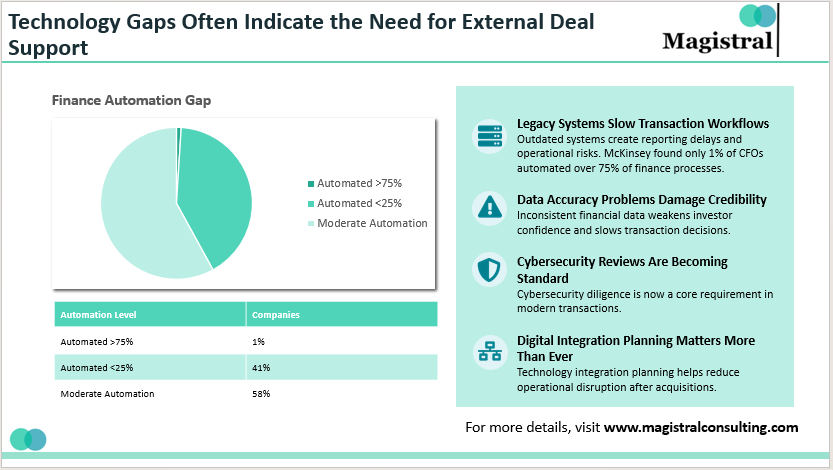
Companies operating legacy systems and utilizing fragmented reporting might experience various transaction execution issues. The use of manual processes poses additional risks to operations. According to McKinsey’s 2024 CFO Pulse research, just 1% of CFOs were able to automate more than three-quarters of their finance processes. Meanwhile, 41% of CFOs had automated up to a quarter of the functions. This technological discrepancy partially explains why many companies have difficulty producing accurate transaction data in a timely manner.
Data Accuracy Problems Damage Credibility
Discrepancies within financial data pose substantial credibility issues in the context of investor negotiations. The investors demand reliable and auditable information, backed up by effective business operations.
Firms that operate via many branches or globally must seek external deal support during deal negotiation to ensure financial data is accurately reported for analysis.
Cybersecurity Reviews Are Becoming Standard
Cybersecurity assessments have become an essential part of contemporary deals. Investors increasingly analyze cybersecurity protocols before making investment decisions.
Companies that lack internal cybersecurity capabilities may need external deal support during deal negotiations to coordinate cyber assessments and meet investors’ expectations.
Digital Integration Planning Matters More Than Ever
Modern digital integration is crucial for deal completion. Investors analyze software integrations, business scalability, and automation before concluding any business transaction.
Outside support agencies assist firms in assessing digital integration challenges and developing an implementation plan before concluding deals.
Magistral’s Services for External Deal Support
Magistral offers comprehensive external deal support services to private equity companies, investment banks, and asset management firms throughout the entire life cycle of deals. These services encompass target screening, industry/company analysis, financial modeling and valuation, due diligence help, investment memorandums drafting, competitive benchmarking, and deal flow management. Leveraging expert analysts’ support and customized engagement models, Magistral assists its clients in enhancing their efficiency, accelerating turnaround time, and managing their transaction workload effectively.
About Magistral Consulting
Magistral Consulting has helped multiple funds and companies in outsourcing operations activities. It has service offerings for Private Equity, Venture Capital, Family Offices, Investment Banks, Asset Managers, Hedge Funds, Financial Consultants, Real Estate, REITs, RE funds, Corporates, and Portfolio companies. Its functional expertise is around Deal origination, Deal Execution, Due Diligence, Financial Modelling, Portfolio Management, and Equity Research
For setting up an appointment with a Magistral representative visit www.magistralconsulting.com/contact
About the Author

Nitin is a Partner and Co-Founder at Magistral Consulting. He is a Stanford Seed MBA (Marketing) and electronics engineer with 19 + years at S&P Global and Evalueserve, leading research, analytics, and inside‑sales teams. An investment‑ and financial‑research specialist, he has delivered due‑diligence, fund‑administration, and market‑entry projects for clients worldwide. He now shapes Magistral Consulting’s strategic direction, oversees global operations, and drives business‑development support.
FAQs
What is external deal support?
When should a company consider external deal support?
How does external deal support improve transaction efficiency?
Is external deal support useful for mid-sized companies?
Can external deal support help during fundraising?