These services sort of sit right in the middle of data-driven investment decisions. With global equity markets now up past $125 trillion, fund managers, analysts, and corporate development teams really do need information that is accurate, timely, and not a moment late to make better calls. The investment research & equity research platform segment is forecast to climb from roughly $6.5 billion to about $11.5 billion between 2025 and 2029. This shows just how critical structured research has become. And yeah, whether you’re hunting for undervalued stocks, comparing yourself against competitors, or stress-testing financial models, it takes raw data and turns it into stronger conviction in your investments.
Thank you for reading this post, don't forget to subscribe!How do Investment Research & Equity Research influence portfolio decisions?
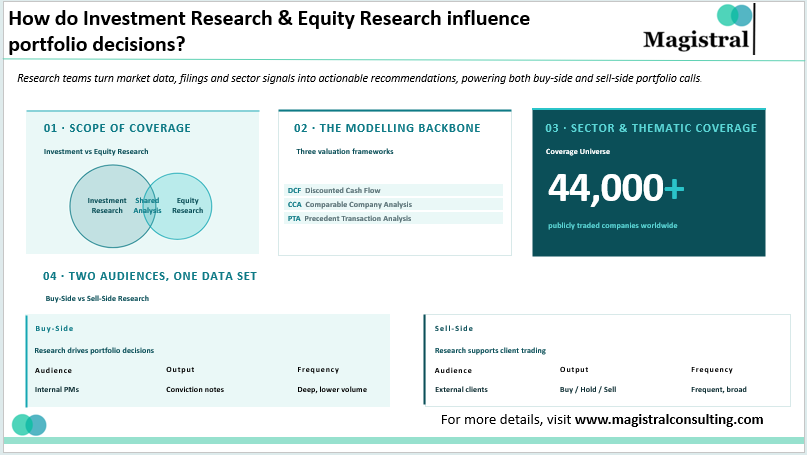
It quietly supports buy-side and sell-side teams. They bring together market data, financial filings, and sector signals, then turn that information into actionable recommendations.
How do Investment Research & Equity Research influence portfolio decisions?
The difference between investment research & equity research
It usually spans Fixed Income, alternative asset classes, macroeconomic trends, and ESG factors. Equity research primarily focuses on publicly traded companies. Equity analysts typically publish Buy, Hold, or Sell signals based on financial models, comparisons with rivals, and their views of management. Meanwhile, investment research helps set the broader macro investment thesis, and equity research then pinpoints which specific equities align with that thesis in practice.
The Role of Financial Modelling in Equity Research
The financial model is kind of the backbone of investment & equity research. Most firms use DCF approaches, comparable company techniques, and LBO frameworks to estimate a business’s intrinsic value and to identify pricing gaps. Magistral builds more tailored models and earnings analyses for hedge funds, asset managers, and investment banks.
Buy-Side vs Sell-Side Research
Sell-side analysts at investment banks produce research to support client trading, while buy-side analysts at asset managers use research to drive portfolio decisions. Both draw on the same core datasets but differ in audience, depth, and output frequency.
Sector and Thematic Coverage
Over 44,000 companies are publicly traded worldwide. Sector analysts monitor regulatory and competitive changes, while thematic researchers track cross-sector trends such as the energy transition and AI infrastructure, and their implications for fund portfolios.
Key Processes in Investment Research & Equity Research Workflows
You want structured processes, very clear deliverable formats, and steady quality checks if these workflows are going to work properly across the entire investment lifecycle, not just in one phase.
Primary and Secondary Research
Think market reports, earnings filings give the historical context, kind of the background that matters. Primary research then adds more colour, like management interviews and discussions with specialists. When you tie both together, analysts usually end up with a broader view of how a company sits competitively and what risks tend to ride along with that view, even when things get a bit messy.
Integrating ESG Considerations into Equity Research
ESG analysis has sort of moved beyond just being reputational, and it is now treated like a real valuation input. When you fold ESG into this analysis, it can move credit spreads, steer analyst ratings, and change how institutional investors apply their ownership thresholds. It’s a more direct linkage than people sometimes expect.
Risk Assessment and Scenario Analysis
Every investment research & equity research output should include a risk framework covering country risk, currency risk, regulatory risk, and macro sensitivity, stress-tested across bear, base, and bull scenarios.
Why Investment Research & Equity Research Outsourcing Is Accelerating?
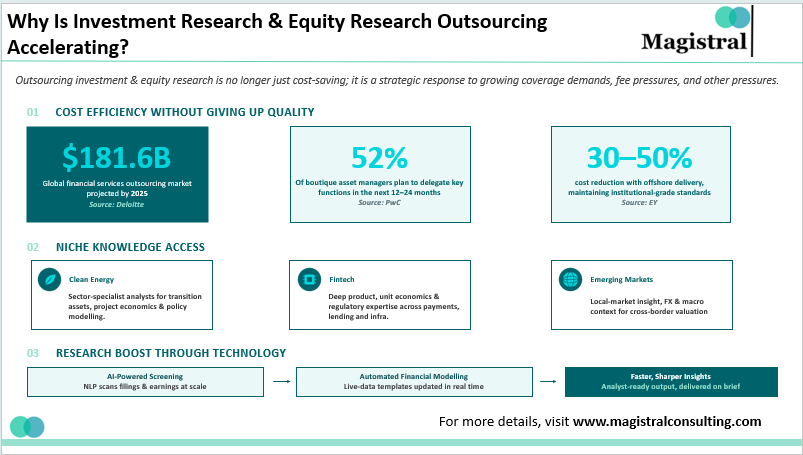
Outsourcing it is no longer just a cost-saving measure. It is a strategic response to growing coverage demands, fee pressure, and market complexity.
Why Is Investment Research & Equity Research Outsourcing Accelerating?
Cost efficiency without giving up quality
According to PwC, 52% of boutique asset managers plan to delegate key functions in the next 12–24 months to stay sharp. Offshore delivery models cut costs by 30–50% compared with onshore options while maintaining institutional-grade standards (EY). In the global financial services outsourcing space, the market is expected to reach $181.6 billion by 2025, and investment research is one of the fastest-growing segments in there (Deloitte).
Niche knowledge access
Some areas, like clean energy, fintech, and emerging markets, really need analysts with more than surface-level know-how. Magistral supports private equity research units by assigning dedicated specialists, who manage intricate valuations and competitive assessments, end-to-end.
Research boost through technology
Augmented delivery AI helps speed up data extraction, and it also drafts earnings summaries and sometimes supports sentiment analysis. When you do risk-sensitive evaluations, the right setup usually mixes AI efficiency with the judgment of seasoned professionals, so you end up with both velocity and command, in a way that feels steady.
Investment Research & Equity Research for Private Equity and Hedge Funds
Private equity and hedge funds have distinct investment research & equity research needs compared to traditional asset managers, driven by compressed deal timelines and the direct link between research outputs and underwriting assumptions and value creation plans.
Pre-deal research work and target company screening
Outsourced research partners add the most visible value during the pre-deal phase by delivering market sizing, competitive landscape summaries, and sector overviews that accelerate the investment committee process.
Support for due diligence
Investment research & equity research during due diligence go beyond just document review to include commercial validation plus customer reference checks, margin analysis, market mapping, and valuation support that ties back to the target returns.
Ongoing Portfolio Monitoring and value creation
After an investment closes, it’s not really “done”. The process carries on with continual monitoring of KPIs, competitive dynamics, and market shifts. Outsourced research teams, in parallel, keep a stable performance readout across several portfolio companies.
How Magistral Supports Investment Research & Equity Research at Scale
Magistral Consulting provides investment research & equity research support to private equity funds, hedge funds, asset managers, family offices, and investment banks, combining sector expertise, financial modelling depth, and scalable infrastructure. It builds DCF and LBO models, conducts quarterly earnings reviews, and runs scenario sensitivity analyses tailored to each client, updated on a defined cadence.
Magistral produces reports covering industry dynamics, competitive landscapes, and investment themes across technology, healthcare, financial services, energy, and consumer sectors.
Built on clear processes and scalable infrastructure, Magistral consistently outperforms approaches that rely on limited internal resources.
About Magistral Consulting
Magistral Consulting has helped multiple funds and companies in outsourcing operations activities. It has service offerings for Private Equity, Venture Capital, Family Offices, Investment Banks, Asset Managers, Hedge Funds, Financial Consultants, Real Estate, REITs, RE funds, Corporates, and Portfolio companies. Its functional expertise is around Deal origination, Deal Execution, Due Diligence, Financial Modelling, Portfolio Management, and Equity Research
For setting up an appointment with a Magistral representative visit www.magistralconsulting.com/contact
About the Author

Himank is an investment and financial analysis specialist with experience across private equity, investment banking, and research-driven engagements. An MBA (Tech) in Finance and BTech in Computer Science graduate from Narsee Monjee Institute of Management Studies, he focuses on financial modeling, valuation, and investment research. He supports project teams at Magistral Consulting, delivering LBO and DCF models, due diligence, investment memorandums, and deal origination support. His blend of analytical thinking, problem-solving ability, and structured approach enables him to translate complex financial data into actionable insights.
FAQs
What is the difference between investment research and equity research?
So which firms actually use investment research and equity research services?
How does outsourcing equity research help these investment firms?
What should a good equity research report include?
How is AI changing investment research and equity research?