Tag Archives: ESG risk management

The financial services industry, investment managers, and startups need to deliver rapid, clear, and investor-ready risk communication. Outsourced risk management reporting is not just about risk identification but rather about taking disparate information and converting it into dashboards, reports for boards, portfolio reports, regulatory reporting, covenant management, and investor communications. Outsourcing risk management reporting can help organizations cut down manual efforts, create better reporting frequency, and bring specialist expertise without building internal teams.

It is important because investor communications today require a proper answer to questions concerning credit, market, operational, liquidity, cybersecurity, environmental, social, governance, vendor, and model risks. Moreover, at the same time, there are changes in the way organizations are communicating risks due to AI deployment, governance requirements, and data volume.

Outsourced Risk Management Reporting Foundations and Context

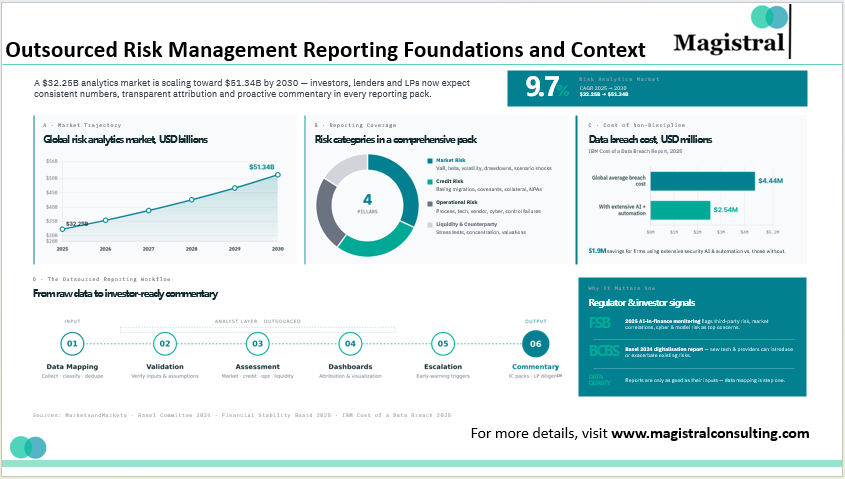
As per industry analysis, the global risk analytics market will increase from USD 32.25 billion in 2025 to USD 51.34 billion in 2030 at a CAGR of 9.7%. The rapidity with which organizations are making investment decisions in terms of better risk intelligence can be seen in this estimate. Outsourcing of risk management reporting is no longer an expense-driven decision in the back office of the organization. Outsourced risk management reporting is now an operational reality in those organizations that require risk visibility, documentation, and analyst capacity.
Outsourced Risk Management Reporting

Outsourced Risk Management Reporting Foundations and Context

What the Reporting Function Covers

Risk reporting is essentially the synthesis of the processes of risk identification, assessment, monitoring, escalation, and commentary. In a fund, outsourced risk management reporting can entail portfolio risk, drawdown analysis, liquidity stress testing, counterparty risk concentration, valuations, and investor-specific reports. In the case of banks and other lenders, risk reporting may entail dashboards on credit risk, early warning signals, non-performing asset flow, covenant violations, regulatory reporting, and operational losses.

In the context of investment funds, the quality of reporting is directly linked to investor confidence. Investors in a fund expect the numbers to be consistent, attribution to be transparent, and proactive risk commentary to be made before and even after outreach meetings.

Why Firms Are Moving Beyond Manual Reporting

Spreadsheets are still widely used, although version control, reconciliation problems, and different assumptions can occur. In the report from the Basel Committee in 2024 on the digitalisation of finance, it is stated that new technologies and technology providers may introduce additional risks or exacerbate existing ones.

This is the reason why organizations are shifting towards combining internal supervision with external implementation of reporting. Outsourced risk management reporting does not eliminate the responsibility of management. On the contrary, it provides an organized layer of analysts that can gather data, validate inputs, produce dashboards, and report on recurring observations.

Key Risk Categories Included

In a comprehensive reporting pack, there are typically two types of risk considered: financial and non-financial. Market risk encompasses price movements, volatility, beta, value at risk, scenario shocks, and drawdowns. Credit risk addresses borrower quality, rating migration, payment performance, collateral coverage, and covenants. Operational risks include process failures, technology breakdowns, vendor risks, cyber risks, and control risks.

Areas of concern identified by the Financial Stability Board in its 2025 efforts to monitor the effects of AI in the finance industry included third-party risks, market correlations, cyber risks, and model risk management. Outsourced risk management reporting helps make such risks more visible in investment committee packs, lender update meetings, LP diligence, and outbound investor outreach meetings.

Recent data from cyber-attacks further justifies the need for greater discipline in reporting. According to IBM’s 2025 Cost of a Data Breach Report, the global average cost of data breaches was $4.44 million, with the additional cost savings achieved by organizations with extensive security AI and automation estimated at $1.9 million compared to organizations lacking such capabilities.

Why Data Quality Matters

Risk reports are as good as the data that backs them up. Inaccurate data classification, outdated portfolio information, data duplication, inconsistency in labeling, or lack of supporting documents may hinder decision-making. This is why data mapping is often the first step in outsourced risk management reporting.

Magistral’s experience with its investor databases demonstrates the importance of organized, timely, and actionable data. Magistral’s investor database gets updated daily and contains investor types like LPs, GPs, angels, HNIs, and more, with contact and profile information suitable for reaching out directly to them. The same principles should apply to risk reporting: collect the necessary data, verify it, organize it, and make it actionable.

Applications and Use Cases for Outsourced Risk Management Reporting

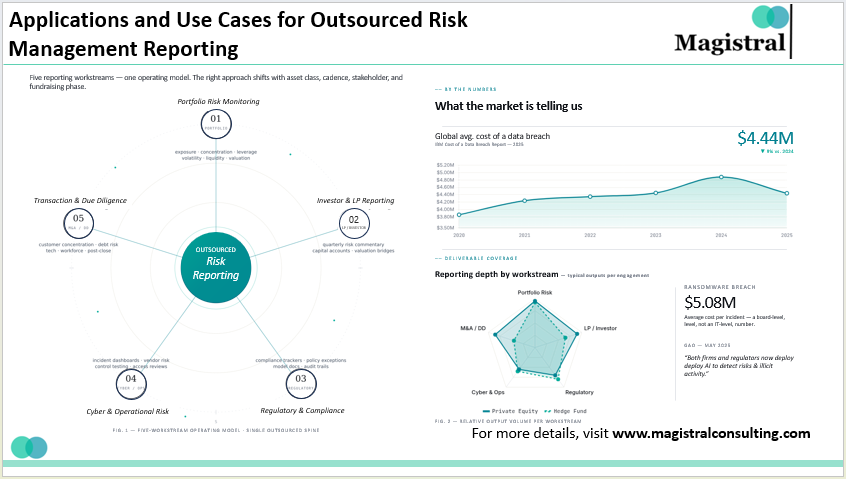
Outsourced risk management reporting facilitates various financial processes like monitoring of investments, preparation for regulations, and outreach to investors. Depending on the financial firm, the most efficient approach will vary based on the asset class, frequency of the reports, expectations of stakeholders, phase of fundraising, and available resources.
Outsourced Risk Management Reporting

Applications and Use Cases for Outsourced Risk Management Reporting

Portfolio Risk Monitoring

Investment firms employ outsourced risk reporting specialists to track portfolio risks like exposure, concentration, volatility, leverage, liquidity, and valuation risk. Through outsourced risk management reporting, private equity firms will focus on portfolio company key performance indicators dashboards, covenants, working capital, variances, and risk heat maps. Hedge funds will need to track performance attribution, risk position level, factors, and drawdowns.

This process provides an opportunity for partners and portfolio managers to get insight into risks in a consistent manner. They will be able to uncover potential problems before they affect the board, lenders, and investors in general terms.

Investor and LP Reporting

The first use case that comes to mind is investor reporting. LPs need transparency in volatile times or when the market performance does not match expectations. Outsourced risk management reporting can provide quarterly risk comments, portfolio performance comments, valuation bridges, capital accounts summary, follow-ups after investor outreach, and due diligence.

Magistral’s materials for fundraisers demonstrate how structured investor communication, CRM-driven outreach, monitoring, and reporting may improve investor relations. It provides live engagement dashboards showing the opens, clicks, and other investor behavior statistics. The same approach to reporting will help to enhance LP communication by being more structured, timely, and evidence based.

The benefit from the consistent outreach to the investors will be the consistent risk metrics used in the teasers, follow-up decks, data rooms, and LP update calls. It will minimize contradictions, save time, and increase confidence of the prospective investors in the reporting abilities of the manager.

Regulatory and Compliance Reporting

Regulated organizations have increasing expectations regarding explainability, audit trails, and governance. Automation and AI facilitate rapid reporting; however, they introduce new requirements for supervision. As pointed out by the U.S. Government Accountability Office in its May 2025 report, financial organizations utilize AI for automated trading, credit scoring, customer relations, and risk assessment activities, while regulators employ AI technology to discover risks and illegal activities associated with those organizations.

For regulated firms, outsourced risk management reporting can support compliance trackers, policy exceptions, regulatory artifacts, model documents, and problem resolution summaries. This is particularly true for organizations with small compliance departments.

Cyber and Operational Risk Reporting

Cyber risk has become a board and shareholder matter. According to the 2025 Cost of a Data Breach Report by IBM, the average global cost of a data breach has decreased 9% in 2025 to reach USD 4.44 million thanks to faster detection and response. The same report mentions that the average ransomware data breach cost was USD 5.08 million. It underlines that operational and cyber risk reporting cannot stay informal anymore.

Outsourced risk management reporting can assist in the creation of incident dashboards, vendor risk assessments, control testing summaries, access review logs, and remediation logs. These outputs can assist leaders in assessing whether the company’s operational risks increase, decrease, or persist.

Transaction and Due Diligence Risk Reporting

During M&A transactions, due diligence requires swift risk analysis. Acquiring entities need to evaluate the target’s customer concentration, revenue quality, debt risks, technological risks, workforce risks, compliance risks, and post-close integration risks.

Outsourced risk management reporting is especially useful when dealing with deal teams handling more than one workstream. It helps keep risk findings well organized and makes sure that important problems do not get lost amid emails or data rooms.

How Magistral Consulting Helps in Outsourced Risk Management Reporting

Magistral Consulting provides comprehensive support for investment firms, helping them deliver accurate, timely, and decision-ready reports. Our services include preparing risk dashboards covering portfolio, credit, market, liquidity, and compliance risks, along with portfolio monitoring, investor reporting, and CRM support. We also assist with compliance documentation, audit evidence, issue tracking, data validation, and reconciliation to ensure reporting accuracy.

By integrating it with fundraising activities, investor communications, and data room management, we help clients streamline operations and improve stakeholder confidence. Backed by experienced financial analysts and a global offshore delivery model, Magistral enables firms to enhance reporting quality, reduce operational costs, and scale efficiently without increasing in-house headcount.


About Magistral Consulting

Magistral Consulting has helped multiple funds and companies in outsourcing operations activities. It has service offerings for Private Equity, Venture Capital, Family Offices, Investment Banks, Asset Managers, Hedge Funds, Financial Consultants, Real Estate, REITs, RE funds, Corporates, and Portfolio companies. Its functional expertise is around Deal origination, Deal Execution, Due Diligence, Financial Modelling, Portfolio Management, and Equity Research

For setting up an appointment with a Magistral representative visit www.magistralconsulting.com/contact

About the Author

Nitin is a Partner and Co-Founder at Magistral Consulting. He is a Stanford Seed MBA (Marketing) and electronics engineer with 19 + years at S&P Global and Evalueserve, leading research, analytics, and inside‑sales teams. An investment‑ and financial‑research specialist, he has delivered due‑diligence, fund‑administration, and market‑entry projects for clients worldwide. He now shapes Magistral Consulting’s strategic direction, oversees global operations, and drives business‑development support.

FAQs

What is outsourced risk management reporting?

It is the use of an external finance and analytics team to prepare recurring risk dashboards, compliance trackers, investor updates, portfolio reports, and management summaries.

Why do firms outsource risk reporting?

Firms outsource to reduce manual workload, improve reporting speed, access specialist analysts, standardize templates, and support internal teams during quarter-end, audits, fundraising, or regulatory reviews.

Is outsourced risk management reporting suitable for funds?

Yes. It is useful for funds that need portfolio monitoring, LP reporting, exposure analysis, valuation support, CRM updates, and recurring investment committee packs.

How does AI improve risk reporting?

AI can help extract data, flag anomalies, summarize documents, and speed up dashboard preparation. However, human review remains necessary for judgment, accuracy, and governance.

How does Magistral support outsourced risk management reporting?

Magistral provides finance analysts, reporting templates, dashboard support, portfolio tracking, compliance documentation, investor reporting, and offshore execution to improve speed and reduce cost.


As global markets push for more differentiated risk management strategies and data-supported validation, the requirements of due diligence questionnaires continue to grow. Not only have regulations tightened, but there are also mounting crises around the world. Changes in technology are accelerating, and the number of business types is also growing and becoming more complex. The scope and sophistication of each questionnaire directly impact business outcomes and vary on existing complexity, linked to technological growth/development. Stakeholders envision a world where use of analytics and automation provides the speed, cost, time savings, and real-time risk management that enhance the questionnaires by 2025. Organizations that have redefined their approach to questionnaire design and execution are moving proactively to surface potential hazards and create value opportunities.

Understanding the Due Diligence Questionnaire

DDQs use a structured approach in the acquisition of the substantive information regarding the financial health, legal position, operational resiliency, cyber security, and ESG performance of a company. These have been found to be useful across organizations to assist risk assessment, offer a more uniform platform for disclosures, and finally arrive at fair judgments. Organizations find them useful for facilitating the risk assessment process, providing a more uniform method for disclosures, and ultimately making informed decisions.

According to PwC’s M&A Outlook 2023 report, 76% of failed deals listed inadequate due diligence as a key reason for the failure. This signifies the due diligence questionnaire is a critical part of completing successfully.

Current Market Trends and Data Insights in Due Diligence Questionnaire Usage

Recent market benchmarks indicate that global M&A deal openings increased by 12% year-on-year in 2024 with APAC seeing a 17% lift. The increase in volume increases the pressure, both for effective questionnaires, and fast turnaround from vendors. More organizations are turning to boutique ODD (operational due diligence) firms and technology consultants as partners to have additional capacity and resilience.

More organizations expect to see ‘digital completion’ and ‘automated review’ of their questionnaire, particularly with the context of regulated industries, cross-border transactions, and operational outsourcing.

Evolving Landscape: Why Modern Businesses Redefine the Due Diligence Questionnaire

Transformative business dynamics and more stringent regulations have now positioned the due diligence questionnaire as a key process to maintain an operational license to operate and be strategic supported. The traditional bastion of due diligence – a straightforward questionnaire has in recent years, left organisations ill-equipped to identify nuanced risks, or adapt to the real-time changes in their supplier or partner environment. In response, companies have utilised digital transformation and data-driven improvements to remedy these shortcomings.

Rise of Regulatory Complexity

The regulatory landscape has quickly evolved resulting in changes to compliance related questions a company has as it relates to its due diligence questionnaire.

Companies are being forced to include the varying updates of global data privacy legislations, anti-bribery legislation, and ESG (environmental, social, governance) requirements around the world into part of their due diligence assessment.

Dependence on Technology and Automation

Recent industry surveys show that using digital tools including artificial intelligence baseline standards and workflow automation have increased the speed and accuracy of prior response inquiries allowing for a more expedited questionnaire process.

Platforms, such as Datasite, allow risk signals to be flagged in real time and now users can integrate outputs of analytics to their compliance, monitoring, and risk scoring engines.

Extended Timeframes and Greater Depth

Market information from Datasite shows due diligence timelines in APAC have increased anywhere from 30-50 days for some markets in 2024, showing the importance of being able to capture all required disclosures and emerging risks in a structured questionnaire those use the due diligence process as thorough validation.

Technology Trends Transforming the Due Diligence Questionnaire

A major transformation in 2025 involves integration of analytics, artificial intelligence, and project management solutions within questionnaire administration.

Analytics for Real-Time Insights

Top organizations are employing analytics platforms to automate the review of questionnaires and the scoring of risk. These solutions help identify inconsistencies or overly optimistic information and provide clear signals for decision-making.

AI and Machine Learning

Artificial intelligence is increasingly improving questionnaires, such as identifying duplicate responses, suggesting follow-up questions, and placing documentary evidence into context. AI systems also help track all previous cycles of questionnaires, which increase the performance of future versions.

Cybersecurity Integration

As threat landscapes continue to broaden, DDQ platforms perform real-time monitoring of cyber risk with threat intelligence feeds providing existing compliance levels and flagging risks.

Technology Trends Transforming the Due Diligence Questionnaire

Technology Trends Transforming the Due Diligence Questionnaire

Essential Components: Structuring a High-Impact Due Diligence Questionnaire

Organizations are increasingly depending on a standardized, risk-based model for their questionnaire. Covering the core pillars of financials, operational health, cyber security, ESG responsibilities.

Financials and Operational Health

A well-structured questionnaire will provide transparency into financial statements, internal controls reports, audit history, and cash flows. Best practices favour transparency and documentation, including auditor reports, profit margins, and relevant insurance coverage.

Legal Compliance

Legal questions focus on completed and pending litigation, contract validity, and intellectual property protections. For M&A or vendor scenarios, questions on anti-corruption and export controls should also be included. This ensures the company’s legal standing and meets the legal obligations of noting adherence to applicable laws.

Cybersecurity and Data Protection

Modern conceptualizations of questionnaires will dwell on IT governance, access management, encryption protocols, and breach notification processes. Adherence to globally recognized standards, such as ISO 27001, NIST, or SOC 2 compliance, is increasingly becoming a must. This is an opportunity to minimize the risk of cyber or data threats and be in a position where the company could manage events to safeguard its information appropriately

ESG and Sustainability Criteria

In 2025, the best practice will include ESG as part of the questionnaire in accordance with investor, regulator, and societal demands for transparency and accountability. Questions about environmental compliance, sustainability initiatives, and governance practices should be present. The purpose is to also ensure that the company complies with global standards and is also prepared for (regulatory) future changes.

Emerging Best Practices for Due Diligence Questionnaire Excellence

Top organizations are refining their questionnaire processes to improve quality, efficiency, and auditability.

Centralizing Risk Data

Consolidating all questionnaire outputs and supporting documentation into a centralized data repository or “single source of truth” improves transparency.  Offers the ability for rapid access to information across the organization, ensuring that it is done consistently.

Emerging Best Practices for Due Diligence Questionnaire Excellence

Emerging Best Practices for Due Diligence Questionnaire Excellence

Standardizing and Updating Questions

Firms can standardize template forms and question sets, taking into consideration industry, risk profile, and jurisdiction. Thereby eliminating redundancy and ensuring compliance with revisions to relevant regulations and/or internal policies.

Risk Scoring and Automated Red Flagging

Integrating risk matrices into the questionnaire process allows organizations to focus resources on the highest-risk areas and initiate immediate escalation for identified “red flags”.

Real-Time Monitoring and Continuous Diligence

DDQ frameworks are increasingly facilitating ongoing monitoring. Enabling organisations to receive timely alerts of any changes to the risk status of third-parties or market conditions.

About Magistral Consulting

Magistral Consulting has helped multiple funds and companies in outsourcing operations activities. It has service offerings for Private Equity, Venture Capital, Family Offices, Investment Banks, Asset Managers, Hedge Funds, Financial Consultants, Real Estate, REITs, RE funds, Corporates, and Portfolio companies. Its functional expertise is around Deal origination, Deal Execution, Due Diligence, Financial Modelling, Portfolio Management, and Equity Research

For setting up an appointment with a Magistral representative visit www.magistralconsulting.com/contact

About the Author

Aman is an investment-research specialist with 5+ years of experience across business and investment research, including 2+ years with Big Four firms like KPMG. A Stanford Seed alumnus with an MBA in Finance and a Bachelor of Commerce (Hons) from University of Delhi, he focuses on private equity, venture capital, and renewable energy sectors. He leads project teams at Magistral Consulting, delivering financial research, due diligence, deal sourcing, and M&A support, while driving strong process management and analytics. His blend of attention to detail, strategic thinking, and dynamic execution enables him to turn complex data into actionable investment insights.


FAQs

What is the main purpose of a due diligence questionnaire?

This gathers critical information about financial health, legal compliance, and risk management to help organizations evaluate business partners, investments, or acquisitions effectively.


How are technology and AI transforming the DDQ in 2025?

Artificial intelligence and analytics platforms now automate much of the process, flag risks in real time, and reduce manual tasks, resulting in faster, more accurate questionnaire completion.


What areas does a standard DDQ cover?

It usually spans financial data, operational practices, legal matters, cybersecurity controls, and increasingly, ESG criteria.


How often should companies update their questionnaire template?

Best practice is to review and update the template annually or whenever major regulatory, industry, or market changes occur.


Are industry benchmarks available for DDQ process efficiency?

Yes. Many consulting firms and industry platforms provide annual benchmarks covering adoption rates of automation, average completion times, and error rates, allowing organizations to compare their processes with peers.