Tag Archives: financial due diligence

As global markets push for more differentiated risk management strategies and data-supported validation, the requirements of due diligence questionnaires continue to grow. Not only have regulations tightened, but there are also mounting crises around the world. Changes in technology are accelerating, and the number of business types is also growing and becoming more complex. The scope and sophistication of each questionnaire directly impact business outcomes and vary on existing complexity. It is also linked to technological growth/development. Stakeholders envision a world where use of analytics and automation provides the speed, cost, time savings, and real-time risk management. It enhances the questionnaires by 2025. Organizations that have redefined their approach to questionnaire design and execution are moving proactively to surface potential hazards and create value opportunities.

Understanding the Due Diligence Questionnaire

DDQs use a structured approach in the acquisition of the substantive information regarding the financial health, legal position, operational resiliency, cyber security, and ESG performance of a company. These have been found to be useful across organizations to assist risk assessment, offer a more uniform platform for disclosures, and finally arrive at fair judgments. Organizations find them useful for facilitating the risk assessment process, providing a more uniform method for disclosures, and ultimately making informed decisions. According to PwC’s M&A Outlook 2023 report, 76% of failed deals listed inadequate due diligence as a key reason for the failure. This signifies the due diligence questionnaire is a critical part of completing successfully.

Current Market Trends and Data Insights in Due Diligence Questionnaire Usage

Recent market benchmarks indicate that global M&A deal openings increased by 12% year-on-year in 2024 with APAC seeing a 17% lift. The increase in volume increases the pressure, both for effective questionnaires, and fast turnaround from vendors. More organizations are turning to boutique ODD (operational due diligence) firms and technology consultants as partners to have additional capacity and resilience.

More organizations expect to see ‘digital completion’ and ‘automated review’ of their questionnaire, particularly with the context of regulated industries, cross-border transactions, and operational outsourcing.

Evolving Landscape: Why Modern Businesses Redefine the Due Diligence Questionnaire

Transformative business dynamics and more stringent regulations have now positioned the due diligence questionnaire as a key process to maintain an operational license to operate and be strategic supported. The traditional bastion of due diligence – a straightforward questionnaire has in recent years, left organisations ill-equipped to identify nuanced risks, or adapt to the real-time changes in their supplier or partner environment. In response, companies have utilised digital transformation and data-driven improvements to remedy these shortcomings.

Rise of Regulatory Complexity

The regulatory landscape has quickly evolved resulting in changes to compliance related questions a company has as it relates to its due diligence questionnaire. Companies are being forced to include the varying updates of global data privacy legislations, anti-bribery legislation, and ESG (environmental, social, governance) requirements around the world into part of their due diligence assessment.

Dependence on Technology and Automation

Recent industry surveys show that using digital tools including artificial intelligence baseline standards and workflow automation have increased the speed and accuracy of prior response inquiries allowing for a more expedited questionnaire process. Platforms, such as Datasite, allow risk signals to be flagged in real time and now users can integrate outputs of analytics to their compliance, monitoring, and risk scoring engines.

Extended Timeframes and Greater Depth

Market information from Datasite shows due diligence timelines in APAC have increased. This is anywhere from 30-50 days for some markets in 2024. This shows the importance of being able to capture all required disclosures and emerging risks in a structured questionnaire. They then use the due diligence process as thorough validation.

Technology Trends Transforming the Due Diligence Questionnaire

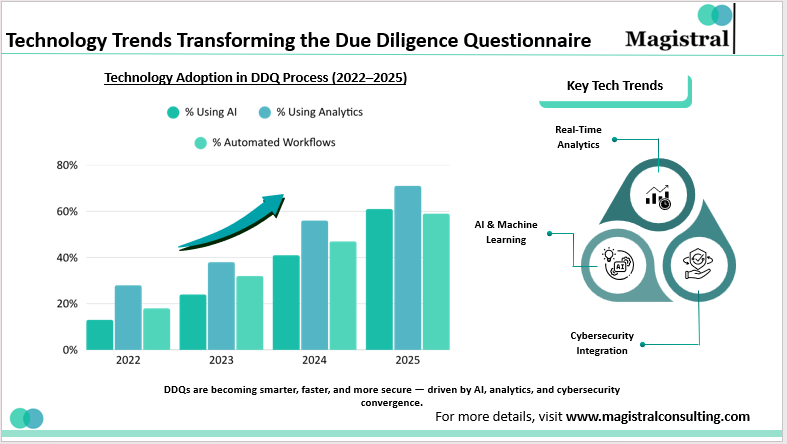
A major transformation in 2025 involves integration of analytics, artificial intelligence, and project management solutions within questionnaire administration.
Technology Trends Transforming the Due Diligence Questionnaire

Technology Trends Transforming the Due Diligence Questionnaire

Analytics for Real-Time Insights

Top organizations are employing analytics platforms to automate the review of questionnaires and the scoring of risk. These solutions help identify inconsistencies or overly optimistic information and provide clear signals for decision-making.

AI and Machine Learning

Artificial intelligence is increasingly improving questionnaires, such as identifying duplicate responses, suggesting follow-up questions, and placing documentary evidence into context. AI systems also help track all previous cycles of questionnaires, which increase the performance of future versions.

Cybersecurity Integration

As threat landscapes continue to broaden, DDQ platforms perform real-time monitoring of cyber risk. It also deals with threat intelligence feeds providing existing compliance levels and flagging risks.

Essential Components: Structuring a High-Impact Due Diligence Questionnaire

Organizations are increasingly depending on a standardized, risk-based model for their questionnaire, covering the core pillars of financials, operational health, cyber security, ESG responsibilities.

Financials and Operational Health

A well-structured questionnaire will provide transparency into financial statements, internal controls reports, audit history, and cash flows. Best practices favour transparency and documentation, including auditor reports, profit margins, and relevant insurance coverage.

Legal Compliance

Legal questions focus on completed and pending litigation, contract validity, and intellectual property protections. For M&A or vendor scenarios, questions on anti-corruption and export controls should also be included. This ensures the company’s legal standing and meets the legal obligations of noting adherence to applicable laws.

Cybersecurity and Data Protection

Modern conceptualizations of questionnaires will dwell on IT governance, access management, encryption protocols, and breach notification processes. Adherence to globally recognized standards, such as ISO 27001, NIST, or SOC 2 compliance, is increasingly becoming a must. This is an opportunity to minimize the risk of cyber or data threats. It also helps in a position where the company could manage events to safeguard its information appropriately

ESG and Sustainability Criteria

In 2025, the best practice will include ESG as part of the questionnaire. It is in accordance with investor, regulator, and societal demands for transparency and accountability. Questions about environmental compliance, sustainability initiatives, and governance practices should be present. The purpose is to also ensure that the company complies with global standards and is also prepared for (regulatory) future changes.

Emerging Best Practices for Due Diligence Questionnaire Excellence

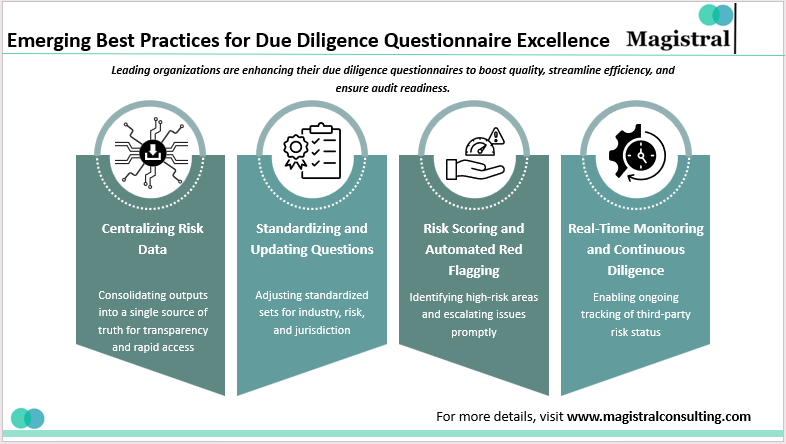
Top organizations are refining their questionnaire processes to improve quality, efficiency, and auditability.
Emerging Best Practices for Due Diligence Questionnaire Excellence

Emerging Best Practices for Due Diligence Questionnaire Excellence

Centralizing Risk Data

Consolidating all questionnaire outputs and supporting documentation into a centralized data repository or “single source of truth”. It improves transparency and offer the ability for rapid access to information across the organization, ensuring that it is done consistently.

Standardizing and Updating Questions

Firms can standardize template forms and question sets, taking into consideration industry, risk profile, and jurisdiction. Thereby eliminating redundancy and ensuring compliance with revisions to relevant regulations and/or internal policies.

Risk Scoring and Automated Red Flagging

Integrating risk matrices into the questionnaire process allows organizations to focus resources on the highest-risk areas and initiate immediate escalation for identified “red flags”.

Real-Time Monitoring and Continuous Diligence

DDQ frameworks are increasingly facilitating ongoing monitoring enabling organisations to receive timely alerts of any changes to the risk status of third-parties or market conditions.

About Magistral Consulting

Magistral Consulting has helped multiple funds and companies in outsourcing operations activities. It has service offerings for Private Equity, Venture Capital, Family Offices, Investment Banks, Asset Managers, Hedge Funds, Financial Consultants, Real Estate, REITs, RE funds, Corporates, and Portfolio companies. Its functional expertise is around Deal origination, Deal Execution, Due Diligence, Financial Modelling, Portfolio Management, and Equity Research

For setting up an appointment with a Magistral representative visit www.magistralconsulting.com/contact

About the Author

Akansha is a Stanford Seed alum with an MBA (Finance & Operations) and B.Com (Hons). She delivers business and financial research for PE/VC and investment banking clients. Experience spans fundraising, M&A support, deal sourcing, consolidation accounting, supply chain analysis, and CRM-led outreach. Known for meticulous detail and fast learning, she turns analysis into investor-ready decisions.
FAQs

What is the main purpose of a due diligence questionnaire?

This gathers critical information about financial health, legal compliance, and risk management to help organizations evaluate business partners, investments, or acquisitions effectively

How are technology and AI transforming the DDQ in 2025?

Artificial intelligence and analytics platforms now automate much of the process, flag risks in real time, and reduce manual tasks, resulting in faster, more accurate questionnaire completion

What areas does a standard DDQ cover?

It usually spans financial data, operational practices, legal matters, cybersecurity controls, and increasingly, ESG criteria

How often should companies update their questionnaire template?

Best practice is to review and update the template annually or whenever major regulatory, industry, or market changes occur

Are industry benchmarks available for DDQ process efficiency?

Yes. Many consulting firms and industry platforms provide annual benchmarks covering adoption rates of automation, average completion times, and error rates, allowing organizations to compare their processes with peers

When it comes to mergers, acquisitions and every investment decision, financial due diligence is important to ensure undertaking the transaction. Review of financials does not only mean checking the balance sheets and cash flow statements; rather it is more of an investigation that seeks the risks, the irregularities, and the prospects that may be hidden in the company. Furthermore, it assures that the figures in the financial reports correspond to the true state of the company and that potential investors have all the information they need. A due diligence process can either support the soundness of the acquisition or expose costly hairs that could have been expensive if overlooked.

Therefore, it can be concluded that financial due diligence is essential in assessing the financial position of the target and provides a basis for making deal decisions.


Audit vs Due Diligence

An audit is an external examination of a company’s financial statements, which is conducted in detail by professional auditors to check the accuracy and conformity to the accepted standards (for example: GAAP or IFRS). Historical financial information is the primary focus of the audit, establishing whether there are any inaccuracies, and validating compliance with the law. The result is an opinion given on the outcome of the audit.

Due diligence, on the other hand, is an intricate and original search that is often used in the course of mergers, acquisitions, or investments. This includes not only the financials but operations, legal aspects, and risks as well to assess how fit a business is. It is intended to mitigate risks, check the truth of the statements made about the target and its prospects, and assist in making decisions related to the transaction.

Therefore, audits pay more attention to the financial figures and their legality while due diligence looks at the overall transaction in terms of business viability and risks.


Impact on Deal Structuring

The outcome of the value assessment in M&A transactions involves adjusting the purchase price based on findings from financial due diligence. When serious adverse financial conditions are revealed, the buyer may lower the offer and negotiate additional warranties, earn-out provisions, or insurance to mitigate risk. Understanding these risks allows both parties to formulate more competitive and cohesive transaction structures. This process emphasizes the critical role of due diligence in ensuring informed decision-making and effective negotiation in M&A deals​.

Financial Due Diligence

Financial Due Diligence’s Impact on Deal Structuring

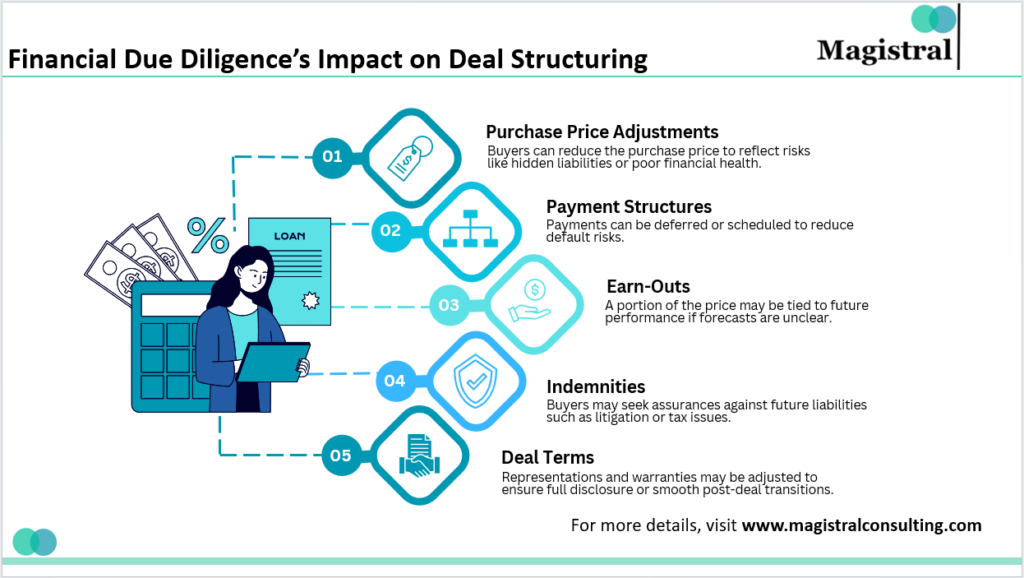
Financial due diligence is perhaps an area that has both transformed and influenced the deal structuring by the risks it exposes and where there is negotiation. The most important aspects that are influenced include:

Purchase Price Adjustments

In the case of underlying risk elements such as hidden liabilities or poor financial health, a buyer is allowed to mark down the price in order to mirror such risks.

Indemnities

Sometimes buyers will insist on some form of assurance that they will not be affected by uncovered risks in the future like litigation that could be occasioned by debt obligations or taxes.

Earn-Outs

If future forecasts are not clear, a portion of the larger purchase price could be linked to later results, thereby minimizing the chances of paying too much.

Payment Structures

It may be suitable to postpone or schedule the payment to minimize the possibilities of defaults.

Deal Terms

Even representations and warranties may be altered to protect against nondisclosure or no disruption after the transaction has taken place.

Future Trends in Financial Due Diligence

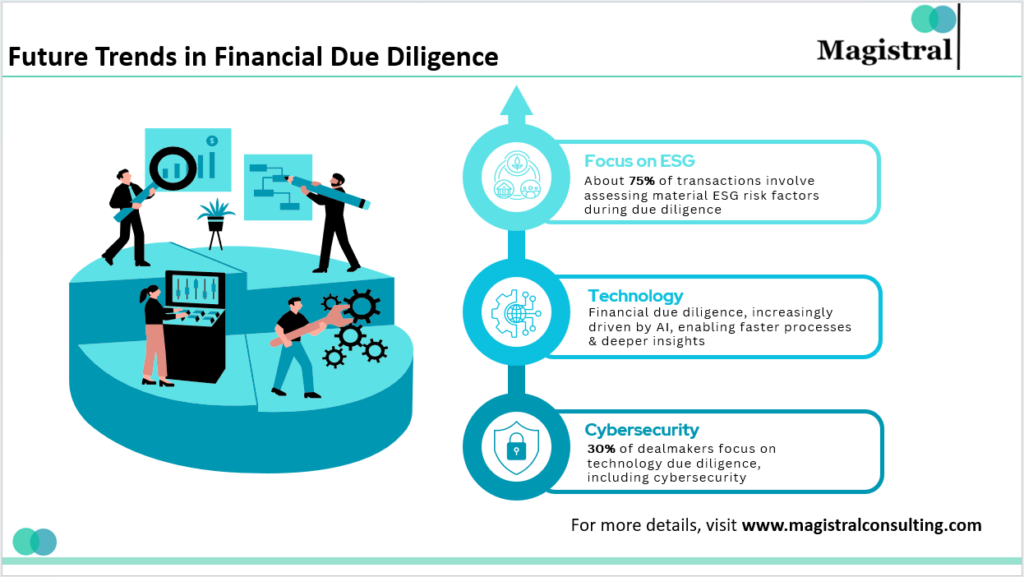
The landscape of financial due diligence is evolving rapidly. Some future trends include:

Financial Due Diligence

Future Trends in Financial Due Diligence

Increased Focus on ESG (Environmental, Social, and Governance)

Today, it is becoming increasingly evident that due diligence is not purely financial. Investors are becoming more aware and concerned about how companies deal with these factors. Research indicates that the influence of ESG risk on the value of a transaction is significant. As many as 74% of transactions include a due diligence element where material ESG risk factors are assessed and uncovered. Such tendencies are common in Europe with 71% of the respondents expecting more emphasis to be placed on ESG aspects of the due diligence engagements. ESG maturity is beneficial to valuation; it can translate into valuation uplift of 6-11% for the company.

Cybersecurity

The danger posed by cyber threats has increased; this has also made it necessary to consider the cybersecurity structure of the company being evaluated financially. Statista 2023 reported that 30 percent of dealmakers covered technology due diligence as a key focus area, with cybersecurity included. This is mainly due to the risks associated with data breaches when it is necessary to keep private matters such as financial and operational information within a few individuals during the course of a deal.

Technology-Driven Processes

Financial due diligence in today’s world is being improved by the introduction of AI and advanced analytical capabilities. With the help of automation tools and insights that are powered by AIs, due diligence processes can be executed in shorter durations with better-elaborated analysis of firms’ financial performance. These technologies are already transforming the process; providing quick and higher levels of information for the decision-makers.

Regional Variations in Financial Due Diligence

Financial due diligence trends vary by region due to differences in market maturity, regulatory environments, and economic conditions.

North America

In this region, financial due diligence mostly spotlights openness and transparency, especially in situating disguised debts, tax requirements, and capital liquidity. The US in particular stands out due to its intense expectations on legal frameworks of operation, hence a careful holistic check of laws and financial matters is required by firms.

Europe

With due diligence extending its definition, many of the practices observed in financial due diligence in the European countries are greatly centered on the legislations of various states. As there are many transactions in the UK post-Brexit, cross-border due diligence has also become a prevalent practice of late. The issue of ESG factors has also started emerging as an important agenda in this region.

Asia-Pacific

Financial due diligence in countries such as China and India face a heightened level of risk because the accounting standards and the regulatory environment there are not very transparent. Financial due diligence in this part of the world tends to drill down more on specific aspects, such as looking at the costs of doing business as well as local financial reporting standards, taxation, and the potential growth of a given market.

Middle East & Africa

These regions present more difficulties in carrying out financial due diligence buy-sided for instance due to lower-developed financial systems and differing regulatory practices. Usually, in addition to the standard financial metrics, the political and economic assessment considering the local conditions will be included in the financial due diligence more.

Magistral’s Services for Financial Due Diligence

Magistral Consulting provides all-encompassing financial due diligence services to tackle mergers and acquisitions. Our strategy aims to present better views on financial information of prospective companies, and their competitive surroundings. Services offered by Magistral are as follows:

Comprehensive Financial Analysis

The scope of work entails the evaluation of the financial statements like the balance sheet(s), income statement(s), and cash flow statement(s) with the view to analyze the financial position and operating trend of the subject company.

Risk Assessment and Mitigation

The range of financial risks, such as undisclosed debt, tax or regulatory risks, and other related issues that are likely to be encountered during the course of the transaction, before and after closings are looked into by our team, including how to deal with them.

Quality of Earnings Analysis

Investors are often wary of the reported number without understanding the revenue, expenses, and what’s called ‘non-recurring’ adjustments with respect to the targets earnings, thus gauging the quality and reliability of the targets earnings.

Valuation Assistance

In this case, we assist in establishing the market price of the target company by employing several approaches to valuation like the Discounted Cash Flow (DCF) or Comparable Company Analysis so that the investors don’t make incorrect pricing.

Post-Transaction Integration Planning

In regard to completing a deal, we help the clients develop financial integration strategies to ensure that the financial systems and processes as well as reporting are properly integrated and aligned with that of the buyer.


About Magistral Consulting

Magistral Consulting has helped multiple funds and companies in outsourcing operations activities. It has service offerings for Private Equity, Venture Capital, Family Offices, Investment Banks, Asset Managers, Hedge Funds, Financial Consultants, Real Estate, REITs, RE funds, Corporates, and Portfolio companies. Its functional expertise is around Deal origination, Deal Execution, Due Diligence, Financial Modelling, Portfolio Management, and Equity Research

For setting up an appointment with a Magistral representative visit www.magistralconsulting.com/contact

About the Author

The article is authored by the Marketing Department of Magistral Consulting. For any business inquiries, you can reach out to prabhash.choudhary@magistralconsulting.com

Financial due diligence is crucial as it helps buyers make informed decisions by revealing the true financial position of the target company. It can identify hidden liabilities, assess financial health, and uncover opportunities, thereby preventing costly mistakes in the transaction process.

Key components typically include reviewing historical financial statements, assessing cash flows, evaluating operational efficiency, conducting industry analysis, and identifying potential risks or irregularities. It may also involve preparing due diligence questionnaires and investment memorandums.

Findings from financial due diligence can significantly influence the purchase price and terms of the deal. Buyers may negotiate price adjustments, additional warranties, earn-out provisions, or alternative payment structures to mitigate risks uncovered during the due diligence process.

Future trends include a growing emphasis on Environmental, Social, and Governance (ESG) factors, increased focus on cybersecurity assessments, and the use of technology-driven processes such as AI and automation to enhance the efficiency and accuracy of due diligence efforts.