Tag Archives: fund accounting services

Fund accounting outsourcing has become a strategic necessity, not just a cost-saving choice. From 2024 to 2026, it is the preferred model for fund managers facing tighter regulatory and reporting demands due to complex products like private markets, semi-liquid vehicles, and private credit. With increased demands for faster and more transparent investor reporting, fund accounting, NAV production, and investor reporting are now seen as critical infrastructure that must be both accurate and timely by LPs, regulators, and internal teams.

And this is something very hard to accomplish consistently with small in-house teams. Especially when working through multiple jurisdictions, time zones, and asset classes. Hence, Fund accounting outsourcing is speeding up as managers look to scale their operations without adding new staff.

Fund Accounting Outsourcing: The Metrics That Show Outsourcing Is Gaining Ground

Signal metrics of Fund accounting outsourcing and adjacent middle-/back-office delegation were sometimes difficult to spot, but, nevertheless, there are a few:

The level of outsourced middle-office activity is increasing very quickly. According to a report, the amount of outsourced treasury transactions processed has increased by 27% year-on-year, almost reaching US$2 trillion in 2024, a clear indicator of the ongoing transition toward specialist third-party operating models across fund operations.

The large administrators are not only but also very significantly increasing fund servicing volumes. For the third quarter of 2025, BNP Paribas Securities Services announces having US$3.4 trillion assets under administration (AuA), which is an increase of +8.3% compared to Q3 2024. Moreover, the company handles 9,747 funds, which is a 6.0% rise, and has settled 158.7 million transactions in 2024 (+10.1% compared to 2023). These figures become a clear indicator of the increasing operational throughput that service providers are able to manage.

The private markets along with the private debt are still taking up a lot of work in the operational side. McKinsey has made an example that, the total amount of global private debt fundraising has decreased by 22% in 2024 to US$166B, while the industry continues to change in terms of structures and capital sources, which is leading to more complexity in valuation, cash movements, and reporting, which is the primary reason.

Regulatory Changes in Europe

The timeline of regulatory changes in Europe is putting pressure on the operating models. AIFMD II came into force in April 2024 and must be incorporated by EU states by 16 April 2026, with further evolution of reporting (including Annex IV changes) coming afterwards, resulting in managers needing to professionalize delegation oversight, liquidity reporting, and operational documentation.

Fund Accounting Outsourcing: The Metrics That Show Outsourcing Is Gaining Ground

Fund Accounting Outsourcing: The Metrics That Show Outsourcing Is Gaining Ground

To sum up: these trends are not merely “outsourcing-friendly” but also scale and risk control trends. Fund accounting outsourcing is at the crossroads of these trends.

Data Insights: Driving Demand for Fund Accounting Outsourcing

The global fund administration outsourcing market size reached ≈ USD 11.2 billion in 2024.

It is projected to grow at a compounded annual growth rate (CAGR) of ~7.8% from 2025 through 2033, reaching an estimated USD 22.1 billion by 2033.

Data Insights: Driving Demand for Fund Accounting Outsourcing

Data Insights: Driving Demand for Fund Accounting Outsourcing

Complexity is compounding (not just increasing)

The complexity is not just increasing, but compounding. Modern funds have more assets and get more events and exceptions: side pockets, multi-currency share classes, co-invest vehicles, continuation structures, private credit cash-flow waterfalls, frequent investor communications, and tighter audit trails.

When the private-market activity comes back but not uniformly (some strategies are being active while others are still slow), then the operations teams face lumpy peaks—this is the kind of workload volatility that makes a fixed in-house model inefficient.

Speed-to-close and speed-to-report are now competitive advantages

Fund managers want:

Rapid month-end/quarter-end closing

NAV cycles with fewer reconciling delays

Swifter turnaround of investor statements

More trustworthy “same-day” replies to LP inquiries

The service providers have developed robust processes and platforms that deliver such performance consistently. It is difficult to emulate this internally without making substantial investments in systems.

Provider scale is real and measurable

The servicing footprint of large administrators is an important marker of the trend the industry is taking. When one provider discloses US$3.4T AuA, about 10k funds, and 158.7M settlements done in a year, it indicates that more and more funds are willing to trust operating partners at such a scale outside their own.

Jurisdictional growth increases operational burden

Fund-domicile ecosystems, which are the dominant locations for global fund formation.  Luxembourg, Ireland, Cayman are constantly adding up the “scale” data that corresponds to the size of the administrative infrastructure as well as the number of funds and their volumes:

Luxembourg (CSSF)

Net assets of supervised UCIs have been constantly about €5.5–€5.7T (e.g., according to CSSF statistics, €5,582.3bn in June 2024 and €5,659.5bn in September 2024).

Cayman (CIMA)

The number of regulated funds is huge, and the activity of the funds is tracked; as an illustration, Cayman provides quarterly figures, for instance, 9,024 registered mutual funds (Q3 2025), in addition to other fund categories (master funds, licensed funds, etc.).

Ireland (Central Bank of Ireland)

The authority releases thoroughly detailed investment fund statistics every quarter as well as public statements revealing the size and structure of the industry.

Regional Insights

Where Outsourcing Momentum Is Strongest (and why)

North America

In the United States, alternatives are still the main driver for growth (private equity, private credit, infrastructure, secondaries). The operational emphasis is progressively on speed, accuracy, and investor servicing, particularly for companies having several products with small staff. The situation in private debt is that demand for liquidity is high, and a lot of financing deals are coming up, thus, the areas of cash flow operations and valuation discipline are becoming very critical. The realism of outsourcing: hybrid models (retain control + make corner decisions internal; hire outsource for production + reconciliation + reporting ops).

Europe (Luxembourg, Ireland, UK relevance)

Europe is significantly influenced by regulatory timelines and the domicile ecosystems:

AIFMD II timeline pressure

The deadline for implementing the regulation into the national laws is 16 April 2026 (latest), which causes the managers to deal with tightening of delegation oversight, liquidity governance (for certain strategies), and operational documentation in advance.

Luxembourg scale and infrastructure

According to CSSF statistics, multi-trillion-euro net assets and thousands of vehicles are in the ecosystem where professional administration is the norm instead of the exception.

Ireland’s reporting-rich environment

The quarterly releases from the Central Bank are very detailed and reflect a mature, data-driven regulatory ecosystem that supports the case for the need of robust operational partners.

Fund Accounting Outsourcing Services by Magistral

Magistral Consulting offers professional Fund accounting outsourcing services to help investor companies run smoothly. We compose regular reports, capital account statements, and detailed summaries of performance. The services include-

Financial Statements Preparation

We provide monthly and quarterly financial reports that conform to either GAAP or IFRS standards. We streamline the client audit process by working hand in hand with auditors.

Regulatory And Tax Compliance Services

We take care of compliance filings, such as FATCA, CRS, and Form PF, create investor tax reports such as K-1s, and collaborate with tax advisors. Besides, compliance monitoring gives assurance of alignment with regulatory requirements pertinent to specific funds, helping mitigate operational risks.

Performance Reporting and Analytics

With Performance Reporting & Analytics, we offer a deep performance analysis, with metrics like IRR and ROI for the evaluation of the fund performance by any organization.

Investor Relations Support

From communicating the notices for capital calls and distribution to answering investor queries. We ensure flawless communication and thereby build trust with accurate, timely, and clear updates.


About Magistral Consulting

Magistral Consulting has helped multiple funds and companies in outsourcing operations activities. It has service offerings for Private Equity, Venture Capital, Family Offices, Investment Banks, Asset Managers, Hedge Funds, Financial Consultants, Real Estate, REITs, RE funds, Corporates, and Portfolio companies. Its functional expertise is around Deal origination, Deal Execution, Due Diligence, Financial Modelling, Portfolio Management, and Equity Research

For setting up an appointment with a Magistral representative visit www.magistralconsulting.com/contact

About the Author

Tanya is an investment-research specialist with 6 + years advising venture-capital, private-equity and lending clients worldwide. A Stanford Seed alumnus with an MBA and an Economics (Hons) degree, she heads project teams at Magistral Consulting, delivering financial modelling, due-diligence and deal support on 3,000 + mandates. Her blend of rigorous analytics, sharp project management and clear client communication turns complex data into actionable investment insight.

FAQs

What is Fund accounting outsourcing?

It’s delegating NAV, books/records, and investor reporting operations to a specialist third-party while retaining oversight internally

Is outsourcing only for small funds?

No, large managers also outsource to scale across products and jurisdictions without adding fixed headcount

Does outsourcing reduce risk?

It can, if paired with strong oversight, controls, SLAs, and clear escalation governance

What services are typically included?

NAV, reconciliations, investor allocations/statements, reporting packs, and audit support (often with treasury/reg reporting add-ons)

How do I choose the right provider?

Prioritize domain expertise (asset class), controls, service model, tech integration, and demonstrated scale, not just price


Fund accounting services remain the backbone of financial clarity and regulatory compliance in the investment industry. The state of fund accounting has surpassed traditional back-office functions. Now, it is a critical strategic role that guarantees the integrity of financial reporting, supports regulatory compliance, and enhances investor confidence.

Investment firms are scrutinized by regulators and stakeholders, so it has made the accountability of funds inevitable. This encompasses proper care to be taken in the direct handling of all financial data; hence follow the brief of tracking in and out of capital flows, calculating the overall value of net assets, and furnishing combined financial reporting. Increasingly, sophisticated fund structures comprising layers of investment, cross-border transactions, and asset class diversification would require fund accounting skills finely integrated with operations to effectively manage financial risks.

Market Dynamics Driving Fund Accounting

Evolving trends in the investment industry continue to change fund accounting services. Driven by operational complexities in this changing environment and demand for specialised service offerings.

Market Size and Growth

The global market for fund accounting services is expanding rapidly, driven by the rise of private equity, hedge funds, and real estate investment trusts. With 65% of private equity firms and 50% of hedge funds outsourcing some accounting processes, external reliance is becoming a norm in the industry.

Operational Challenges

As investment structures grow more complex, encompassing cross-border transactions and diverse asset classes, fund accounting services must adapt. Precision in tracking capital flows, net asset value (NAV) calculations, and consolidated financial reporting has become indispensable for managing financial risks.

Operational Benchmarks in Fund Accounting

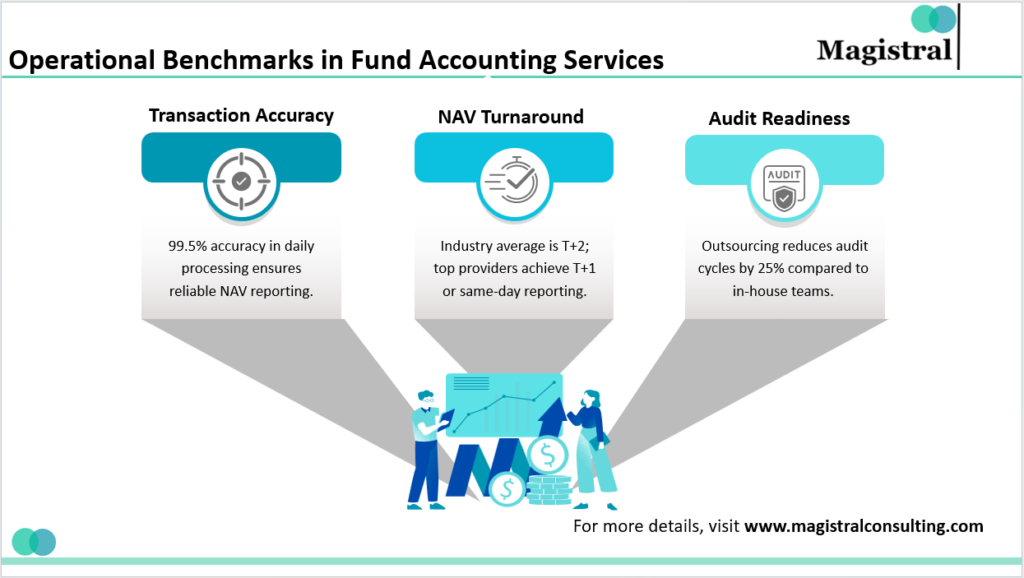
Fund accounting services find themselves bound by demanding operational benchmarks. Here are some of the benchmarks from industry surveys and studies.

Operational Benchmarks in Fund Accounting Services

Operational Benchmarks in Fund Accounting Services

Daily Transaction Processing Accuracy

Establishment of a Best Process benchmark, in fund accounting services, based on the practice of most leading service providers resulting in a 99.5% accuracy, dispelling fears of discrepancies during reporting of the NAV.

NAV Turnaround Time

NAV calculation and reporting is on average two days. However, leading service providers are able to provide the same on a T+1 basis or even same-day reporting for large frequency funds.

Audit Readiness

Companies outsourcing fund accounting services report 25% fewer audit completion cycles than those that rely on in-house teams.

The Strategic Case for Outsourcing

Outsourcing fund accounting services has evolved into a significant decision with enormous cost savings, operational flexibility, and access to specialized expertise that also enhance efficiency and compliance.

Cost Implications and Efficiencies

For this reason, outsourcing fund accounting services has a cost advantage, saving costs that can vary between 30% to 70% of the usual average cost of accounting. The mid-sized private equity fund is one that manages $2 billion in assets, which would need to spend between $1.5 million a year covering salaries, infrastructure, software, and compliance for in-house accounting.  Transitioning to an outsourced model can reduce this figure to around $900,000 annually—a $600,000 savings that can be reinvested in strategic areas such as portfolio growth, investor engagement, or technological innovation.

These savings are made possible by outsourcing providers’ ability to leverage economies of scale, advanced technology, and domain expertise. Providers spread the costs of technology and infrastructure among several clients. Thus, harnessing cutting-edge solutions at a fraction of the cost it would take to maintain an in-house system.

Operational Flexibility

Outsourcing takes the load of recruiting, training, and especially finding and keeping specialized talent off the organization. Particularly in markets where the demand for such talent is extremely high.

Outsourcing reduces costs while mitigating financial and reputational risks by supporting streamlined operations and a reduction of errors. It provides the flexibility required to support the much-needed agility in operations, with the business being able to shift focus to activities that increase growth and competitiveness. This makes outsourcing fund accounting not only a competitive service but also a strategic consideration for the firm seeking efficiency without compromising quality and compliance.

Technological Innovations in Fund Accounting Services

The introduction of technology is changing fund accounting from a transactionally intensive process into a value-adding function.

Automation and RPA

Automated systems for reconciliation reduce manual processing by 80%. A survey of fund administrators found that 73% use robotic process automation (RPA) for everyday tasks, such as transaction matching and journal entries.

AI-Driven Anomaly Detection

With as much as 95 percent accuracy, AI applications detect fund data anomalies that significantly reduce the risk of higher-value mistakes. For example, a top hedge fund deployed an AI system that identified valuation errors worth $2 million ahead of the regulatory filing.

Blockchain Technology

One main benefit that blockchain offers is to have transactions in real-time authentication. A study demonstrated a significant decrease of 35 percent in reconciliation and a subsequent 25 percent decrease in the reporting cycle.

Future Outlook for Fund Accounting Services

The system of fund accounting is surely going to undergo fundamental shifts owing to technology, effective regulations, and increasing emphasis on sustainability that would lead to greater efficiency, transparency, and global compliance.

Future Outlook for Fund Accounting Services

Future Outlook for Fund Accounting Services

Increased Automation and AI Adoption

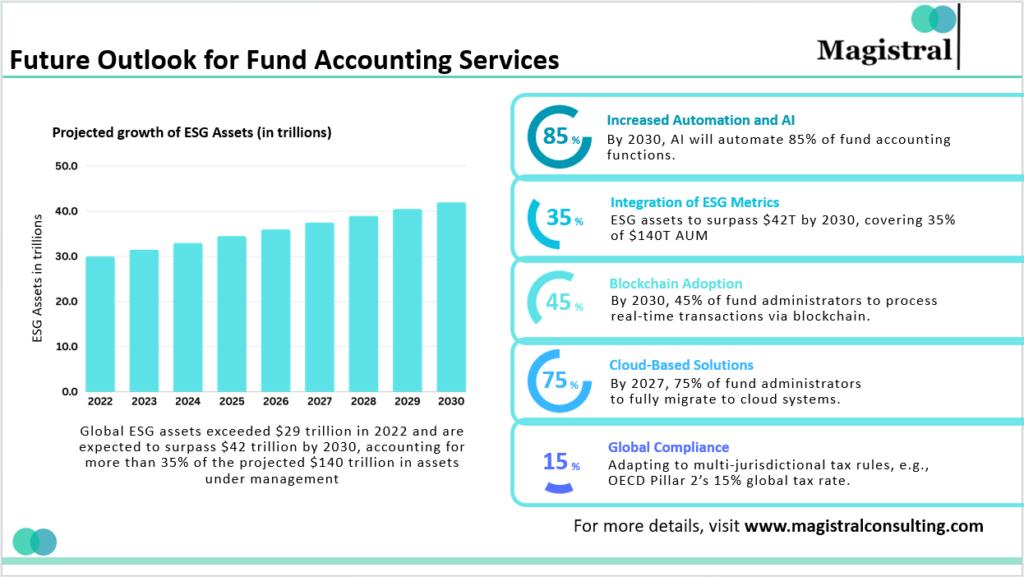
Currently, AI and machine learning applications, which are growing more and more in a number of areas, are set to automate nearly 85% of the functions of fund accountants by 2030. Predictive and anomaly detection capability as well as enhanced decision-making speed will be enabled through this technology.
>It is also said that fund accountants will see a boost in predictive analysis using AI, which will help monetary authorities identify the changing trends in the market and the risks involved automatically.

Integration of ESG Metrics

With global ESG assets surpassing $29 trillion in 2022 and projected to exceed $42 trillion by 2030, comprising over 35% of the anticipated $140 trillion in assets under management. Fund accountants need to move beyond traditional reporting practices and incorporate non-financial metrics into their frameworks. These changes will require tools that can track the sustainability and social impact data. According to a 2024 MSCI survey, 67% of fund managers view ESG compliance as a significant factor for outsourcing fund accounting services.

Adoption of Blockchain and Distributed Ledger Technology

There will be a complete transformation of fund accounting since blockchain is considered a transparent and immovable type of transaction. By 2030, it is expected that 45% of fund administrators will be able to process transactions on the blockchain in real-time.
>A study by the leading fund administrator indicates that blockchain represents a 20% reduction in calculating net asset value and a 30% improvement in transaction accuracy.

Demand for Cloud-Based Solutions

Multiple industry forecasts predict an influx of cloud-based solutions into fund accounting as a result of access to real-time data, scaling capability, and better security. Gartner Research predicts that by 2027, over 75% of fund administrators will have fully migrated to fully cloud-based systems

Focus on Global Compliance

With increasing cross-border investments, fund accounting will have to adapt itself to multi-jurisdictional tax and compliance requirements. One of them will be the OECD Pillar 2 tax rules enforcing a minimum 15% global tax rate, just as an example of upcoming challenges.

Fund Accounting Services by Magistral

Magistral Consulting offers professional fund accounting services to help investor companies run smoothly. We compose regular reports, capital account statements, and detailed summaries of performance. The services include-

Financial Statements Preparation

We provide monthly and quarterly financial reports that conform to either GAAP or IFRS standards. We streamline the client audit process by working hand in hand with auditors. Thus, making their financial audit-ready and saving them lots of time. Our tailored solutions have kept firms compliant with complex regulations.

Regulatory And Tax Compliance Services

We take care of compliance filings, such as FATCA, CRS, and Form PF, create investor tax reports such as K-1s, and collaborate with tax advisors. Besides, compliance monitoring gives assurance of alignment with regulatory requirements pertinent to specific funds, helping mitigate operational risks.

Performance Reporting and Analytics

With Performance Reporting & Analytics, we offer a deep performance analysis, with metrics like IRR and ROI for the evaluation of the fund performance by any organization. The benchmarking reports help them gain insight through a comparative performance analysis with the industry benchmarks.

Investor Relations Support

From communicating the notices for capital calls and distribution to answering investor queries. We ensure flawless communication and thereby build trust with accurate, timely, and clear updates.


About Magistral Consulting

Magistral Consulting has helped multiple funds and companies in outsourcing operations activities. It has service offerings for Private Equity, Venture Capital, Family Offices, Investment Banks, Asset Managers, Hedge Funds, Financial Consultants, Real Estate, REITs, RE funds, Corporates, and Portfolio companies. Its functional expertise is around Deal origination, Deal Execution, Due Diligence, Financial Modelling, Portfolio Management, and Equity Research

For setting up an appointment with a Magistral representative visit www.magistralconsulting.com/contact

About the Author

The article is Authored by the Marketing Department of Magistral Consulting. For any business inquiries, you could reach out to prabhash.choudhary@magistralconsulting.com

Key benchmarks include:

Daily Transaction Processing Accuracy: Industry leaders achieve 99.5% accuracy.

NAV Turnaround Time: Leading providers offer T+1 or even same-day NAV reporting for high-frequency funds.

Audit Readiness: Outsourced fund accounting reduces audit cycles by 25% compared to in-house teams.

Outsourcing reduces costs (savings between 30%-70%), enhances operational efficiency, mitigates errors, and ensures compliance. For instance, a mid-sized private equity firm managing $2 billion can save up to $600,000 annually by outsourcing fund accounting.

With ESG assets surpassing $29 trillion in 2022 and expected to exceed $42 trillion by 2030, fund accountants are incorporating sustainability and social impact metrics. Tools are being developed to track and report ESG compliance, making it a significant factor in outsourcing decisions.