Tag Archives: Fund Accounting Research

The timeframes for reports are getting shorter, asset classes are becoming more sophisticated, and expectations of investors are on the rise. Under these conditions, an outsourced NAV calculation services can be useful for investment companies because it allows one to calculate net asset value with higher consistency, independent verification, and operational rigor. Net asset value is no longer an accounting figure that is calculated once a month. It impacts subscriptions, redemptions, reports for investors, performance analysis, fees for management, carry, and operations due diligence. With the growing share of alternative investments among funds, private credit, hedge funds, real estate, and co-investments, internal teams usually have problems keeping pace.

Outsourced NAV Calculation Services: Foundations and Context

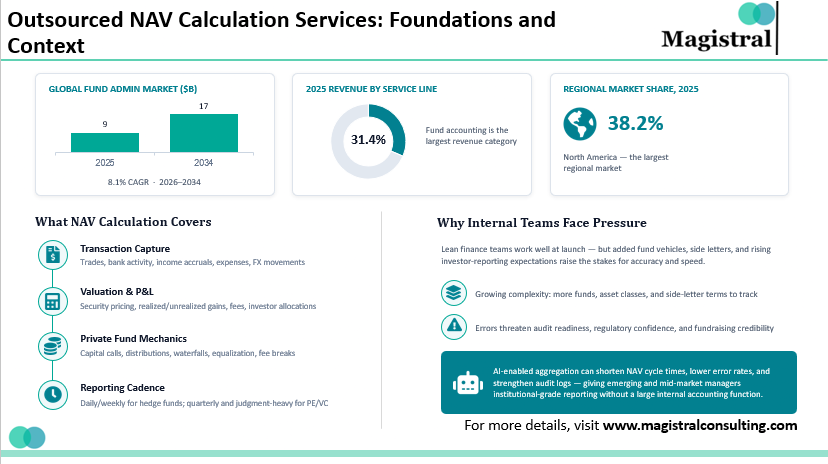
The global fund administration services market size in 2025 was worth USD 8.6 billion and is expected to reach USD 17.4 billion by 2034 with a CAGR of 8.1% between 2026 to 2034. The fund accounting service had the highest segment size in terms of value, capturing a share of 31.4% of the 2025 revenue. In addition, North America held a market share of 38.2%. These numbers give context into why fund accounting, NAV calculation, compliance reporting, and portfolio valuation are outsourced by asset managers.

Outsourced NAV Calculation Services

Outsourced NAV Calculation Services: Foundations and Context

Outsourced NAV calculation services is core to fund accounting, investor reporting, and compliance. The NAV is calculated by dividing total assets less total liabilities by the outstanding units/shares. An efficient NAV calculation process should include valuation of securities, accruals, realized/unrealized gain/loss, expense/fees, and investor-level allocations. In complex private funds, the same NAV calculation process must accommodate capital calls, distributions, side letter provisions, management fee holidays, carried interest waterfalls, and entity consolidation.

What NAV Calculation Covers

A good NAV calculation begins with capturing all transactions. This comprises trades, bank transactions, income recognition, expense recognition, capital activity, valuation adjustments, FX adjustments, and investor allocations. In private market fund NAV calculation processes, the items include waterfall calculations, equalization, capital calls, distributions, and management fee accruals.
In hedge fund and liquid strategies, NAV is usually done on a daily, weekly, and monthly basis. In private equity and venture capital vehicles, the NAV process occurs on a quarterly basis. However, the process becomes more judgmental since valuations depend on fair values, comparable companies, and updated company performance data.

Why Internal NAV Teams Face Pressure

Most investment firms usually have a lean finance team initially. This works perfectly fine during the early stages but is hard as more vehicles, side letters, assets, and investor reports come into the system.

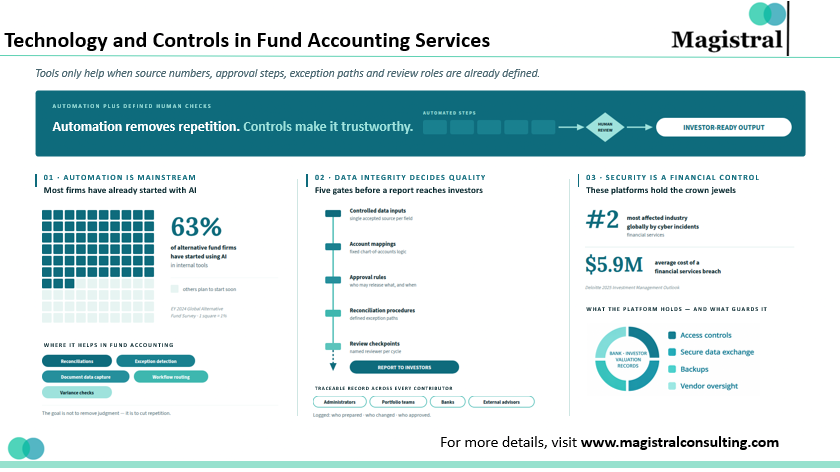
Pressure is mounting since the reporting paradigm shift is shifting towards quicker and more data-driven operations. According to Grant Thornton, AI-driven consolidation will decrease NAV cycle time, increase error reduction, improve exception resolution, and provide audit trails when employed for reconciliation and NAV generation purposes. This point is particularly valid for managers of start-ups and mid-market organizations who seek institutional-quality reporting without the need for a big accounting staff.

How Outsourcing Improves Control

Outsourced NAV calculation services separate decisions from accounting for the investments in the fund. It enhances transparency through independent review, and standard reconciliations mitigate the risks associated with outdated information and errors that could arise from spreadsheets. Some of the services provided by service providers include trial balance reconciliation, cash reconciliation, accrual confirmation, P&L tests, price checks, and comparisons with administrator’s records.

NAV specialists may provide full or shadow NAV calculation, accrual booking, cash and P&L reconciliation, market value testing, price checks, and reconciliation of discrepancies. The importance of such controls emanates from the nature of NAV as a financial measure and the basis of trust. Controls are important in demonstrating segregation of duties, audit readiness, and reliance on manual spreadsheets to investors.

Relevance for Alternative Investment Managers

Alternative asset managers have more complicated fee structures, valuations, and reporting requirements. Credit funds need to keep track of interest income, payment-in-kind interest, amortization, covenants, and fair value accounting. Real estate funds require property-level valuation information, debt structure, operating ratios, and capital expenditure assumptions. Venture capital funds require regular valuation of illiquid assets.

For real estate financial modeling managers, NAV quality is dependent on proper linkage between property models, valuations, debt assumptions, and reporting at the fund level. Outsourcing will help maintain proper linkage while enhancing review discipline.

Applications and Use Cases for Outsourced NAV Calculation Services

Outsourced NAV calculation services serve a wide range of different funds, reporting schedules, and business models. What the use case is will differ based on the strategy, but at its heart, the goal is always the same: precise and prompt valuations of the funds.

Hedge Funds and Liquid Strategies

A hedge fund usually needs to produce frequent NAV calculations due to the ability to subscribe or redeem on shorter schedules. The pricing, corporate actions, foreign exchange, derivatives, reconciliation, and expense accruals all have to tie in promptly. Otherwise, there may be problems with the investors.

Private Equity and Venture Capital Funds

Private market managers require NAV workflows accounting for capital calls and distributions, portfolio valuation, fund management fees, expenses, and waterfall of carried interests. Illiquidity of private assets makes valuation documents crucial.
Venture capital fund managers may use an outsourced NAV team to manage files of valuation of portfolio companies, cap tables, investment schedules, and investor report packages. Buyout funds may have NAV workflows involving EBITDA updates, comparable companies’ data, leverage adjustments, and exit strategy.

Private Credit and Fund Finance

Private credit funds make NAV calculations more complex since the loan will include variables such as floating interest rates, origin fees, amortization, delayed draw, payment-in-kind interest, covenant information, and fair value marks. Private credit AUM forecasted by Moody’s for the year 2026 is expected to be higher than $2 trillion and will reach $4 trillion by the year 2030. According to Reuters, as of April 2026, the fund finance market crossed the $1 trillion mark, where Moody’s mentioned NAV loans, hybrid financing, and private credit as major contributors.

In light of the growth, the need for outsourced NAV calculation services becomes even greater. Confidence is required from lenders, investors, and auditors for the proper valuation of assets, liabilities, borrowing base, payments in kind, interest income, and fund-level leverage. With an increase in NAV facilities, the stress test and documentation on leverage structure becomes very important.

Market Trends and the Future of Outsourced NAV Calculation Services

The demand for transparent, accurate, and faster reporting and the need for institutional-quality processes will increasingly drive the importance of outsourced NAV calculation services. The future of NAV calculation goes beyond just NAV calculation and requires a platform that can provide an integrated approach to managing funds and managing data while offering a single operating base for fundraising, auditing, financing, and communication with investors.

Outsourced NAV Calculation Services

Market Trends and the Future of Outsourced NAV Calculation Services

Growth of Alternatives and Private Markets

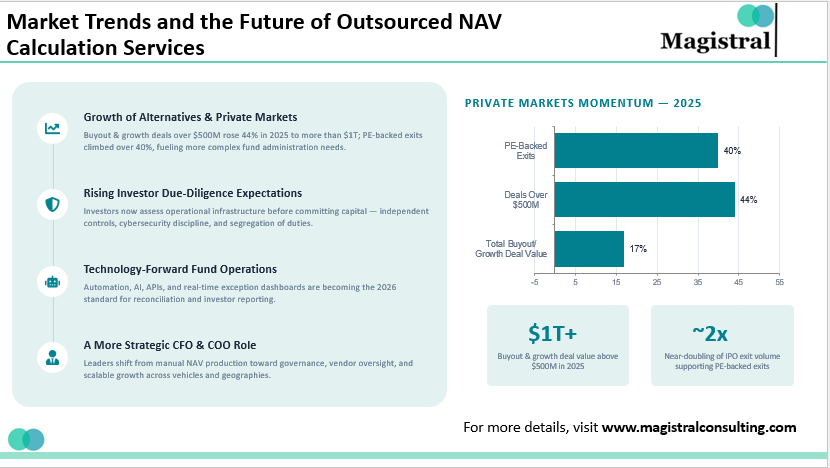
Private markets continue to raise capital and increase the challenges of fund administration. In 2025, according to McKinsey & Company, private equity buyout and growth deals worth more than $500 million grew by 44% to $1 trillion, with total deal value increasing by 17% and PE-backed exits growing by 40+%, primarily driven by a doubling of IPO exits. As alternatives continue to grow, firms will be able to scale up their institutional processes without having any high fixed costs.

Investor Due Diligence Expectations

Increasingly, investors look at the quality of operations alongside the investment returns. Strong controls, security, accurate reporting, and separation of duties are expected. Outsource NAV allows due diligence to be performed effectively using documented processes, reconciliations, and multiple levels of review rather than the efforts of one individual or Excel file.

Technology-Forward Fund Operations

The adoption of automation, AI, APIs, and workflow dashboards is changing the face of fund operations. The top priorities in 2026 are automated reconciliations, investor portals, live exception management, AI-driven variance analysis, and reporting. This leads to the outsourced NAV calculation services, transforming from an accounting process to a fund operations and investor servicing activity.

Strategic Role of the CFO and COO

With the increasing complexity of operations, CFOs and COOs are focused on governance, oversight, and communication with investors rather than NAV creation. Outsourcing allows lean organizations to operate at an institutional level, respond quickly to due diligence queries, and facilitate growth in new funds, geographies, and asset classes.

How Magistral Consulting Helps in Outsourced NAV Calculation Services

Outsourced NAV calculation services through Magistral are an extension of a fund finance, operations, and investor reporting team at the firm. The firm helps with NAV calculations, fund accounting, reconciliations, calculations of expenses and fees, portfolio and cash validation, and handling exceptions to make the process of reporting accurate and audit-ready. Magistral also helps in the preparation of investor reports, capital account reports, performance dashboards, and valuations for private equity, venture capital, private credit, and real asset funds. Through the use of its global outsourcing approach by combining client teams and offshoring for efficiency, Magistral can help investment managers improve reporting and keep investors satisfied.

About Magistral Consulting

Magistral Consulting has helped multiple funds and companies in outsourcing operations activities. It has service offerings for Private Equity, Venture Capital, Family Offices, Investment Banks, Asset Managers, Hedge Funds, Financial Consultants, Real Estate, REITs, RE funds, Corporates, and Portfolio companies. Its functional expertise is around Deal origination, Deal Execution, Due Diligence, Financial Modelling, Portfolio Management, and Equity Research

For setting up an appointment with a Magistral representative visit www.magistralconsulting.com/contact

About the Author

Dhanita is a BD and Marketing professional with 6+ years’ experience in sales strategy, growth execution, and client acquisition; credentials include Stanford Seed (Stanford GSB), an MBA from USMS–GGSIPU, and a B.Com (Hons) from the University of Delhi. Expertise spans market research and opportunity mapping, sales strategy, CRM, brand positioning, integrated campaigns, content development, lead generation, and analytics; currently oversees business development calls and end-to-end marketing operations


FAQs

What are outsourced NAV calculation services?

They are third-party or specialist support services that calculate, review, reconcile, and document a fund’s net asset value for investor reporting, audit, compliance, and operational control.

Why do fund managers outsource NAV calculation?

Managers outsource to improve accuracy, reduce manual workload, access specialist fund accounting expertise, scale reporting, and strengthen independent operational controls.

Which funds benefit most from outsourced NAV calculation?

Hedge funds, private equity funds, venture capital funds, private credit funds, real estate funds, fund of funds, SPVs, and co-investment vehicles benefit from structured NAV support.

What is shadow NAV calculation?

Shadow NAV is an independent calculation used to verify an administrator’s official NAV. It helps managers identify discrepancies before numbers are released to investors.

How does Magistral support NAV workflows?

Magistral supports fund accounting, reconciliations, valuation schedules, investor reporting, exception tracking, and offshore execution for scalable fund operations.


Fund accounting outsourcing has become a strategic necessity, not just a cost-saving choice. From 2024 to 2026, it is the preferred model for fund managers facing tighter regulatory and reporting demands due to complex products like private markets, semi-liquid vehicles, and private credit. With increased demands for faster and more transparent investor reporting, fund accounting, NAV production, and investor reporting are now seen as critical infrastructure that must be both accurate and timely by LPs, regulators, and internal teams.

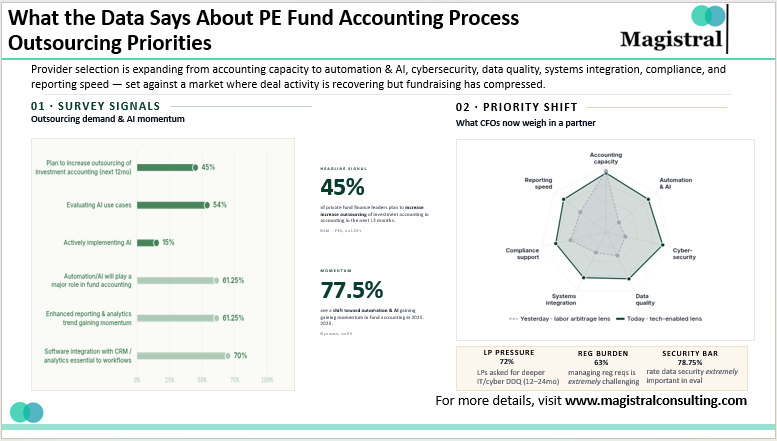
And this is something very hard to accomplish consistently with small in-house teams. Especially when working through multiple jurisdictions, time zones, and asset classes. Hence, Fund accounting outsourcing is speeding up as managers look to scale their operations without adding new staff.

Fund Accounting Outsourcing: The Metrics That Show Outsourcing Is Gaining Ground

Signal metrics of Fund accounting outsourcing and adjacent middle-/back-office delegation were sometimes difficult to spot, but, nevertheless, there are a few:

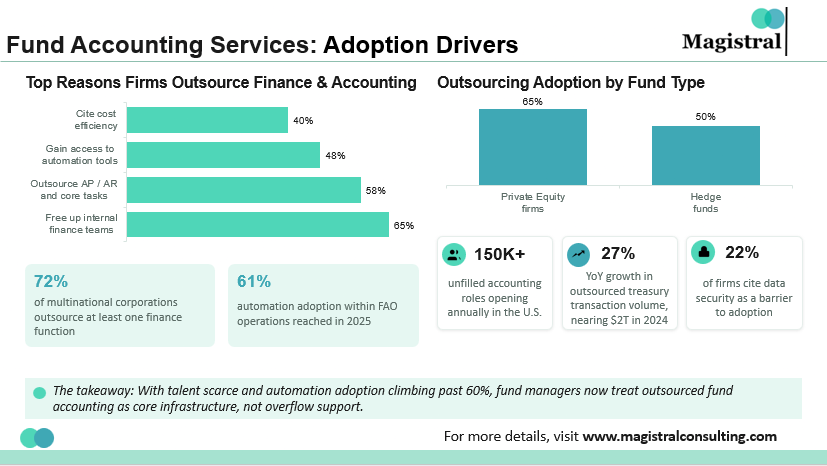
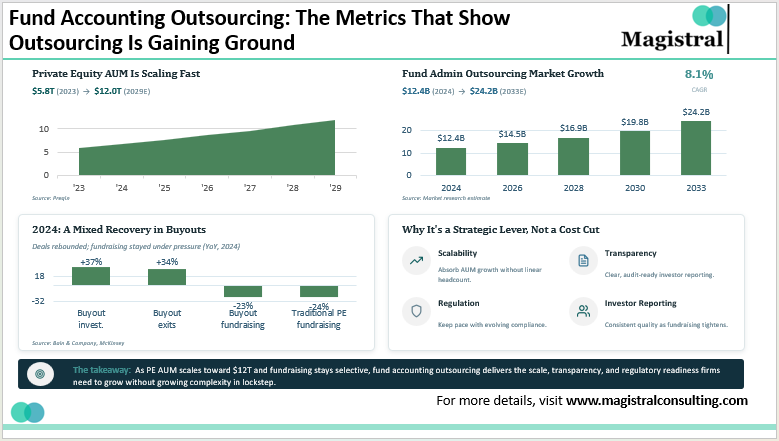
The level of outsourced middle-office activity is increasing very quickly. According to a report, the amount of outsourced treasury transactions processed has increased by 27% year-on-year, almost reaching US$2 trillion in 2024, a clear indicator of the ongoing transition toward specialist third-party operating models across fund operations.

The large administrators are not only but also very significantly increasing fund servicing volumes. For the third quarter of 2025, BNP Paribas Securities Services announces having US$3.4 trillion assets under administration (AuA), which is an increase of +8.3% compared to Q3 2024. Moreover, the company handles 9,747 funds, which is a 6.0% rise, and has settled 158.7 million transactions in 2024 (+10.1% compared to 2023). These figures become a clear indicator of the increasing operational throughput that service providers are able to manage.

The private markets along with the private debt are still taking up a lot of work in the operational side. McKinsey has made an example that, the total amount of global private debt fundraising has decreased by 22% in 2024 to US$166B, while the industry continues to change in terms of structures and capital sources, which is leading to more complexity in valuation, cash movements, and reporting, which is the primary reason.

Regulatory Changes in Europe

The timeline of regulatory changes in Europe is putting pressure on the operating models. AIFMD II came into force in April 2024 and must be incorporated by EU states by 16 April 2026, with further evolution of reporting (including Annex IV changes) coming afterwards, resulting in managers needing to professionalize delegation oversight, liquidity reporting, and operational documentation.

Fund Accounting Outsourcing: The Metrics That Show Outsourcing Is Gaining Ground

Fund Accounting Outsourcing: The Metrics That Show Outsourcing Is Gaining Ground

To sum up: these trends are not merely “outsourcing-friendly” but also scale and risk control trends. Fund accounting outsourcing is at the crossroads of these trends.

Data Insights: Driving Demand for Fund Accounting Outsourcing

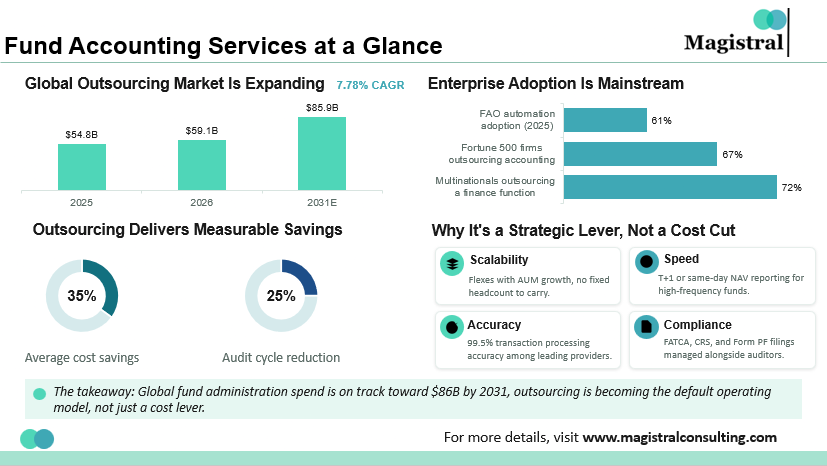
The global fund administration outsourcing market size reached ≈ USD 11.2 billion in 2024.

It is projected to grow at a compounded annual growth rate (CAGR) of ~7.8% from 2025 through 2033, reaching an estimated USD 22.1 billion by 2033.

Data Insights: Driving Demand for Fund Accounting Outsourcing

Data Insights: Driving Demand for Fund Accounting Outsourcing

Complexity is compounding (not just increasing)

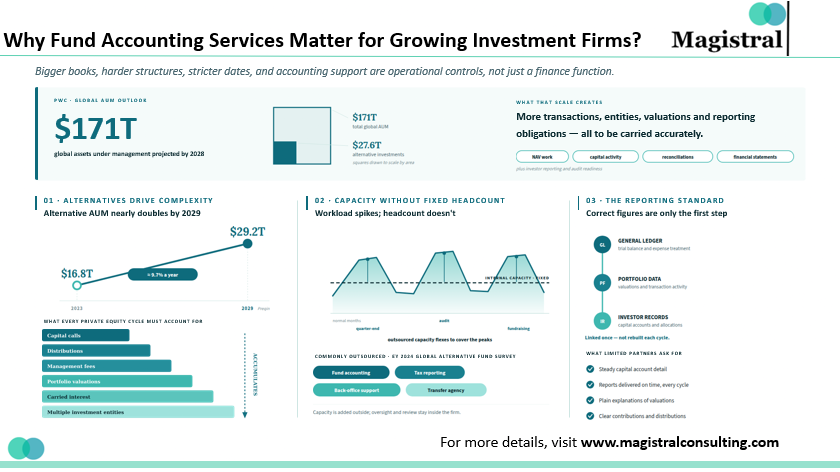
The complexity is not just increasing, but compounding. Modern funds have more assets and get more events and exceptions: side pockets, multi-currency share classes, co-invest vehicles, continuation structures, private credit cash-flow waterfalls, frequent investor communications, and tighter audit trails.

When the private-market activity comes back but not uniformly (some strategies are being active while others are still slow), then the operations teams face lumpy peaks—this is the kind of workload volatility that makes a fixed in-house model inefficient.

Speed-to-close and speed-to-report are now competitive advantages

Fund managers want:

Rapid month-end/quarter-end closing

NAV cycles with fewer reconciling delays

Swifter turnaround of investor statements

More trustworthy “same-day” replies to LP inquiries

The service providers have developed robust processes and platforms that deliver such performance consistently. It is difficult to emulate this internally without making substantial investments in systems.

Provider scale is real and measurable

The servicing footprint of large administrators is an important marker of the trend the industry is taking. When one provider discloses US$3.4T AuA, about 10k funds, and 158.7M settlements done in a year, it indicates that more and more funds are willing to trust operating partners at such a scale outside their own.

Jurisdictional growth increases operational burden

Fund-domicile ecosystems, which are the dominant locations for global fund formation.  Luxembourg, Ireland, Cayman are constantly adding up the “scale” data that corresponds to the size of the administrative infrastructure as well as the number of funds and their volumes:

Luxembourg (CSSF)

Net assets of supervised UCIs have been constantly about €5.5–€5.7T (e.g., according to CSSF statistics, €5,582.3bn in June 2024 and €5,659.5bn in September 2024).

Cayman (CIMA)

The number of regulated funds is huge, and the activity of the funds is tracked; as an illustration, Cayman provides quarterly figures, for instance, 9,024 registered mutual funds (Q3 2025), in addition to other fund categories (master funds, licensed funds, etc.).

Ireland (Central Bank of Ireland)

The authority releases thoroughly detailed investment fund statistics every quarter as well as public statements revealing the size and structure of the industry.

Regional Insights

Where Outsourcing Momentum Is Strongest (and why)

North America

In the United States, alternatives are still the main driver for growth (private equity, private credit, infrastructure, secondaries). The operational emphasis is progressively on speed, accuracy, and investor servicing, particularly for companies having several products with small staff. The situation in private debt is that demand for liquidity is high, and a lot of financing deals are coming up, thus, the areas of cash flow operations and valuation discipline are becoming very critical. The realism of outsourcing: hybrid models (retain control + make corner decisions internal; hire outsource for production + reconciliation + reporting ops).

Europe (Luxembourg, Ireland, UK relevance)

Europe is significantly influenced by regulatory timelines and the domicile ecosystems:

AIFMD II timeline pressure

The deadline for implementing the regulation into the national laws is 16 April 2026 (latest), which causes the managers to deal with tightening of delegation oversight, liquidity governance (for certain strategies), and operational documentation in advance.

Luxembourg scale and infrastructure

According to CSSF statistics, multi-trillion-euro net assets and thousands of vehicles are in the ecosystem where professional administration is the norm instead of the exception.

Ireland’s reporting-rich environment

The quarterly releases from the Central Bank are very detailed and reflect a mature, data-driven regulatory ecosystem that supports the case for the need of robust operational partners.

Fund Accounting Outsourcing Services by Magistral

Magistral Consulting offers professional Fund accounting outsourcing services to help investor companies run smoothly. We compose regular reports, capital account statements, and detailed summaries of performance. The services include-

Financial Statements Preparation

We provide monthly and quarterly financial reports that conform to either GAAP or IFRS standards. We streamline the client audit process by working hand in hand with auditors.

Regulatory And Tax Compliance Services

We take care of compliance filings, such as FATCA, CRS, and Form PF, create investor tax reports such as K-1s, and collaborate with tax advisors. Besides, compliance monitoring gives assurance of alignment with regulatory requirements pertinent to specific funds, helping mitigate operational risks.

Performance Reporting and Analytics

With Performance Reporting & Analytics, we offer a deep performance analysis, with metrics like IRR and ROI for the evaluation of the fund performance by any organization.

Investor Relations Support

From communicating the notices for capital calls and distribution to answering investor queries. We ensure flawless communication and thereby build trust with accurate, timely, and clear updates.


About Magistral Consulting

Magistral Consulting has helped multiple funds and companies in outsourcing operations activities. It has service offerings for Private Equity, Venture Capital, Family Offices, Investment Banks, Asset Managers, Hedge Funds, Financial Consultants, Real Estate, REITs, RE funds, Corporates, and Portfolio companies. Its functional expertise is around Deal origination, Deal Execution, Due Diligence, Financial Modelling, Portfolio Management, and Equity Research

For setting up an appointment with a Magistral representative visit www.magistralconsulting.com/contact

About the Author

Tanya is an investment-research specialist with 6 + years advising venture-capital, private-equity and lending clients worldwide. A Stanford Seed alumnus with an MBA and an Economics (Hons) degree, she heads project teams at Magistral Consulting, delivering financial modelling, due-diligence and deal support on 3,000 + mandates. Her blend of rigorous analytics, sharp project management and clear client communication turns complex data into actionable investment insight.

FAQs

What is Fund accounting outsourcing?

It’s delegating NAV, books/records, and investor reporting operations to a specialist third-party while retaining oversight internally

Is outsourcing only for small funds?

No, large managers also outsource to scale across products and jurisdictions without adding fixed headcount

Does outsourcing reduce risk?

It can, if paired with strong oversight, controls, SLAs, and clear escalation governance

What services are typically included?

NAV, reconciliations, investor allocations/statements, reporting packs, and audit support (often with treasury/reg reporting add-ons)

How do I choose the right provider?

Prioritize domain expertise (asset class), controls, service model, tech integration, and demonstrated scale, not just price