Tag Archives: PE Fund Accounting Process Outsourcing

Fund managers operate in an increasingly complex environment. Portfolio sizes continue to increase. Clients expect more. The structures are harder to run. Reports must be sent on strict dates. This pushes finance teams every day. Fund accounting services help bring order to all of it. They support the NAV work. They track capital activity. They handle reconciliations. They prepare financial statements. They help with investor reporting.

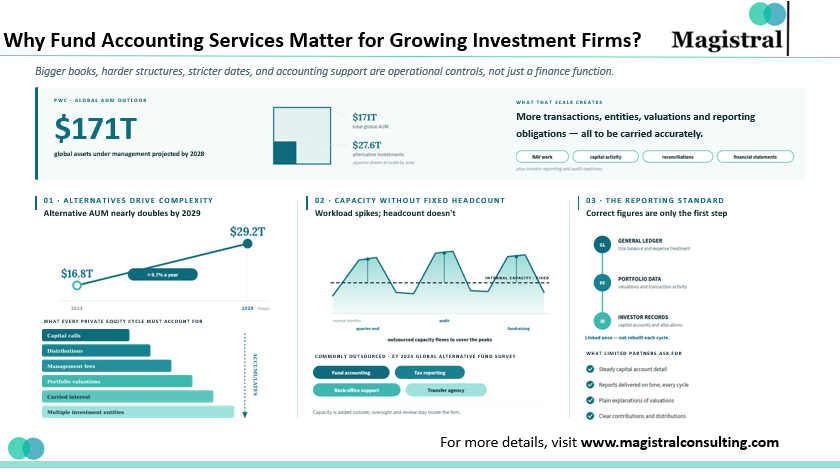
They also support audit readiness. PwC expects global assets under management to reach $171 trillion by 2028. PwC also expects alternative investments to reach $27.6 trillion by then. That scale creates more transactions, entities, valuations, and reporting obligations for fund managers to manage accurately. Specialized accounting support therefore serves not only as a finance function, but also as an important operational control.

Why Fund Accounting Services Matter for Growing Investment Firms?

Fund accounting services help investment managers maintain reliable books while translating complex portfolio activity into information that investors, auditors, and management teams can use. At a practical level, fund accounting services establish repeatable processes around transaction recording, reconciliations, valuation inputs, allocations, expense treatment, and reporting, reducing the risk that increasing fund complexity overwhelms a relatively lean internal finance team.
Fund Accounting Services

Why Fund Accounting Services Matter for Growing Investment Firms?

Growth in Alternative Assets Is Increasing Accounting Complexity

Alternative investments illustrate the operational challenge. Preqin estimated global alternative assets under management at $16.8 trillion at the end of 2023 and forecast that figure to reach $29.2 trillion by 2029, representing annualized growth of approximately 9.7%. As portfolios expand, managers in private equity must account for capital calls, distributions, management fees, portfolio valuations, carried interest, and multiple investment entities while maintaining consistency across every reporting cycle.

Outsourcing Adds Specialized Capacity Without Fixed Headcount

Trying to build all accounting tasks inside the firm can get costly. This is true when work levels change across normal months, quarter-end work, audits, and fundraising. It matters even more for venture capital groups that run with small teams. In EY’s 2024 Global Alternative Fund Survey, many managers said outsourcing is becoming a common choice for items like fund accounting, tax reports, back-office work, and transfer agency support. Using outside staff can add capacity. The firm can still oversee the work and keep control through review.

Investor Expectations Raise the Standard for Reporting

For many investors, correct figures are only the first step. Limited partners often want steady capital account details. They also want reports on time and plain explanations of valuations. They want records that show contributions and distributions clearly. Because of that, accounting work should link the general ledger to portfolio data and investor records. Each report should not feel like a one-off task. EY also noted that investors care about transparency and solid reporting systems, especially as alternative managers deal with a wider set of investor groups.

Core Functions Within Fund Accounting Services

Fund accounting services focus on keeping the fund records correct. They also aim to produce reports that stakeholders can rely on. In most cases, the tasks tie together transaction work, portfolio accounting, investor capital records, valuations, and the final financial statements. When these steps follow a set workflow, fund managers can see how performance is going. They can also handle repeat work in a smoother way.

NAV Calculation and Reconciliation

Net asset value depends on reliable asset values, liabilities, cash balances, income, expenses, and ownership information. Well-designed fund accounting services reconcile bank accounts, custody records, investment schedules, and the general ledger before reporting numbers move forward. For private market vehicles, where pricing is less observable than in public markets, fund accounting services’ teams must also maintain clear valuation inputs and documentation so that reported balances can be traced and reviewed.

Capital Calls, Distributions, and Investor Allocations

Private funds require close tracking of commitments, contributions, distributions, fees, and investor ownership. A missed allocation can affect multiple capital accounts and create problems during reporting or audit review. Accounting processes therefore need to apply the partnership agreement consistently while maintaining supporting schedules for every movement. This becomes especially important when funds contain multiple share classes, parallel vehicles, co-investments, or different fee arrangements for individual investors.

Financial Statements and Audit Support

Preparing financial statements pulls many accounting tasks into one workflow. Before auditors start, teams typically need clean trial balances, investment schedules, correct expense categories, and updated capital accounts. They also need supporting reconciliations and records tied to valuations. A steady close process helps cut down the work done after the period ends. It also makes it easier for managers to reply to auditor questions. Then the year-end reporting stays on time.

Technology and Controls in Fund Accounting Services

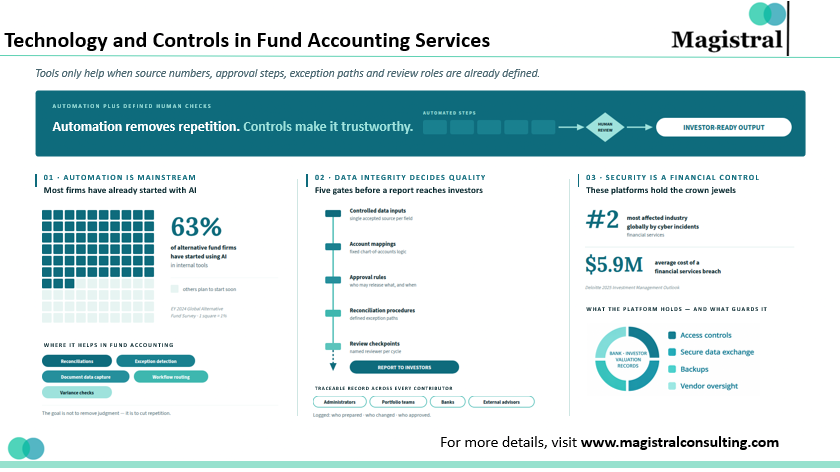
Fund accounting services are being shaped by new technology. Still, the best day-to-day setup uses automation plus clear human checks. New platforms can speed up reconciliations and bring data together. They can flag items that look out of place. They can also help produce routine reports without as much manual effort. Even so, tools only help when the source numbers, approval steps, and exception paths are defined. The roles for review also need to be spelled out.
Fund Accounting Services

Technology and Controls in Fund Accounting Services

Automation Is Moving into Mainstream Fund Operations

In EY’s 2024 survey, 63% of alternative fund firms said they had started using AI in internal tools. Others said they plan to start soon. In fund accounting, useful uses may include help with reconciliations, finding exceptions, pulling data from documents, sending work through the right steps, and doing variance checks. The goal is not to take away judgment. The goal is to cut repetitive tasks. That way, accountants can focus on the items that need attention and review.

Data Integrity Still Determines Reporting Quality

Automation cannot compensate for fragmented source records. A sound accounting model establishes controlled data inputs, account mappings, approval rules, reconciliation procedures, and review checkpoints before reports reach investors. Strong compliance workflows also create a traceable record of who prepared, changed, and approved important financial information. This becomes particularly valuable when multiple administrators, portfolio teams, banks, and external advisors contribute information to the same reporting cycle.

Cybersecurity Has Become Part of Financial Control

Fund accounting services platforms contain bank details, investor information, portfolio valuations, and confidential financial records, making information security part of operational risk management. Deloitte’s 2025 Investment Management Outlook reported that financial services was the second most affected industry globally by cyber incidents and put the average cost of a financial services breach at approximately $5.9 million. Access controls, secure data exchange, backups, and vendor oversight therefore belong alongside conventional accounting controls.

How Magistral Strengthens Fund Accounting Services?

Magistral supports investment managers that need scalable fund accounting services without continually expanding fixed internal capacity. The delivery approach can support accounting records, reconciliations, NAV preparation, capital activity, investor reporting, financial statements, and audit coordination while integrating with the manager’s existing control environment. This allows internal professionals to spend more time on oversight, portfolio decisions, and investor relationships rather than recurring processing.

Scalable Support Across Different Fund Structures

Fund accounting services requirements change considerably across hedge funds, private equity, venture funds, real estate vehicles, and other alternative structures. A scalable provider of fund accounting services must adapt reporting calendars, valuation workflows, capital account logic, and review procedures to the relevant fund structure. As funds expand or launch additional vehicles, flexible support can absorb increases in transaction volume without forcing the manager to rebuild the finance team for every growth phase.

Combining Process Discipline with Management Oversight

The strongest outsourcing model keeps accountability visible. Managers should establish clear responsibilities for preparation, review, approval, escalation, data access, and reporting deadlines before work begins. Magistral can operate as an extension of the internal finance function while the fund manager retains governance over critical accounting judgments and final outputs. This combination of specialist execution and internal oversight helps improve consistency while keeping financial responsibility where it belongs.


About Magistral Consulting

Magistral Consulting has helped multiple funds and companies in outsourcing operations activities. It has service offerings for Private Equity, Venture Capital, Family Offices, Investment Banks, Asset Managers, Hedge Funds, Financial Consultants, Real Estate, REITs, RE funds, Corporates, and Portfolio companies. Its functional expertise is around Deal origination, Deal Execution, Due Diligence, Financial Modelling, Portfolio Management, and Equity Research

For setting up an appointment with a Magistral representative visit www.magistralconsulting.com/contact

About the Author

Tanya is an investment-research specialist with 6 + years advising venture-capital, private-equity and lending clients worldwide. A Stanford Seed alumnus with an MBA and an Economics (Hons) degree, she heads project teams at Magistral Consulting, delivering financial modelling, due-diligence and deal support on 3,000 + mandates. Her blend of rigorous analytics, sharp project management and clear client communication turns complex data into actionable investment insight.


FAQs

What are Fund Accounting Services?

Fund Accounting Services cover specialized accounting activities for investment vehicles, including bookkeeping, NAV preparation, reconciliations, investor capital accounting, financial reporting, valuation support, and assistance with audits and recurring reporting requirements.

Why do investment managers outsource fund accounting?

Managers commonly outsource to gain specialized expertise, flexible capacity, process consistency, and access to technology without building a large permanent team. Outsourcing can be especially useful when workloads rise sharply during quarterly closes, audits, or fund launches.

How is fund accounting different from general accounting?

General accounting primarily records the finances of an operating company, while fund accounting must also address investor ownership, subscriptions or commitments, distributions, investment valuations, fund expenses, management fees, performance allocations, and fund-specific reporting requirements.

What should a manager check before choosing a provider?

Managers should examine experience with the relevant fund structure, accounting expertise, technology, data security, review controls, reporting capabilities, turnaround times, audit support, staffing continuity, escalation procedures, and the provider's ability to scale as the fund grows.

Can accounting outsourcing replace internal oversight?
No. An external provider can perform recurring accounting and reporting processes, but fund managers should retain appropriate governance, approvals, accounting judgments, performance monitoring, access control, and review of important financial outputs.


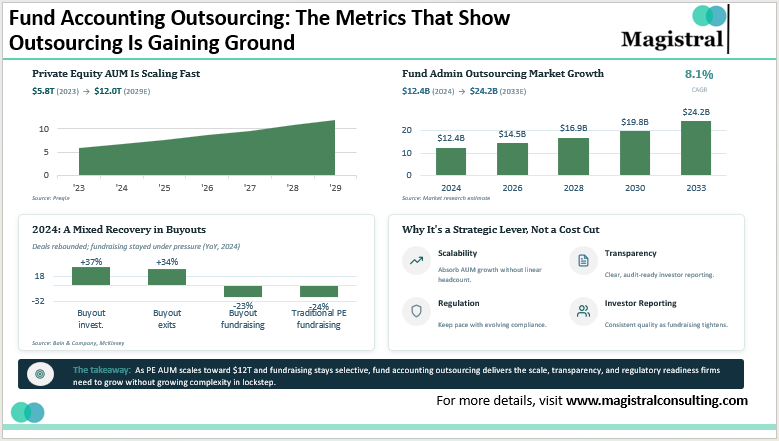
PE fund accounting process outsourcing is not about keeping track of money anymore. The work involved in managing these funds is getting harder because private markets are big, complicated and people are watching them closely. For example, A report says that the private equity assets under management will go up from about USD 5.8 trillion at the end of 2023 to USD 12.0 trillion by the end of 2029. Meanwhile a report found out that private markets fundraising in 2024 was the lowest it has been since 2016 and traditional private equity fundraising went down by 24% from the year

In this situation PE fund accounting process outsourcing is not a way to save money it is a smart way for PE fund accounting process outsourcing to deal with the need to get bigger be more transparent handle complicated regulations and report, to investors. PE fund accounting process outsourcing needs to be able to handle all these things, which’s why PE fund accounting process outsourcing is becoming so important.


Why PE Fund Accounting Process Outsourcing Is Gaining Momentum

PE fund accounting process outsourcing in a mixed recovery. Bain reported that global buyout investments rose 37% and exits rose 34% in 2024, reversing two years of decline, but buyout fundraising fell 23% versus 2023 and the number of funds closed dropped to 2017 levels. McKinsey said that the way people usually raise money for equity or PE went down by 24 percent in 2024.

PE Fund Accounting Process Outsourcing

Fund Accounting Outsourcing: The Metrics That Show Outsourcing Is Gaining Ground

For PE fund accounting process outsourcing, PE firms can get help from companies that specialize in doing the accounting work for funds. This way they can get help and use the latest technology without having to build everything themselves. A lot of people think this is an idea. One report said that the market for outsourcing fund administration work was worth 12.4 billion dollars in 2024. They also think it will keep growing and be worth 24.2 billion dollars by 2033, which’s an increase of 8.1 percent every year from 2025, to 2033.


What the Data Says About PE Fund Accounting Process Outsourcing Priorities

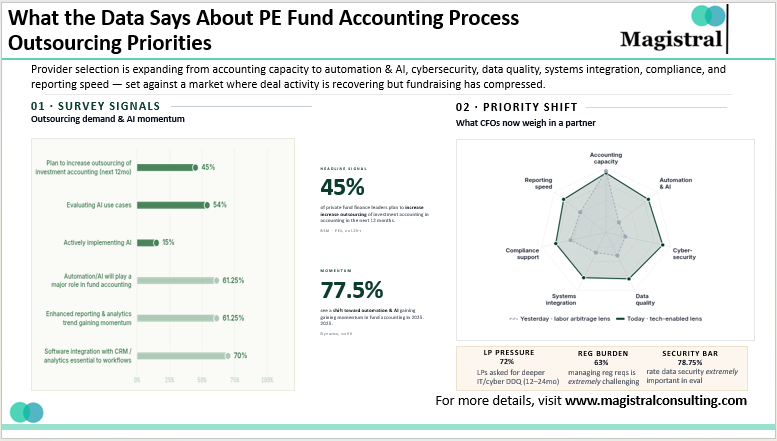
Research on PE fund accounting process outsourcing CFOs shows that outsourcing is becoming a part of how these companies work. It is not about saving money anymore. The 2025 Private Funds CFO Insights survey, which was done by RSM and Private Equity International got answers from than 120 people who oversee money for private funds. 45% Of these people said they will outsource more of the work for investment accounting in the next year. They also want to get help with things like IT, cybersecurity, fund accounting making sure they follow the rules and taxes.

Another survey, the 2025 Dynamo Software survey asked 80 people who work with money for equity and venture capital funds what they think is important. Most of them about 70% said that using automation and artificial intelligence is the thing happening in their field this year. In this survey 61% of people said that automation and artificial intelligence will be very important for fund accounting.. 34% Of them think these technologies will help a little but not change everything.

PE Fund Accounting Process Outsourcing

What the Data Says About PE Fund Accounting Process Outsourcing Priorities

The people in the survey also said that they struggle with things, like making reports, which takes a lot of time and doing things by hand which slows them down. 60% Of them think it is very important to have better reports and ways to look at data. 70% Said that it is essential to have all their software work together smoothly. Private funds CFOs and private equity and venture capital fund accountants are all looking for ways to make their jobs easier. Private funds are looking to outsourcing and automation and artificial intelligence to help them.


Key Benefits for PE Fund Accounting Process Outsourcing

Some of the key benefits for PE fund accounting process outsourcing are as follows:

Scalability

In 2024 global buyout investments went up by 37%. Exits went up by 34%. By the quarter of 2025 the total dry powder for closed-end private capital reached USD 4.63 trillion. This was up USD 201.5 billion or 4.6% from the end of 2024. When there is capacity to deploy there are more capital calls, closings, special purpose vehicles (SPVs) reconciliations and investor reports.

Access to specialist expertise

Experienced fund administrators know about waterfalls, capital accounts, investor reporting, audit support, tax coordination and regulatory workflows. A survey showed that 61% of fund accountants said manual workflows slow them down. 45% Wanted tools for complex transactions and 39% wanted automated compliance monitoring.

Cost efficiency

PE fund accounting process outsourcing market is expected to grow at about 8.1% to 8.2% each year until 2033. Providers are investing in shared platforms, cloud infrastructure, automation and specialised teams. Private equity firms can use these capabilities without paying all the fixed costs themselves. This is especially helpful when fundraising is uneven. For example, buyout fundraising fell by 23% in 2024. Traditional commingled private equity fundraising also declined by 24% year-over-year.

Improved reporting discipline

A good provider can standardise calendars, reconciliations, review steps and reporting packs. Many fund accountants struggle with reporting. 64% Said it takes much time and 60% said better reporting and analytics are important. Standardisation can reduce delays. Improve quarterly investor communication.

Independent oversight

Third-party administration can make a funds accounting records credible for limited partners (LPs) auditors and regulators. This is separate from investment decision-making. LPs are asking for information. 72% Of LPs surveyed want details, on IT systems and cybersecurity protocols during due diligence.

Implementation: Moving from In-House to Outsourced Operations

A successful transition starts with making a map of the process. To do this you need a plan that includes important steps like mapping out the fund structure, reconciling the historical trial balance, checking the investor master data, aligning the chart of accounts, standardizing the reporting templates, assigning control owners.

The plan should also include goals that can be measured such as finishing the validation of the opening balance testing the system getting approval for bank reconciliations approving a sample of investor statements and being ready for an audit before everything is up and running.

Many private equity firms use a mix of external resources. In this approach the administrator takes care of processing transactions, reconciliations, preparing reports and sending investor statements while the internal finance team keeps control of tasks that require judgement, such as putting in valuation inputs, reviewing items, communicating with investors, giving approvals, providing strategic oversight.

The Future of PE Fund Accounting Process Outsourcing

In 2025 54% of the people in charge of private fund finance were looking into using intelligence and 15% were using it. When it comes to doing the accounting for funds 70% of the accountants said that automation and using intelligence are the biggest things happening right now and 70% said that it is important to have all the software work together. So, when we pick a provider, we will look at how they do the accounting but also at how they handle data keep it safe from cyber threats, automate workflows make it easy to integrate with other systems and how fast they can give us reports.

Compared to the time from 2022 to 2023 the time from 2024 to 2025 is different because it is more about using technology caring about data and being transparent with investors. If we look at the numbers, it is clear what is happening: Bain said that the value of buyout investments went up 37% to USD 602 billion in 2024 and the value of exits went up 34% to USD 468 billion but the amount of money raised for buyouts went down 23%. McKinsey said that the traditional way of raising money for equity declined 24% from the year before in 2024.

In a survey in 2025 45% of the people in charge of private fund finance said they would outsource more of the accounting for investments and 72% of the investors asked for more information, about technology and cybersecurity when they were checking things out.

PE Fund Accounting Outsourcing Services by Magistral

Magistral Consulting is a professional provider of Fund accounting outsourcing services, ensuring the smooth operation of investor companies. We offer regular reporting, capital account statements and detailed performance summaries. Services offered:

Financial Statements Preparation

We prepare monthly and quarterly financial statements in accordance with GAAP or IFRS standards. “The audit process is easier as we work with the auditors.

Regulatory and Tax Compliance

We help you file regulatory and tax compliance forms such as FATCA, CRS and Form PF, prepare the investor’s tax report such as K-1 and work together with tax advisors. Compliance monitoring also ensures that the regulatory requirements for specific funds are being met.

Performance Reporting and Analytics

With Performance Reporting & Analytics, we ensure comprehensive performance analysis using IRR and ROI to evaluate the performance of the fund.

Investor Relations Support

Starting from the notice regarding capital calls and distribution through providing answers to the questions raised by investors.


About Magistral Consulting

Magistral Consulting has helped multiple funds and companies in outsourcing operations activities. It has service offerings for Private Equity, Venture Capital, Family Offices, Investment Banks, Asset Managers, Hedge Funds, Financial Consultants, Real Estate, REITs, RE funds, Corporates, and Portfolio companies. Its functional expertise is around Deal origination, Deal Execution, Due Diligence, Financial Modelling, Portfolio Management, and Equity Research

For setting up an appointment with a Magistral representative visit www.magistralconsulting.com/contact

About the Author

Himank is an investment and financial analysis specialist with experience across private equity, investment banking, and research-driven engagements. An MBA (Tech) in Finance and BTech in Computer Science graduate from Narsee Monjee Institute of Management Studies, he focuses on financial modeling, valuation, and investment research. He supports project teams at Magistral Consulting, delivering LBO and DCF models, due diligence, investment memorandums, and deal origination support. His blend of analytical thinking, problem-solving ability, and structured approach enables him to translate complex financial data into actionable insights.

FAQs

What is PE fund accounting process outsourcing?

It involves assigning fund accounting tasks, such as reconciliations, capital accounts, investor reporting and audit support, to a specialist provider.

Why do private equity firms outsource fund accounting?

Firms outsource to improve scalability, reduce operating costs, access specialist expertise and strengthen reporting accuracy.

Which activities can be outsourced?

Common activities include transaction processing, capital calls, distributions, bank reconciliations, investor statements and financial reporting.

How does outsourcing improve investor reporting?

It introduces standardised processes, review controls and reporting calendars, helping firms deliver accurate and timely reports to investors.

How can Magistral support PE fund accounting operations?

Magistral provides flexible offshore support for reconciliations, reporting, financial analysis, data management and other fund operations.