Tag Archives: outsourced equity research

The financial industry requires deep market intelligence to make hedging decisions and identify new investment possibilities. Banks, asset managers, hedge funds, and investment firms use sector research outsourcing in financial services as their primary operational approach to financial services delivery. As financial markets expand and data volumes grow exponentially, in-house teams often struggle to keep pace with sector-level analysis across industries such as technology, healthcare, real estate, and energy.

Institutions benefit from sector research outsourcing in financial services because it provides specialized analytical resources, advanced data tools, and affordable, skilled professionals. Financial institutions will increase their operational outsourcing expenses until 2025, according to Deloitte’s global financial services outlook, as they use outsourcing to delegate research to specialized partners while concentrating on core business functions.

Sector Research Outsourcing in Financial Services Market Growth and Importance

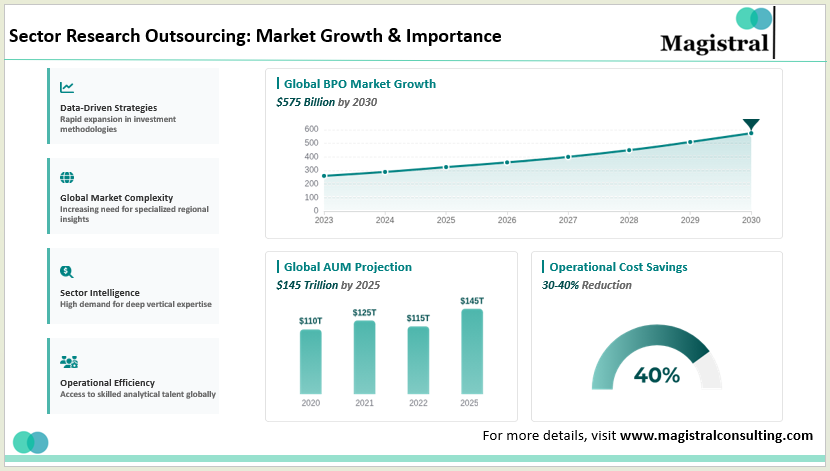
The financial services sector now depends on research outsourcing to empower its institutions with operational capabilities and industry expertise. The market demands that research organizations provide insights that help businesses track their investment risks and understand industry fluctuations. Precedence Research estimates that the worldwide business process outsourcing market will surpass $575.83 billion by 2030, with financial services driving most of this expansion.
Investment strategies that rely on data analysis require further development.
Sector Research Outsourcing: Market Growth & Importance

Sector Research Outsourcing: Market Growth & Importance

Expansion of Data-Driven Investment Strategies

Financial markets generate substantial data because they require sophisticated analytical tools and professional data analysis techniques. Institutional investors, therefore, combine sector analysis with valuation methods and outsourced research support to improve the accuracy of investment insights within Sector Research Outsourcing in Financial Services frameworks.

Growing Complexity of Global Financial Markets

The development of global financial markets creates interdependence between different markets, which leads to more complicated analysis procedures. The asset management industry needs dependable research about different market sectors because PwC projects global asset management will reach $145 trillion by 2025, increasing reliance on Sector Research Outsourcing in Financial Services.

Increasing Demand from Investment Firms

Investment firms require access to industry knowledge because they need to assess potential investment opportunities and associated risks. Private equity research partnerships enable organizations to develop their analytical capabilities while their internal teams concentrate on strategic investment activities, often supported by Sector Research Outsourcing in Financial Services providers.

Cost Efficiency and Talent Availability

Building large research teams that organizations can operate from their own facilities presents both high expenses and major difficulties for businesses. Financial institutions can achieve 30 to 40% research operational cost reductions through outsourcing, according to Deloitte.

Sector Research Outsourcing in Financial Services for Investment Decision Making

Financing research activities through outsourcing enables investors to assess industry trends and economic indicators, as well as specific business outcomes. Financial institutions use their dedicated analytical resources to discover investment possibilities that assist them in constructing their investment portfolios.

Industry Trend Analysis

Sector analysts study long-term industry developments through their research of technology innovation, renewable energy growth, and healthcare expansion. These insights help investors identify high-growth sectors and allocate capital more effectively.

Competitive Landscape Assessment

Companies require knowledge about their industry competitors to conduct proper business evaluations. Analysts investigate market share distribution together with pricing approaches and innovation skills, which research experts in venture capital commonly used to support their work.

Regulatory and Policy Monitoring

Regulatory changes create major effects that determine how industries will operate. Research teams that work externally monitor policy changes in different sectors to help investors modify their investment approaches.

Macroeconomic Impact Analysis

Economic indicators such as inflation, interest rates, and global trade conditions determine how different sectors will perform economically. The IMF predicts that worldwide economic development will reach a stable growth rate of approximately 3% per year, which will result in different business opportunities across various fields.

Technology and Analytics for Sector Research Outsourcing in Financial Services

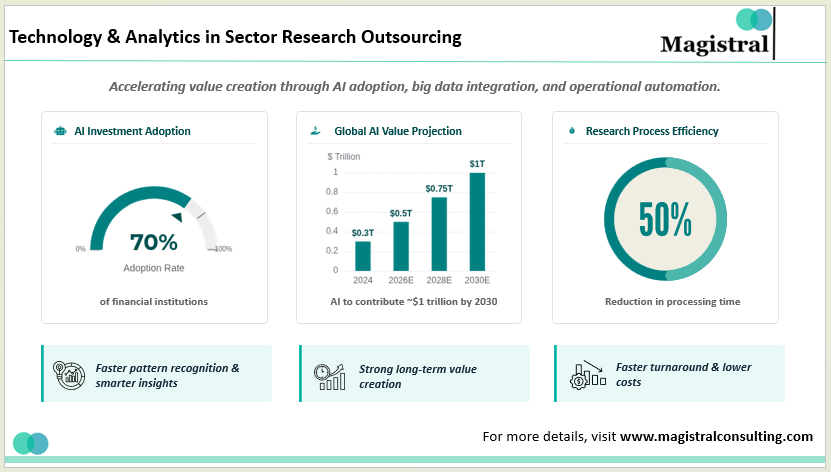
The sector research outsourcing operations of financial services companies are transforming technological advancements that enhance their analytical capabilities and generate better insights. Financial institutions increasingly integrate outsourced research activities with their digital systems, which include artificial intelligence and advanced data analytics, with PwC estimating that AI could contribute up to $1 trillion in value to financial services by 2030.
Technology & Analytics in Sector Research Outsourcing

Technology & Analytics in Sector Research Outsourcing

Adoption of Artificial Intelligence in Financial Research

Analysts use artificial intelligence to analyze large financial datasets, enabling them to identify investment patterns. More than 70% of financial institutions now allocate their resources toward developing artificial intelligence analytics systems, according to Deloitte, while McKinsey notes AI can reduce research processing time by up to 50 %.

Big Data and Alternative Data Sources

Research across industries now relies on alternative data sources, including transaction data, satellite imagery, and digital consumer behaviour patterns. The sources enable companies to gain deeper insights into their industry performance and emerging market trends.

Automation of Research Processes

Automation tools facilitate essential tasks, including gathering financial information and producing reports. Investment companies use outsourced research to enhance operational efficiency by integrating it with their fund-management data.

Integration with Portfolio Management Systems

Investment teams use outsourced research insights, integrating them with portfolio management systems to assess sector intelligence and evaluate financial metrics and market data.

Sector Research Outsourcing in Financial Services Risk Management and Strategy

The research outsourcing process in the financial services sector enables financial institutions to manage industry risks while developing their future business strategies. The Global Risk Survey conducted by PwC shows that more than 60% of financial institutions require industry risk assessment to support their long-term strategic planning.

Identifying Sector Specific Risks

All industries encounter unique obstacles, which include regulatory changes, technological advancements, and supply chain disturbances.

Scenario Modeling and Forecasting

Analysts use advanced financial models to create market condition simulations, which help them predict how different sectors will perform. The insights provide additional support for capital strategies that benefit from capital raising advisory services.

Enhancing Due Diligence Processes

Investors use in-depth sector studies to strengthen their investment due diligence processes through the assessment of market positioning, competitive strengths, and industry threats. The integrated due diligence frameworks used by investors combine third-party insights with operational due diligence approaches.

Sector Research Outsourcing in Financial Services and How Magistral Supports Investors

Institutions gain operational efficiency through specialized analytical abilities, which they obtain from sector research outsourcing in financial services. Magistral Consulting supports global investors by delivering detailed sector analysis, competitive intelligence, and financial research across multiple industries. The firm provides investment banks, asset managers, and private equity firms with data-driven insights through its scalable research teams, which enable them to make informed investment decisions in complex global markets.

About Magistral Consulting

Magistral Consulting has helped multiple funds and companies in outsourcing operations activities. It has service offerings for Private Equity, Venture Capital, Family Offices, Investment Banks, Asset Managers, Hedge Funds, Financial Consultants, Real Estate, REITs, RE funds, Corporates, and Portfolio companies. Its functional expertise is around Deal origination, Deal Execution, Due Diligence, Financial Modelling, Portfolio Management, and Equity Research

For setting up an appointment with a Magistral representative visit www.magistralconsulting.com/contact

About the Author

Nitin is a Partner and Co-Founder at Magistral Consulting. He is a Stanford Seed MBA (Marketing) and electronics engineer with 19 + years at S&P Global and Evalueserve, leading research, analytics, and inside‑sales teams. An investment‑ and financial‑research specialist, he has delivered due‑diligence, fund‑administration, and market‑entry projects for clients worldwide. He now shapes Magistral Consulting’s strategic direction, oversees global operations, and drives business‑development support.

FAQs

Why do financial institutions outsource sector research?

Financial institutions outsource sector research to access specialized expertise, reduce operational costs, and obtain faster insights into industry developments and market opportunities.

Which industries benefit most from sector research outsourcing?

Industries such as banking, asset management, private equity, venture capital, and hedge funds benefit significantly because their investment decisions depend heavily on industry level analysis.

How does technology improve sector research outsourcing?

Technology such as artificial intelligence, big data analytics, and automation tools enables research teams to process large datasets efficiently and generate deeper insights for investment decisions.

What role does sector research play in investment strategy?
Sector research helps investors evaluate industry trends, identify high-growth sectors, assess risks, and allocate capital effectively across different industries.

ESG equity research outsourcing has developed from a peripheral support activity to a strategic enhancement of institutional research capabilities. For asset managers in 2026, the challenge is to deal with the growth of regulation, rating agency differences, political attention, and investor demands, in addition to the challenge of cost constraints. As ESG research goes from brand marketing to balance-sheet materiality, the research becomes more complex, data-intensive, and globally consistent, driving the need for outsourced ESG research expertise.

Global ESG Capital Continues to Reshape Equity Markets

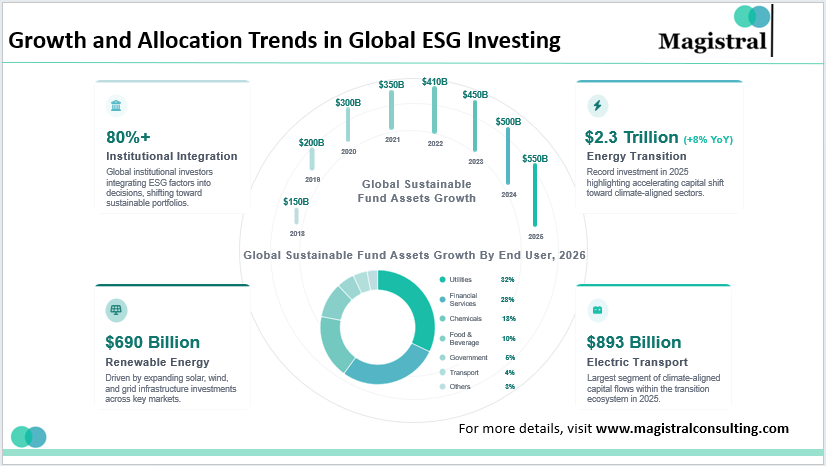
Growth and Allocation Trends in Global ESG Investing

Growth and Allocation Trends in Global ESG Investing

Sustainable investing remains an important part of global capital markets. The global ESG investing market was valued at approximately $39.08 trillion in 2025, and it is expected to grow to $45.61 trillion by 2026.

In terms of long-term projections, it is expected that ESG assets will be worth over $40 trillion by 2030, which is over a quarter of the global assets under management.

In terms of funds, global sustainable funds have over $3.9 trillion in assets under management by the end of 2025, which indicates that investment into ESG strategies is still sizeable despite periodic outflows.

Asset managers, therefore, have a direct research imperative, as investment theses must now show how ESG factors impact long-run earnings quality, valuation multiples, and risk profiles.

ESG equity research outsourcing helps research teams meet this demand through specialized sustainability analysis integrated into fundamental equity models.

Regulatory Expansion Is Driving Research Complexity

The expansion of regulatory activity in key markets is significantly increasing the depth of analysis needed for sustainability analysis from the equity research function. As the CSRD, ISSB, and climate disclosure regulations evolve, ESG equity research outsourcing is helping investment firms address the increasing complexity of regulatory data interpretation.

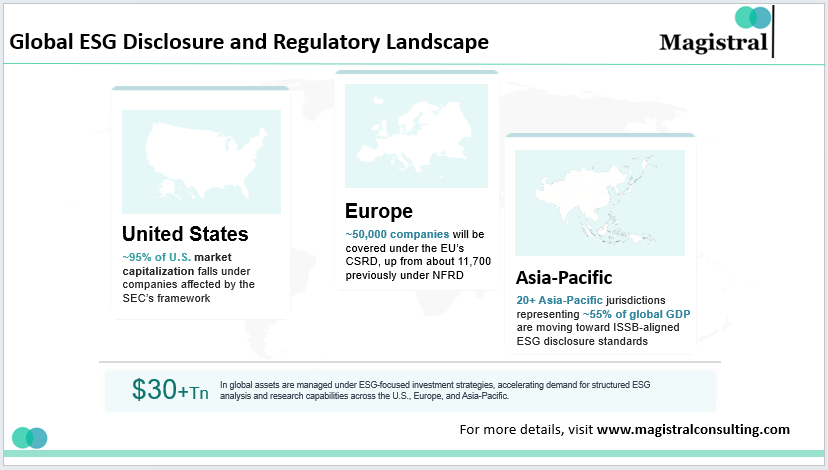
Global ESG Disclosure and Regulatory Landscape

Global ESG Disclosure and Regulatory Landscape

CSRD and SFDR in Europe

The epicentre of regulatory-driven ESG integration remains Europe, with the Corporate Sustainability Reporting Directive (CSR D) significantly increasing the scope of mandatory sustainability reporting from around 11,000 companies to almost 50,000 companies within the EU. This will have the effect of significantly increasing the amount of standardized ESG data available to equity analysts. At the same time, the Sustainable Finance Disclosure Regulation (SFDR) remains to drive asset managers to support their Article 8 and Article 9 fund classifications with sustainability metrics.

For global investors with European exposure, ESG equity research outsourcing helps manage the technical interpretation of double materiality assessments, taxonomy alignment, and Principal Adverse Impact indicators without overextending internal teams.

US Climate Disclosure and Litigation Sensitivity

In the United States, the Securities Exchange Commission has finalized climate-related disclosure rules in 2024, requiring enhanced reporting on Scope 1 and Scope 2 emissions for several public corporations. While there are legal challenges to the implementation, institutional investors are pressuring the integration of climate risk in financial models. This has led to a higher level of scrutiny on the translation of ESG risks into revenue, capital expenditure, and cost of capital estimates.

ESG equity research outsourcing teams are increasingly supporting scenario modeling and regulatory mapping to ensure investment theses reflect evolving disclosure expectations.

Asia-Pacific Alignment with ISSB Standards

In the Asia-Pacific region, countries such as Japan, Singapore, and Hong Kong are moving towards the alignment of sustainability disclosure with the ISSB framework. This is creating a regulatory environment that is more harmonized, but it is also creating more work in terms of analysis. Investment managers are using ESG equity research outsourcing to deal with the changes in disclosure mandates.

The Data Explosion Behind ESG Research

The proliferation of ESG datasets, ratings providers, and company-level sustainability disclosures has increased the data intensity of ESG analysis. Under such circumstances, ESG equity research outsourcing helps investment firms manage the high volume of ESG data and integrate it into a structured framework of equity research.

ESG Data Sources Are Expanding Rapidly

In the last ten years, ESG data has developed into a sophisticated system that includes ratings, corporate disclosures, climate data, and alternative data. Some of the major ESG providers include MSCI, Sustainalytics, S&P Global, Refinitiv, which have developed thousands of ESG indicators that measure everything from emissions to corporate structures, labor practices, and supply chain risks.

One of the challenges that arise with ESG ratings is that they vary significantly between providers due to differences in their methodologies.

Integrating ESG Factors into Financial Models

Current trends in modern equity research show that ESG factors have an impact on financial measures such as the cost of capital, regulatory risks, and asset risk of impairment.

For instance, climate transition risk can have an impact on capital expenditure for industries that rely heavily on fossil fuels, whereas governance issues can have an impact on the valuation multiples of the firm.

ESG equity research outsourcing helps the research team create models that connect ESG factors to the financial valuation models.

Market Pressures Are Changing the Research Operating Model

The increase in the costs of research, the compression of fees in asset management, and the rise in the demand for ESG reporting are making firms rethink their conventional research models. In this new paradigm, ESG equity research outsourcing is helping investment managers to increase their scale with the benefits of cost efficiency and in-depth research.

Fee Compression and Research Scalability

The asset management industry is still under pressure to maintain margins, driven by passive investment competition and reduced management fee income. At the same time, ESG integration demands deeper research coverage and ongoing ESG risk monitoring.

Assembling fully integrated internal ESG teams, especially across industries and regions, can be resource intensive. ESG equity research outsourcing can provide a flexible business model, enabling asset managers to increase their research capabilities without necessarily growing their headcount.

Technology and AI Are Reshaping ESG Analysis

Technology is becoming an integral part of the ESG research process. For example, artificial intelligence tools are now being utilized to analyze company disclosures, detect sustainability controversies, and monitor climate risk profiles. These technologies demand data infrastructure and analytical capabilities.

In addition, external research partners may utilize their own investments in centralized analytics platforms for ESG research, which integrate regulatory data, satellite data, and alternative data sets. By leveraging ESG equity research outsourcing, asset managers gain access to advanced analytical tools without significant technology investment.

ESG Research Is Shifting Toward Financial Materiality

The most significant change in ESG investing is the shift in investment strategies from screening-based investing to financially material ESG integration. Investors are increasingly using sustainability factors based on their effects on the profitability and resiliency of the company, and capital allocation.

Climate change, transition policies, poor governance, and other issues in the supply chain and society could affect the valuation and earnings of a company. As ESG risks become financially quantifiable, equity research teams must analyze them with the same level of detail as other traditional financial metrics. In this environment, ESG equity research outsourcing functions as a strategic extension of investment research. It supports deeper sustainability analysis, improves coverage breadth, and ensures ESG insights are embedded within core equity valuation models rather than treated as standalone reporting exercises.

How Magistral Supports ESG Analysis for Investment Firms

As ESG considerations become central to equity research and portfolio construction, investment firms require structured analytics that connect sustainability indicators with financial performance. Magistral supports asset managers, hedge funds, and private equity firms by providing dedicated research capabilities that strengthen ESG integration within investment decision-making. The support focuses on transforming fragmented sustainability data into actionable insights that align with institutional investment frameworks.

ESG Data Aggregation & Normalization

Collecting and standardizing ESG datasets from multiple providers to create consistent and comparable company-level ESG profiles.

Sector-Specific ESG Materiality Analysis

Identifying financially material ESG risks and opportunities within specific industries to support deeper fundamental research.

ESG Integration in Valuation Models

Incorporating ESG metrics into financial models, including scenario analysis for climate risk, governance impact, and regulatory exposure.

ESG Benchmarking & Peer Analysis

Developing sector-based ESG benchmarking frameworks that allow investment teams to evaluate companies relative to industry sustainability performance.

Regulatory and Disclosure Alignment

Supporting analysis aligned with global sustainability frameworks such as CSRD, SFDR, and ISSB to ensure investment research reflects evolving disclosure standards.

About Magistral Consulting

Magistral Consulting has helped multiple funds and companies in outsourcing operations activities. It has service offerings for Private Equity, Venture Capital, Family Offices, Investment Banks, Asset Managers, Hedge Funds, Financial Consultants, Real Estate, REITs, RE funds, Corporates, and Portfolio companies. Its functional expertise is around Deal origination, Deal Execution, Due Diligence, Financial Modelling, Portfolio Management, and Equity Research

For setting up an appointment with a Magistral representative visit www.magistralconsulting.com/contact

About the Author

Utkarsh is a finance professional with expertise in investment research, M&A, and financial modeling. He has built and applied models including DCF, LBO, and comparable analysis, supporting investment banks, private equity, and venture capital firms across diverse sectors. Utkarsh holds an MBA in International Business & Finance from Symbiosis International University, a B.Com (Hons) from Delhi University, and has completed the Stanford Seed program at Stanford Graduate School of Business.

FAQs

How does Magistral work with investment teams?

Magistral typically operates as an extension of the client’s internal team, delivering research outputs that follow the firm’s templates, modeling frameworks, and reporting standards.

Can Magistral support ESG-related regulatory analysis?

Magistral assists research teams in interpreting sustainability disclosure frameworks such as CSRD, SFDR, and ISSB, helping ensure research outputs remain aligned with evolving reporting standards.

Can Magistral support both ongoing and project-based research requirements?

Yes, support can be structured through dedicated analyst models, project-based engagements, or flexible research support depending on the intensity and duration of the client’s requirements.

How does Magistral support ESG integration in valuation models?

Support includes incorporating ESG variables such as climate transition risk, governance factors, and regulatory exposure into financial models and investment analyses.