Tag Archives: financial analytics services

Financial Process Outsourcing is becoming a strategic finance solution as organisations face rising reporting demands, regulatory complexity, talent shortages, and rapid AI adoption. This article examines the market’s growth, key adoption drivers, regional shifts, investment activity, and emerging opportunities shaping the FPO landscape in 2026 and beyond.

Why Financial Process Outsourcing Is Scaling Fast in 2026

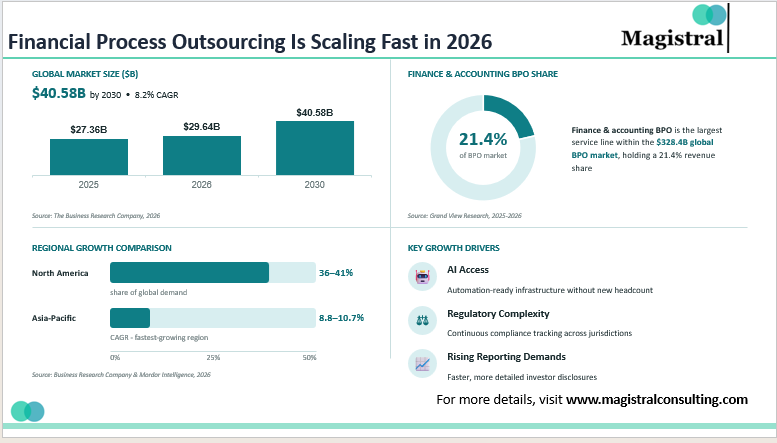
Financial Process Outsourcing is shifting from a cost-saving tactic to a core finance strategy worldwide. The global market reached $29.64B in 2026, up from $27.36B in 2025, growing at an 8.3% CAGR, and is expected to approach $40.58B by 2030. Growth is increasingly driven by AI access, regulatory complexity, and rising reporting demands. Alternative investment managers are outsourcing fund accounting, NAV calculation, and investor reporting to build institutional-grade infrastructure without adding permanent headcount.
Financial Process Outsourcing

Financial Process Outsourcing Is Scaling Fast in 2026

Financial Process Outsourcing Market Size and Growth Outlook

The financial process outsourcing market has moved past early-stage niche status into a multi-billion-dollar global category. Independent research houses differ on exact figures, but every major estimate points towards consistent, high-single-digit growth through the end of the decade.

Global Market Valuation and Compound Growth

The Business Research Company sizes the market at $29.64B in 2026, up 8.3% from $27.36B in 2025. The market is projected to grow at an 8.2% CAGR through 2030, reaching $40.58B. This growth signals structural rather than cyclical demand.

Finance and Accounting BPO as the Anchor Segment

Grand View Research values finance and accounting BPO at $70.2B in 2025, rising to $76.5B in 2026, with a 9.3% CAGR through 2033. Within the $328.4B global BPO market, it is the largest service line, holding a 21.4% revenue share.

Regional Growth Differentials

North America holds the largest share of financial process outsourcing, at 36%–41% of global demand. Asia-Pacific is growing fastest, with CAGRs of 8.8%–10.7%, as regional enterprises adopt outsourcing more aggressively.

Forecast Through 2030 and Beyond

Beyond the $40.58 billion 2030 estimate, Mordor Intelligence projects the wider finance and accounting outsourcing category reaching $85.92 billion by 2031. The spread reflects differing scope definitions, but the direction is unambiguous: the sector is compounding faster than professional services at large.

Key Drivers Behind Financial Process Outsourcing Adoption

AI adoption, mounting regulatory complexity, and thinly staffed internal finance teams are pushing more organisations towards providers that can supply both delivery scale and specialised technology.

AI and Automation Inside Finance Functions

Deloitte’s Q4 2025 CFO Signals survey found that 87% of CFOs expect AI to be extremely or very important to finance operations in 2026, while 63% of finance departments already use AI. 81% are adopting AI through outsourced providers, as specialised AI talent remains scarce internally.

Rising Regulatory and Reporting Complexity

The EU Corporate Sustainability Reporting Directive requires disclosure of ~1,100 data points across 50,000+ entities from 2026. With limited internal capacity, finance teams are increasingly relying on providers for compliance-adjacent services.

Rising Regulatory and Reporting Complexity

Forecasts for 2026–2030 highlight rising adoption among small and mid-sized enterprises, driven by cloud-based finance platforms. Lower entry costs are making outsourced finance accessible beyond large enterprises to leaner organisations.

Rising Regulatory and Reporting Complexity

Lean finance teams often face capacity gaps as fund structures become more complex. Side letters, waterfalls, and multi-currency vehicles are driving greater use of outsourced NAV calculation and financial process outsourcing to meet investor expectations.

Geographic Shifts Reshaping Financial Process Outsourcing Delivery

Delivery is consolidating around a small number of global hubs, with India extending its lead as capability centres move from transactional processing towards strategic ownership.
Financial Process Outsourcing

Geographic Shifts Reshaping FPO Delivery

India’s Expanding Global Capability Centre Footprint

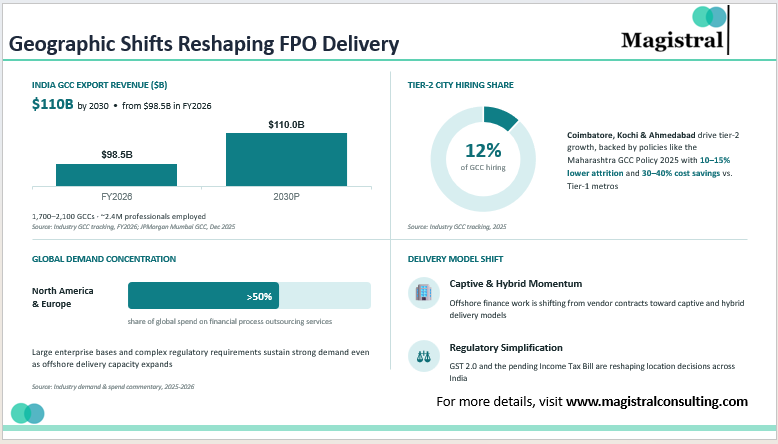
Industry tracking counts 1,700–2,100 GCCs in India, employing ~2.4M professionals and generating ~$98.5B in FY2026 exports, projected to reach $110B by 2030. JPMorgan Chase’s December 2025 plans for Asia’s largest GCC in Mumbai highlights India’s shift towards strategic infrastructure, beyond cost-driven back offices.

Tier-2 City Expansion

Coimbatore, Kochi, and Ahmedabad account for ~12% of GCC hiring, supported by policies like the Maharashtra GCC Policy 2025. Attrition is 10%–15% lower than Tier-1 metros, with 30%–40% talent-cost savings.

North America and Europe as Demand Centres

North America and Europe account for well over half of global spend on these services. Their large enterprise bases and complex regulatory requirements sustain strong demand. This remains true even as offshore delivery capacity expands.

Captive GCCs Versus Third-Party Vendors

Offshore finance work is shifting from vendor contracts to captive and hybrid models.
India’s regulatory simplification is supporting this transition.
GST 2.0 and the pending Income Tax Bill are influencing location decisions.

Investment and Deal Activity in Financial Process Outsourcing

Private capital is consolidating financial process outsourcing providers, favouring scale and AI-enabled delivery capability over simple headcount growth.

Private Equity Appetite for Services Platforms

Global M&A value reached $4.9T in 2025, up 37% YoY, with private-equity-backed transactions totaling ~$1.8T. This capital is increasingly flowing into business services and technology-enabled platforms. Finance and accounting providers with recurring revenue are benefiting from this trend.

Platform Buyouts and Scale as a Deal Thesis

PitchBook expects platform buyouts to reach at least 25% of private equity deals in 2026, with larger funds gaining share. In FPO, sponsors are consolidating smaller providers into scalable platforms to support AI investment and cross-selling.

Strategic Reviews Among Established Providers

Consolidation pressure is visible across established BPO players. Conduent explored a potential sale in early 2025 after attracting takeover interest, signalling continued strategic repositioning across the broader sector.

Emerging Opportunities and the Road Ahead for Financial Process Outsourcing

The next phase will be defined by ESG reporting demand, agentic AI, and closer integration with fund operations for alternative asset managers.

ESG and Sustainability Reporting Services

Providers are expanding financial close services into materiality assessment and carbon-footprint tracking as disclosure requirements grow. This turns compliance needs into a new outsourced service opportunity.

Agentic AI and Touchless Finance Operations

Providers are moving from AI copilots to agentic systems that automate complex finance workflows with limited human oversight. Deloitte is already applying these capabilities to tasks such as month-end close and vendor validation.

Institutional-Grade Reporting for Alternative Managers

Alternative investment managers are among the fastest adopters as reporting complexity outpaces internal capacity. Private credit, real estate, and venture funds increasingly use outsourced NAV calculation, fund administration, accounting, and financial modelling to deliver institutional-quality reporting without expanding permanent staff.

What This Means for CFOs and COOs

Financial process outsourcing is becoming a strategic infrastructure choice, enabling faster scaling, regulatory readiness, and AI adoption. Firms treating finance functions as core infrastructure can better compete for capital and talent.

Services Offered by Magistral Consulting for Financial Process Outsourcing

General Ledger & Accounting

End-to-end management of accounting activities, reconciliations, journal entries, and financial close processes to ensure accurate and timely books.

Financial Reporting & MIS

Preparation of financial reports, dashboards, and MIS to deliver clear, timely, and actionable insights for management.

Financial Planning & Analysis (FP&A)

Budgeting, forecasting, financial modelling, and variance analysis to support strategic planning and informed business decisions.

Cash Flow & Treasury Management

Cash-flow forecasting, liquidity monitoring, payment management, and treasury support to optimise working capital and cash utilisation.

Payroll & Expense Processing

Accurate processing of payroll, employee expenses, reimbursements, and related financial reconciliations while maintaining compliance.

Tax & Compliance Support

Preparation of financial data, tax reports, compliance documentation, and regulatory requirements to minimize financial and compliance risks.

Financial Data Management & Analytics

Collection, validation, analysis, and reporting of financial data to improve data quality, visibility, and decision-making.

Financial Controls & Quality Assurance

Implementation of financial controls, validation processes, and quality checks to enhance accuracy, consistency, and governance.


About Magistral Consulting

Magistral Consulting has helped multiple funds and companies in outsourcing operations activities. It has service offerings for Private Equity, Venture Capital, Family Offices, Investment Banks, Asset Managers, Hedge Funds, Financial Consultants, Real Estate, REITs, RE funds, Corporates, and Portfolio companies. Its functional expertise is around Deal origination, Deal Execution, Due Diligence, Financial Modelling, Portfolio Management, and Equity Research

For setting up an appointment with a Magistral representative visit www.magistralconsulting.com/contact

About the Author

Nitin is a Partner and Co-Founder at Magistral Consulting. He is a Stanford Seed MBA (Marketing) and electronics engineer with 19 + years at S&P Global and Evalueserve, leading research, analytics, and inside‑sales teams. An investment‑ and financial‑research specialist, he has delivered due‑diligence, fund‑administration, and market‑entry projects for clients worldwide. He now shapes Magistral Consulting’s strategic direction, oversees global operations, and drives business‑development support.


FAQs

What is financial process outsourcing?

Delegating finance and accounting functions such as bookkeeping, reconciliations, NAV calculation, and reporting to external specialists.

How large is the financial process outsourcing market in 2026?

The market is $29.64 billion in 2026, growing at 8.3% CAGR and projected to reach ~$40.58 billion by 2030, according to The Business Research Company.

Which regions lead financial process outsourcing delivery?

North America leads consumption at 36%–41% of global demand, while India leads delivery capacity and Asia-Pacific is the fastest-growing consumption region.

How is AI changing financial process outsourcing?

AI is shifting delivery towards automated workflows, with ~81% of finance functions adopting AI through outsourced providers.

Which functions benefit most from financial process outsourcing?
Fund accounting, NAV calculation, investor reporting, financial modelling, and compliance reporting, especially among alternative asset managers.


The financial industry requires deep market intelligence to make hedging decisions and identify new investment possibilities. Banks, asset managers, hedge funds, and investment firms use sector research outsourcing in financial services as their primary operational approach to financial services delivery. As financial markets expand and data volumes grow exponentially, in-house teams often struggle to keep pace with sector-level analysis across industries such as technology, healthcare, real estate, and energy.

Institutions benefit from sector research outsourcing in financial services because it provides specialized analytical resources, advanced data tools, and affordable, skilled professionals. Financial institutions will increase their operational outsourcing expenses until 2025, according to Deloitte’s global financial services outlook, as they use outsourcing to delegate research to specialized partners while concentrating on core business functions.

Sector Research Outsourcing in Financial Services Market Growth and Importance

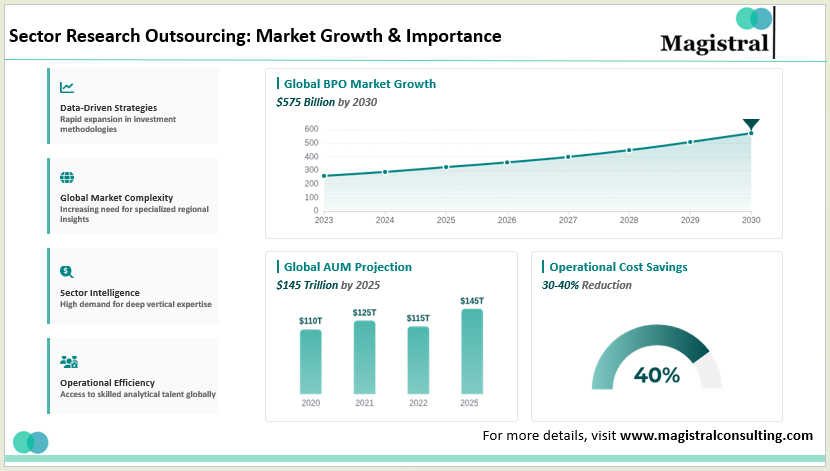
The financial services sector now depends on research outsourcing to empower its institutions with operational capabilities and industry expertise. The market demands that research organizations provide insights that help businesses track their investment risks and understand industry fluctuations. Precedence Research estimates that the worldwide business process outsourcing market will surpass $575.83 billion by 2030, with financial services driving most of this expansion.
Investment strategies that rely on data analysis require further development.

Sector Research Outsourcing: Market Growth & Importance

Sector Research Outsourcing: Market Growth & Importance

Expansion of Data-Driven Investment Strategies

Financial markets generate substantial data because they require sophisticated analytical tools and professional data analysis techniques. Institutional investors, therefore, combine sector analysis with valuation methods and outsourced research support to improve the accuracy of investment insights within Sector Research Outsourcing in Financial Services frameworks.

Growing Complexity of Global Financial Markets

The development of global financial markets creates interdependence between different markets, which leads to more complicated analysis procedures. The asset management industry needs dependable research about different market sectors because PwC projects global asset management will reach $145 trillion by 2025, increasing reliance on Sector Research Outsourcing in Financial Services.

Increasing Demand from Investment Firms

Investment firms require access to industry knowledge because they need to assess potential investment opportunities and associated risks. Private equity research partnerships enable organizations to develop their analytical capabilities while their internal teams concentrate on strategic investment activities, often supported by Sector Research Outsourcing in Financial Services providers.

Cost Efficiency and Talent Availability

Building large research teams that organizations can operate from their own facilities presents both high expenses and major difficulties for businesses. Financial institutions can achieve 30 to 40% research operational cost reductions through outsourcing, according to Deloitte.

Sector Research Outsourcing in Financial Services for Investment Decision Making

Financing research activities through outsourcing enables investors to assess industry trends and economic indicators, as well as specific business outcomes. Financial institutions use their dedicated analytical resources to discover investment possibilities that assist them in constructing their investment portfolios.

Industry Trend Analysis

Sector analysts study long-term industry developments through their research of technology innovation, renewable energy growth, and healthcare expansion. These insights help investors identify high-growth sectors and allocate capital more effectively.

Competitive Landscape Assessment

Companies require knowledge about their industry competitors to conduct proper business evaluations. Analysts investigate market share distribution together with pricing approaches and innovation skills, which research experts in venture capital commonly used to support their work.

Regulatory and Policy Monitoring

Regulatory changes create major effects that determine how industries will operate. Research teams that work externally monitor policy changes in different sectors to help investors modify their investment approaches.

Macroeconomic Impact Analysis

Economic indicators such as inflation, interest rates, and global trade conditions determine how different sectors will perform economically. The IMF predicts that worldwide economic development will reach a stable growth rate of approximately 3% per year, which will result in different business opportunities across various fields.

Technology and Analytics for Sector Research Outsourcing in Financial Services

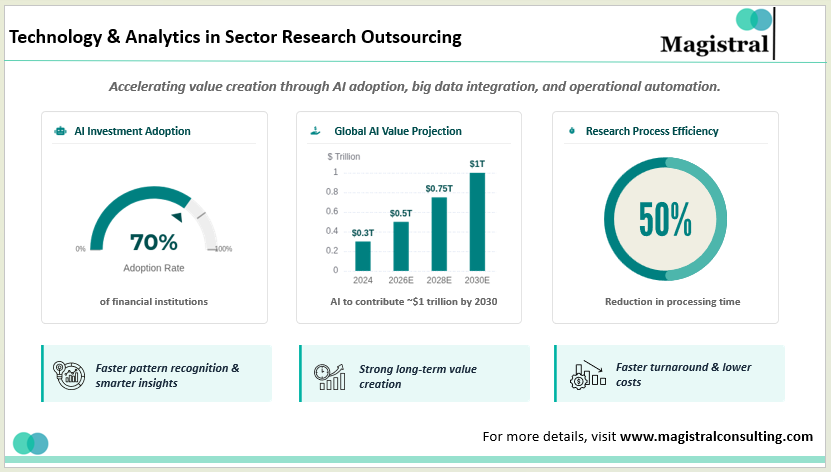
The sector research outsourcing operations of financial services companies are transforming technological advancements that enhance their analytical capabilities and generate better insights. Financial institutions increasingly integrate outsourced research activities with their digital systems, which include artificial intelligence and advanced data analytics, with PwC estimating that AI could contribute up to $1 trillion in value to financial services by 2030.

Technology & Analytics in Sector Research Outsourcing

Technology & Analytics in Sector Research Outsourcing

Adoption of Artificial Intelligence in Financial Research

Analysts use artificial intelligence to analyze large financial datasets, enabling them to identify investment patterns. More than 70% of financial institutions now allocate their resources toward developing artificial intelligence analytics systems, according to Deloitte, while McKinsey notes AI can reduce research processing time by up to 50 %.

Big Data and Alternative Data Sources

Research across industries now relies on alternative data sources, including transaction data, satellite imagery, and digital consumer behaviour patterns. The sources enable companies to gain deeper insights into their industry performance and emerging market trends.

Automation of Research Processes

Automation tools facilitate essential tasks, including gathering financial information and producing reports. Investment companies use outsourced research to enhance operational efficiency by integrating it with their fund-management data.

Integration with Portfolio Management Systems

Investment teams use outsourced research insights, integrating them with portfolio management systems to assess sector intelligence and evaluate financial metrics and market data.

Sector Research Outsourcing in Financial Services Risk Management and Strategy

The research outsourcing process in the financial services sector enables financial institutions to manage industry risks while developing their future business strategies. The Global Risk Survey conducted by PwC shows that more than 60% of financial institutions require industry risk assessment to support their long-term strategic planning.

Identifying Sector Specific Risks

All industries encounter unique obstacles, which include regulatory changes, technological advancements, and supply chain disturbances.

Scenario Modeling and Forecasting

Analysts use advanced financial models to create market condition simulations, which help them predict how different sectors will perform. The insights provide additional support for capital strategies that benefit from capital raising advisory services.

Enhancing Due Diligence Processes

Investors use in-depth sector studies to strengthen their investment due diligence processes through the assessment of market positioning, competitive strengths, and industry threats. The integrated due diligence frameworks used by investors combine third-party insights with operational due diligence approaches.

Sector Research Outsourcing in Financial Services and How Magistral Supports Investors

Institutions gain operational efficiency through specialized analytical abilities, which they obtain from sector research outsourcing in financial services. Magistral Consulting supports global investors by delivering detailed sector analysis, competitive intelligence, and financial research across multiple industries. The firm provides investment banks, asset managers, and private equity firms with data-driven insights through its scalable research teams, which enable them to make informed investment decisions in complex global markets.

About Magistral Consulting

Magistral Consulting has helped multiple funds and companies in outsourcing operations activities. It has service offerings for Private Equity, Venture Capital, Family Offices, Investment Banks, Asset Managers, Hedge Funds, Financial Consultants, Real Estate, REITs, RE funds, Corporates, and Portfolio companies. Its functional expertise is around Deal origination, Deal Execution, Due Diligence, Financial Modelling, Portfolio Management, and Equity Research

For setting up an appointment with a Magistral representative visit www.magistralconsulting.com/contact

About the Author

Nitin is a Partner and Co-Founder at Magistral Consulting. He is a Stanford Seed MBA (Marketing) and electronics engineer with 19 + years at S&P Global and Evalueserve, leading research, analytics, and inside‑sales teams. An investment‑ and financial‑research specialist, he has delivered due‑diligence, fund‑administration, and market‑entry projects for clients worldwide. He now shapes Magistral Consulting’s strategic direction, oversees global operations, and drives business‑development support.

FAQs

Why do financial institutions outsource sector research?

Financial institutions outsource sector research to access specialized expertise, reduce operational costs, and obtain faster insights into industry developments and market opportunities.

Which industries benefit most from sector research outsourcing?

Industries such as banking, asset management, private equity, venture capital, and hedge funds benefit significantly because their investment decisions depend heavily on industry level analysis.

How does technology improve sector research outsourcing?

Technology such as artificial intelligence, big data analytics, and automation tools enables research teams to process large datasets efficiently and generate deeper insights for investment decisions.

What role does sector research play in investment strategy?

Sector research helps investors evaluate industry trends, identify high-growth sectors, assess risks, and allocate capital effectively across different industries.