Tag Archives: Financial Advisory for Startups

Financial Process Outsourcing is becoming a strategic finance solution as organisations face rising reporting demands, regulatory complexity, talent shortages, and rapid AI adoption. This article examines the market’s growth, key adoption drivers, regional shifts, investment activity, and emerging opportunities shaping the FPO landscape in 2026 and beyond.

Why Financial Process Outsourcing Is Scaling Fast in 2026

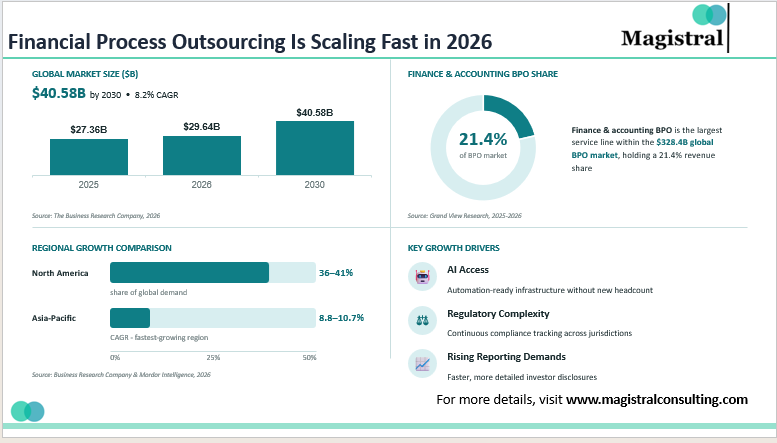
Financial Process Outsourcing is shifting from a cost-saving tactic to a core finance strategy worldwide. The global market reached $29.64B in 2026, up from $27.36B in 2025, growing at an 8.3% CAGR, and is expected to approach $40.58B by 2030. Growth is increasingly driven by AI access, regulatory complexity, and rising reporting demands. Alternative investment managers are outsourcing fund accounting, NAV calculation, and investor reporting to build institutional-grade infrastructure without adding permanent headcount.
Financial Process Outsourcing

Financial Process Outsourcing Is Scaling Fast in 2026

Financial Process Outsourcing Market Size and Growth Outlook

The financial process outsourcing market has moved past early-stage niche status into a multi-billion-dollar global category. Independent research houses differ on exact figures, but every major estimate points towards consistent, high-single-digit growth through the end of the decade.

Global Market Valuation and Compound Growth

The Business Research Company sizes the market at $29.64B in 2026, up 8.3% from $27.36B in 2025. The market is projected to grow at an 8.2% CAGR through 2030, reaching $40.58B. This growth signals structural rather than cyclical demand.

Finance and Accounting BPO as the Anchor Segment

Grand View Research values finance and accounting BPO at $70.2B in 2025, rising to $76.5B in 2026, with a 9.3% CAGR through 2033. Within the $328.4B global BPO market, it is the largest service line, holding a 21.4% revenue share.

Regional Growth Differentials

North America holds the largest share of financial process outsourcing, at 36%–41% of global demand. Asia-Pacific is growing fastest, with CAGRs of 8.8%–10.7%, as regional enterprises adopt outsourcing more aggressively.

Forecast Through 2030 and Beyond

Beyond the $40.58 billion 2030 estimate, Mordor Intelligence projects the wider finance and accounting outsourcing category reaching $85.92 billion by 2031. The spread reflects differing scope definitions, but the direction is unambiguous: the sector is compounding faster than professional services at large.

Key Drivers Behind Financial Process Outsourcing Adoption

AI adoption, mounting regulatory complexity, and thinly staffed internal finance teams are pushing more organisations towards providers that can supply both delivery scale and specialised technology.

AI and Automation Inside Finance Functions

Deloitte’s Q4 2025 CFO Signals survey found that 87% of CFOs expect AI to be extremely or very important to finance operations in 2026, while 63% of finance departments already use AI. 81% are adopting AI through outsourced providers, as specialised AI talent remains scarce internally.

Rising Regulatory and Reporting Complexity

The EU Corporate Sustainability Reporting Directive requires disclosure of ~1,100 data points across 50,000+ entities from 2026. With limited internal capacity, finance teams are increasingly relying on providers for compliance-adjacent services.

Rising Regulatory and Reporting Complexity

Forecasts for 2026–2030 highlight rising adoption among small and mid-sized enterprises, driven by cloud-based finance platforms. Lower entry costs are making outsourced finance accessible beyond large enterprises to leaner organisations.

Rising Regulatory and Reporting Complexity

Lean finance teams often face capacity gaps as fund structures become more complex. Side letters, waterfalls, and multi-currency vehicles are driving greater use of outsourced NAV calculation and financial process outsourcing to meet investor expectations.

Geographic Shifts Reshaping Financial Process Outsourcing Delivery

Delivery is consolidating around a small number of global hubs, with India extending its lead as capability centres move from transactional processing towards strategic ownership.
Financial Process Outsourcing

Geographic Shifts Reshaping FPO Delivery

India’s Expanding Global Capability Centre Footprint

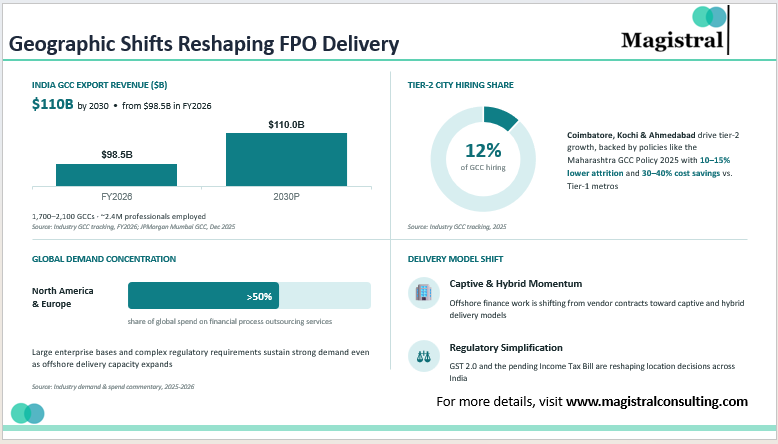
Industry tracking counts 1,700–2,100 GCCs in India, employing ~2.4M professionals and generating ~$98.5B in FY2026 exports, projected to reach $110B by 2030. JPMorgan Chase’s December 2025 plans for Asia’s largest GCC in Mumbai highlights India’s shift towards strategic infrastructure, beyond cost-driven back offices.

Tier-2 City Expansion

Coimbatore, Kochi, and Ahmedabad account for ~12% of GCC hiring, supported by policies like the Maharashtra GCC Policy 2025. Attrition is 10%–15% lower than Tier-1 metros, with 30%–40% talent-cost savings.

North America and Europe as Demand Centres

North America and Europe account for well over half of global spend on these services. Their large enterprise bases and complex regulatory requirements sustain strong demand. This remains true even as offshore delivery capacity expands.

Captive GCCs Versus Third-Party Vendors

Offshore finance work is shifting from vendor contracts to captive and hybrid models.
India’s regulatory simplification is supporting this transition.
GST 2.0 and the pending Income Tax Bill are influencing location decisions.

Investment and Deal Activity in Financial Process Outsourcing

Private capital is consolidating financial process outsourcing providers, favouring scale and AI-enabled delivery capability over simple headcount growth.

Private Equity Appetite for Services Platforms

Global M&A value reached $4.9T in 2025, up 37% YoY, with private-equity-backed transactions totaling ~$1.8T. This capital is increasingly flowing into business services and technology-enabled platforms. Finance and accounting providers with recurring revenue are benefiting from this trend.

Platform Buyouts and Scale as a Deal Thesis

PitchBook expects platform buyouts to reach at least 25% of private equity deals in 2026, with larger funds gaining share. In FPO, sponsors are consolidating smaller providers into scalable platforms to support AI investment and cross-selling.

Strategic Reviews Among Established Providers

Consolidation pressure is visible across established BPO players. Conduent explored a potential sale in early 2025 after attracting takeover interest, signalling continued strategic repositioning across the broader sector.

Emerging Opportunities and the Road Ahead for Financial Process Outsourcing

The next phase will be defined by ESG reporting demand, agentic AI, and closer integration with fund operations for alternative asset managers.

ESG and Sustainability Reporting Services

Providers are expanding financial close services into materiality assessment and carbon-footprint tracking as disclosure requirements grow. This turns compliance needs into a new outsourced service opportunity.

Agentic AI and Touchless Finance Operations

Providers are moving from AI copilots to agentic systems that automate complex finance workflows with limited human oversight. Deloitte is already applying these capabilities to tasks such as month-end close and vendor validation.

Institutional-Grade Reporting for Alternative Managers

Alternative investment managers are among the fastest adopters as reporting complexity outpaces internal capacity. Private credit, real estate, and venture funds increasingly use outsourced NAV calculation, fund administration, accounting, and financial modelling to deliver institutional-quality reporting without expanding permanent staff.

What This Means for CFOs and COOs

Financial process outsourcing is becoming a strategic infrastructure choice, enabling faster scaling, regulatory readiness, and AI adoption. Firms treating finance functions as core infrastructure can better compete for capital and talent.

Services Offered by Magistral Consulting for Financial Process Outsourcing

General Ledger & Accounting

End-to-end management of accounting activities, reconciliations, journal entries, and financial close processes to ensure accurate and timely books.

Financial Reporting & MIS

Preparation of financial reports, dashboards, and MIS to deliver clear, timely, and actionable insights for management.

Financial Planning & Analysis (FP&A)

Budgeting, forecasting, financial modelling, and variance analysis to support strategic planning and informed business decisions.

Cash Flow & Treasury Management

Cash-flow forecasting, liquidity monitoring, payment management, and treasury support to optimise working capital and cash utilisation.

Payroll & Expense Processing

Accurate processing of payroll, employee expenses, reimbursements, and related financial reconciliations while maintaining compliance.

Tax & Compliance Support

Preparation of financial data, tax reports, compliance documentation, and regulatory requirements to minimize financial and compliance risks.

Financial Data Management & Analytics

Collection, validation, analysis, and reporting of financial data to improve data quality, visibility, and decision-making.

Financial Controls & Quality Assurance

Implementation of financial controls, validation processes, and quality checks to enhance accuracy, consistency, and governance.


About Magistral Consulting

Magistral Consulting has helped multiple funds and companies in outsourcing operations activities. It has service offerings for Private Equity, Venture Capital, Family Offices, Investment Banks, Asset Managers, Hedge Funds, Financial Consultants, Real Estate, REITs, RE funds, Corporates, and Portfolio companies. Its functional expertise is around Deal origination, Deal Execution, Due Diligence, Financial Modelling, Portfolio Management, and Equity Research

For setting up an appointment with a Magistral representative visit www.magistralconsulting.com/contact

About the Author

Nitin is a Partner and Co-Founder at Magistral Consulting. He is a Stanford Seed MBA (Marketing) and electronics engineer with 19 + years at S&P Global and Evalueserve, leading research, analytics, and inside‑sales teams. An investment‑ and financial‑research specialist, he has delivered due‑diligence, fund‑administration, and market‑entry projects for clients worldwide. He now shapes Magistral Consulting’s strategic direction, oversees global operations, and drives business‑development support.


FAQs

What is financial process outsourcing?

Delegating finance and accounting functions such as bookkeeping, reconciliations, NAV calculation, and reporting to external specialists.

How large is the financial process outsourcing market in 2026?

The market is $29.64 billion in 2026, growing at 8.3% CAGR and projected to reach ~$40.58 billion by 2030, according to The Business Research Company.

Which regions lead financial process outsourcing delivery?

North America leads consumption at 36%–41% of global demand, while India leads delivery capacity and Asia-Pacific is the fastest-growing consumption region.

How is AI changing financial process outsourcing?

AI is shifting delivery towards automated workflows, with ~81% of finance functions adopting AI through outsourced providers.

Which functions benefit most from financial process outsourcing?
Fund accounting, NAV calculation, investor reporting, financial modelling, and compliance reporting, especially among alternative asset managers.


Capital remains the fuel for growth across all business types, from early-stage startup ideas to expanding mid-market organizations enjoying revenue streams. However, raising funds is no longer a linear process involving just banks or venture capitalists. The modern fundraising landscape is fragmented, dynamic, and requires a high level of financial sophistication, storytelling finesse, and strategic outreach. Capital raising consultants provide outstanding value and have become trusted advisors for navigating these complexities.

These consultants offer an end-to-end service from refining the fundraising strategy and developing the financial documents, to identifying, targeting, and managing. They represent investment bankers’ knowledge, the flexibility of startup operatives, and the detail of financial analysts in one package. For businesses hoping to accelerate growth, expand globally and navigate a volatile economic climate, capital raising consultants can be a source of significant competitive advantage.

Capital Raising Consultants: An Evolving Need in the Investment Ecosystem

Capital raising consultants have transitioned away from being “nice-to-have” advisors to becoming an integral group of the fundraising machinery, primarily for companies in all sectors and in all geographies.

Rising Complexity in Capital Markets

The capital markets have transformed from a binary decision between equity and debt into a continuum of funding vehicles— convertible notes, SAFE’s, mezzanine debt, revenue-based financing, and more. With these decisions requiring a high degree of knowledge about capital structuring, few companies will have this capability internally. The primary service offering of a capital raising consultant is to demystify the range of options and determine the best capital stack for the specific business model at the point of growth.

Surge in Alternative Capital Sources

The rise of global family offices, corporate VCs, private credit funds, and crowdfunding platforms has widened the capital base. While this increases options, it also creates noise. Capital raising consultants provide an intelligent filter to help the company and their team decide which capital sources make the most sense and align with their long-term plans and interests in ownership.

Increased Focus on Investor Readiness

Today, a good idea or product isn’t enough. Investors demand clear financial projections, proven traction, and a compelling narrative. Consultants help clients navigate through those challenges and prepare investor-ready packages that comprise many elements from market intelligence or point of difference, competitor benchmarking and comparison, projected growth, mitigation of risk and finally the compelling story to tell.

Customized Outreach and Targeting

Generic email no longer works. Fundraising now demands a CRM-driven, data-backed approach to investor engagement. Top consultants currently capitalize on using advanced targeting methods that include databases, predictive analytics, and AI-driven tools in securing the right investors with the right messaging.

Value Addition Beyond Fundraising

Capital raising consultants are not only useful in raising funds. They advise the business on negotiation terms, preparation for due diligence, and even post-acquisition onboarding actions with investors. All these actions will lead to better-managed dilution, good governance, and quicker disbursement of funds.

Services Offered by Capital Raising Consultants

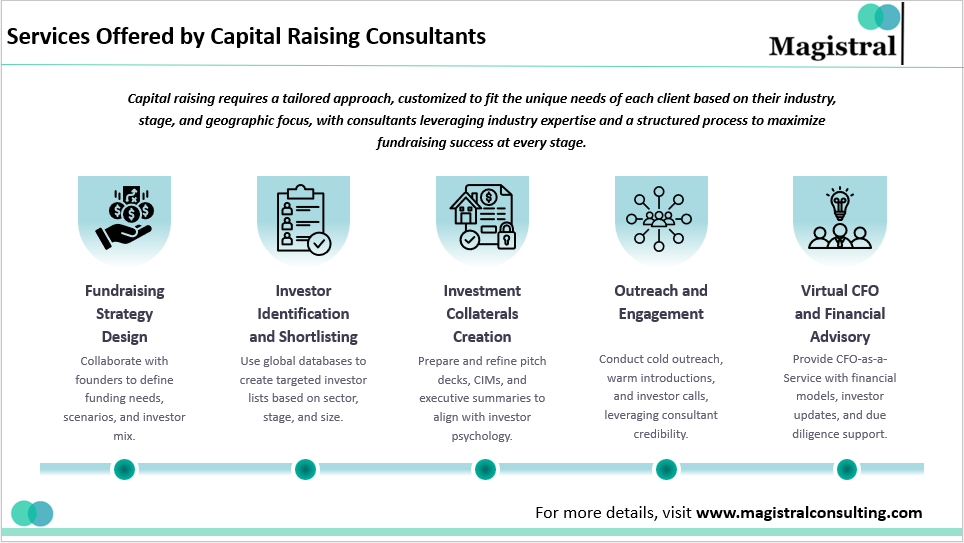
Capital raising is rarely a one-size-fits-all process. Depending on the client’s industry, stage, and target geography, consultants offer a suite of modular and customizable services.

Fundraising Strategy Design

Before pitching begins, consultants work with the founders or CFOs to establish clarity on why funding is needed, how much is optimal, and what timeline to follow. This includes scenario planning, use-of-funds modeling, and planning the ideal investor mix.

Investor Identification and Shortlisting

Consultants have global databases, past deal data, and industry contacts to tailor investor shortlists. These lists are divided into sector preference, average cheque size, stage focus, ticket size, geographic mandate, and investment thesis. Under this laser-targeted approach, outreach conversions occur with much greater frequency.

Investment Collaterals Creation

A strong set of documents can make or break a deal. Consultants prepare or refine the pitch deck, executive summary, CIM (Confidential Information Memorandum), one-pagers, and teaser notes. Sometimes they block the message with their information, which confuses investors, but mainly it is an art to align the story with the psychology of an investor, while putting up visuals that clarify rather than confuse.

Outreach and Engagement

Consultants run targeted outreach campaigns, at times playing the role of an intermediary between the client and investor. They include cold outreach, warm introductions, investor calls, coordination of NDAs, and follow-ups. The Consultancy’s Credibility often opens doors that founders may not be able to open by themselves.

Virtual CFO and Financial Advisory

For those startups without a finance team, the capital-raising consultant has CFO-as-a-Service solutions: investor updates, financial models, MIS reporting, and due diligence support.

Services Offered by Capital Raising Consultants

Services Offered by Capital Raising Consultants

How Capital Raising Consultants Add Value Across Business Stages

Different stages of business require different fundraising strategies, and capital raising consultants fit their playbook accordingly.

Startups and Early-Stage Ventures

Startups tend to operate with small teams and often have a limited understanding of how fundraising works. Startup consultants help companies determine what they can celebrate as a “vision” that investors would buy into; help benchmark valuations based on their stage; and help find the right “strategic” angel investors or accelerators. They help clients prepare financial models that represent flexibility while controlling expenses and align the narratives with the investor persona.

Growth-Stage Companies

By this point, the fundraising round is larger than an early-stage round, and the investor comes primarily from institutional investors. In this role, consultants help with due diligence readiness, secure data rooms, practice investor meetings with leadership, and respond to investor objections. The role is also to lessen the fatigue and stress for the founders, particularly with long funding rounds.

Mature Companies or PE/VC Portfolio Firms

These companies may be craving funding for expansion or product development, or even buybacks. Consultants help provide structure for funding, possibly as bridge rounds, mezzanine funding or PE secondaries. Consultants to PE or VC portfolios help at the fund level, look at the opportunities to make changes or to optimize capital allocation across the portfolio

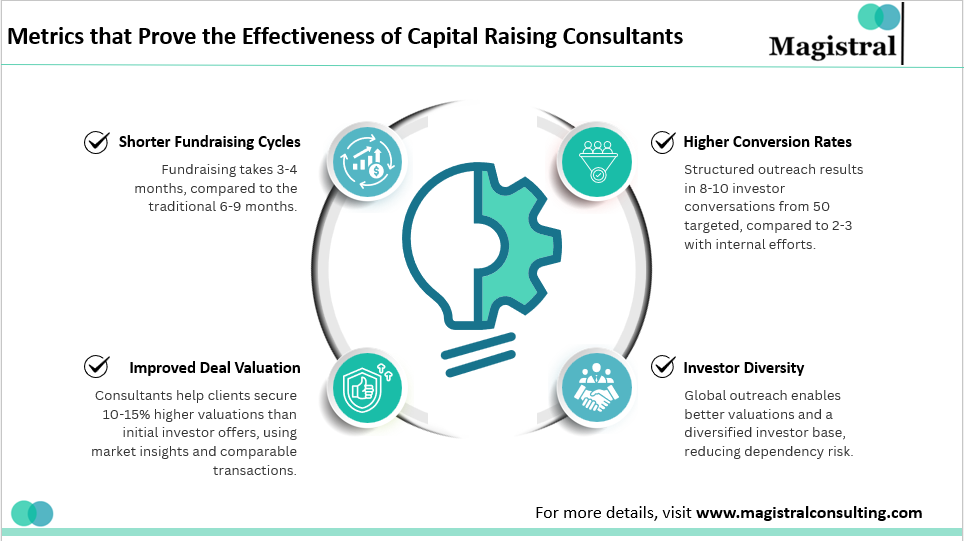
Metrics that Prove the Effectiveness of Capital Raising Consultants

Cutting-edge capital fundraisers produce data-oriented results that surpass the value of anecdotal evidence.

Shorter Fundraising Cycles

Fundraising can take from 3 to 4 months, while traditionally, 6 to 9 months would be expected, with investor targeting and documentation readiness.

Higher Conversion Rates

Clients claim that investors’ response rate doubles or triples with the structured outreach prepared by a consultant. Of the 50 investors targeted, a well-organized campaign conducts 8 to 10 conversations, whereas an internal one reaches 2 to 3.

Improved Deal Valuation

Based on comparable transactions, market insight, and techniques, consultants can assist clients in obtaining a better deal—we are often looking at valuations that reflect a 10- to 15-percent premium over the initial offers from investors.

Investor Diversity

Capital raising will open a global investor arena to the consultants. This not only offers the chance of better valuation but also serves in developing a diversified cap table, thus reducing dependency risk.

Metrics that Prove the Effectiveness of Capital Raising Consultants

Metrics that Prove the Effectiveness of Capital Raising Consultants

Choosing the Right Capital Raising Consultant

Given the devastation caused by the impacts, it is vital to pick your consultant wisely.

Domain Expertise and Track Record

Ask for references, success metrics, and case studies in your industry. Those consultants who speak your sector’s language and KPIs will be much better able to affect the outcomes.

Access to Investor Network

Check if these guys really have relationships or are just database accesses. Top-notch consultants keep personal relationships with family offices, VCs, and strategic funds.

Global vs. Local Reach

If your market or product is international, a global reach is required. But for regulatory-heavy industries like healthcare or fintech, local capabilities matter more.

Cost and Fee Structures

Avoid full success-based models as they lessen accountability. Instead, opt for hybrid models-a small retainer and a success-linked bonus-as it keeps the consultant focused and aligned.

About Magistral Consulting

Magistral Consulting has helped multiple funds and companies in outsourcing operations activities. It has service offerings for Private Equity, Venture Capital, Family Offices, Investment Banks, Asset Managers, Hedge Funds, Financial Consultants, Real Estate, REITs, RE funds, Corporates, and Portfolio companies. Its functional expertise is around Deal origination, Deal Execution, Due Diligence, Financial Modelling, Portfolio Management, and Equity Research

For setting up an appointment with a Magistral representative visit www.magistralconsulting.com/contact

About the Author

Tanya is an investment-research specialist with 6 + years advising venture-capital, private-equity and lending clients worldwide. A Stanford Seed alumnus with an MBA and an Economics (Hons) degree, she heads project teams at Magistral Consulting, delivering financial modelling, due-diligence and deal support on 3,000 + mandates. Her blend of rigorous analytics, sharp project management and clear client communication turns complex data into actionable investment insight.


FAQs

What does a capital raising consultant do?

They provide strategic and financial advisory services to help companies plan, execute, and close funding rounds.


When should a startup hire a capital raising consultant?

Ideally, before the fundraising begins—when you're ready with your product or traction, but before preparing documents or reaching out to investors.


Do capital raising consultants charge upfront?

Yes, most charge a base retainer and a success fee. This helps keep efforts aligned with outcomes.


Can capital raising consultants guarantee funding?

No ethical consultant will guarantee funding. However, they dramatically improve your chances through better targeting and preparation.


How long does it take to raise capital with a consultant?

With good preparation, most early-stage companies can raise capital in 3–6 months