Tag Archives: Investor Outreach Services

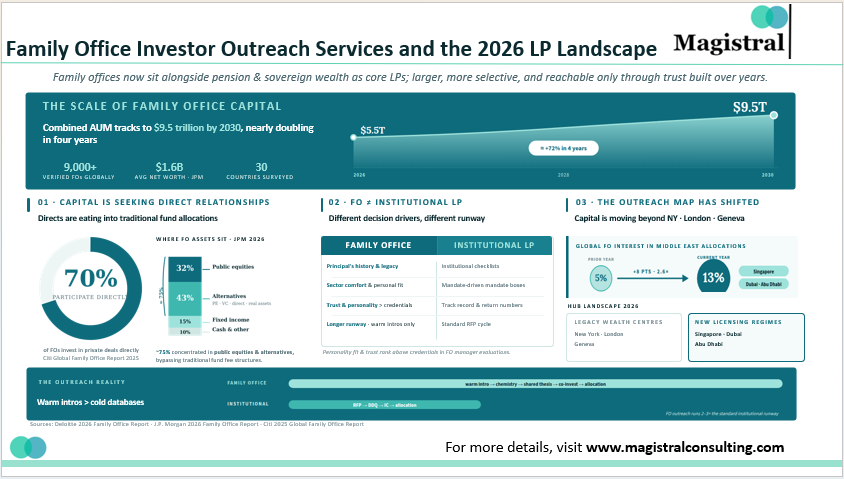
Family offices now control more capital than most institutional investors combined, but getting to the right principal still depends on trust that gets built over years, not something you can pull from a cold spreadsheet or database. Deloitte’s 2026 numbers put the global family office count above 9,000, with combined assets over $5.5 trillion, and they expect it to climb to $9.5 trillion by 2030. For fund managers, the core problem is obvious: Family Office Investor Outreach Services have turned into a must-have because the investor base is bigger, more selective, and frankly harder to reach.

That growth expanded the investor universe quite a lot, but it also makes outreach messier to run properly, since family offices usually do not answer generic proposals or mass mail, and most still want a warm referral first rather than a cold intro.

Family Office Investor Outreach Services and the 2026 LP Landscape

Family offices now sit next to pension funds and sovereign wealth funds as major limited partners for private capital. Their decision drivers, however, do not match those of institutional allocators at all, so narrowing that mismatch is the real work behind a well-built Family Office Investor Outreach Services effort.
Family Office Investor Outreach Services

Family Office Investor Outreach Services and the 2026 LP Landscape

The Scale of Family Office Capital in 2026

Scale is the first thing that moved. J.P. Morgan’s report shows average family office net worth at $1.6 billion across 333 offices in 30 countries, and independent trackers now count more than 9,000 verified family offices worldwide. Spread across single-family offices, multi-family platforms, and family-office-backed sponsors, that population is simply too large to rely on outreach that runs only from a few trusted relationships that have been around forever.

Family Offices Versus Institutional LPs

Pension funds and endowments usually march through institutional checklists; family offices… not so much. A principal’s personal story, day-to-day sector comfort, and legacy intentions often end up mattering as much as upside potential, and some independent polls rank personality fit plus trust signals above pure credentials in how a family office chooses a manager. So, Family Office Investor Outreach Services tend to need a longer runway than a “normal” institutional process can give.

Direct and Private Equity Allocations Keep Climbing

Direct deal sourcing keeps chewing up allocations that used to go into traditional funds. Citi’s 2025 Global Family Office Report said that about 70% of family offices now take part in private opportunities directly, sometimes sidestepping classic private equity fee frameworks entirely. At the same time, J.P. Morgan’s 2026 check-up indicates almost three-quarters of family office capital sits in public equities and alternatives, which reads like a clear pointer: investors want close hand-to-hand relationships, not only fund commitments.

Geographic Expansion Widens the Outreach Map

The formation of family offices is not just anchored in New York, London, and Geneva anymore. Singapore, Dubai, and Abu Dhabi have each spun up specific licensing lanes, and interest in Middle East allocations among global family offices rose from 5% to 13% year over year. As a result, a Family Office Investor Outreach Services push that is built solely around old-school legacy hubs will miss the place the capital is sliding toward now.


Why Family Office Investor Outreach Services Are a 2026 Strategic Priority

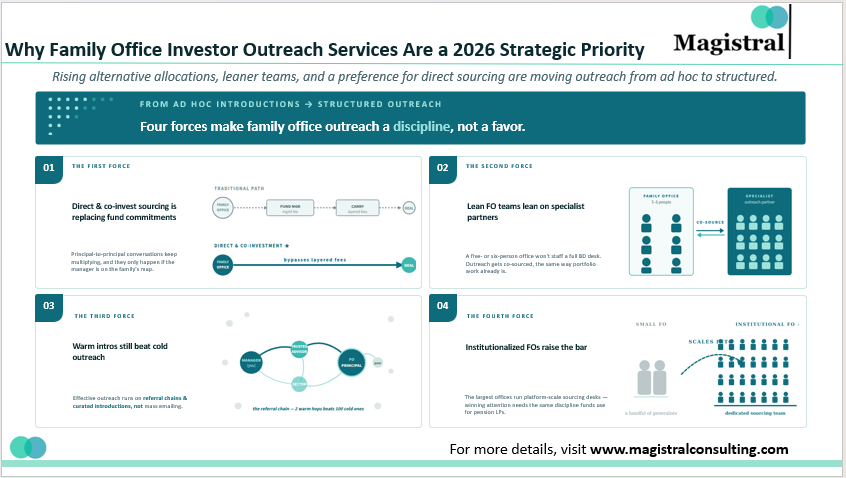
More capital moving into alternatives, smaller internal teams, and a stronger preference for direct sourcing mean family offices increasingly rely on structured outreach instead of ad hoc warm introductions.
Why Family Office Investor Outreach Services

Why Family Office Investor Outreach Services Are a 2026 Strategic Priority

The Shift Toward Direct and Co-Investment Sourcing

Family offices are leaning away from just signing on to fund commitments and instead using more direct setups with co-investment structures, mostly so they can dodge layered management and those carry fees that stack up. In UBS’s 2026 Global Family Office Report, it says most of the surveyed offices expect to adjust their strategic asset allocation over the next 12 months, which basically means principal-to-principal conversations won’t really slow down.

Lean Teams Are Driving Co-Sourcing Adoption

Most family offices are still compact operations. J.P. Morgan’s 2026 report found that about 80% of them already outsource at least some of their portfolio management, and more than a third outsource over half of it. The same idea then rolls right into how these offices handle investor and deal outreach: a lean five-or-six-person group would rather use a specialist partner than build and staff an entire business development desk from scratch.

Warm Introductions Still Beat Cold Outreach

More than two-thirds of family office deals end up closing next to another family office, so the environment is not exactly built for lone-wolf emailing. Sourcing through a trusted advisor, or a sector-focused specialist, tends to outperform a cold approach in a consistent way. So, effective Family Office Investor Outreach Services tend to rely on referral networks and carefully curated introductions, not broad blasts or mass mail.

Institutionalization Raises the Bar for Managers

At the same time, the biggest family offices are now operating more like platforms, often with 200 to 500 people, plus dedicated sourcing teams. And tech founders are also gaining influence, controlling a larger portion of the largest single-family offices. Getting noticed increasingly means you need the same research discipline that funds already use when they approach institutional LPs.

Core Components of a Family Office Investor Outreach Services Program

An effective program kind of blends segmentation verified data, and multi-channel engagement, instead of just chasing volume. The pieces below make a clear gap between outreach that earns a meeting and outreach that gets ignored.

Segmenting the Family Office Universe

Family offices can be sorted by ticket size, sector emphasis, geography, generation of wealth, and past deal rhythm. This narrows the outreach to principals who can say yes. This layer is usually where most Family Office Investor Outreach Services engagements start before a single message even goes out.

Building Verified, Research-Backed Profiles

Directors move fast. Mandates change, principals rotate, and sometimes offices split or merge. Also, one outdated contact can quietly burn weeks of relationship-building, so a credible Family Office Investor Outreach Services program keeps profiles updated on ticket size, sector mandate, and recent deal activity.

Multi-Channel, Relationship-Led Engagement

Family offices tend to answer warm introductions, co-investor ecosystems, and advisor referrals much more than cold email alone. So, the program should mix direct calls, curated events, and referral corridors, because building that kind of network internally can take years, more or less.

Tracking and Follow-Up Discipline

Even so, through targeting, most family office conversations still require a few extra touchpoints stretched over weeks or months. Outreach often lives or dies on CRM discipline, and consistent follow-up at the right moments, not sheer volume, is typically what separates a program that converts from one that stalls.

How Magistral Consulting Delivers Family Office Investor Outreach Services

Magistral supports fund managers, operating companies, and advisors who need structured research-backed access to family office capital, not just a scattershot list of names, and this is really building on the firm’s broader work in outsourced family office services. They build and keep up verified family office and LP profiles that are segmented by ticket size, sector preference, and geography, and they do it off a live directory with more than 25,000 LP and GP contacts across the US, Europe, the Middle East, and Asia. So, a Family Office Investor Outreach Services engagement can start with a shortlist, instead of an unfiltered spreadsheet.

And for managers who are looking at parallel sources of capital, the same research infrastructure kind of flows into deal origination outsourcing and due diligence support as well. That helps funds move from first contact to a closed commitment with fewer dropped threads, you know, fewer dead ends. As more capital concentrates inside family offices and multi-family platforms, Family Office Investor Outreach Services is turning into less of an optional add-on and more of a standard line item in any serious fundraising or business development budget for 2026 and beyond. In practical terms, the takeaway is clear: teams that want access to this capital need a structured outreach approach.


About Magistral Consulting

Magistral Consulting has helped multiple funds and companies in outsourcing operations activities. It has service offerings for Private Equity, Venture Capital, Family Offices, Investment Banks, Asset Managers, Hedge Funds, Financial Consultants, Real Estate, REITs, RE funds, Corporates, and Portfolio companies. Its functional expertise is around Deal origination, Deal Execution, Due Diligence, Financial Modelling, Portfolio Management, and Equity Research

For setting up an appointment with a Magistral representative visit www.magistralconsulting.com/contact

About the Author

Prabhash Choudhary is the CEO of Magistral Consulting. He is a Stanford Seed alumnus and mechanical engineer with 20 + years’ leadership at Fortune 500 firms- Accenture Strategy, Deloitte, News Corp, and S&P Global. At Magistral Consulting, he directs global operations and has delivered over $3.5 billion in client impact across finance, research, analytics, and outsourcing. His expertise spans management consulting, investment and strategic research, and operational excellence for 1,200 + clients worldwide


FAQs

What are Family Office Investor Outreach Services?

They are structured research, targeting, and engagement programs that connect fund managers and operating companies with verified family office principals suited to a specific deal or fund.

How is family office outreach different from institutional LP outreach?

Family offices decide based on the principal's personal history, sector comfort, and relationship trust, so outreach needs a longer, more personalized cadence than a standard institutional process.

How long does it typically take to secure a family office meeting?

Most programs need several touchpoints over weeks or months, since family offices rarely commit to a first conversation without a warm introduction or referral.

Can outsourcing outreach improve fundraising outcomes?

Yes, dedicated research and outreach support reduces time spent on unqualified contacts and lets internal teams focus on conversations that are already qualified.

What data matters most when targeting family offices in 2026?
Ticket size, sector focus, geography, and direct investment history matter more than the size of the contact list, since accuracy drives response rates.


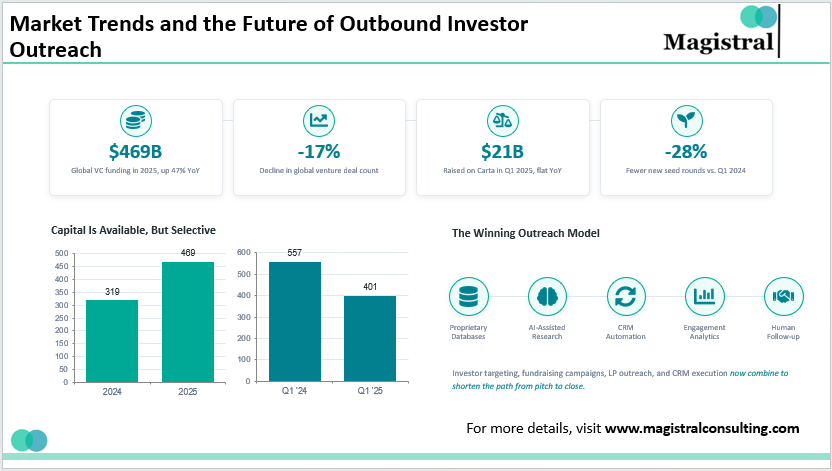
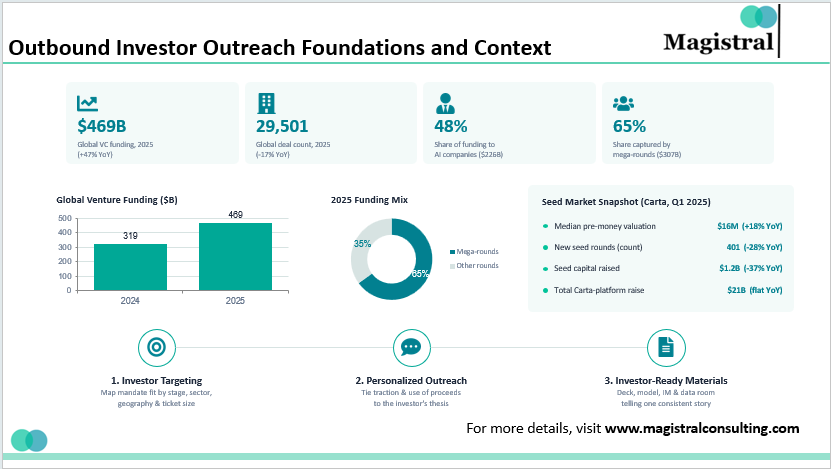
Outbound investor outreach has become an integral part of raising funds for early-stage startups, young managers, investment banks, and private market advisors. The money is out there, but investors are now pickier, data-driven, and focused on mandate fit. According to CB Insights, venture funding worldwide reached $469 billion in 2025, representing a 47% YoY growth, while deal count was down 17% to 29,501 deals. Companies in AI raised $226 billion, which represents 48% of all venture funding, while mega rounds captured $307 billion, or 65% of global venture capital.

Outbound Investor Outreach

Outbound Investor Outreach Foundations and Context

According to Carta, the median pre-money valuation of seed rounds reached $16 million in Q1 2025, growing by 18% year over year, whereas the number of seed rounds decreased by 28%. Under these conditions, outbound investor outreach depends on correct investor targeting, proper positioning, personalized communication, a CRM approach, and follow-up. Outbound investor outreach is not mass mailing. Outbound investor outreach is a selective capital-raising process that involves identification and segmentation of relevant investors and engagement based on a credible reason for looking at your opportunity.

Investor Targeting Comes Before Messaging

The initial step in the process is investor-fit mapping. Seed rounds should not be targeted by late-stage growth capital funds, and a lower mid-market firm searching for buyout funding requires a totally different investor universe than a SaaS company raising venture capital. The relevance of an opportunity will lead to better responses, as investors screen deals on various parameters – stage, location, sector, ticket size, and portfolio concentration. The Magistral investor database helps in this regard by listing 5,000+ LPs, 17,000+ GPs, 6,500+ angel investors, and 6,500+ HNIs, with information on the type of company, location, contact names, email addresses, LinkedIn IDs, and physical address.

In that sense, outbound investor targeting becomes more systematic rather than through scattered networks or generic online databases.

Personalization Is Now the Baseline

Every investor receives hundreds of pitch emails in a month. Hence, the personalization must be much more than a simple first-name addition to an email. It must be done in such a way that the investor can see how the company’s sector, traction, round size, and use of proceeds fit into their mandate. However, according to the data from Carta for the first quarter of 2025 in the private market, good companies are still being noticed. Yet, deal count compression indicates that investors are now using higher-quality filters.

Startups on Carta have raised $21 billion in Q1 2025, which is consistent with Q1 2024, yet the volume of seed capital has reduced to $1.2 billion in 401 seed deals, representing a 37% reduction from Q1 2024. That makes outbound investor outreach a positioning as well as a distribution effort.

Materials Must Be Investor-Ready

Weak materials will not be saved by even the strongest email. The story told in the pitch deck, the teaser, financial modeling, data room, and information memorandum must be consistent. This is especially true in capital raising, where discrepancies in valuation, market size, traction, and use of funds might cause trouble in early-stage meetings. Magistral’s fundraising assistance consists of pitch deck development, valuation modeling, information memorandums, teasers, data room assistance, investor matching, CRM-based campaigns, follow-ups, scheduling, and closing deals.

Applications and Use Cases in Outbound Investor Outreach

The outbound process helps companies raise money in various situations, including startups, LP fundraising for funds, and others. In each situation, you will need a unique investor list, message, and conversion funnel. As the duplication of the above overview has been omitted, now we will consider only examples of use cases and segments of potential investors.

Startup Fundraising

In the case of startups, the process of outbound investor outreach is mostly related to angels, seed funds, micro-VCs, industry specialists, and strategic investors. The message here should be brief – problem, solution, traction, market, team, and fundraising request. According to CB Insights, the US has been able to attract $328 billion, which accounted for 70% of global venture capital investment in 2025, while Asia and Europe were able to attract $53 billion and $68 billion, respectively.

Fundraising for Funds

In the case of fund managers, outbound investor outreach usually goes out to LPs, including family offices, funds of funds, endowments, pension funds, sovereigns, and wealth management platforms. Outbound investor outreach needs more time since there are many factors that LPs consider, such as track record, team stability, DPI, strategy, portfolio construction, and infrastructure. Here comes the utility of the well-designed database of funds. According to Magistral, it will provide customized lead generation based on the type of investor, industry, and geography, and will offer 500 customized leads along with a subscription to its database within three weeks after signing.

Private Equity and Lower Mid-Market Deals

Outbound investor outreach for private equity usually assists in acquisition finance, growth equity, recapitalization, debt raise, or sponsor coverage. It includes the process of finding out those investors who have the relevant check size, sector interest, deal experience, and deployment capacity. The Q1 2025 Global Private Market Fundraising Report by PitchBook reported that there was a trailing-four-quarter private capital fundraising of $1.26 trillion, which declined 17.0% year over year, while the private debt fundraising increased 18.2% and secondaries fundraising increased 51.6%.

Debt and Private Credit Outreach

For debt outreaches, banks, private credit funds, specialty finance firms, and alternative lenders become targets of outreach. The main points of focus for such outreaches include cash flow, collateral, repayability, covenants, and protection from downside risks. The investor list needs to be smaller but deeper since the fit of lenders depends significantly on sectors, leverage, EBITDA, geography, and security structure.

Tools, Trends, and Technologies in Outbound Investor Outreach

The technology has impacted fundraising teams’ approach to list building, communication management, and tracking of investor behavior patterns. Still, tools become effective only if combined with thorough research and human discretion.

Investor Databases and Segmentation

The modern databases allow fundraising teams to segment investors based on location, sector, investment stage, fund type, investment size, and other details about decision-makers. Magistral’s database includes useful data on investors, such as email addresses, phone numbers, LinkedIn profiles, investor types, and geography. In addition, there is an option for analyst-driven customization of the database.

CRM and Outreach Automation

With a CRM, investor outreach can be measured. Tracking is performed on what has been done – who has been contacted, how and when they opened the deck, did they reply, follow up, and where does this particular investor stand in your pipeline. The fundraising approach at Magistral implies automation of personalized e-mail sequences, advanced triggers on opens, clicks, and replies, a real-time engagement dashboard, and follow-up scheduling.

AI-Led Research and Personalization

AI can help to profile investors, map industries, create emails, and evaluate engagement more quickly. However, AI can’t replace human judgment. The optimal usage of AI lies in identifying patterns and prioritizing investors based on relevance, and only after that, letting a human review the final version of the message. It reflects the general trend towards AI-powered deal origination, where the main advantage is automation and speed.

Engagement Analytics

Fundraising teams increasingly measure investor engagement through email open rates, deck opening, click-throughs, follow-up response, and meetings. Such measurement allows them to fine-tune messaging, prioritize warm leads, and avoid engaging uninterested investors. In a competitive market, the ability to measure such metrics can sometimes become more valuable than the list of investors itself.

Market Trends and the Future of Outbound Investor Outreach

Outbound investor outreach will become more targeted than mass based. Investors have more options, more data, and less time for anything irrelevant. As such, the fundraising team should be more specific, present cleaner material, and give a good enough reason to meet.
Two major trends in the fundraising world in 2025 can be identified. Firstly, there is money out there: CB Insights reported $469 billion worth of venture investments globally in 2025, 47% higher than the year before.

Outbound Investor Outreach

Market Trends and the Future of Outbound Investor Outreach

Secondly, the capital is highly selective: according to CB Insights, the number of venture deals decreased by 17%, while Carta reported that startups on its platform raised $21 billion in Q1 2025, roughly the same as in Q1 2024, but did 401 new seed deals, which is 28% fewer than the year before.

In the future, the successful model will be built using proprietary databases, AI-powered research, CRM process automation, investor outreach analysis, and top-notch human follow-through. For entrepreneurs, investors, and financial advisors, outbound investor outreach will always be among the most efficient ways to establish a fundraising process pipeline, gauge interest, and cut the time between pitching and closing.

For practical purposes of keyword planning, the article uses “outbound investor outreach” in controlled repetition within the body of the text without resorting to unnecessary repetition. The term is used in headlines and throughout the text where it fits the search intent context, while related keywords like investor targeting, fundraising campaigns, LP outreach, CRM implementation, and capital raising make the text readable.

Magistral’s Services for Outbound Investor Outreach

The company helps clients execute outbound investor outreach through a research-driven, CRM-led fundraising process supported by investor databases, offshore analysts, AI-powered workflows, and investment banking expertise. Its services include identifying and segmenting potential investors such as LPs, GPs, angels, HNIs, family offices, VCs, PE firms, strategic investors, and private credit providers based on geography, sector, stage, and fundraising requirements. The company also provides customized investor lists aligned with fundraising criteria, develops investor-ready materials including pitch decks, teasers, valuation models, CIMs, information memoranda, and data rooms, and manages CRM-driven outreach campaigns, follow-ups, engagement tracking, and workflow automation. Additionally, it supports investor meetings, NDA management, data room coordination, and deal closure activities.


About Magistral Consulting

Magistral Consulting has helped multiple funds and companies in outsourcing operations activities. It has service offerings for Private Equity, Venture Capital, Family Offices, Investment Banks, Asset Managers, Hedge Funds, Financial Consultants, Real Estate, REITs, RE funds, Corporates, and Portfolio companies. Its functional expertise is around Deal origination, Deal Execution, Due Diligence, Financial Modelling, Portfolio Management, and Equity Research

For setting up an appointment with a Magistral representative visit www.magistralconsulting.com/contact

About the Author

Aman is an investment-research specialist with 5+ years of experience across business and investment research, including 2+ years with Big Four firms like KPMG. A Stanford Seed alumnus with an MBA in Finance and a Bachelor of Commerce (Hons) from University of Delhi, he focuses on private equity, venture capital, and renewable energy sectors. He leads project teams at Magistral Consulting, delivering financial research, due diligence, deal sourcing, and M&A support, while driving strong process management and analytics. His blend of attention to detail, strategic thinking, and dynamic execution enables him to turn complex data into actionable investment insights.


FAQs

What is outbound investor outreach?

Outbound investor outreach is the process of identifying relevant investors and proactively contacting them with a tailored investment opportunity.

Why is investor targeting important?

Targeting improves response rates because investors usually evaluate opportunities based on sector, stage, geography, check size, and mandate fit.

What materials are needed before outreach?

A pitch deck, teaser, financial model, data room, and clear fundraising ask should be ready before outreach begins.

How does CRM improve investor outreach?

CRM systems track emails, follow-ups, deck opens, replies, meetings, and pipeline movement, making the fundraising process more disciplined.

How can Magistral support fundraising campaigns?

Magistral supports investor research, database access, customized lead generation, pitch materials, CRM campaigns, follow-ups, and meeting coordination.


In the current capital-centric ecosystem, managing investors’ relations is much more complicated than simply using spreadsheets and emails. The CRM software solutions for investors have come to play a vital role in facilitating businesses involved in the management of their investors’ data, communications, and deal pipelines. From private equity, venture capital, or hedge funds, investors use advanced systems for effective management of communications with their investors. As Deloitte predicts in its 2024 financial services outlook, more than 68% of investors will accelerate digitization in client and investor management. It shows that there is a general trend of becoming efficient, transparent, and personalized to satisfy investors.

Investors’ CRM in Modern Investment Ecosystems

An investors’ CRM system is essential for the effective organization of investors’ data and effective communication within different investment firms. It serves as a unified system whereby all the interaction processes, deal flows, and other aspects are managed.

Functionality of Investors’ CRM System in Managing Data

An investment firm deals with numerous amounts of data, including information on investor profiles and their transaction history. Investors’ CRM systems integrate these pieces of information into one place. Thus, the process of decision-making can be done effectively.
Furthermore, those investment firms that have a complex structure of operations, such as those operating with investments, may take advantage of the unified system to facilitate the investor commitment and capital call process.

Enhancing Investor Communication

One of the main purposes of any relationship with investors is to communicate effectively. In the context of investors’ CRM, it means sending out automatic updates, messages, and communicating with the client on a regular basis using consistent approaches.

Improving Deal Flow Visibility

The CRM solution for investors gives a complete picture of the deal flow, helping companies manage the entire process of deals from sourcing to closing. It makes sure that nothing is missed along the way, allowing them to focus on important deals.

Integration with Financial Tools

Contemporary investors’ CRM solutions also connect investor information with financial measures, making it easier for investors to forecast.

Investors’ CRM Features Driving Efficiency

There are multiple features associated with investors’ CRM, which help make operations more efficient. They address the specific needs and challenges that arise within the realm of investment, particularly at a time when customer expectations are changing quickly. For example, it is reported that nearly 70% of investors demand personal communication with fund managers.

Automation and Workflow Management

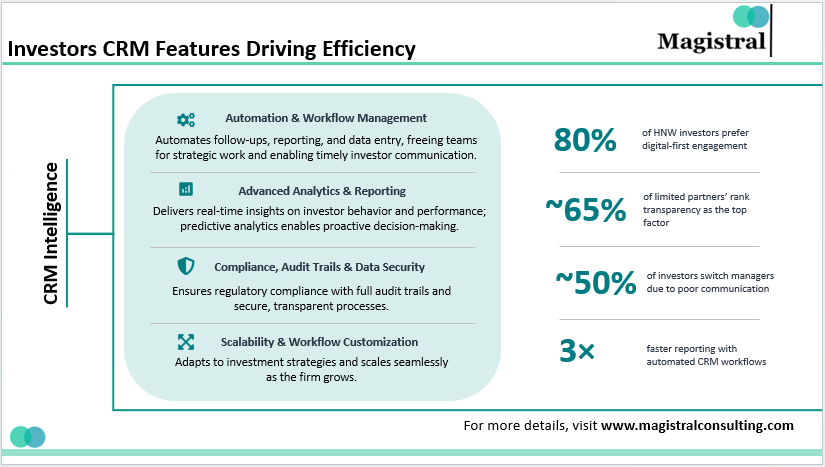
Automation eliminates unnecessary manual efforts and decreases risks related to errors. Investors’ CRM allows automating activities, such as follow-ups, report generation, and other routine tasks, so that people can be devoted to more strategic actions. It is particularly important given that over 80% of high-net-worth individuals now opt for a digital-first approach in communications, as reported by Capgemini 2024.

Workflow Customization

Depending on firms’ investment strategies, they can customize workflows. For instance, investors who have a venture strategy can adjust workflows to match the cycle of deals and evaluations, similarly to venture capital. However, flexible workflows will help address investor concerns. Over half of investors change their managers because of poor communication, McKinsey Wealth Report.

Advanced Analytics and Reporting

Being data-driven is one of the most crucial benefits offered by investors’ CRM systems. Investors’ CRM platforms offer valuable insights on how investors behave, engage, and perform.
Additionally, transparency is a crucial issue nowadays when it comes to investor relations. Transparency becomes an essential criterion for decision-making in 65 percent of cases for limited partners, as shown by the Preqin Global Investor Survey. The CRM system will allow your firm to generate high-quality reports that can increase transparency and credibility.

Predictive Analytics

Using predictive analytics allows your business to be aware of future opportunities or challenges. Using the historical data, you may predict trends and act based on them.
Using this feature will help you establish proactive engagement strategies. You will have the opportunity to contact investors and offer them something they need even before competing companies.

Compliance and Data Security

Meeting regulatory requirements is one of the primary concerns that come up when discussing investor relations. Your CRM solution should also have capabilities for maintaining data security and regulatory compliance in global jurisdictions.

Audit Trails

Audit trails provide a record of all interactions and transactions, ensuring transparency and accountability. This is particularly important in highly regulated environments where firms must demonstrate compliance at every stage.

Scalability and Customization

With growth comes change. The CRM system that investors provide is capable of scaling, giving organizations the opportunity to upgrade without changing everything.
In an environment where investors’ demands are ever-increasing, the ability to scale alongside being smart is key for companies.

Investors’ CRM Market Trends and Adoption

There has been an increase in the usage of investor CRMs due to advances in technology and rising demands from investors. In today’s world, it is important for investment firms to have sophisticated CRM systems in order to sustain their growth and remain competitive.

Investors CRM Market Trends and Adoption

Investors CRM Market Trends and Adoption

Growth in CRM Adoption

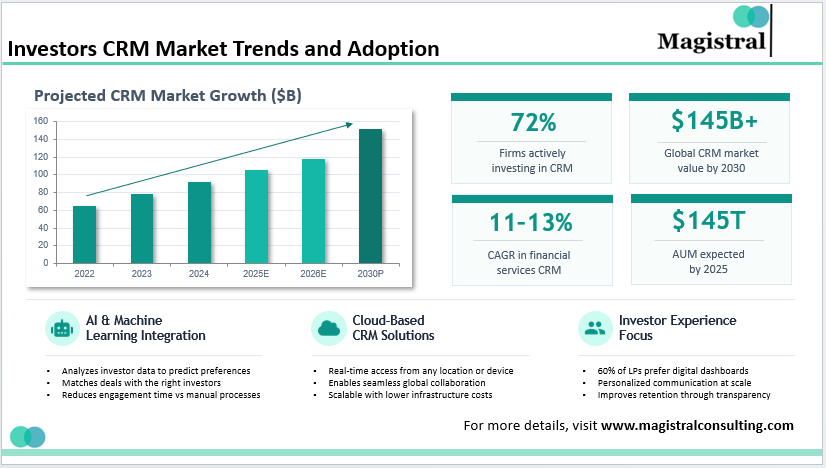
PwC’s 2025 asset management outlook reveals that 72% of companies are now spending on CRM technologies in order to improve their operational capabilities. The increasing adoption of CRM systems also corresponds to an increase in the overall CRM industry, which is expected to achieve a market value of around $145-160 billion by 2030, as suggested by Precedence Research and Fortune Business Insights. reference

In particular, the financial services segment is predicted to be one of the fast-growing segments, with a CAGR of around 11-13%, from 2024 to 2030. This rise can be attributed to the importance of data management and customer life-cycle analysis for investment firms. Simultaneously, the asset management industry is growing rapidly; PwC predicts that the industry will grow to exceed $145 trillion by 2025.

AI and Machine Learning Integration

Artificial intelligence has been revolutionizing the ability of firms to have advanced CRM in terms of understanding investor preferences. AI has the capability of analyzing previous communications between firms and investors and predicting future expectations based on those patterns.

AI in Deal Origination

In addition, AI has revolutionized deal origination, whereby potential deals can be identified through technology and subsequently matched to potential investors. This is in line with current developments in technology that focus on improving efficiency in sourcing potential deals. With investors’ CRM, this process becomes easier since it involves less time finding and communicating with the best investors.

Cloud-Based CRM Solutions

With cloud computing, CRM solutions for investors become more efficient due to real-time updates, regardless of where one is located. Cloud solutions make it possible for one to have real-time updates about the performance of the CRM system.

Focus on Investor Experience

The expectations of the investors have changed a lot, focusing on the principles of transparency, promptness, and customization. Based on the results of the survey conducted by Preqin in 2024, almost 60% of limited partners would like to receive their reports through the digital dashboard, rather than through the traditional PDF format.
Through CRM, investors provide an opportunity for investment firms to respond to those requirements, offering personalized communication and reporting possibilities. Thus, investors become happier, and their loyalty increases.

Investors’ CRM Implementation Strategies

The implementation of a CRM system for investors is essential for the firm’s proper functioning. It needs to take into account the needs of the company and integrate it with its goals.

Investors CRM Features Driving Efficiency

Investors CRM Features Driving Efficiency

Assessing Business Requirements

It is crucial to determine what needs exist in order to select an appropriate CRM platform. It will allow you to match the needs with the capabilities of the CRM system.

Data Migration and Integration

When transferring data to a new CRM system, it is important to provide high-quality and consistent information in the process. Integration with other tools is also required.

Training and Adoption

The success of the project is directly related to the effective training of users. Without it, it is unlikely that the company will be able to benefit from the system.

Change Management

Often, such projects require a change in culture within the organization. Effective strategies can help you achieve these goals more easily.

Continuous Optimization

CRM systems for investors must constantly improve in response to changing business needs. They are updated regularly and receive new features.

Investors’ CRM and How Magistral Supports Investment Firms

Investors’ CRM has become an essential tool for investment firms aiming to enhance efficiency, improve investor relationships, and drive growth. However, implementing and optimizing these systems requires expertise and strategic guidance.

Tailored CRM Solutions for Investment Firms

Magistral consulting firm proposes tailored CRM services that correspond to each client’s needs. Understanding client needs and problems helps the consulting firm to propose an adequate and efficient strategy that will increase CRM performance and effectiveness.

Data Management and Analytics Support

In order to work efficiently, data management becomes important. In this regard, Magistral proposes effective data management services, as well as analytics services.

Enhancing Fundraising and Investor Relations

A CRM system used by investors may greatly increase opportunities to raise funds. In particular, Magistral will assist you in using CRM effectively in order to raise money.

Operational Excellence and Outsourcing

Outsourcing services proposed by Magistral include operations outsourcing that involves professional knowledge and skills of the company to provide services of CRM and investment operations. Thus, investors’ CRM becomes important when dealing with many operations associated with managing relations with clients and fundraising.

About Magistral Consulting

Magistral Consulting has helped multiple funds and companies in outsourcing operations activities. It has service offerings for Private Equity, Venture Capital, Family Offices, Investment Banks, Asset Managers, Hedge Funds, Financial Consultants, Real Estate, REITs, RE funds, Corporates, and Portfolio companies. Its functional expertise is around Deal origination, Deal Execution, Due Diligence, Financial Modelling, Portfolio Management, and Equity Research

For setting up an appointment with a Magistral representative visit www.magistralconsulting.com/contact

About the Author

Tanya is an investment-research specialist with 6 + years advising venture-capital, private-equity and lending clients worldwide. A Stanford Seed alumnus with an MBA and an Economics (Hons) degree, she heads project teams at Magistral Consulting, delivering financial modelling, due-diligence and deal support on 3,000 + mandates. Her blend of rigorous analytics, sharp project management and clear client communication turns complex data into actionable investment insight.

FAQs

What is an investor's CRM

An investor's CRM is a specialized system designed to manage investor relationships, track interactions, and streamline investment processes within firms.

Why is Investors’ CRM important for investment firms?

It improves efficiency, enhances communication, and provides data-driven insights that support better decision-making and investor engagement.

How does Investors’ CRM support fundraising?

It helps track investor preferences, manage outreach campaigns, and monitor engagement, making fundraising efforts more targeted and effective.

Can Investors’ CRM integrate with other tools?

Yes, most investors' CRM platforms integrate with financial, analytics, and reporting tools to provide a comprehensive view of operations.

What are the key features of Investors’ CRM?

Key features include automation, analytics, compliance tools, data centralization, and customizable workflows.


The capital market is now driven by speed, relevance, and accuracy, rather than just relationships and intuition. AI-driven investor database models help firms move from static spreadsheets to dynamic, real-time intelligence systems, enabling faster capital raising and better alignment with investor mandates. PwC and Deloitte reports highlight that asset managers using AI in investor workflows experience quicker fundraising cycles and more data-driven strategies, reshaping investor relations and long-term allocation planning in private markets.

AI investor database solutions transforming investor intelligence

This is a rapidly growing market, as asset managers embed advanced analytics into investment and operational workflows. The size of the global market has evolved from less than USD 1 billion in 2019 to about USD 3.7 billion in 2023 and is anticipated to reach nearly USD 17 billion by 2030, reflecting accelerating institutional adoption. North America currently leads the market; the region’s early technology uptake, together with large asset managers, underpins the growth, while Europe and the Asia Pacific are scaling quickly as regulatory clarity and digital investment infrastructure improve. This regional expansion shows AI increasingly as a core capability for asset managers in pursuit of better decision-making, investor insight, and operational efficiency across global portfolios.

AI investor database solutions transforming investor intelligence

AI investor database solutions transforming investor intelligence

AI investor database solutions are redefining how firms discover, qualify, and engage investors by turning fragmented data into structured insight.

Data aggregation and enrichment at scale

This is because, unlike AI investor database solutions, conventional investor databases traditionally involve manual processes that result in the database becoming outdated as time passes. This is because automated platforms enable the collection of data from regulatory filings, deal-making, conferences, and digital traces. Research that MSCI cites in its outlook for the 2024 capital market suggests that accuracy in targeting investors improves by more than a third.

Predictive investor profiling

Apart from aggregation, machine-learning algorithms use the past behavior of people to make future predictions about their interests. Taking the example of an allocator, who in the past favored mid-market technology funds in the rising rate environment, the system will identify the allocator automatically. The above-mentioned point provides insight into the advisory model that works in the field of private equity.

Real-time mandate alignment

Investor mandates change more rapidly than most CRM platforms are capable of keeping pace with. AI investor database tools dynamically rescore investors based on changing mandates, making it possible to relate contact efforts to current values and interests instead of guessing based on outdated hypotheses.

Improving relationship continuity

Investor relationships span years and multiple funds. Artificial Intelligence systems retain the collective memory of the institution because they record user engagement, preferences, and feedback. In the long run, this builds a more detailed context in which more reflective conversations about capital can take place.

AI investor database solutions supporting modern fundraising strategies

As a consequence of an ever-increasing number of environments becoming more cutthroat when it comes to fundraising, AI investor database solutions keep organizations from being forced to engage a large number of investors. In a matter of a few clicks, they can engage in targeted outreach efforts with their ideal few.

AI investor database solutions supporting modern fundraising strategies

AI investor database solutions supporting modern fundraising strategies

Smarter segmentation for capital raising

AI-driven analysis considers the size and geographic appetite, sector exposure, and pacing behaviors of each ticket investment. This method benefits capital raising by ensuring that each outreach effort targets appropriate capacity and time constraints. When paired with structured capital raising planning, segmentation becomes a powerful execution tool rather than a static list.

Reducing time to close

According to 2024 commentary from Precedence Research, data-driven fundraising processes can shorten capital raise timelines by up to twenty percent. AI investor database solutions contribute by prioritizing warm prospects and flagging investors most likely to progress through diligence stages efficiently.

Supporting cross-asset fundraising

Increasingly, allocators invest in each of the following areas: private equity, private credit, infrastructure, and venture capital investments. AI models pick up on patterns in cross-asset behaviors, which enables teams to work together on outreach efforts. This approach can be particularly valuable in cases involving venture capital and/or growth equity strategies.

Enhancing institutional credibility

There is a growing expectation from the investors that fund managers have a clear grasp of the objectives of the allocator. AI investor database solutions and AI-driven outreach show that the individual has taken the time to consider the goals of the allocator, which has a significant impact on first impressions.

AI investor database solutions improving decision accuracy and compliance

The increase in data volumes about investors requires accuracy and governance. The use of AI investor database solutions assists in dealing with complexity across compliance requirements as expected by the allocator.

Data validation and accuracy controls

Human error is introduced when collecting the information through manual entry. However, AI-powered validation processes compare different sources to identify discrepancies automatically. Information from KPMG supports the argument that technology can significantly enhance the accuracy rate for data compared to the standards set by CRM.

Supporting regulatory and compliance needs

Investor data management overlaps with privacy laws and reporting requirements. AI platforms can highlight sensitive information and provide access control and audit trails. This overlaps well with compliance requirements and can serve multiple jurisdictions well.

Scenario analysis and stress testing

Advanced platforms go even beyond analytics to databases. Simulations of the ways different market scenarios might play out in allocations give teams insight into how investor behavior might shift. The analytical depth adds a final layer to the valuation and real estate financial modeling work, an investor behavior lens.

AI investor database solutions and the future of allocator engagement

Going forward, solutions for AI-investor databases will have an even more significant influence on how companies compete for capital. This is because, with more mature artificial intelligence models, leading to prescriptive advice, investing will be guided by advice that is directly integrated into fundraising.

Integration with deal origination and portfolio insights

Future systems would integrate investment intelligence with deal pipelines so that firms can instantly match investment opportunities with allocator preferences. This is in line with the progression in AI-powered deal origination and represents a general trend of front-office intelligence software integration.

Greater personalization at scale

Natural language processing allows for highly customized communication without losing efficiency. Outreach can be driven by unique portfolio exposures or thematic interests to improve the quality of engagement despite scale.

Democratization of institutional-grade intelligence

Traditionally, only big players had the capital necessary for extensive investor research. However, the use of AI removes such obstacles, allowing start-ups, for instance, equal access to the intelligence.


Services provided by Magistral Consulting for AI investor database solutions

Magistral helps firms design and operationalize AI investor database solutions that align with fundraising goals and internal capabilities. By combining data strategy, technology integration, and domain expertise, the firm supports clients across private equity, venture capital, and multi-asset platforms in building sustainable investor intelligence ecosystems. This support integrates naturally with broader services spanning operations, investor relations, and long-term growth planning.


About Magistral Consulting

Magistral Consulting has helped multiple funds and companies in outsourcing operations activities. It has service offerings for Private Equity, Venture Capital, Family Offices, Investment Banks, Asset Managers, Hedge Funds, Financial Consultants, Real Estate, REITs, RE funds, Corporates, and Portfolio companies. Its functional expertise is around Deal origination, Deal Execution, Due Diligence, Financial Modelling, Portfolio Management, and Equity Research

For setting up an appointment with a Magistral representative visit www.magistralconsulting.com/contact

About the Author

Tanya is an investment-research specialist with 6 + years advising venture-capital, private-equity and lending clients worldwide. A Stanford Seed alumnus with an MBA and an Economics (Hons) degree, she heads project teams at Magistral Consulting, delivering financial modelling, due-diligence and deal support on 3,000 + mandates. Her blend of rigorous analytics, sharp project management and clear client communication turns complex data into actionable investment insight.

FAQs

What makes AI investor database solutions different from traditional CRMs?

AI-driven platforms continuously learn from new data and predict investor behavior, while traditional CRMs rely largely on static manual inputs.

Are AI investor database solutions suitable for smaller fund managers?

Yes, many platforms scale modularly, allowing emerging managers to access advanced intelligence without enterprise-level overhead.

How do these solutions improve fundraising efficiency?

They prioritize the most aligned investors, reduce wasted outreach, and shorten overall fundraising timelines through better targeting.

Can AI investor database solutions support compliance requirements?

Modern platforms include data governance, audit trails, and access controls that support regulatory and privacy obligations.

How quickly can firms see value after implementation?

Many firms report meaningful improvements in targeting accuracy and engagement quality within the first fundraising cycle.


Capital remains the fuel for growth across all business types, from early-stage startup ideas to expanding mid-market organizations enjoying revenue streams. However, raising funds is no longer a linear process involving just banks or venture capitalists. The modern fundraising landscape is fragmented, dynamic, and requires a high level of financial sophistication, storytelling finesse, and strategic outreach. Capital raising consultants provide outstanding value and have become trusted advisors for navigating these complexities.

These consultants offer an end-to-end service from refining the fundraising strategy and developing the financial documents, to identifying, targeting, and managing. They represent investment bankers’ knowledge, the flexibility of startup operatives, and the detail of financial analysts in one package. For businesses hoping to accelerate growth, expand globally and navigate a volatile economic climate, capital raising consultants can be a source of significant competitive advantage.

Capital Raising Consultants: An Evolving Need in the Investment Ecosystem

Capital raising consultants have transitioned away from being “nice-to-have” advisors to becoming an integral group of the fundraising machinery, primarily for companies in all sectors and in all geographies.

Rising Complexity in Capital Markets

The capital markets have transformed from a binary decision between equity and debt into a continuum of funding vehicles— convertible notes, SAFE’s, mezzanine debt, revenue-based financing, and more. With these decisions requiring a high degree of knowledge about capital structuring, few companies will have this capability internally. The primary service offering of a capital raising consultant is to demystify the range of options and determine the best capital stack for the specific business model at the point of growth.

Surge in Alternative Capital Sources

The rise of global family offices, corporate VCs, private credit funds, and crowdfunding platforms has widened the capital base. While this increases options, it also creates noise. Capital raising consultants provide an intelligent filter to help the company and their team decide which capital sources make the most sense and align with their long-term plans and interests in ownership.

Increased Focus on Investor Readiness

Today, a good idea or product isn’t enough. Investors demand clear financial projections, proven traction, and a compelling narrative. Consultants help clients navigate through those challenges and prepare investor-ready packages that comprise many elements from market intelligence or point of difference, competitor benchmarking and comparison, projected growth, mitigation of risk and finally the compelling story to tell.

Customized Outreach and Targeting

Generic email no longer works. Fundraising now demands a CRM-driven, data-backed approach to investor engagement. Top consultants currently capitalize on using advanced targeting methods that include databases, predictive analytics, and AI-driven tools in securing the right investors with the right messaging.

Value Addition Beyond Fundraising

Capital raising consultants are not only useful in raising funds. They advise the business on negotiation terms, preparation for due diligence, and even post-acquisition onboarding actions with investors. All these actions will lead to better-managed dilution, good governance, and quicker disbursement of funds.

Services Offered by Capital Raising Consultants

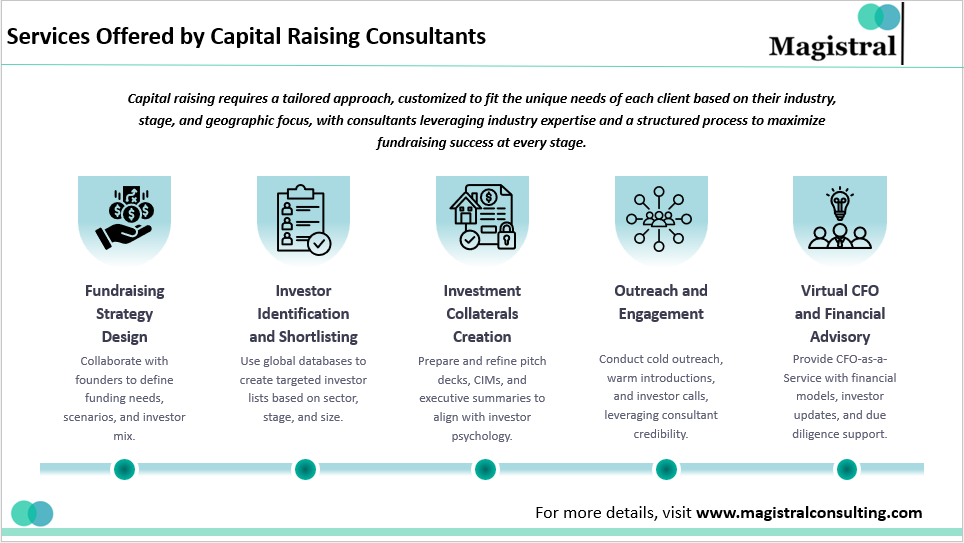
Capital raising is rarely a one-size-fits-all process. Depending on the client’s industry, stage, and target geography, consultants offer a suite of modular and customizable services.

Fundraising Strategy Design

Before pitching begins, consultants work with the founders or CFOs to establish clarity on why funding is needed, how much is optimal, and what timeline to follow. This includes scenario planning, use-of-funds modeling, and planning the ideal investor mix.

Investor Identification and Shortlisting

Consultants have global databases, past deal data, and industry contacts to tailor investor shortlists. These lists are divided into sector preference, average cheque size, stage focus, ticket size, geographic mandate, and investment thesis. Under this laser-targeted approach, outreach conversions occur with much greater frequency.

Investment Collaterals Creation

A strong set of documents can make or break a deal. Consultants prepare or refine the pitch deck, executive summary, CIM (Confidential Information Memorandum), one-pagers, and teaser notes. Sometimes they block the message with their information, which confuses investors, but mainly it is an art to align the story with the psychology of an investor, while putting up visuals that clarify rather than confuse.

Outreach and Engagement

Consultants run targeted outreach campaigns, at times playing the role of an intermediary between the client and investor. They include cold outreach, warm introductions, investor calls, coordination of NDAs, and follow-ups. The Consultancy’s Credibility often opens doors that founders may not be able to open by themselves.

Virtual CFO and Financial Advisory

For those startups without a finance team, the capital-raising consultant has CFO-as-a-Service solutions: investor updates, financial models, MIS reporting, and due diligence support.

Services Offered by Capital Raising Consultants

Services Offered by Capital Raising Consultants

How Capital Raising Consultants Add Value Across Business Stages

Different stages of business require different fundraising strategies, and capital raising consultants fit their playbook accordingly.

Startups and Early-Stage Ventures

Startups tend to operate with small teams and often have a limited understanding of how fundraising works. Startup consultants help companies determine what they can celebrate as a “vision” that investors would buy into; help benchmark valuations based on their stage; and help find the right “strategic” angel investors or accelerators. They help clients prepare financial models that represent flexibility while controlling expenses and align the narratives with the investor persona.

Growth-Stage Companies

By this point, the fundraising round is larger than an early-stage round, and the investor comes primarily from institutional investors. In this role, consultants help with due diligence readiness, secure data rooms, practice investor meetings with leadership, and respond to investor objections. The role is also to lessen the fatigue and stress for the founders, particularly with long funding rounds.

Mature Companies or PE/VC Portfolio Firms

These companies may be craving funding for expansion or product development, or even buybacks. Consultants help provide structure for funding, possibly as bridge rounds, mezzanine funding or PE secondaries. Consultants to PE or VC portfolios help at the fund level, look at the opportunities to make changes or to optimize capital allocation across the portfolio

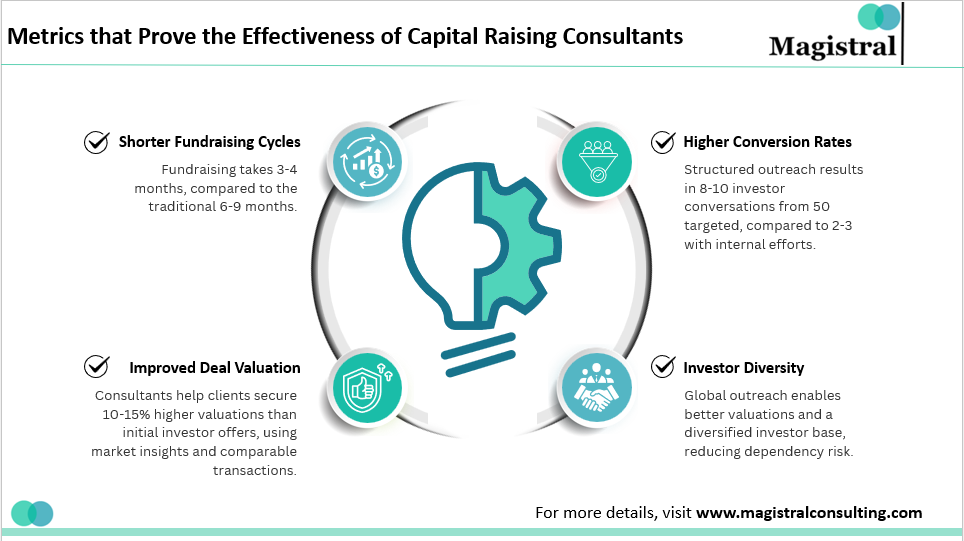
Metrics that Prove the Effectiveness of Capital Raising Consultants

Cutting-edge capital fundraisers produce data-oriented results that surpass the value of anecdotal evidence.

Shorter Fundraising Cycles

Fundraising can take from 3 to 4 months, while traditionally, 6 to 9 months would be expected, with investor targeting and documentation readiness.

Higher Conversion Rates

Clients claim that investors’ response rate doubles or triples with the structured outreach prepared by a consultant. Of the 50 investors targeted, a well-organized campaign conducts 8 to 10 conversations, whereas an internal one reaches 2 to 3.

Improved Deal Valuation

Based on comparable transactions, market insight, and techniques, consultants can assist clients in obtaining a better deal—we are often looking at valuations that reflect a 10- to 15-percent premium over the initial offers from investors.

Investor Diversity

Capital raising will open a global investor arena to the consultants. This not only offers the chance of better valuation but also serves in developing a diversified cap table, thus reducing dependency risk.

Metrics that Prove the Effectiveness of Capital Raising Consultants

Metrics that Prove the Effectiveness of Capital Raising Consultants

Choosing the Right Capital Raising Consultant

Given the devastation caused by the impacts, it is vital to pick your consultant wisely.

Domain Expertise and Track Record

Ask for references, success metrics, and case studies in your industry. Those consultants who speak your sector’s language and KPIs will be much better able to affect the outcomes.

Access to Investor Network

Check if these guys really have relationships or are just database accesses. Top-notch consultants keep personal relationships with family offices, VCs, and strategic funds.

Global vs. Local Reach

If your market or product is international, a global reach is required. But for regulatory-heavy industries like healthcare or fintech, local capabilities matter more.

Cost and Fee Structures

Avoid full success-based models as they lessen accountability. Instead, opt for hybrid models-a small retainer and a success-linked bonus-as it keeps the consultant focused and aligned.

About Magistral Consulting

Magistral Consulting has helped multiple funds and companies in outsourcing operations activities. It has service offerings for Private Equity, Venture Capital, Family Offices, Investment Banks, Asset Managers, Hedge Funds, Financial Consultants, Real Estate, REITs, RE funds, Corporates, and Portfolio companies. Its functional expertise is around Deal origination, Deal Execution, Due Diligence, Financial Modelling, Portfolio Management, and Equity Research

For setting up an appointment with a Magistral representative visit www.magistralconsulting.com/contact

About the Author

Tanya is an investment-research specialist with 6 + years advising venture-capital, private-equity and lending clients worldwide. A Stanford Seed alumnus with an MBA and an Economics (Hons) degree, she heads project teams at Magistral Consulting, delivering financial modelling, due-diligence and deal support on 3,000 + mandates. Her blend of rigorous analytics, sharp project management and clear client communication turns complex data into actionable investment insight.


FAQs

What does a capital raising consultant do?

They provide strategic and financial advisory services to help companies plan, execute, and close funding rounds.


When should a startup hire a capital raising consultant?

Ideally, before the fundraising begins—when you're ready with your product or traction, but before preparing documents or reaching out to investors.


Do capital raising consultants charge upfront?

Yes, most charge a base retainer and a success fee. This helps keep efforts aligned with outcomes.


Can capital raising consultants guarantee funding?

No ethical consultant will guarantee funding. However, they dramatically improve your chances through better targeting and preparation.


How long does it take to raise capital with a consultant?

With good preparation, most early-stage companies can raise capital in 3–6 months