In the current capital-centric ecosystem, managing investors’ relations is much more complicated than simply using spreadsheets and emails. The CRM software solutions for investors have come to play a vital role in facilitating businesses involved in the management of their investors’ data, communications, and deal pipelines. From private equity, venture capital, or hedge funds, investors use advanced systems for effective management of communications with their investors. As Deloitte predicts in its 2024 financial services outlook, more than 68% of investors will accelerate digitization in client and investor management. It shows that there is a general trend of becoming efficient, transparent, and personalized to satisfy investors.
Investors’ CRM in Modern Investment Ecosystems
An investors’ CRM system is essential for the effective organization of investors’ data and effective communication within different investment firms. It serves as a unified system whereby all the interaction processes, deal flows, and other aspects are managed.
Functionality of Investors’ CRM System in Managing Data
An investment firm deals with numerous amounts of data, including information on investor profiles and their transaction history. Investors’ CRM systems integrate these pieces of information into one place. Thus, the process of decision-making can be done effectively.
Furthermore, those investment firms that have a complex structure of operations, such as those operating with investments, may take advantage of the unified system to facilitate the investor commitment and capital call process.
Enhancing Investor Communication
One of the main purposes of any relationship with investors is to communicate effectively. In the context of investors’ CRM, it means sending out automatic updates, messages, and communicating with the client on a regular basis using consistent approaches.
Improving Deal Flow Visibility
The CRM solution for investors gives a complete picture of the deal flow, helping companies manage the entire process of deals from sourcing to closing. It makes sure that nothing is missed along the way, allowing them to focus on important deals.
Integration with Financial Tools
Contemporary investors’ CRM solutions also connect investor information with financial measures, making it easier for investors to forecast.
Investors’ CRM Features Driving Efficiency
There are multiple features associated with investors’ CRM, which help make operations more efficient. They address the specific needs and challenges that arise within the realm of investment, particularly at a time when customer expectations are changing quickly. For example, it is reported that nearly 70% of investors demand personal communication with fund managers.
Automation and Workflow Management
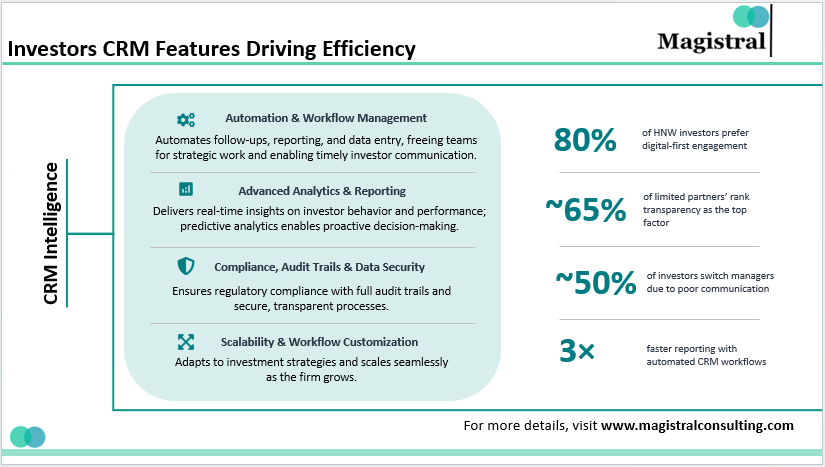
Automation eliminates unnecessary manual efforts and decreases risks related to errors. Investors’ CRM allows automating activities, such as follow-ups, report generation, and other routine tasks, so that people can be devoted to more strategic actions. It is particularly important given that over 80% of high-net-worth individuals now opt for a digital-first approach in communications, as reported by Capgemini 2024.
Workflow Customization
Depending on firms’ investment strategies, they can customize workflows. For instance, investors who have a venture strategy can adjust workflows to match the cycle of deals and evaluations, similarly to venture capital. However, flexible workflows will help address investor concerns. Over half of investors change their managers because of poor communication, McKinsey Wealth Report.
Advanced Analytics and Reporting
Being data-driven is one of the most crucial benefits offered by investors’ CRM systems. Investors’ CRM platforms offer valuable insights on how investors behave, engage, and perform.
Additionally, transparency is a crucial issue nowadays when it comes to investor relations. Transparency becomes an essential criterion for decision-making in 65 percent of cases for limited partners, as shown by the Preqin Global Investor Survey. The CRM system will allow your firm to generate high-quality reports that can increase transparency and credibility.
Predictive Analytics
Using predictive analytics allows your business to be aware of future opportunities or challenges. Using the historical data, you may predict trends and act based on them.
Using this feature will help you establish proactive engagement strategies. You will have the opportunity to contact investors and offer them something they need even before competing companies.
Compliance and Data Security
Meeting regulatory requirements is one of the primary concerns that come up when discussing investor relations. Your CRM solution should also have capabilities for maintaining data security and regulatory compliance in global jurisdictions.
Audit Trails
Audit trails provide a record of all interactions and transactions, ensuring transparency and accountability. This is particularly important in highly regulated environments where firms must demonstrate compliance at every stage.
Scalability and Customization
With growth comes change. The CRM system that investors provide is capable of scaling, giving organizations the opportunity to upgrade without changing everything.
In an environment where investors’ demands are ever-increasing, the ability to scale alongside being smart is key for companies.
Investors’ CRM Market Trends and Adoption
There has been an increase in the usage of investor CRMs due to advances in technology and rising demands from investors. In today’s world, it is important for investment firms to have sophisticated CRM systems in order to sustain their growth and remain competitive.
Investors CRM Market Trends and Adoption
Growth in CRM Adoption
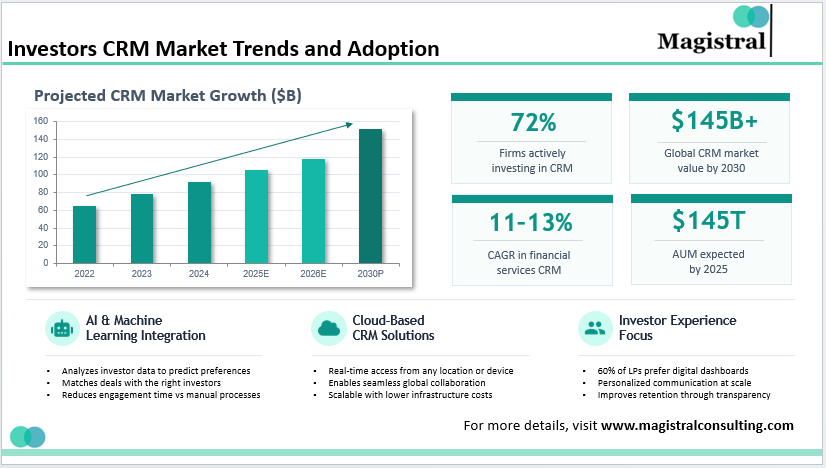
PwC’s 2025 asset management outlook reveals that 72% of companies are now spending on CRM technologies in order to improve their operational capabilities. The increasing adoption of CRM systems also corresponds to an increase in the overall CRM industry, which is expected to achieve a market value of around $145-160 billion by 2030, as suggested by Precedence Research and Fortune Business Insights. reference
In particular, the financial services segment is predicted to be one of the fast-growing segments, with a CAGR of around 11-13%, from 2024 to 2030. This rise can be attributed to the importance of data management and customer life-cycle analysis for investment firms. Simultaneously, the asset management industry is growing rapidly; PwC predicts that the industry will grow to exceed $145 trillion by 2025.
AI and Machine Learning Integration
Artificial intelligence has been revolutionizing the ability of firms to have advanced CRM in terms of understanding investor preferences. AI has the capability of analyzing previous communications between firms and investors and predicting future expectations based on those patterns.
AI in Deal Origination
In addition, AI has revolutionized deal origination, whereby potential deals can be identified through technology and subsequently matched to potential investors. This is in line with current developments in technology that focus on improving efficiency in sourcing potential deals. With investors’ CRM, this process becomes easier since it involves less time finding and communicating with the best investors.
Cloud-Based CRM Solutions
With cloud computing, CRM solutions for investors become more efficient due to real-time updates, regardless of where one is located. Cloud solutions make it possible for one to have real-time updates about the performance of the CRM system.
Focus on Investor Experience
The expectations of the investors have changed a lot, focusing on the principles of transparency, promptness, and customization. Based on the results of the survey conducted by Preqin in 2024, almost 60% of limited partners would like to receive their reports through the digital dashboard, rather than through the traditional PDF format.
Through CRM, investors provide an opportunity for investment firms to respond to those requirements, offering personalized communication and reporting possibilities. Thus, investors become happier, and their loyalty increases.
Investors’ CRM Implementation Strategies
The implementation of a CRM system for investors is essential for the firm’s proper functioning. It needs to take into account the needs of the company and integrate it with its goals.
Investors CRM Features Driving Efficiency
Assessing Business Requirements
It is crucial to determine what needs exist in order to select an appropriate CRM platform. It will allow you to match the needs with the capabilities of the CRM system.
Data Migration and Integration
When transferring data to a new CRM system, it is important to provide high-quality and consistent information in the process. Integration with other tools is also required.
Training and Adoption
The success of the project is directly related to the effective training of users. Without it, it is unlikely that the company will be able to benefit from the system.
Change Management
Often, such projects require a change in culture within the organization. Effective strategies can help you achieve these goals more easily.
Continuous Optimization
CRM systems for investors must constantly improve in response to changing business needs. They are updated regularly and receive new features.
Investors’ CRM and How Magistral Supports Investment Firms
Investors’ CRM has become an essential tool for investment firms aiming to enhance efficiency, improve investor relationships, and drive growth. However, implementing and optimizing these systems requires expertise and strategic guidance.
Tailored CRM Solutions for Investment Firms
Magistral consulting firm proposes tailored CRM services that correspond to each client’s needs. Understanding client needs and problems helps the consulting firm to propose an adequate and efficient strategy that will increase CRM performance and effectiveness.
Data Management and Analytics Support
In order to work efficiently, data management becomes important. In this regard, Magistral proposes effective data management services, as well as analytics services.
Enhancing Fundraising and Investor Relations
A CRM system used by investors may greatly increase opportunities to raise funds. In particular, Magistral will assist you in using CRM effectively in order to raise money.
Operational Excellence and Outsourcing
Outsourcing services proposed by Magistral include operations outsourcing that involves professional knowledge and skills of the company to provide services of CRM and investment operations. Thus, investors’ CRM becomes important when dealing with many operations associated with managing relations with clients and fundraising.
About Magistral Consulting
Magistral Consulting has helped multiple funds and companies in outsourcing operations activities. It has service offerings for Private Equity, Venture Capital, Family Offices, Investment Banks, Asset Managers, Hedge Funds, Financial Consultants, Real Estate, REITs, RE funds, Corporates, and Portfolio companies. Its functional expertise is around Deal origination, Deal Execution, Due Diligence, Financial Modelling, Portfolio Management, and Equity Research
For setting up an appointment with a Magistral representative visit www.magistralconsulting.com/contact
About the Author

Tanya is an investment-research specialist with 6 + years advising venture-capital, private-equity and lending clients worldwide. A Stanford Seed alumnus with an MBA and an Economics (Hons) degree, she heads project teams at Magistral Consulting, delivering financial modelling, due-diligence and deal support on 3,000 + mandates. Her blend of rigorous analytics, sharp project management and clear client communication turns complex data into actionable investment insight.
FAQs
What is an investor's CRM
Why is Investors’ CRM important for investment firms?
How does Investors’ CRM support fundraising?
Can Investors’ CRM integrate with other tools?
What are the key features of Investors’ CRM?