Tag Archives: Private Equity Fundraising

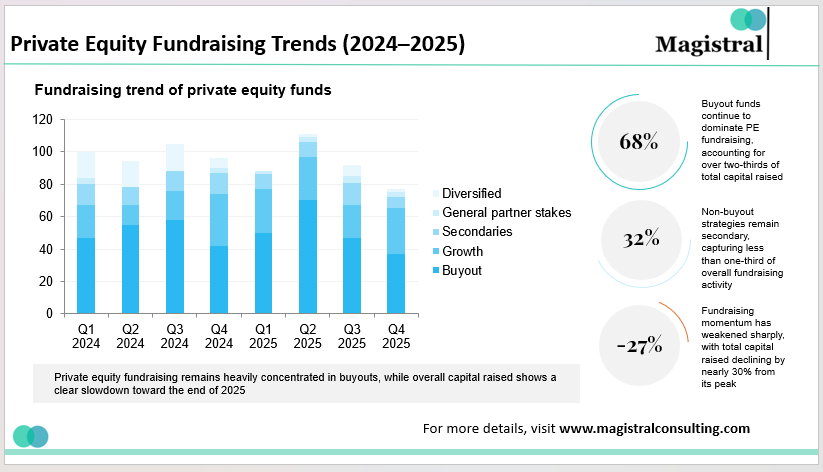
Global capital markets are not facing a shortage of capital, but a structural shift in how that capital is allocated. Private equity capital raises have been on a downward trajectory since then, with declines by about 27% in the quarter ending Q4 2025 from the peak level reached in Q2 2025.

Meanwhile, the concentration of capital continues to exist. Buyout strategies continue to be dominant, taking up about 68% of all funds raised, with other strategies accounting for about 32%.
Private Equity Fundraising Trends (2024–2025)

Private Equity Fundraising Trends (2024–2025)

Interestingly, while all-round fundraising has become less effective, the nature of capital itself suggests a more discriminating approach, as only limited numbers of fundraising approaches attract the lion’s share of investment decisions, indicating that the trend now lies with the concentration of capital management.

This difference characterizes the current fundraising climate. Investment activities are alive; however, there is significantly more discipline involved.

It becomes obvious that successful fundraising today has nothing to do with having access to capital sources, but about finding the right ones. In this regard, there is where the importance of an investor Database comes in handy.

Why Traditional Investor Lists Are Losing Relevance

The traditional fundraising model relied on broad investor lists with limited segmentation. Investors are now facing tighter conditions. The accumulation of unsold securities, delays in exits, and an expectation of returning investments are making a difference in their investment allocation behavior. Simultaneously, there is excess dry powder at a global level, standing at over $2 trillion, making it necessary for the funds to allocate capital in a smarter manner.

Hence, investing has become a more selective and strategic activity for the fund managers. Moreover, even in India, the fundraising efforts have gone down by about 35% during 2025, although investors remain interested in certain thematic areas, such as sustainability and technology.

Generic efforts in the current scenario will not produce the desired results. There is no match between the efforts made by investors and the results they can expect if the targeting by the investor does not go well.

The Evolution of the Investor Database

The investor database has undergone a fundamental shift in its role within fundraising. The traditional back-office solution will transform into an integral part of how organizations build their fundraising plans. Such changes result from stricter capital allocation processes, increasing competition between funds, and the necessity of data-based decisions.

Since investors’ demands have become sophisticated and selective, financial organizations cannot depend on generic data anymore. They must develop specialized solutions that can offer insights into investor preferences and timing, making the investor database a key component of fundraising strategies.

From Static Data to Strategic Intelligence

The modern investor database has evolved into a dynamic intelligence layer that reflects how investors behave, not just who they are.

This trend is part of larger developments within the private equity market as an entire business. Indeed, it has grown considerably, moving from operating in a space where it is often referred to as “tougher ground” where value creation, not market movement, defines success.

An effective investor database identifies trends regarding capital deployment, sector preference, investment size, and geography, in addition to other factors, including responsiveness and themes.

This development is essential as fundraising has moved away from being a game of presence and toward one of relevance.

The Rise of Selective Capital Deployment

Capital deployment in private markets is no longer driven by abundance alone, but by discipline and prioritization. Capital allocation by investors is becoming more tactical due to extended periods of time required for exits, economic volatility, and pressure on performance.

It is changing the dynamics of the capital raising process and the approach to investment by making diversification give way to thesis-based investment. Therefore, access to capital today is becoming less about visibility in the market than alignment with investor goals.

Capital Is Concentrated, Not Scarce

One of the most important dynamics in 2026 is the concentration of capital.

Despite a general downturn in fundraising, there continues to be an emphasis on big funds. Almost half of all capital that was raised in 2025 came from the best-performing companies. Clearly, investors have an obvious tendency to work with proven managers.

Deal-making is also getting tighter. The number of investments made is decreasing while total funding is increasing. This means that less money is being invested, but the checks that are being written are much more carefully considered by the investors.

Moreover, with about $2.18 trillion in dry powder, investors need somewhere to invest it. But this has to happen within certain return on investment standards.

Thus, we have a situation where capital is available, but its access requires strict alignment.

The proper development of an investor database will help a firm determine what capital is being actively sought and what capital can be left unused.

How an Investor Database Directly Impacts Fundraising Outcomes

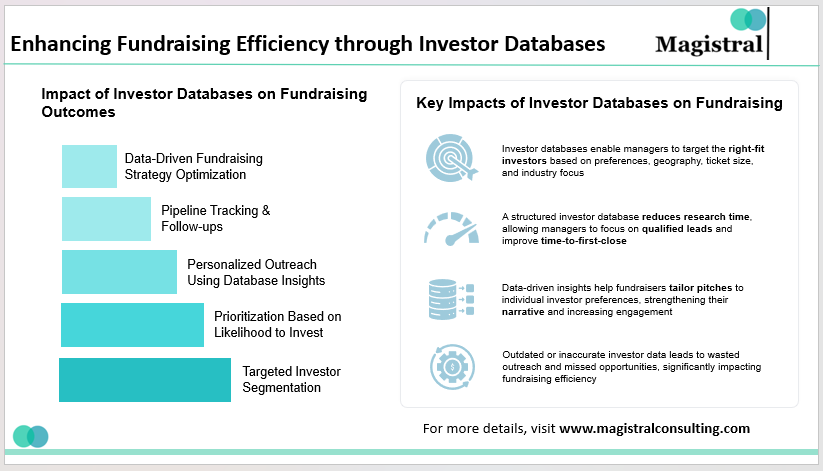
When investor interest is constrained and there is stiff competition among potential investors, success is defined largely by how well companies turn data into action. This is where the investor database becomes an important tool by making it easier to make decisions.
Enhancing Fundraising Efficiency through Investor Databases

Enhancing Fundraising Efficiency through Investor Databases

It is the link between market insight and action that allows businesses to focus on the appropriate opportunities, connect more effectively, and use their internal resources wisely. With more structure and data-driven processes in fundraising, the accuracy of the investor data used has a direct impact on both speed and effectiveness of fundraising campaigns.

Precision Becomes the Primary Advantage

In the context of a selective market environment, the precision-targeted approach has emerged as the fundamental principle behind successful fundraising campaigns.

With an investor database that offers sophisticated capabilities, companies can tailor their outreach strategy to match actual investor actions, including recent transactions and sector emphasis. The result is more efficiency and far better-quality dialogue with investors.

There is no longer room for the outdated approach of broad-based outreach. It is now mandatory.

Speed and Efficiency in Extended Fundraising Cycles

Fundraising cycles have extended in the private sector because of enhanced diligence and careful capital allocation.

But companies that utilize an organized investor database can shorten these fundraising cycles through targeting investors who have a higher probability of making investments. They will receive faster responses, which will make the cycle shorter from contact to interaction.

In a slow market, timing is not about hurrying but about skipping unnecessary steps.

Strengthening Investor Narratives Through Data

Expectations from investors now demand greater contextual involvement. The use of generic stories is becoming less effective in gaining commitment.

The existence of an efficient investor database enables a firm to personalize its message according to the specific interests of the investor. This can include matching up to industry trends like AI, infrastructures, and energy, which are currently drawing a lot of investment interest.

Personalization converts fundraising efforts into a strategic discussion.

The Hidden Cost of Poor Investor Data

Many firms continue to underestimate the cost of fragmented or outdated investor information.

Misinformation creates a misalignment between the company and its investors, decreases interaction, and leaves room for other active investors who would be more interested in doing business. The poor quality of information adds costs to raising capital, especially since there is limited attention from investors.

Moving Beyond Automation

The next phase in the evolution of the investor database lies in the integration of artificial intelligence with human expertise.

With AI, one can perform massive data crunching, identify patterns, and track investors’ behaviour on a real-time basis. Also, more PE companies are integrating AI into their strategies and using it as an advantage over others.

However, the contribution of human intelligence is also critical in terms of providing context, identifying relationships, and aligning decisions.

Together, AI and human intelligence ensure that the investor database becomes a living database for decision-making rather than just an information storage place.

How Magistral Supports Fundraising with a Strategic Investor Database

In a capital environment defined by selectivity and precision, Magistral supports fundraising by combining deep research, structured processes, and Magistral’s Investor Database to enable targeted and efficient investor outreach. The focus is on aligning each fundraising effort with the right investors, backed by data on investor behavior, sector focus, and capital deployment patterns. This ensures that fundraising is not driven by volume, but by relevance and conversion.

Magistral supports clients across the fundraising lifecycle through:

Customized Investor Database Development aligned to fund strategy, sector, and geography

Investor Identification and Mapping based on active capital deployment and recent deal activity

Investor Profiling and Segmentation to enable precise targeting and prioritization

Fundraising Collateral Support including pitch decks, teasers, and investor communication materials

Targeted Outreach Support with data-backed investor shortlists and engagement strategy

Market Research and Benchmarking to position funds effectively within current market dynamics

Ongoing Database Updates and Enrichment using AI-driven tracking and human validation

This integrated approach ensures that Magistral’s Investor Database is not just a data asset, but a strategic tool that directly improves fundraising outcomes.

About Magistral Consulting

Magistral Consulting has helped multiple funds and companies in outsourcing operations activities. It has service offerings for Private Equity, Venture Capital, Family Offices, Investment Banks, Asset Managers, Hedge Funds, Financial Consultants, Real Estate, REITs, RE funds, Corporates, and Portfolio companies. Its functional expertise is around Deal origination, Deal Execution, Due Diligence, Financial Modelling, Portfolio Management, and Equity Research

For setting up an appointment with a Magistral representative visit www.magistralconsulting.com/contact

About the Author

Tanya is an investment-research specialist with 6 + years advising venture-capital, private-equity and lending clients worldwide. A Stanford Seed alumnus with an MBA and an Economics (Hons) degree, she heads project teams at Magistral Consulting, delivering financial modelling, due-diligence and deal support on 3,000 + mandates. Her blend of rigorous analytics, sharp project management and clear client communication turns complex data into actionable investment insight.

FAQs

Who are Magistral’s typical clients?

Magistral primarily works with private equity and venture capital firms, hedge funds, family offices, and investment banks, as well as corporates looking for strategic and financial insights.

How does Magistral differentiate itself from other research firms?

Magistral combines domain expertise with a flexible engagement model and a strong focus on quality. Its approach integrates deep research capabilities with practical execution support, enabling clients to make faster and more informed decisions.

How frequently is Magistral’s Investor Database updated?

The Investor Database is continuously updated using a combination of AI-driven tracking and human validation to reflect the latest investor activity, fund launches, and capital deployment trends.

How does Magistral’s Investor Database improve fundraising outcomes?

By enabling precise investor targeting, the Investor Database helps reduce irrelevant outreach, improve response rates, and increase the likelihood of meaningful investor engagement.

Reflecting on my journey supporting fundraising efforts for PE/VC and capital advisory firms, I’m reminded just how much can change in two years. When you start out, not quite sure what you’re doing and, little by little, become someone who truly makes a difference for your clients.

I began my first fundraising client engagement with honest questions: How do I build the right outreach strategy? Who do I contact? What is the magic formula for getting a reply (let alone a meeting)? Back then, I did the only thing I could—work hard. I reached out to 800 firms, received just under 5% response, but didn’t get disheartened by the lack of meetings. There was still so much that mattered: maintaining the client’s CRM, planning weekly partner agendas, managing deal pipelines, and screening investment targets. All these activities shaped my practical knowledge and resilience.

As I spent more time working with various fundraising clients, I learned to iterate and innovate, experimenting with tailored outreach strategies, honing the craft of persuasive emails, reviewing NDAs, preparing teasers, pitch decks, and CIMs. Globally, successful fundraising rounds for private equity and venture capital have acceptance rates as low as 1-5% from cold outreach, so progress is a game of both patience and precision.

Fast forward to today: I am supporting a client with not one, but two mandates—one debt, and the other a debt/equity mix. I was nervous, not going to lie, but started by focusing on getting our collaterals right, collaborating closely so that every document had the client’s full confidence. Once we agreed on an action plan, the outreach began. Within a couple of weeks and 400 investor contacts, we secured above a 15% positive response rate, booked a dozen meetings, and started signing NDAs with interested parties—well ahead of typical market benchmarks. According to industry reports, the average VC fundraising period can take 12-18 months, so every early win truly matters.

None of this would be possible without the constant trust and support of my incredible clients and the stellar teams I work with at Magistral Consulting. Thank you for the encouragement and opportunities to learn and contribute. Here’s to more growth and successful partnerships ahead!

About Magistral Consulting

Magistral Consulting has helped multiple funds and companies in outsourcing operations activities. It has service offerings for Private Equity, Venture Capital, Family Offices, Investment Banks, Asset Managers, Hedge Funds, Financial Consultants, Real Estate, REITs, RE funds, Corporates, and Portfolio companies. Its functional expertise is around Deal origination, Deal Execution, Due Diligence, Financial Modelling, Portfolio Management, and Equity Research

For setting up an appointment with a Magistral representative visit www.magistralconsulting.com/contact

About the Author

Akansha is a Stanford Seed alum with an MBA (Finance & Operations) and B.Com (Hons). She delivers business and financial research for PE/VC and investment banking clients. Experience spans fundraising, M&A support, deal sourcing, consolidation accounting, supply chain analysis, and CRM-led outreach. Known for meticulous detail and fast learning, she turns analysis into investor-ready decisions.

The global fundraising market forms a significant pillar of capital distribution, covering all from private equity firms and venture capital funding to other forms such as nonprofits and corporate foundations. As financial markets grow and develop, methods of fundraising must constantly pursue modifications that go in line with changes within economic ecosystems, investor preferences, and technological evolution. Use of innovations, private-credit instruments, AI-driven investment strategies, and development of the secondary market are likely to enhance the growth of the sector.

Strategies for Effective Fundraising

You can greatly amplify your success by employing these strategies:

Properly define the fund’s investment strategy

Describing the purpose of the fund, along with a clear strategy to achieve that goal, is a must.  This should include specifics on the kinds of businesses being targeted, geographical focus, and industry sectors.

Use Your Existing Networks

Begin your fundraising effort by working through the investors connected to your firm. It can create some initial momentum and lend credence, which is essential when reaching out to new investors.

Offer Co-Investment Opportunities

Co-investment prospects can attract some investors who look for better net returns and control over capital deployment. The fund enables access to capital while building stronger relationships with limited partners (LPs).

Differentiate Your Fund

Having a unique selling advantage is vital in a competitive environment. It may include niche expertise in emerging markets, proprietary investment algorithms, or unique industry partnerships.

Build for the Long Term

The establishment of a solid operational plan with short- and long-term goals would show commitment and strategic vision-forward features which are appealing to the potential investors.


Fundraising Market Overview

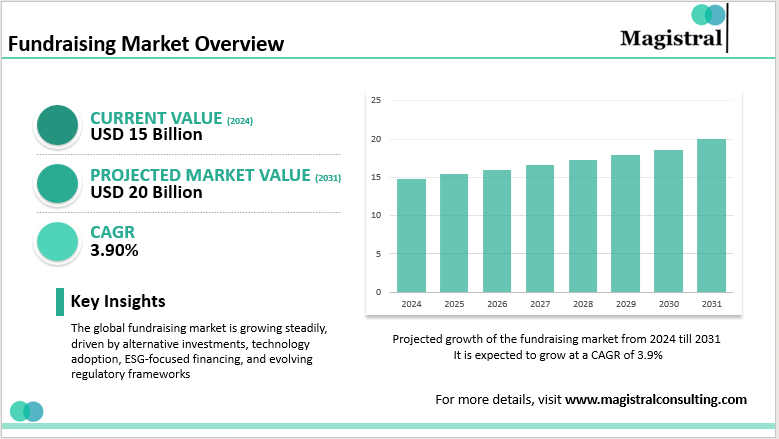
Increased investments in private equity, venture capital, and philanthropy are driving market growth. The market reached USD 15 billion in 2024 and is projected to grow to nearly USD 20 billion by 2031, driven by the steady expansion of global capital-raising efforts. It is expected to sustain a consistent CAGR of 3.9% during this period.

Fundraising Market Overview

Fundraising Market Overview

Growth prospects depend on alternative investment strategies, growing use of tech-driven platforms, and more influence from institutional investors. They’re also driven by rising interest in Environmental, Social and Governance investments, and capital allocation strategies are being rewritten, with much interest in ESG-aligned investments and impact-driven finance.

The investor interest in the demand for capital-raising efficient mechanisms, interspersed with developing regulatory frameworks, is envisioned to further drive the market’s growth for the next several years. Global economic stabilization implies greater fundraising efforts generally centered on investor outreach, secondary market transactions, and private credit opportunities for sustained growth.

Fundraising Market by Regions

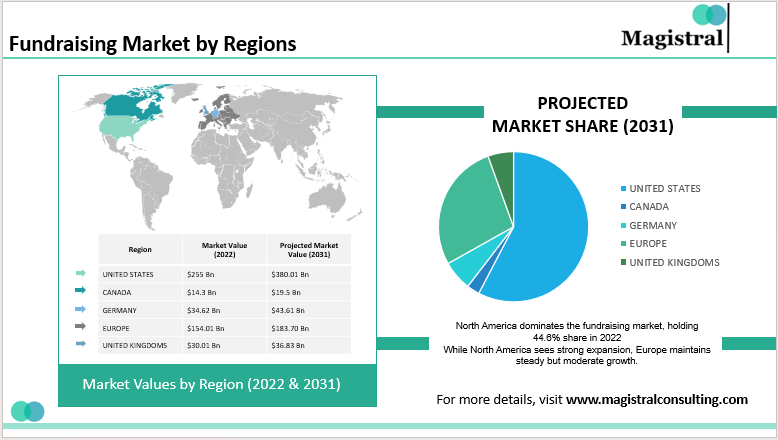
The global market is diverse, with different entities contributing to its growth.

Fundraising Market by Regions

Fundraising Market by Regions

North America: The Dominant Player

North America continued its dominant position in the global fundraising market by absorbing 44.6% out of the total $279 billion in 2022. Most of this dominance owes itself primarily to the United States, as it made up 91% of North America’s total with a value of $255 billion. The United States is expected to maintain strong growth, with a projected CAGR of 5.12%, driven by a vibrant private equity and venture capital ecosystem, rising institutional investor participation, and a robust regulatory framework that promotes capital formation.

The market is expected to grow from $14.3 billion USD in 2022, achieving a compound annual growth rate of 3.59% in 2023. This growth strengthens the fundraising outlook, providing a compelling pitch for pension funds and family offices in Canada, particularly as they gradually expand their cross-border investment activities.

Europe: A Steady Growth Trajectory

Europe also grows as the second-largest fundraising market, making North America add up to 25 percent of the whole market, valuing $154.01 billion. Although Europe is growing at a slower pace than North America, it is likely to achieve a CAGR of around 1.98% and thus will contribute significantly to areas such as impact investing, sustainable finance, and private credit.

Germany leads the European market with a 23% share, worth USD 34.61 billion in 2022. Sustained growth is projected at a 2.61% CAGR, driven by a strong base of institutional investors and a stable financial services industry.

United Kingdom in 2022 with an anticipated market volume of $30.01 billion for fundraising becomes the next largest fundraising market in Europe. The UK’s market is projected to increase at CAGR of 2.3%. Owing to hedge funds, private equity, venture capital, and asset management companies based in it.


Fundraising Market by Entity

The market is still very strong in the nonprofit sector, which occupies the premier position within the hierarchy. By 2030, nonprofit organizations are expected to make up 47.65% of the total market, valued at around $94 billion. The sector is projected to grow at a 4.45% CAGR from 2024 to 2030.

Nonprofit organizations, including NGOs, play a significant role when it comes to tackling societal problems, building communities that are less privileged, and facilitating charitable initiatives. These fund-raising efforts have to provide financial assistance for such organizations from individuals, corporations, foundations as well as the other donors. Effectively it ensures their sustainability and increases the programmatic impact by constantly developing and expanding their programs.

As the corporate foundations also come up as a key player in the scenario, this segment is expected to account for 27.01% of the market by 2030. Adding $35.28 billion value with a CAGR of 2.90%, while dependence on the corporate world increases in terms of integrating corporate social responsibility (CSR) into overall business strategies. Companies today create corporate foundations, which often become very important in philanthropy, funding many projects in line with their values and social missions.


Emerging Trends

The introduction of technological advances along with change in the institutional model of donations will certainly make the task more efficient, transparent, and effective.

The Rise of Online Platforms

Effective with Digital Transformation, online mode evolved to become the most preferred mode. Insights driven by AI are empowering organizations to individualize campaigns, predict donor behavior, and streamline outreach. Crowdfunding websites, social media campaigns, and mobile donation apps have enhanced reach on a global scale. Adds donor convenience are digital wallets and cryptocurrencies.

Corporate Fundraising as a CSR Tool

Most companies now incorporate fundraising activities in their corporate social responsibility programs. Primarily to enhance reputation, increase consumer trust, and seal employee engagement. To this end, companies have sought out matching employee donations, sponsorship of events and activities, and even corporate foundations to channel resources to various causes. Thus, making their companies a part of the market while doing real hard work to make meaningful contributions.

Technology Integration

Entry of AI-powered donor targeting programs improves personalized and engagement processes. While, blockchain enhances transparency and security through verifiable, tamper-proof transactions. Introducing VR or AR continues to engage the audience by making what they experience experiential. As well as showcase the live impact that brings about greater contributions.


Magistral’s Services for Fundraising

Magistral Consulting provides complete capital raising solutions to Private Equity and Venture Capital firms in an effective manner along the entire capital-raising process in a most impactful way. This enables the PE and VC firms to spend more time on running their strategic initiatives while yielding better results with fundraising. Our services include:

Creating Private Placement Memorandums (PPMs), Pitch Decks, and Teasers

We draft all kinds of investor documents around the fund’s vision, strategy, and future performance. These include PPMs, pitch decks, teasers, and more. Every one of these deliverables is geared toward impacting the potential investors and fitting them perfectly into the market.

Email Campaigns and Investor Reach-out

We write and then run targeted email campaigns designed to build effective liaison-the potential with its other important stakeholders. Besides that, we have expertise in investment profiling along with outreach targets to engage the intended audience with a broader outreach in your network.

Design and Data Support

Presentations become reality through riveting aesthetics and data-driven insights. Firms can convincingly present their value proposition.


About Magistral Consulting

Magistral Consulting has helped multiple funds and companies in outsourcing operations activities. It has service offerings for Private Equity, Venture Capital, Family Offices, Investment Banks, Asset Managers, Hedge Funds, Financial Consultants, Real Estate, REITs, RE funds, Corporates, and Portfolio companies. Its functional expertise is around Deal origination, Deal Execution, Due Diligence, Financial Modelling, Portfolio Management, and Equity Research

For setting up an appointment with a Magistral representative visit www.magistralconsulting.com/contact

About the Author

The article is authored by the Marketing Department of Magistral Consulting. For any business inquiries, you can reach out to prabhash.choudhary@magistralconsulting.com

Introduction to Fund Strategy

Fund strategy refers to the planning and research before launching a fund to ensure maximum chances of its success in the future. Success here is usually defined as better returns for investors as compared to their peers.

Fund managers build a strategy through multiple steps to ensure all moving parts align and deliver the desired results. Below are the key steps required to execute a successful fund strategy and marketing effort.

Type of the fund

It is usually no brainer when a fund starts its operations. The type of the fund depends on the experience of the founding partners. Personnel who are most experienced in Hedge funds would usually go for starting a hedge fund. When a larger fund launches a separate arm or enters a new domain, the team evaluates and finalizes the appropriate type of fund to pursue.

While deciding the type of the proposed fund, the following parameters play an important role:

What investors want: The key here is meeting investor expectations. Some investors limit themselves to returns generated while others may get into the details like the social impact that the planned investments make. Big investors usually budget for investments like ESG, impact, or social investments. If a proposed fund has a big investor who is ready to support and has specific needs, it’s better to align the fund strategy with that of the investor needs. This is all the more important if these investors are early or only investors.

What generate returns: Many times fund managers also need to check the track record in terms of returns for various other types of funds and make a compelling case to go for a specific type of the fund

How fast your investors need returns: While a Hedge fund may start showing returns as soon as stock markets run high, A Private Equity or a venture capital fund may take even a decade to show returns. Understanding the expectations of investors in terms of returns period horizon is the key

Team’s capability: Here the natural talent and experience of fund partners come into play. If partners who have an illustrious career in hedge fund management come together, it is obvious that they should start a hedge fund. It will also be easier to raise funds in that case by showcasing the experience of founding partners to investors

Fund Strategy

Here are the major type of funds that could be thought of at the first stage and the further fund strategy accordingly required

Fund Strategy Steps

Major Steps Required Towards Fund Strategy

Hedge Funds: This fund invests in listed stocks primarily. Long short equity is the most popular option. Usually, funds go for more long calls than short ones. Here, Hedge Fund Strategy needs to identify geography focus, industry focus, long-short calls ratio, stock strategy (blue-chip, value-based, etc), holding horizon (long term, short term, etc), trading norms (AI, manual, process, etc), the economic rationale (macro-based, etc.,). Sometimes an experienced founding team understands what makes sense to them as per their experience but still a fresh eyes’ perspective on where the opportunity is, going to help. This process requires collecting vast amounts of data and information to understand market directions from a returns perspective. Analysts must carefully evaluate the many hedge fund strategy types and assess the hedge fund strategy outlook.

Private Equity Fund: This fund invests in private companies and sometimes in public companies and takes substantial stock positions in their investments. The idea is to have a significant portion of the stock holding to impact the business decisions. Skills required here are way different from what is required in establishing a hedge fund. Hedge Fund requires more financial skills whereas managing a Private Equity fund requires more company operational skills. Private Equity fund strategy here concerns the industry focus, geography focus, stake (controlling, minority, etc.), investment focus (late stage, public companies, family-owned businesses, etc.). Along with the experience of founding partners, a great deal of research on returns generated by various types of PE funds help go a long way. This fine-tunes the fund management strategy.

Venture Capital Funds: Quite like Private Equity, but the venture capital fund is smaller in size and places relatively smaller bets on early-stage private companies. This form of investing is high risk and high returns that bet aggressively on companies that may become big in the future. Venture Capital fund strategy identifies geographic focus, industry focus, stakes (minority, control), investments focus (seed, early-stage, late-stage, etc.) Here again apart from the experience of founding partners, research on emerging trends help go a long way

Real Estate or Infrastructure Funds: These funds invest in real estate based assets to generate regular returns over a long period. This form of investing carries lower risk and are comparatively more stable. Upside returns are also moderate as compared to other forms of investing. A Real Estate fund strategy would require to finalize the asset class (public infrastructure, hotels, low-cost housing, self-storage, etc.), geographic focus, Government incentives behind some forms of investing, potential returns, etc.

Crypto-based funds: This is a relatively smaller and new development. The fund manager invests in different forms of cryptocurrencies as an asset class. Phenomenal returns from Bitcoin has given a boost to this category. Here, the team develops the cryptocurrency fund strategy by identifying specific cryptocurrencies to invest in and finding ways to minimize brokerage fees to maximize returns.

Family Office or Fund of Funds: This is for an investor himself. It usually works in a combination of parking money in various funds and doing direct investments as well. Here the strategy would be to find the best asset manager or performing funds. Then, finding great direct investment or co-investing opportunities, and regularly scanning the environment for tracking the emerging investment class.

Bond Funds: There are debt funds and funds that are based on returns from sovereign and corporate bonds. These are bond funds. Here the strategy is about finding the bonds that produce the best returns with comparably lower risks. Bond fund allocation strategy also needs to be identified in this case.

Others: There are multiple other funds that emerge due to arbitrage opportunities created by policy changes by Governments. Assessing the fund strategy in detail along with statutory requirements is the imperative of fund research here

Fund Raising and Fund Marketing

Fund Raising is the most critical step in the lifecycle of a fund. Fundraising efforts primarily end up deciding the fate of the fund singlehandedly.

Fund Raising Steps

Steps Required for a Successful Fund Raising Strategy

Founders typically raise seed funding from themselves, family, friends, or their personal network. Once they secure seed funding, they expand their outreach to a broader or international pool of investors. They carry out this outreach through emails, social media, investor websites, fundraising platforms, and various other channels. There are many databases and information services providers that deal with the contact information of investors.

Hedge Fund Marketing strategy decides whether the fund will be able to garner the requisite funds. A good Hedge Fund marketing plan suggests the type of investors to be reached out to.

Reach out leads to investors showing interest in a fund and then set up meetings. Once the meeting is set up, Partners are expected to present their ideas about their style of investing and further details about the fund. Bigger funds rely on international fund marketing for the fundraise

Another critical step is to prepare the fundraising documents. Like pitch deck, Private Placement Memorandums, Confidential Information Memorandums, 1 pager, Teasers, hedge fund marketing documents, hedge fund marketing deck, fund marketing materials, and details about the previous experience and investments by the founding team.

Fund Administration and Investor Relations

Once they raise the money, the fund focuses on operations, working to invest the capital in ways that generate superior and secure returns for investors. In addition, the team handles various fund administration activities. It’s about accounting, handling trade exceptions, keeping books, calculating taxes for investors, and several other tasks that show, investors that their money is in safe hands. This brings further investors to the fund. The investment strategy for the fund is implemented in this stage. A fund with a successful track record of execution attracts far more investors than a fund with no considerable experience or track record.

Launching bigger follow-on funds and funding rounds

Once the fund is successful it branches out in the same or different space and raises more money often at terms that are more favorable to the fund manager than it was while raising the maiden fund.

Magistral Consulting provides in the space of Hedge Funds, Private Equity, Venture Capital, Real Estate, and Family offices with Fund Strategy and Fund Marketing services. It has successful fundraising strategy templates that work across the type of funds. Please drop an inquiry here.

About Magistral

Magistral Consulting has helped multiple funds and companies in outsourcing operations activities. It has service offerings for Private Equity, Venture Capital, Family OfficesInvestment BanksAsset Managers, Hedge Funds, Financial Consultants, Real Estate, REITs, RE fundsCorporates and Portfolio companies. Its functional expertise is around Deal originationDeal Execution, Due Diligence, Financial ModelingPortfolio Management and Equity Research

For setting up an appointment with a Magistral representative visit www.magistralconsulting.com/contact

About the Author

The Author, Prabhash Choudhary is the CEO of Magistral Consulting and can be reached at Prabhash.choudhary@magistralconsutling.com for any queries or business inquiries.