Tag Archives: Investor relations

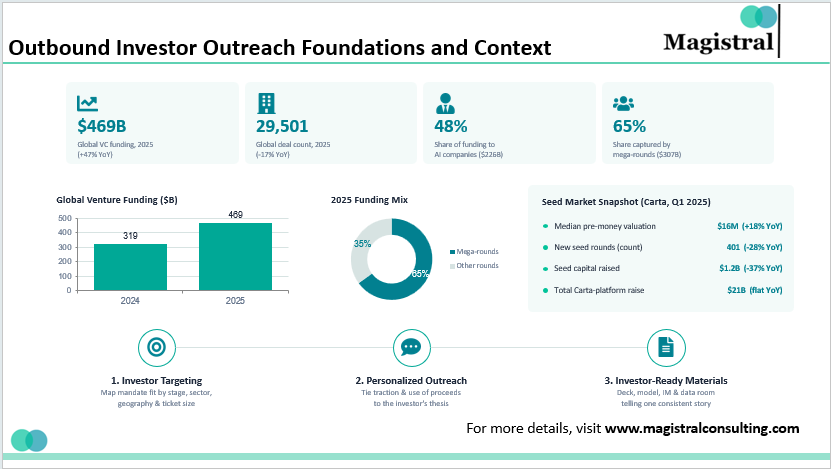
Outbound investor outreach has become an integral part of raising funds for early-stage startups, young managers, investment banks, and private market advisors. The money is out there, but investors are now pickier, data-driven, and focused on mandate fit. According to CB Insights, venture funding worldwide reached $469 billion in 2025, representing a 47% YoY growth, while deal count was down 17% to 29,501 deals. Companies in AI raised $226 billion, which represents 48% of all venture funding, while mega rounds captured $307 billion, or 65% of global venture capital.
Outbound Investor Outreach

Outbound Investor Outreach Foundations and Context

According to Carta, the median pre-money valuation of seed rounds reached $16 million in Q1 2025, growing by 18% year over year, whereas the number of seed rounds decreased by 28%. Under these conditions, outbound investor outreach depends on correct investor targeting, proper positioning, personalized communication, a CRM approach, and follow-up. Outbound investor outreach is not mass mailing. Outbound investor outreach is a selective capital-raising process that involves identification and segmentation of relevant investors and engagement based on a credible reason for looking at your opportunity.

Investor Targeting Comes Before Messaging

The initial step in the process is investor-fit mapping. Seed rounds should not be targeted by late-stage growth capital funds, and a lower mid-market firm searching for buyout funding requires a totally different investor universe than a SaaS company raising venture capital. The relevance of an opportunity will lead to better responses, as investors screen deals on various parameters – stage, location, sector, ticket size, and portfolio concentration. The Magistral investor database helps in this regard by listing 5,000+ LPs, 17,000+ GPs, 6,500+ angel investors, and 6,500+ HNIs, with information on the type of company, location, contact names, email addresses, LinkedIn IDs, and physical address.

In that sense, outbound investor targeting becomes more systematic rather than through scattered networks or generic online databases.

Personalization Is Now the Baseline

Every investor receives hundreds of pitch emails in a month. Hence, the personalization must be much more than a simple first-name addition to an email. It must be done in such a way that the investor can see how the company’s sector, traction, round size, and use of proceeds fit into their mandate. However, according to the data from Carta for the first quarter of 2025 in the private market, good companies are still being noticed. Yet, deal count compression indicates that investors are now using higher-quality filters.

Startups on Carta have raised $21 billion in Q1 2025, which is consistent with Q1 2024, yet the volume of seed capital has reduced to $1.2 billion in 401 seed deals, representing a 37% reduction from Q1 2024. That makes outbound investor outreach a positioning as well as a distribution effort.

Materials Must Be Investor-Ready

Weak materials will not be saved by even the strongest email. The story told in the pitch deck, the teaser, financial modeling, data room, and information memorandum must be consistent. This is especially true in capital raising, where discrepancies in valuation, market size, traction, and use of funds might cause trouble in early-stage meetings. Magistral’s fundraising assistance consists of pitch deck development, valuation modeling, information memorandums, teasers, data room assistance, investor matching, CRM-based campaigns, follow-ups, scheduling, and closing deals.

Applications and Use Cases in Outbound Investor Outreach

The outbound process helps companies raise money in various situations, including startups, LP fundraising for funds, and others. In each situation, you will need a unique investor list, message, and conversion funnel. As the duplication of the above overview has been omitted, now we will consider only examples of use cases and segments of potential investors.

Startup Fundraising

In the case of startups, the process of outbound investor outreach is mostly related to angels, seed funds, micro-VCs, industry specialists, and strategic investors. The message here should be brief – problem, solution, traction, market, team, and fundraising request. According to CB Insights, the US has been able to attract $328 billion, which accounted for 70% of global venture capital investment in 2025, while Asia and Europe were able to attract $53 billion and $68 billion, respectively.

Fundraising for Funds

In the case of fund managers, outbound investor outreach usually goes out to LPs, including family offices, funds of funds, endowments, pension funds, sovereigns, and wealth management platforms. Outbound investor outreach needs more time since there are many factors that LPs consider, such as track record, team stability, DPI, strategy, portfolio construction, and infrastructure. Here comes the utility of the well-designed database of funds. According to Magistral, it will provide customized lead generation based on the type of investor, industry, and geography, and will offer 500 customized leads along with a subscription to its database within three weeks after signing.

Private Equity and Lower Mid-Market Deals

Outbound investor outreach for private equity usually assists in acquisition finance, growth equity, recapitalization, debt raise, or sponsor coverage. It includes the process of finding out those investors who have the relevant check size, sector interest, deal experience, and deployment capacity. The Q1 2025 Global Private Market Fundraising Report by PitchBook reported that there was a trailing-four-quarter private capital fundraising of $1.26 trillion, which declined 17.0% year over year, while the private debt fundraising increased 18.2% and secondaries fundraising increased 51.6%.

Debt and Private Credit Outreach

For debt outreaches, banks, private credit funds, specialty finance firms, and alternative lenders become targets of outreach. The main points of focus for such outreaches include cash flow, collateral, repayability, covenants, and protection from downside risks. The investor list needs to be smaller but deeper since the fit of lenders depends significantly on sectors, leverage, EBITDA, geography, and security structure.

Tools, Trends, and Technologies in Outbound Investor Outreach

The technology has impacted fundraising teams’ approach to list building, communication management, and tracking of investor behavior patterns. Still, tools become effective only if combined with thorough research and human discretion.

Investor Databases and Segmentation

The modern databases allow fundraising teams to segment investors based on location, sector, investment stage, fund type, investment size, and other details about decision-makers. Magistral’s database includes useful data on investors, such as email addresses, phone numbers, LinkedIn profiles, investor types, and geography. In addition, there is an option for analyst-driven customization of the database.

CRM and Outreach Automation

With a CRM, investor outreach can be measured. Tracking is performed on what has been done – who has been contacted, how and when they opened the deck, did they reply, follow up, and where does this particular investor stand in your pipeline. The fundraising approach at Magistral implies automation of personalized e-mail sequences, advanced triggers on opens, clicks, and replies, a real-time engagement dashboard, and follow-up scheduling.

AI-Led Research and Personalization

AI can help to profile investors, map industries, create emails, and evaluate engagement more quickly. However, AI can’t replace human judgment. The optimal usage of AI lies in identifying patterns and prioritizing investors based on relevance, and only after that, letting a human review the final version of the message. It reflects the general trend towards AI-powered deal origination, where the main advantage is automation and speed.

Engagement Analytics

Fundraising teams increasingly measure investor engagement through email open rates, deck opening, click-throughs, follow-up response, and meetings. Such measurement allows them to fine-tune messaging, prioritize warm leads, and avoid engaging uninterested investors. In a competitive market, the ability to measure such metrics can sometimes become more valuable than the list of investors itself.

Market Trends and the Future of Outbound Investor Outreach

Outbound investor outreach will become more targeted than mass based. Investors have more options, more data, and less time for anything irrelevant. As such, the fundraising team should be more specific, present cleaner material, and give a good enough reason to meet.
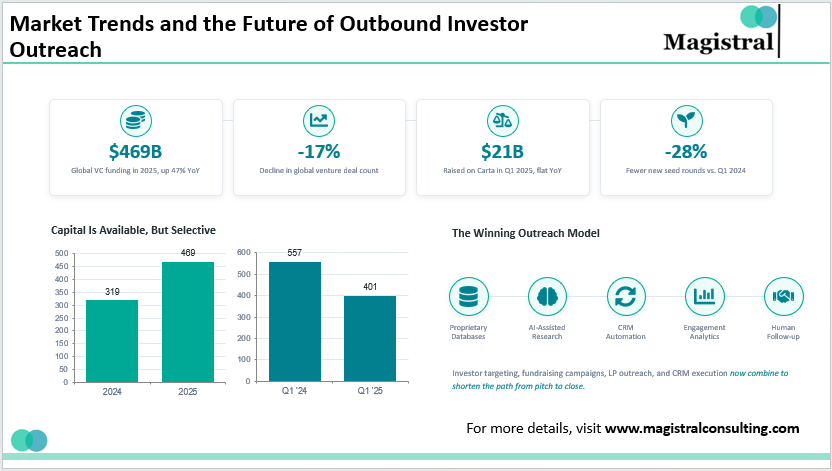
Two major trends in the fundraising world in 2025 can be identified. Firstly, there is money out there: CB Insights reported $469 billion worth of venture investments globally in 2025, 47% higher than the year before.
Outbound Investor Outreach

Market Trends and the Future of Outbound Investor Outreach

Secondly, the capital is highly selective: according to CB Insights, the number of venture deals decreased by 17%, while Carta reported that startups on its platform raised $21 billion in Q1 2025, roughly the same as in Q1 2024, but did 401 new seed deals, which is 28% fewer than the year before.

In the future, the successful model will be built using proprietary databases, AI-powered research, CRM process automation, investor outreach analysis, and top-notch human follow-through. For entrepreneurs, investors, and financial advisors, outbound investor outreach will always be among the most efficient ways to establish a fundraising process pipeline, gauge interest, and cut the time between pitching and closing.

For practical purposes of keyword planning, the article uses “outbound investor outreach” in controlled repetition within the body of the text without resorting to unnecessary repetition. The term is used in headlines and throughout the text where it fits the search intent context, while related keywords like investor targeting, fundraising campaigns, LP outreach, CRM implementation, and capital raising make the text readable.

Magistral’s Services for Outbound Investor Outreach

The company helps clients execute outbound investor outreach through a research-driven, CRM-led fundraising process supported by investor databases, offshore analysts, AI-powered workflows, and investment banking expertise. Its services include identifying and segmenting potential investors such as LPs, GPs, angels, HNIs, family offices, VCs, PE firms, strategic investors, and private credit providers based on geography, sector, stage, and fundraising requirements. The company also provides customized investor lists aligned with fundraising criteria, develops investor-ready materials including pitch decks, teasers, valuation models, CIMs, information memoranda, and data rooms, and manages CRM-driven outreach campaigns, follow-ups, engagement tracking, and workflow automation. Additionally, it supports investor meetings, NDA management, data room coordination, and deal closure activities.


About Magistral Consulting

Magistral Consulting has helped multiple funds and companies in outsourcing operations activities. It has service offerings for Private Equity, Venture Capital, Family Offices, Investment Banks, Asset Managers, Hedge Funds, Financial Consultants, Real Estate, REITs, RE funds, Corporates, and Portfolio companies. Its functional expertise is around Deal origination, Deal Execution, Due Diligence, Financial Modelling, Portfolio Management, and Equity Research

For setting up an appointment with a Magistral representative visit www.magistralconsulting.com/contact

About the Author

Aman is an investment-research specialist with 5+ years of experience across business and investment research, including 2+ years with Big Four firms like KPMG. A Stanford Seed alumnus with an MBA in Finance and a Bachelor of Commerce (Hons) from University of Delhi, he focuses on private equity, venture capital, and renewable energy sectors. He leads project teams at Magistral Consulting, delivering financial research, due diligence, deal sourcing, and M&A support, while driving strong process management and analytics. His blend of attention to detail, strategic thinking, and dynamic execution enables him to turn complex data into actionable investment insights.


FAQs

What is outbound investor outreach?

Outbound investor outreach is the process of identifying relevant investors and proactively contacting them with a tailored investment opportunity.

Why is investor targeting important?

Targeting improves response rates because investors usually evaluate opportunities based on sector, stage, geography, check size, and mandate fit.

What materials are needed before outreach?

A pitch deck, teaser, financial model, data room, and clear fundraising ask should be ready before outreach begins.

How does CRM improve investor outreach?

CRM systems track emails, follow-ups, deck opens, replies, meetings, and pipeline movement, making the fundraising process more disciplined.

How can Magistral support fundraising campaigns?
Magistral supports investor research, database access, customized lead generation, pitch materials, CRM campaigns, follow-ups, and meeting coordination.


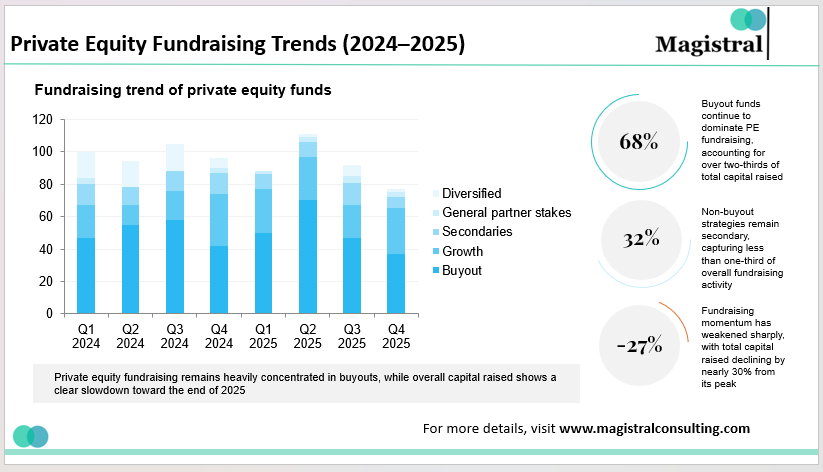
Global capital markets are not facing a shortage of capital, but a structural shift in how that capital is allocated. Private equity capital raises have been on a downward trajectory since then, with declines by about 27% in the quarter ending Q4 2025 from the peak level reached in Q2 2025.

Meanwhile, the concentration of capital continues to exist. Buyout strategies continue to be dominant, taking up about 68% of all funds raised, with other strategies accounting for about 32%.

Private Equity Fundraising Trends (2024–2025)

Private Equity Fundraising Trends (2024–2025)

Interestingly, while all-round fundraising has become less effective, the nature of capital itself suggests a more discriminating approach, as only limited numbers of fundraising approaches attract the lion’s share of investment decisions, indicating that the trend now lies with the concentration of capital management.

This difference characterizes the current fundraising climate. Investment activities are alive; however, there is significantly more discipline involved.

It becomes obvious that successful fundraising today has nothing to do with having access to capital sources, but about finding the right ones. In this regard, there is where the importance of an investor Database comes in handy.

Why Traditional Investor Lists Are Losing Relevance

The traditional fundraising model relied on broad investor lists with limited segmentation. Investors are now facing tighter conditions. The accumulation of unsold securities, delays in exits, and an expectation of returning investments are making a difference in their investment allocation behavior. Simultaneously, there is excess dry powder at a global level, standing at over $2 trillion, making it necessary for the funds to allocate capital in a smarter manner.

Hence, investing has become a more selective and strategic activity for the fund managers. Moreover, even in India, the fundraising efforts have gone down by about 35% during 2025, although investors remain interested in certain thematic areas, such as sustainability and technology.

Generic efforts in the current scenario will not produce the desired results. There is no match between the efforts made by investors and the results they can expect if the targeting by the investor does not go well.

The Evolution of the Investor Database

The investor database has undergone a fundamental shift in its role within fundraising. The traditional back-office solution will transform into an integral part of how organizations build their fundraising plans. Such changes result from stricter capital allocation processes, increasing competition between funds, and the necessity of data-based decisions.

Since investors’ demands have become sophisticated and selective, financial organizations cannot depend on generic data anymore. They must develop specialized solutions that can offer insights into investor preferences and timing, making the investor database a key component of fundraising strategies.

From Static Data to Strategic Intelligence

The modern investor database has evolved into a dynamic intelligence layer that reflects how investors behave, not just who they are.

This trend is part of larger developments within the private equity market as an entire business. Indeed, it has grown considerably, moving from operating in a space where it is often referred to as “tougher ground” where value creation, not market movement, defines success.

An effective investor database identifies trends regarding capital deployment, sector preference, investment size, and geography, in addition to other factors, including responsiveness and themes.

This development is essential as fundraising has moved away from being a game of presence and toward one of relevance.

The Rise of Selective Capital Deployment

Capital deployment in private markets is no longer driven by abundance alone, but by discipline and prioritization. Capital allocation by investors is becoming more tactical due to extended periods of time required for exits, economic volatility, and pressure on performance.

It is changing the dynamics of the capital raising process and the approach to investment by making diversification give way to thesis-based investment. Therefore, access to capital today is becoming less about visibility in the market than alignment with investor goals.

Capital Is Concentrated, Not Scarce

One of the most important dynamics in 2026 is the concentration of capital.

Despite a general downturn in fundraising, there continues to be an emphasis on big funds. Almost half of all capital that was raised in 2025 came from the best-performing companies. Clearly, investors have an obvious tendency to work with proven managers.

Deal-making is also getting tighter. The number of investments made is decreasing while total funding is increasing. This means that less money is being invested, but the checks that are being written are much more carefully considered by the investors.

Moreover, with about $2.18 trillion in dry powder, investors need somewhere to invest it. But this has to happen within certain return on investment standards.

Thus, we have a situation where capital is available, but its access requires strict alignment.

The proper development of an investor database will help a firm determine what capital is being actively sought and what capital can be left unused.

How an Investor Database Directly Impacts Fundraising Outcomes

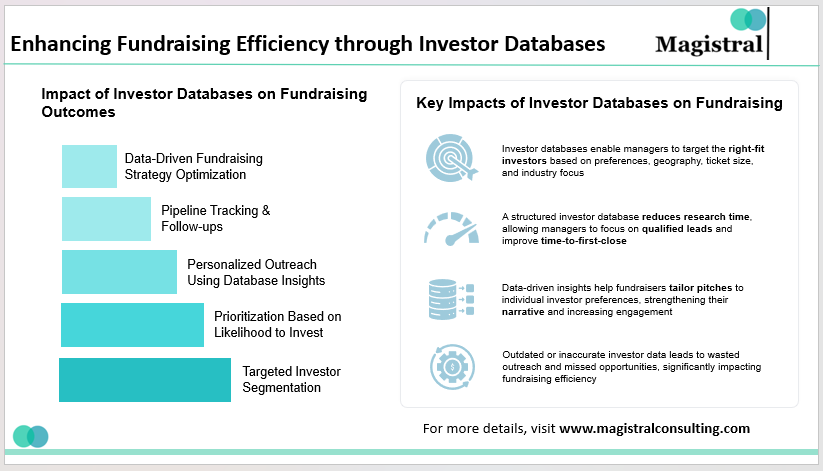
When investor interest is constrained and there is stiff competition among potential investors, success is defined largely by how well companies turn data into action. This is where the investor database becomes an important tool by making it easier to make decisions.

Enhancing Fundraising Efficiency through Investor Databases

Enhancing Fundraising Efficiency through Investor Databases

It is the link between market insight and action that allows businesses to focus on the appropriate opportunities, connect more effectively, and use their internal resources wisely. With more structure and data-driven processes in fundraising, the accuracy of the investor data used has a direct impact on both speed and effectiveness of fundraising campaigns.

Precision Becomes the Primary Advantage

In the context of a selective market environment, the precision-targeted approach has emerged as the fundamental principle behind successful fundraising campaigns.

With an investor database that offers sophisticated capabilities, companies can tailor their outreach strategy to match actual investor actions, including recent transactions and sector emphasis. The result is more efficiency and far better-quality dialogue with investors.

There is no longer room for the outdated approach of broad-based outreach. It is now mandatory.

Speed and Efficiency in Extended Fundraising Cycles

Fundraising cycles have extended in the private sector because of enhanced diligence and careful capital allocation.

But companies that utilize an organized investor database can shorten these fundraising cycles through targeting investors who have a higher probability of making investments. They will receive faster responses, which will make the cycle shorter from contact to interaction.

In a slow market, timing is not about hurrying but about skipping unnecessary steps.

Strengthening Investor Narratives Through Data

Expectations from investors now demand greater contextual involvement. The use of generic stories is becoming less effective in gaining commitment.

The existence of an efficient investor database enables a firm to personalize its message according to the specific interests of the investor. This can include matching up to industry trends like AI, infrastructures, and energy, which are currently drawing a lot of investment interest.

Personalization converts fundraising efforts into a strategic discussion.

The Hidden Cost of Poor Investor Data

Many firms continue to underestimate the cost of fragmented or outdated investor information.

Misinformation creates a misalignment between the company and its investors, decreases interaction, and leaves room for other active investors who would be more interested in doing business. The poor quality of information adds costs to raising capital, especially since there is limited attention from investors.

Moving Beyond Automation

The next phase in the evolution of the investor database lies in the integration of artificial intelligence with human expertise.

With AI, one can perform massive data crunching, identify patterns, and track investors’ behaviour on a real-time basis. Also, more PE companies are integrating AI into their strategies and using it as an advantage over others.

However, the contribution of human intelligence is also critical in terms of providing context, identifying relationships, and aligning decisions.

Together, AI and human intelligence ensure that the investor database becomes a living database for decision-making rather than just an information storage place.

How Magistral Supports Fundraising with a Strategic Investor Database

In a capital environment defined by selectivity and precision, Magistral supports fundraising by combining deep research, structured processes, and Magistral’s Investor Database to enable targeted and efficient investor outreach. The focus is on aligning each fundraising effort with the right investors, backed by data on investor behavior, sector focus, and capital deployment patterns. This ensures that fundraising is not driven by volume, but by relevance and conversion.

Magistral supports clients across the fundraising lifecycle through:

Customized Investor Database Development aligned to fund strategy, sector, and geography

Investor Identification and Mapping based on active capital deployment and recent deal activity

Investor Profiling and Segmentation to enable precise targeting and prioritization

Fundraising Collateral Support including pitch decks, teasers, and investor communication materials

Targeted Outreach Support with data-backed investor shortlists and engagement strategy

Market Research and Benchmarking to position funds effectively within current market dynamics

Ongoing Database Updates and Enrichment using AI-driven tracking and human validation

This integrated approach ensures that Magistral’s Investor Database is not just a data asset, but a strategic tool that directly improves fundraising outcomes.

About Magistral Consulting

Magistral Consulting has helped multiple funds and companies in outsourcing operations activities. It has service offerings for Private Equity, Venture Capital, Family Offices, Investment Banks, Asset Managers, Hedge Funds, Financial Consultants, Real Estate, REITs, RE funds, Corporates, and Portfolio companies. Its functional expertise is around Deal origination, Deal Execution, Due Diligence, Financial Modelling, Portfolio Management, and Equity Research

For setting up an appointment with a Magistral representative visit www.magistralconsulting.com/contact

About the Author

Tanya is an investment-research specialist with 6 + years advising venture-capital, private-equity and lending clients worldwide. A Stanford Seed alumnus with an MBA and an Economics (Hons) degree, she heads project teams at Magistral Consulting, delivering financial modelling, due-diligence and deal support on 3,000 + mandates. Her blend of rigorous analytics, sharp project management and clear client communication turns complex data into actionable investment insight.

FAQs

Who are Magistral’s typical clients?

Magistral primarily works with private equity and venture capital firms, hedge funds, family offices, and investment banks, as well as corporates looking for strategic and financial insights.

How does Magistral differentiate itself from other research firms?

Magistral combines domain expertise with a flexible engagement model and a strong focus on quality. Its approach integrates deep research capabilities with practical execution support, enabling clients to make faster and more informed decisions.

How frequently is Magistral’s Investor Database updated?

The Investor Database is continuously updated using a combination of AI-driven tracking and human validation to reflect the latest investor activity, fund launches, and capital deployment trends.

How does Magistral’s Investor Database improve fundraising outcomes?

By enabling precise investor targeting, the Investor Database helps reduce irrelevant outreach, improve response rates, and increase the likelihood of meaningful investor engagement.