Tag Archives: Fundraising Strategy

Valuation is one of the most contentious areas in fundraising in the current capital markets. As startups and growth-stage companies look to raise capital, the gap between their internal assessment of their business value and investors’ willingness to pay for it has grown significantly.  

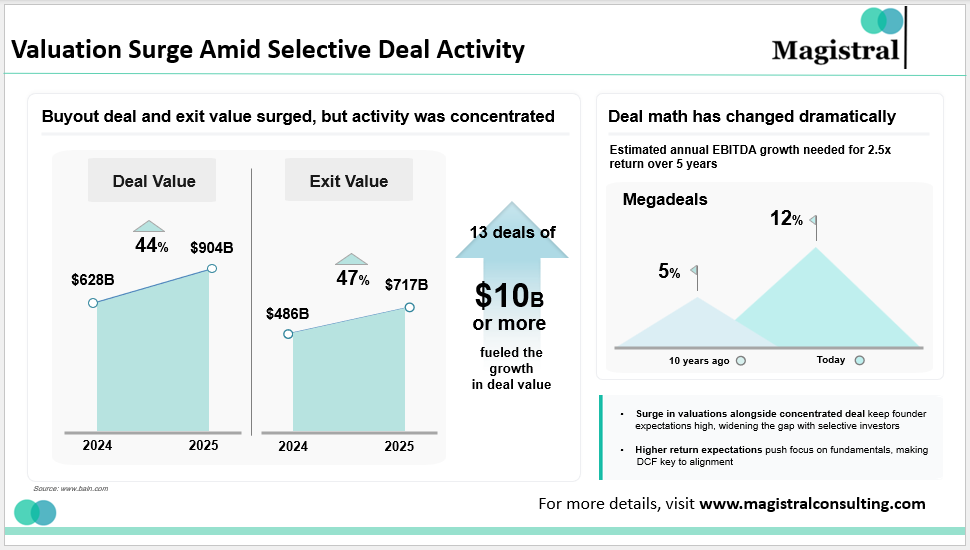
Valuation Surge Amid Selective Deal Activity

Valuation Surge Amid Selective Deal Activity

According to data from PitchBook, the median valuations for startups have fallen by 15-25% across various stages from 2022 to 2024. This is a correction after the peak funding environment in 2021. However, the gap in valuations is a result of founders’ high valuations, especially for earlier-stage companies.  

The gap in valuations is not just a result of over- or under-optimism. There is a fundamental difference in approach. Founders focus on potential, while investors focus on returns. In this context, DCF modeling has re-emerged as a key framework for alignment in valuations. 

Why Founders and Investors Disagree on Valuation 

This is primarily due to differences in how they approach valuation. Founders usually concentrate on growth potential, market opportunity, and overall strategy, whereas investors usually concentrate on return on investment, cash flow, and overall risk. These differences become more apparent in uncertain market conditions. However, DCF modeling helps in bridging this gap by providing a common ground for both parties. It does this by quantifying risks and growth potential in terms of financial outcomes, making it easier for both parties to arrive at a more objective and less biased position. 

Potential vs. Probability: A Structural Disconnect 

At the core of valuation disagreements lies a difference in perspective. Founders are generally interested in valuations of potential and look at growth, scalability, and market size, whereas investors are interested in valuations of probability. 

A study by McKinsey & Company indicates that currently, there is a greater focus on profitability and cash flow predictability over growth at all costs, especially in a higher interest rate environment. 

In such situations, DCF modeling helps both founders and investors clearly articulate their assumptions around growth and risk, thereby bridging the fundamental gap. 

Information Asymmetry in Financial Projections 

Another key driver of valuation gaps is information asymmetry. Founders, being more aware of the business, make more optimistic assumptions, whereas investors make more pessimistic assumptions based on market data. 

This lack of a standardized framework causes a valuation gap. With DCF modeling, both parties will be able to evaluate each other’s assumptions in a more objective and realistic way. 

Market Conditions Are Widening Valuation Gaps 

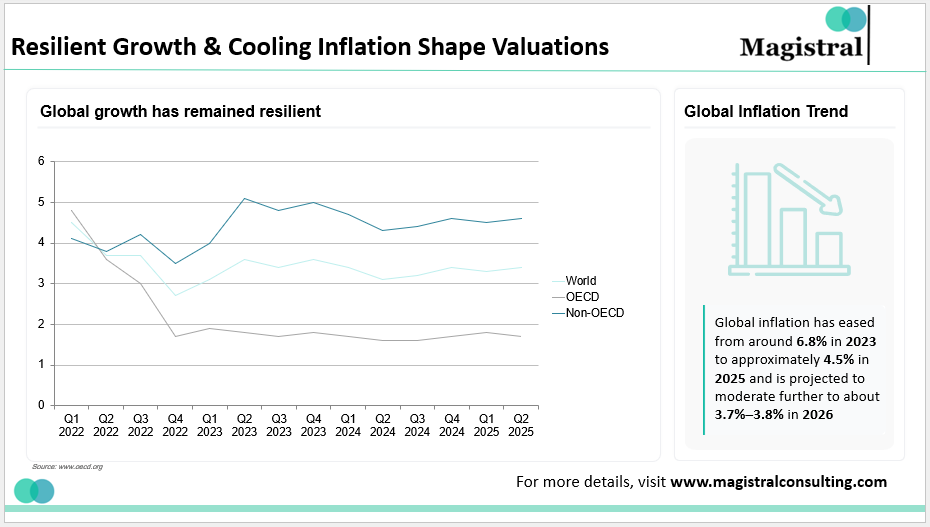
Resilient global economic growth with moderation in inflation rates implies that macroeconomic conditions are gradually returning to normal. Nevertheless, even with the moderation in inflationary pressures, the overall market conditions are still being dictated by relatively high interest rates, tight liquidity, and an uncertain exit scenario. These factors have led to more conservative estimates being used, especially with regard to discount rates and cash flow estimates. On the other hand, founders are using growth rate estimates based on more favorable market conditions. This is leading to an increasing expectation gap. DCF analysis is also important in this regard, as it takes into consideration the impact of macroeconomic conditions on valuations. 

Resilient Growth & Cooling Inflation Shape Valuations

Resilient Growth & Cooling Inflation Shape Valuations

Higher Cost of Capital and Its Impact on Valuation 

Rising interest rates have increased the cost of capital, directly affecting how future cash flows are valued. 

Data from CB Insights indicates that global venture funding declined by over 30% in 2023, reflecting tighter liquidity and increased investor selectivity. 

In DCF modeling, higher discount rates reduce the present value of projected cash flows, resulting in lower valuations. However, founders often adjust expectations more slowly, leading to persistent valuation gaps. 

Exit Uncertainty and Delayed Liquidity Events 

The exit markets, too, are becoming increasingly challenging. According to EY, “public listings are lower than pre-2021 levels, and private equity firms are holding assets for longer as exit conditions remain weak.” 

This again adds to the divergence in DCF modeling as the founders continue to assume exit scenarios from pre-pandemic days. 

Multiple Compression and Market Volatility Are Distorting Comparable-Based Valuations 

Market volatility and declining valuation multiples have made comparable-based methods less reliable, as investors adjust expectations faster than founders. This has created a disconnect where historical data is not representative of current reality. In these situations, a more stable approach is offered by DCF modeling, where companies are valued on their fundamental attributes instead of multiples. 

The Impact of Public Market Corrections 

One of the most notable changes in the past few years has been the significant correction in the valuation levels of the public markets. Technology and growth equities saw a significant compression in valuation multiples post 2021, which has impacted the private markets. 

The use of comparable company analysis, which relies on public market multiples, has been impacted by the volatility in the public markets. This has resulted in the private market valuation levels temporarily deviating from the founder and investor views. 

Why Intrinsic Valuation Is Gaining Importance 

Unlike market-based techniques, DCF modeling offers an intrinsic valuation approach that relies on a company’s underlying financials and cash flow projections. 

For example, DCF modeling’s focus on underlying fundamentals like revenue growth, margins, and capital efficiency minimizes reliance on unstable external references. This technique becomes more relevant in a volatile market where comparable data may not be a true representation of a company’s value. 

Today, DCF modeling has emerged as a popular technique that many investors use to verify or refute traditional comparable-based valuation approaches. 

How DCF Modeling Bridges the Valuation Gap 

Valuation gaps often arise from differing assumptions around growth, risk, and returns. DCF modeling assists in closing the gap by providing a framework wherein both the founders and the investors are able to agree upon key variables like cash flows and discount rates. 

Bringing Transparency to Valuation Assumptions 

One of the key benefits associated with DCF modeling is the ability to make assumptions around valuation transparent. This means items such as growth rates, margins, capital expenditures, and discount rates are all defined and can be adjusted. 

This allows for a much more constructive dialogue between founders and investors as they are able to better understand the implications of changing assumptions around valuation. 

Moving from Point Estimates to Scenario-Based Valuation 

Rather than relying on a single valuation figure, DCF modeling allows for scenario analysis. Founders can make an upside case based on high growth assumptions, while investors can analyze downside risk based on low growth assumptions. 

This takes the discussion away from a fixed valuation number and puts it towards understanding the range of outcomes, which makes DCF modeling a very effective tool for alignment during fundraising. 

The Increasing Role of DCF Modeling in Institutional Investment Decisions 

Institutional investors are increasingly adopting structured valuation frameworks as an integral part of their due diligence process. As capital becomes more selective, the reliance on narrative-driven valuation approaches is falling out of favor. 

According to a report by Deloitte, investors are increasingly focusing on cash flow-based valuation methods, especially for private markets due to transparency issues. 

In the current scenario, DCF modeling is widely used for evaluating downside risk, understanding value creation over a period of time, and making investment decisions across various industries. This is because DCF modeling has the ability to incorporate various factors under a single analytical framework. 

The valuation gaps between founders and investors have widened in the current volatile market scenario due to various factors such as differing expectations, macroeconomic factors, and valuation approaches. DCF modeling can play an important role in bridging valuation gaps between founders and investors. As capital becomes more selective, adopting strong valuation approaches becomes imperative for successful fundraising and better investor alignment. 

How Magistral Consulting Supports Financial Modeling 

As financial modeling plays an integral role in investment decisions, fundraising activities, and valuation analysis, companies are looking for well-structured, accurate, and scalable financial models. At Magistral Consulting, we are committed to assisting our clients in developing robust financial models that clearly interpret the business assumptions into meaningful data-driven insights. 

DCF modeling to assess intrinsic valuation based on projected cash flows and risk assumptions

Three-statement financial modeling integrating income statement, balance sheet, and cash flow projections

Scenario and sensitivity analysis to evaluate upside, downside, and risk-adjusted outcomes

LBO and investment modeling to support private equity transactions and return analysis

Financial model validation and audit to ensure accuracy, consistency, and investor readiness

Customized models for fundraising and M&A aligned with specific deal structures and investor requirements

About Magistral Consulting

Magistral Consulting has helped multiple funds and companies in outsourcing operations activities. It has service offerings for Private Equity, Venture Capital, Family Offices, Investment Banks, Asset Managers, Hedge Funds, Financial Consultants, Real Estate, REITs, RE funds, Corporates, and Portfolio companies. Its functional expertise is around Deal origination, Deal Execution, Due Diligence, Financial Modelling, Portfolio Management, and Equity Research

For setting up an appointment with a Magistral representative visit www.magistralconsulting.com/contact

About the Author

Nitin is a Partner and Co-Founder at Magistral Consulting. He is a Stanford Seed MBA (Marketing) and electronics engineer with 19 + years at S&P Global and Evalueserve, leading research, analytics, and inside‑sales teams. An investment‑ and financial‑research specialist, he has delivered due‑diligence, fund‑administration, and market‑entry projects for clients worldwide. He now shapes Magistral Consulting’s strategic direction, oversees global operations, and drives business‑development support.

FAQs

What are the core services offered by Magistral Consulting?

The firm offers services such as financial modeling, market research, outsourced industry benchmarking reports, competitive intelligence, and investor presentation support.

How does Magistral Consulting support data-driven decision-making?

Magistral Consulting helps transform complex data into structured insights, enabling firms to make informed strategic and financial decisions.

How does Magistral Consulting help in investor communication through financial models?

The firm ensures that financial models are investor-ready, with clear assumptions, structured outputs, and insights that can be effectively presented in pitch decks and discussions.

Why is outsourcing financial modeling beneficial for firms?

Outsourcing financial modeling to Magistral Consulting allows firms to access specialized expertise, improve model accuracy, and focus internal teams on strategic activities such as deal execution and portfolio management.

Investor reachout is often mistaken solely as a short-term fundraising activity. The purpose of reaching out to investors is fundraising. This activity is important, as it helps in connecting and building relationships with investors for the long run. When done well, investor reachout not only facilitates immediate funding for a company’s product development or market expansion but also builds a track record with investors that integrates the company into a shared long-term growth vision.

Today, financial markets evolve rapidly—investors have new opportunities to consider, valuations change, and perceptions of risk and reward shift rapidly If a company wants to stand out, it needs a lot more than just a pitch deck. It needs investors’ incisive comments, reputable data-backed narratives, a deeply investor-centric outreach that is tightly targeted, and the appropriate investor-centric pull. In the battle for funding, great companies with potential will be passed up if they fail to clear these hurdles.

Data-Backed Windows for Engagement

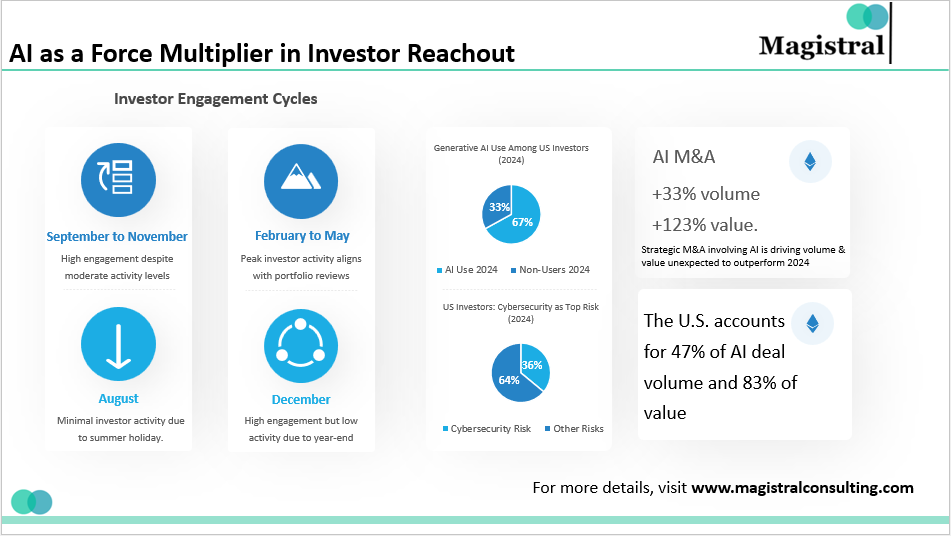
Outreach engaging potential investors follows a seasonal pattern and has specific periods that are more fruitful than others. Synchronizing one’s activity to these specific periods immensely benefits the visibility and proportion of responses received.

The message is not the only thing that matters in investor reachout timing is equally important. The ideal periods to approach investors are February to May and September to November (Qubit). These timeframes coincide with portfolio reviews, reallocation exercises, and opportunity-seeking phases. These include August and December, which tend to be the least active months due to holidays and the year-end closing.

Capital Markets Appetite & Investor Reachout

The ways of accessing investors as well as the allocations of capital are changing very quickly. This is indicative of the changes taking place in the market. Investors changes in the market are changing the places, timings, and methods of investment.

Capital Markets Appetite & Investor Reachout

Capital Markets Appetite & Investor Reachout

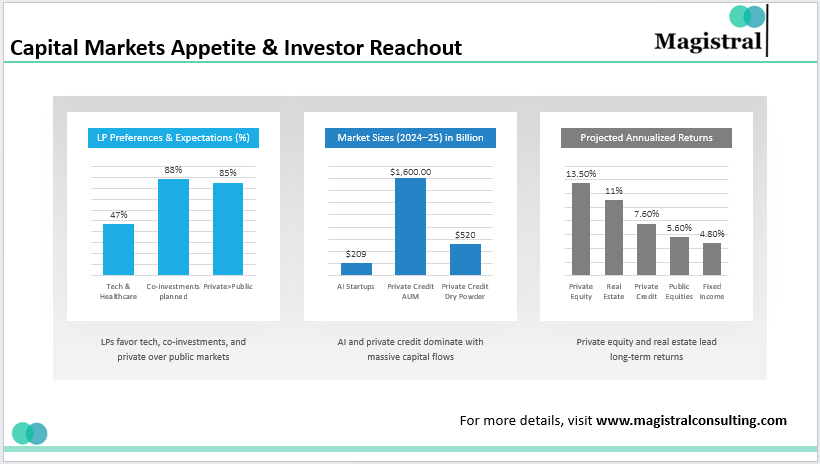
Deal valuations strive towards realism, while being underpinned by plentiful capital and suppressed deal demand, especially from institutional investors.

Technology and healthcare continue to be the dominant sectors, with 47% of limited partners expressing interest in them.

Globally, AI startups raised close to $209 billion in 2024, and this trend is anticipated to continue into 2025.

Private credit is on the rise. It has $1.6 trillion in AUM and $520 billion in dry powder.

Co‑investments are rising 88% of LPs plan to allocate up to 20% of capital this way.

Most LPs (85%) expect private markets to outperform public markets long term.

Projected annualized returns (2025–2035): private equity 13.5%, private credit 7.6%, real estate 11%, versus 5.6% for public equities and 4.8% for fixed income.

This sets a compelling backdrop: investors are hungry for alternative channels, especially private markets, with AI, healthcare, and tech at the helm.

AI as a Force Multiplier in Outreach

The ways of accessing investors as well as the allocations of capital are changing very quickly. This is indicative of the changes taking place in the market. Investors changes in the market are changing the places, timings, and methods of investment.

AI as a Force Multiplier in Investor Reachout

AI as a Force Multiplier in Investor Reachout

Even as deal volume dropped by 20%, investors still were willing to pay a premium for AI-linked targets in the first half of 2025. This is illustrated by the fact that the value of AI deals increased by 127% YoY.

Strategic M&A involving AI is driving volume and value up expected to outperform 2024 by 33% (volume) and 123% (value).

The U.S. makes up 47% of AI-related deals by number and a staggering 83% by the total dollar value.

Like private equity, fund managers seem to be focusing their attention on modernizing data infrastructure (for example, data centers). This is an indication that they want to support foundational AI in the long run.

For investor reachout, AI isn’t just a buzzword, it’s a door-opener.

Economic Patterns Shape Outreach Strategy

The international economic outlook affects the financial markets:

In 2024-2025, India leads the diversification and funding efforts by raising $1.7 trillion through 320 IPOs. Additionally, mutual funds thrive with 54 million retail participants and a doubling in the number of sub-Rs 500 SIPs.

The United States displays signs of increasing caution: 36% of investors cite cybersecurity threats as the most worrisome issue in the near future. The demand for generative AI-driven research has also grown from 49% to 67% in 2024.

In the US, the investor’s response to climate change and corporate risks/opportunities marks a focus area, with 2/3 of them being very likely to invest additional funds in such companies.

For the US IPO market, there is a forecast that the market will remain active in 2025 amid interest rate cuts and continued moderation of inflation.

While AI implementation in investor relations and financial institutions leads to better operational efficiency, ESG is under a fresh scrutiny given the existing political and economic upheaval.

Developing Your Investor Reachout Strategy

Building strong investor connections requires appropriate investor targeting and timing, diligent drafting of the right messages, and the ability to pivot as the situation requires. The following strategies can help maximize outreach effectiveness and engagement

Timing is Crucial

For maximum engagement and visibility, initiate investor reachout between February and May or September and November.

Appropriate Language and Lens

Craft your pitch on high-growth sectors such as technology, healthcare, AI, and climate, and showcase genuine merits such as IP, defensibility, and infrastructure.

Use AI Smartly

In AI, highlight any strategy, platform, or use case.

Write individualized communication for each investor and create press briefings, monitor the current sentiment of the investors, and keep track investors with prescribed AI that matches the investor’s generative AI.

Use specific webinars, short digital videos, or other digital marketing to get the attention of investors.

Address New Risk Landscapes

Especially as investors demand data-privacy and resilience, demonstrate cybersecurity and data-privacy protection measures and provide disclosures to investor data-privacy and resilience demands.

Offer Flexibility in Capital Structures

Indicate the willingness for co-investments or private credit instruments, which are becoming popular.

Adapt for Retail and Emerging Markets

Modify your communications if applicable for small-scale (e.g., investing under ₹500 SIP in India) or neglected market investors.

Looking Ahead: Evolving Investor Reachout

Investor engagement is shifting from passive asset pitching to active, insight-sharing dialogues.

AI-driven tailored experiences are on the rise.

There is an increased focus on alternative assets and private markets.

Constructive trust-building is through the availability of data, increasingly focused on ESG, cybersecurity, and other relevant standards.

Cross-border digital reach (e.g., into India’s retail base) will unlock new pools of capital.

Looking for investors in 2025 requires a special skill set that involves an understanding of timing, technology, sectors, and relational capital. The evolving investor behavior with respect to AI, private equity, green industries, and the like, the poster’s strategy should be well informed, relevant, insightful, and aligned with investor expectations. Not only will the right attention be garnered, with the right partnerships and relationships, the right, and modern, AI relational tools, proper investor timeframes, and demands can be met and built upon with legacy impact.

Services Offered by Magistral Consulting for Investor Reachout

At Magistral Consulting, we handle all phases of the process, from evaluating and selecting the proper investors to finalizing agreements with practical advice and effortless follow-through.

Identification and Profiling of Target Investors

Making refined lists of Private Equity firms, Venture Capitalists, family offices, sovereign wealth funds, and High Net Worth Individuals including in-depth profiles covering their investment thesis, deal size, and key decision makers.

Investor Communication and Outreach Strategy

Developing campaigns on LinkedIn, emails, and events; crafting one-pagers, teasers, and comprehensive decks; and organizing meetings with investors.

Fundraising Collateral Preparation

Producing expert pitch decks, Confidential Information Memorandums (CIMs), teasers along with detailed financial models and valuation support to boost negotiations.

Deal Sourcing & Warm Introductions

Using global networks to identify active deal leads and providing warm introductions to boost the likelihood of positive investor engagement.

Investor Tracking & Reporting

The process of managing investor outreach, capturing responses, and tracking engagement within the CRM, as well as creating dashboard snapshots and progress reports at regular intervals.

Market Intelligence & Insights

Sector-specific report generation on trends, analyzing the deployment of capital, benchmarking, and aligning opportunities to the investor priorities.

End-to-End Fundraising Support

Managing the full process—from investor identification to outreach, follow-ups, and deal closure—as an extended team.

About Magistral Consulting

Magistral Consulting has helped multiple funds and companies in outsourcing operations activities. It has service offerings for Private Equity, Venture Capital, Family Offices, Investment Banks, Asset Managers, Hedge Funds, Financial Consultants, Real Estate, REITs, RE funds, Corporates, and Portfolio companies. Its functional expertise is around Deal origination, Deal Execution, Due Diligence, Financial Modelling, Portfolio Management, and Equity Research

For setting up an appointment with a Magistral representative visit www.magistralconsulting.com/contact

About the Author

Tanya is an investment-research specialist with 6 + years advising venture-capital, private-equity and lending clients worldwide. A Stanford Seed alumnus with an MBA and an Economics (Hons) degree, she heads project teams at Magistral Consulting, delivering financial modelling, due-diligence and deal support on 3,000 + mandates. Her blend of rigorous analytics, sharp project management and clear client communication turns complex data into actionable investment insight.
 

FAQs

Why is investor outreach critical in 2025?

Because markets are shifting fast—valuations, risks, and investor priorities are changing, making strong outreach vital to secure funding.


What are the best times to approach investors?

February–May and September–November, when investors review allocations and are most active.


Which sectors attract the most interest in 2025?

AI, technology, healthcare, climate-focused businesses, and private markets.


How is AI changing investor engagement?

AI helps personalize outreach, analyze sentiment, and makes pitches more compelling, while AI-driven firms attract premium attention.


What macro trends impact outreach strategies?

Retail investor growth in India, cybersecurity focusses on the U.S., climate investment demand, and rising private credit/secondaries.

Capital remains the fuel for growth across all business types, from early-stage startup ideas to expanding mid-market organizations enjoying revenue streams. However, raising funds is no longer a linear process involving just banks or venture capitalists. The modern fundraising landscape is fragmented, dynamic, and requires a high level of financial sophistication, storytelling finesse, and strategic outreach. Capital raising consultants provide outstanding value and have become trusted advisors for navigating these complexities.

These consultants offer an end-to-end service from refining the fundraising strategy and developing the financial documents, to identifying, targeting, and managing. They represent investment bankers’ knowledge, the flexibility of startup operatives, and the detail of financial analysts in one package. For businesses hoping to accelerate growth, expand globally and navigate a volatile economic climate, capital raising consultants can be a source of significant competitive advantage.

Capital Raising Consultants: An Evolving Need in the Investment Ecosystem

Capital raising consultants have transitioned away from being “nice-to-have” advisors to becoming an integral group of the fundraising machinery, primarily for companies in all sectors and in all geographies.

Rising Complexity in Capital Markets

The capital markets have transformed from a binary decision between equity and debt into a continuum of funding vehicles— convertible notes, SAFE’s, mezzanine debt, revenue-based financing, and more. With these decisions requiring a high degree of knowledge about capital structuring, few companies will have this capability internally. The primary service offering of a capital raising consultant is to demystify the range of options and determine the best capital stack for the specific business model at the point of growth.

Surge in Alternative Capital Sources

The rise of global family offices, corporate VCs, private credit funds, and crowdfunding platforms has widened the capital base. While this increases options, it also creates noise. Capital raising consultants provide an intelligent filter to help the company and their team decide which capital sources make the most sense and align with their long-term plans and interests in ownership.

Increased Focus on Investor Readiness

Today, a good idea or product isn’t enough. Investors demand clear financial projections, proven traction, and a compelling narrative. Consultants help clients navigate through those challenges and prepare investor-ready packages that comprise many elements from market intelligence or point of difference, competitor benchmarking and comparison, projected growth, mitigation of risk and finally the compelling story to tell.

Customized Outreach and Targeting

Generic email no longer works. Fundraising now demands a CRM-driven, data-backed approach to investor engagement. Top consultants currently capitalize on using advanced targeting methods that include databases, predictive analytics, and AI-driven tools in securing the right investors with the right messaging.

Value Addition Beyond Fundraising

Capital raising consultants are not only useful in raising funds. They advise the business on negotiation terms, preparation for due diligence, and even post-acquisition onboarding actions with investors. All these actions will lead to better-managed dilution, good governance, and quicker disbursement of funds.

Services Offered by Capital Raising Consultants

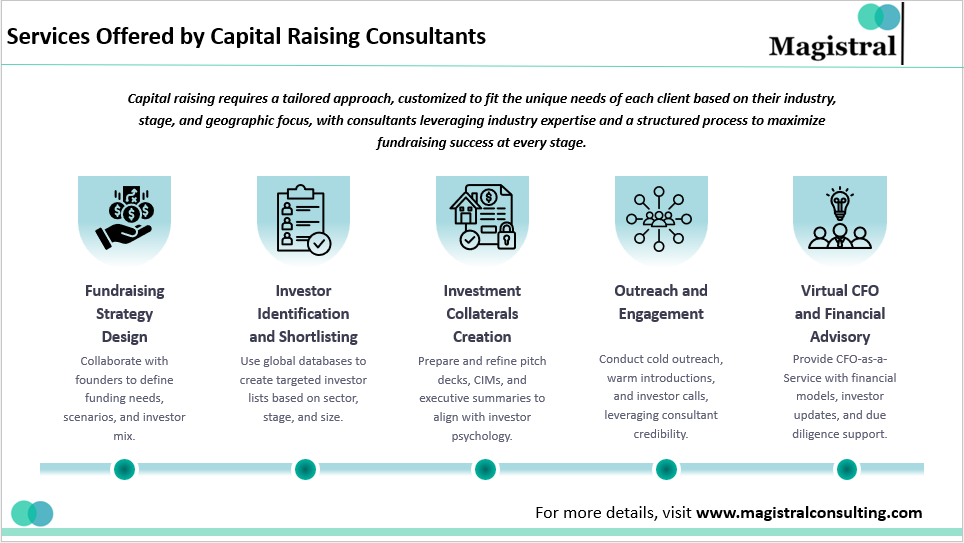
Capital raising is rarely a one-size-fits-all process. Depending on the client’s industry, stage, and target geography, consultants offer a suite of modular and customizable services.

Fundraising Strategy Design

Before pitching begins, consultants work with the founders or CFOs to establish clarity on why funding is needed, how much is optimal, and what timeline to follow. This includes scenario planning, use-of-funds modeling, and planning the ideal investor mix.

Investor Identification and Shortlisting

Consultants have global databases, past deal data, and industry contacts to tailor investor shortlists. These lists are divided into sector preference, average cheque size, stage focus, ticket size, geographic mandate, and investment thesis. Under this laser-targeted approach, outreach conversions occur with much greater frequency.

Investment Collaterals Creation

A strong set of documents can make or break a deal. Consultants prepare or refine the pitch deck, executive summary, CIM (Confidential Information Memorandum), one-pagers, and teaser notes. Sometimes they block the message with their information, which confuses investors, but mainly it is an art to align the story with the psychology of an investor, while putting up visuals that clarify rather than confuse.

Outreach and Engagement

Consultants run targeted outreach campaigns, at times playing the role of an intermediary between the client and investor. They include cold outreach, warm introductions, investor calls, coordination of NDAs, and follow-ups. The Consultancy’s Credibility often opens doors that founders may not be able to open by themselves.

Virtual CFO and Financial Advisory

For those startups without a finance team, the capital-raising consultant has CFO-as-a-Service solutions: investor updates, financial models, MIS reporting, and due diligence support.

Services Offered by Capital Raising Consultants

Services Offered by Capital Raising Consultants

How Capital Raising Consultants Add Value Across Business Stages

Different stages of business require different fundraising strategies, and capital raising consultants fit their playbook accordingly.

Startups and Early-Stage Ventures

Startups tend to operate with small teams and often have a limited understanding of how fundraising works. Startup consultants help companies determine what they can celebrate as a “vision” that investors would buy into; help benchmark valuations based on their stage; and help find the right “strategic” angel investors or accelerators. They help clients prepare financial models that represent flexibility while controlling expenses and align the narratives with the investor persona.

Growth-Stage Companies

By this point, the fundraising round is larger than an early-stage round, and the investor comes primarily from institutional investors. In this role, consultants help with due diligence readiness, secure data rooms, practice investor meetings with leadership, and respond to investor objections. The role is also to lessen the fatigue and stress for the founders, particularly with long funding rounds.

Mature Companies or PE/VC Portfolio Firms

These companies may be craving funding for expansion or product development, or even buybacks. Consultants help provide structure for funding, possibly as bridge rounds, mezzanine funding or PE secondaries. Consultants to PE or VC portfolios help at the fund level, look at the opportunities to make changes or to optimize capital allocation across the portfolio

Metrics that Prove the Effectiveness of Capital Raising Consultants

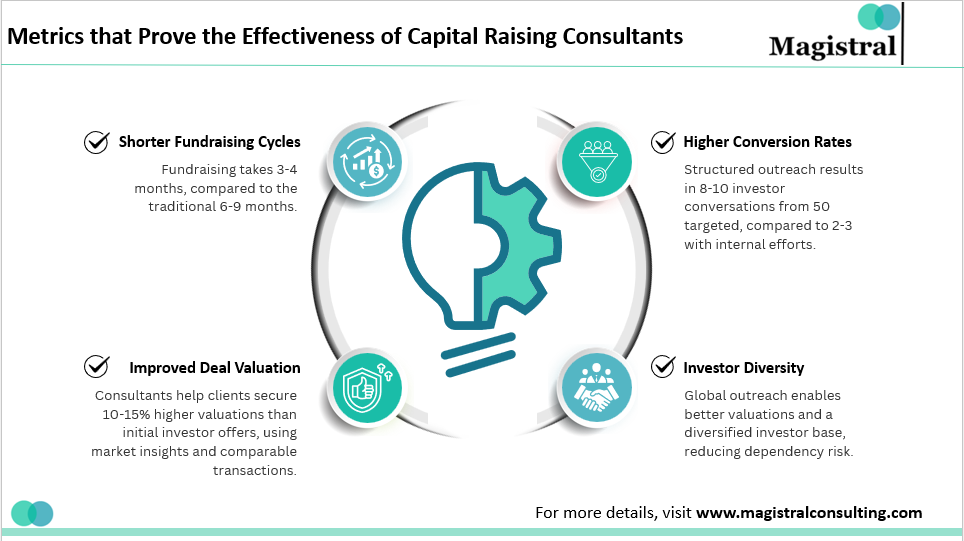
Cutting-edge capital fundraisers produce data-oriented results that surpass the value of anecdotal evidence.

Shorter Fundraising Cycles

Fundraising can take from 3 to 4 months, while traditionally, 6 to 9 months would be expected, with investor targeting and documentation readiness.

Higher Conversion Rates

Clients claim that investors’ response rate doubles or triples with the structured outreach prepared by a consultant. Of the 50 investors targeted, a well-organized campaign conducts 8 to 10 conversations, whereas an internal one reaches 2 to 3.

Improved Deal Valuation

Based on comparable transactions, market insight, and techniques, consultants can assist clients in obtaining a better deal—we are often looking at valuations that reflect a 10- to 15-percent premium over the initial offers from investors.

Investor Diversity

Capital raising will open a global investor arena to the consultants. This not only offers the chance of better valuation but also serves in developing a diversified cap table, thus reducing dependency risk.

Metrics that Prove the Effectiveness of Capital Raising Consultants

Metrics that Prove the Effectiveness of Capital Raising Consultants

Choosing the Right Capital Raising Consultant

Given the devastation caused by the impacts, it is vital to pick your consultant wisely.

Domain Expertise and Track Record

Ask for references, success metrics, and case studies in your industry. Those consultants who speak your sector’s language and KPIs will be much better able to affect the outcomes.

Access to Investor Network

Check if these guys really have relationships or are just database accesses. Top-notch consultants keep personal relationships with family offices, VCs, and strategic funds.

Global vs. Local Reach

If your market or product is international, a global reach is required. But for regulatory-heavy industries like healthcare or fintech, local capabilities matter more.

Cost and Fee Structures

Avoid full success-based models as they lessen accountability. Instead, opt for hybrid models-a small retainer and a success-linked bonus-as it keeps the consultant focused and aligned.

About Magistral Consulting

Magistral Consulting has helped multiple funds and companies in outsourcing operations activities. It has service offerings for Private Equity, Venture Capital, Family Offices, Investment Banks, Asset Managers, Hedge Funds, Financial Consultants, Real Estate, REITs, RE funds, Corporates, and Portfolio companies. Its functional expertise is around Deal origination, Deal Execution, Due Diligence, Financial Modelling, Portfolio Management, and Equity Research

For setting up an appointment with a Magistral representative visit www.magistralconsulting.com/contact

About the Author

Tanya is an investment-research specialist with 6 + years advising venture-capital, private-equity and lending clients worldwide. A Stanford Seed alumnus with an MBA and an Economics (Hons) degree, she heads project teams at Magistral Consulting, delivering financial modelling, due-diligence and deal support on 3,000 + mandates. Her blend of rigorous analytics, sharp project management and clear client communication turns complex data into actionable investment insight.
 

FAQs

What does a capital raising consultant do?

They provide strategic and financial advisory services to help companies plan, execute, and close funding rounds.


When should a startup hire a capital raising consultant?

Ideally, before the fundraising begins—when you're ready with your product or traction, but before preparing documents or reaching out to investors.


Do capital raising consultants charge upfront?

Yes, most charge a base retainer and a success fee. This helps keep efforts aligned with outcomes.


Can capital raising consultants guarantee funding?

No ethical consultant will guarantee funding. However, they dramatically improve your chances through better targeting and preparation.


How long does it take to raise capital with a consultant?

With good preparation, most early-stage companies can raise capital in 3–6 months