Financial modeling is performed by investment banks in an environment where success or failure could very well depend on how timely, accurate, and professional the financial models are presented to potential clients or customers. It is for these reasons, therefore, that the practice of outsourcing financial models by investment banks has grown from just being seen as a means of saving money to a core operating strategy in today’s world. This claim is backed up by verified data from the market: According to Deloitte’s Global Outsourcing Survey for 2024, 80% of executives surveyed will continue to outsource, or will outsource even more, with 50% already utilizing outsourcing for front-office functions.
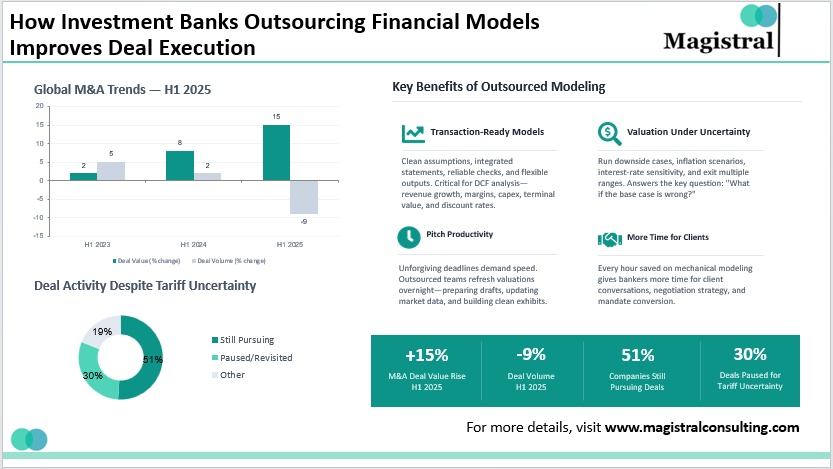
In addition, PwC’s M&A outlook for the first half of 2025 recorded an increase in global deal values by 15%, despite the 9% decrease in deal volumes during the same period
Why Investment banks outsourcing Financial Models Has Become Mainstream
Investment banks must deal with increased analysis demands, shortened deal periods, and increased client expectations. Investment banks outsourcing allows banks flexibility when dealing with a lot of work without overstressing the senior investment bankers. Investment banks outsourcing helps firms add flexible capacity without overburdening internal teams.
Why Investment Banks Outsourcing Financial Models Has Become Mainstream
Deal cycles are faster and less predictable
Deals in the live process do not move smoothly. In one week, you could have a management presentation, while the following week calls for a range of revisions that include valuation, updated debt schedule, and new sensitivities before board discussions. In cases where the internal analyst is busy making pitchbooks and diligence, the banks will resort to outsourcing modeling teams to handle the extra workload.
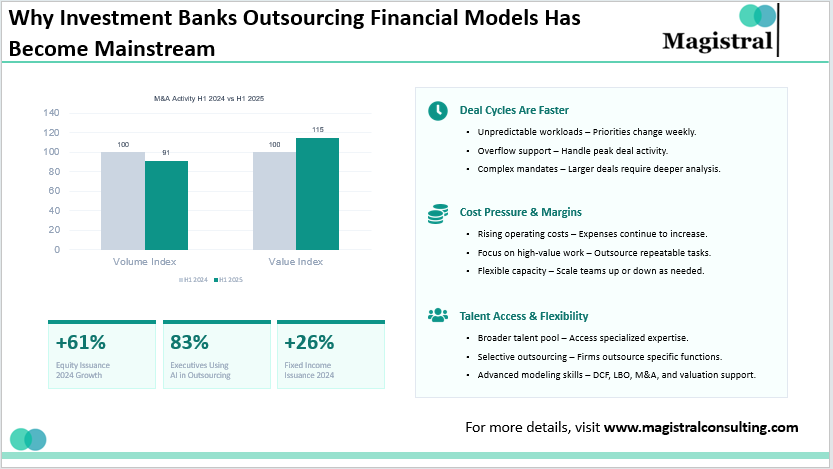
PWC’s mid-year M&A forecast for 2025 demonstrated a trend in the market. There was a 9% decline in the global volume of M&A transactions in H1 2025 compared to the first half of 2024, while at the same time, there was a growth in the value of deals by 15%. It is likely to mean that investment bankers are handling fewer deals but bigger deals with more analysis demands, one reason why investment banks outsourcing of financial models has gained popularity.
Cost pressure is changing the operating model
While the need for high-quality analysis remains, investment banks now need to manage their bottom line as well. According to the recent Capital Markets Fact Book by SIFMA, expenses incurred by FINRA-registered broker-dealers amounted to $565.2 billion in 2024, increasing by 2.4% year over year. Capital-markets activities also proved robust, with U.S. long-term fixed-income issuance amounting to $10.4 trillion in 2024, representing a year-over-year increase of 26.0%, as well as total equity issuance reaching $222.9 billion, showing a significant increase of 60.9%. In such circumstances, it becomes important for banks to differentiate between judgment work and repetitive activities, hence making investment banking outsourcing a sensible solution for expanding capacity.
The senior bankers would control client strategy, while outsourced analysts would develop operating case studies, refresh the comparable companies database, and cleanse raw company data. Investment banking outsourcing will be particularly helpful here since it provides the missing link between modeling and all other processes.
Talent access matters as much as cost
Talent accessibility is just as important as costs. As revealed in Deloitte’s 2024 outsourcing survey conducted with input from over 500 executives from around the world, 83% of executives are currently using AI in conjunction with their outsourced services, while 70% of them have partially insourced some tasks they used to give out to third parties over the last five years.
Thus, the current practice of sourcing is much more concerned with the construction of a flexible delivery model in terms of skills, control, and time than pure offloading. For instance, given the need for a banking analyst to be well-versed in DCF, LBO, mergers, accretion/dilution, debt schedules, as well as KPIs for particular industries, investment banks outsourcing is mostly motivated by talent accessibility, rather than cost efficiency.
The practical benefit
For a bank, it would be possible to scale up modeling activities at times of high transaction volumes and scale back down once deal flow decreases. Investment banks outsourcing gives teams a practical way to match resources to changing deal flow.
How Investment Banks Outsourcing Financial Models Improves Deal Execution
Outsourced financial models support speed, consistency, and better decision-making. The best external teams do not simply “fill spreadsheets”; they help bankers convert messy assumptions into clean investment logic.
How Investment Banks Outsourcing Financial Models Improves Deal Execution
Building transaction-ready models
Investment banking models must withstand client scrutiny. A well-built model should have clear assumptions, consistent formatting, integrated financial statements, reliable checks, and flexible outputs. This is especially important when banks prepare fairness opinions, sell-side materials, buy-side screens, or sponsor pitches.
Many banks rely on outsourced teams for DCF analysis because discounted cash flow models demand disciplined assumptions around revenue growth, margins, working capital, capex, terminal value, and discount rates.
Supporting valuation under uncertainty
In 2025, quality rather than volume dominated markets. PwC indicated that despite a 9% reduction in the number of M&A deals, deal values were up by 15% in the first half of 2025. This demonstrates how the market was becoming increasingly selective, with buyers paying a premium for higher-quality assets and better strategic fit. PwC also revealed that 30% of firms had put deals on hold due to uncertainty over tariffs, but 51% were still engaged in transactions. The careful approach combined with ongoing activities underscored the increased relevance of well-thought-out downside analysis, financing and sensitivity studies – just the kind of task an outsourced investment banking firm is adept at handling.
The right investment banks outsourcing team could model the downside, inflation risk, interest rate risk, financing capacity, and multiple ranges. They would be addressing the key question from their clients: “What happens if our base case fails?”
Improving pitch productivity
Deadlines for pitching can be merciless. The MD could require a new valuation section by the following morning in order to prepare to meet with the founder, investor, or corporate development team. The role of external modeling teams is to facilitate this process. Investment banks outsourcing can therefore improve turnaround when pitch materials need to be refreshed overnight.
Why this matters for bankers
Time that does not have to be spent on model creation is free time for the banker to spend on client interactions and mandate generation.
Best Practices for Investment Banks Outsourcing Financial Models
The most successful engagement occurs when investment banks outsourcing is viewed as part of a process rather than a bandage approach. Scope clarity, communication rhythm, and review diligence will help the model become more actionable.
Start with a precise scope
A generic statement like “create a valuation model” leads to a redo. Instead, provide a detailed description that includes details on the company, the transaction being executed, deliverables required, operating drivers, valuation approach, timeline, and expected format.
Use standardized templates where possible
Standardization increases efficiency and consistency. On the other hand, it is important that bankers not use a one-size-fits-all approach. A SaaS business model will include very different revenue and margin drivers compared to healthcare services and manufacturing.
Combine sector research with modeling
A model becomes more persuasive when assumptions reflect market reality. For instance, a banker preparing a healthcare services pitch may need utilization rates, reimbursement pressure, wage inflation, and regional expansion assumptions. This is why modeling often works best when paired with deal support.
Build AI carefully into the workflow
AI may facilitate faster information acquisition, comparisons, and consistency verifications, but judgment cannot be replaced. According to the World Economic Forum’s 2025 report on the use of AI in finance, firms spent an estimated $35 billion on AI in 2023 and forecast that expenditure related to banking, insurance, capital markets, and payments would increase to around $97 billion annually by 2027.
The report additionally pointed out that approximately 32%-39% of work in major segments of the financial-services industry is highly automatable, whereas 34%-37% of work within those sectors has high augmentation potential.
The relevance to outsourcing from investment banks arises from the fact that today’s best practice is to adopt a hybrid operating model, leveraging automation for speed, third-party experts for scalable execution, and the bank’s own bankers for customer judgment.
How Magistral Supports Investment Banks Outsourcing Financial Models
Magistral Consulting assists investment banks outsourcing by managing their financial modeling, valuations, research, and presentation support for deals. The idea is straightforward: provide bankers the analytical capability they need on tight schedules.
Financial modeling and valuation support
Magistral assists with building DCF valuations, LBO valuations, merger transactions, comparable firm analysis, precedent transaction analysis, forecasted operations, and scenario analysis. These models assist banks with developing investment theses, pitches, and deal perspectives.
For corporations that span private equity and strategic M&A, outsourced modeling could prove beneficial in comparisons of sponsor economics, leverage capacity, exit assumptions, and operational improvement theses.
Research-backed model assumptions
A model is only as strong as its assumptions. Magistral combines market research, company profiling, industry benchmarking, and transaction screening to make forecasts more grounded. This is especially useful when banks support venture capital clients, growth companies, and emerging sectors where historical data may be limited.
Flexible execution for lean teams
For investment banks outsourcing, during peak deal periods, external modeling support helps them compete with larger platforms without carrying a permanent analyst bench. In larger banks, outsourced teams can support repetitive but important workstreams, allowing internal teams to focus on client judgment and execution.
About Magistral Consulting
Magistral Consulting has helped multiple funds and companies in outsourcing operations activities. It has service offerings for Private Equity, Venture Capital, Family Offices, Investment Banks, Asset Managers, Hedge Funds, Financial Consultants, Real Estate, REITs, RE funds, Corporates, and Portfolio companies. Its functional expertise is around Deal origination, Deal Execution, Due Diligence, Financial Modelling, Portfolio Management, and Equity Research
For setting up an appointment with a Magistral representative visit www.magistralconsulting.com/contact
About the Author

Nitin is a Partner and Co-Founder at Magistral Consulting. He is a Stanford Seed MBA (Marketing) and electronics engineer with 19 + years at S&P Global and Evalueserve, leading research, analytics, and inside‑sales teams. An investment‑ and financial‑research specialist, he has delivered due‑diligence, fund‑administration, and market‑entry projects for clients worldwide. He now shapes Magistral Consulting’s strategic direction, oversees global operations, and drives business‑development support.
FAQs
Why do investment banks outsource financial models?
What financial models are commonly outsourced?
Is outsourced financial modeling secure?
How does outsourcing improve investment banking productivity?
Can outsourced teams support live deal deadlines?