Tag Archives: Investment Bank Operations Outsourcing

Financial modeling is performed by investment banks in an environment where success or failure could very well depend on how timely, accurate, and professional the financial models are presented to potential clients or customers. It is for these reasons, therefore, that the practice of outsourcing financial models by investment banks has grown from just being seen as a means of saving money to a core operating strategy in today’s world. This claim is backed up by verified data from the market: According to Deloitte’s Global Outsourcing Survey for 2024, 80% of executives surveyed will continue to outsource, or will outsource even more, with 50% already utilizing outsourcing for front-office functions.

In addition, PwC’s M&A outlook for the first half of 2025 recorded an increase in global deal values by 15%, despite the 9% decrease in deal volumes during the same period

Why Investment banks outsourcing Financial Models Has Become Mainstream

Investment banks must deal with increased analysis demands, shortened deal periods, and increased client expectations. Investment banks outsourcing allows banks flexibility when dealing with a lot of work without overstressing the senior investment bankers. Investment banks outsourcing helps firms add flexible capacity without overburdening internal teams.
Why Investment Banks Outsourcing Financial Models Has Become Mainstream

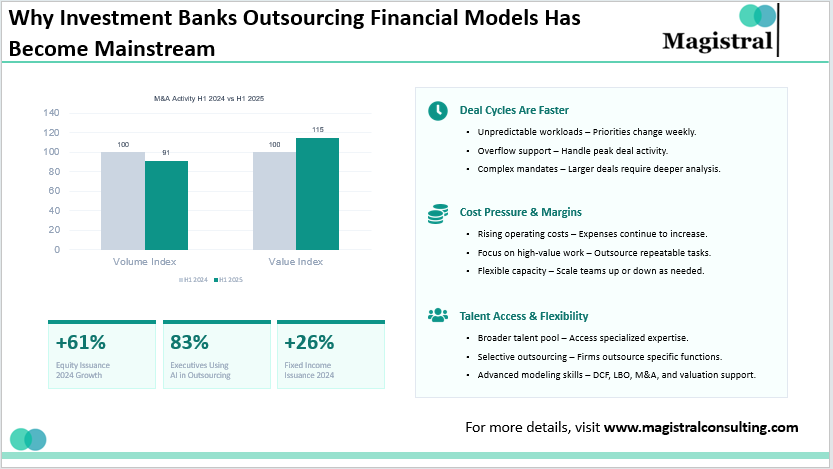
Why Investment Banks Outsourcing Financial Models Has Become Mainstream

Deal cycles are faster and less predictable

Deals in the live process do not move smoothly. In one week, you could have a management presentation, while the following week calls for a range of revisions that include valuation, updated debt schedule, and new sensitivities before board discussions. In cases where the internal analyst is busy making pitchbooks and diligence, the banks will resort to outsourcing modeling teams to handle the extra workload.

PWC’s mid-year M&A forecast for 2025 demonstrated a trend in the market. There was a 9% decline in the global volume of M&A transactions in H1 2025 compared to the first half of 2024, while at the same time, there was a growth in the value of deals by 15%. It is likely to mean that investment bankers are handling fewer deals but bigger deals with more analysis demands, one reason why investment banks outsourcing of financial models has gained popularity.

Cost pressure is changing the operating model

While the need for high-quality analysis remains, investment banks now need to manage their bottom line as well. According to the recent Capital Markets Fact Book by SIFMA, expenses incurred by FINRA-registered broker-dealers amounted to $565.2 billion in 2024, increasing by 2.4% year over year. Capital-markets activities also proved robust, with U.S. long-term fixed-income issuance amounting to $10.4 trillion in 2024, representing a year-over-year increase of 26.0%, as well as total equity issuance reaching $222.9 billion, showing a significant increase of 60.9%. In such circumstances, it becomes important for banks to differentiate between judgment work and repetitive activities, hence making investment banking outsourcing a sensible solution for expanding capacity.

The senior bankers would control client strategy, while outsourced analysts would develop operating case studies, refresh the comparable companies database, and cleanse raw company data. Investment banking outsourcing will be particularly helpful here since it provides the missing link between modeling and all other processes.

Talent access matters as much as cost

Talent accessibility is just as important as costs. As revealed in Deloitte’s 2024 outsourcing survey conducted with input from over 500 executives from around the world, 83% of executives are currently using AI in conjunction with their outsourced services, while 70% of them have partially insourced some tasks they used to give out to third parties over the last five years.

Thus, the current practice of sourcing is much more concerned with the construction of a flexible delivery model in terms of skills, control, and time than pure offloading. For instance, given the need for a banking analyst to be well-versed in DCF, LBO, mergers, accretion/dilution, debt schedules, as well as KPIs for particular industries, investment banks outsourcing is mostly motivated by talent accessibility, rather than cost efficiency.

The practical benefit

For a bank, it would be possible to scale up modeling activities at times of high transaction volumes and scale back down once deal flow decreases. Investment banks outsourcing gives teams a practical way to match resources to changing deal flow.

How Investment Banks Outsourcing Financial Models Improves Deal Execution

Outsourced financial models support speed, consistency, and better decision-making. The best external teams do not simply “fill spreadsheets”; they help bankers convert messy assumptions into clean investment logic.
How Investment Banks Outsourcing Financial Models Improves Deal Execution

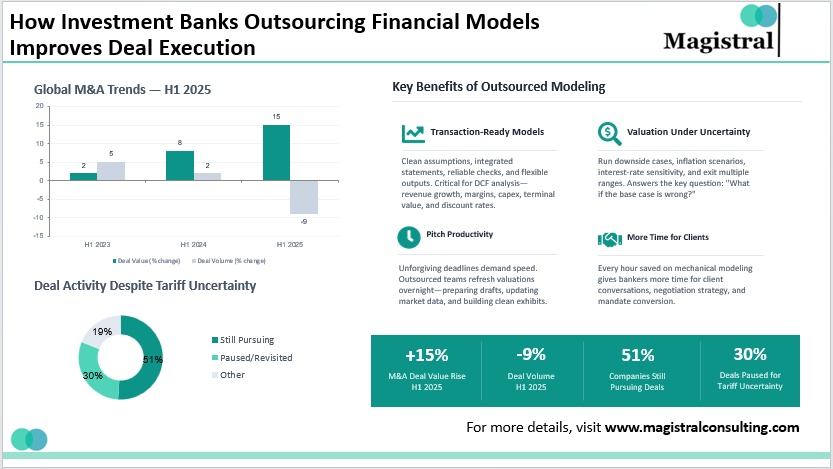
How Investment Banks Outsourcing Financial Models Improves Deal Execution

Building transaction-ready models

Investment banking models must withstand client scrutiny. A well-built model should have clear assumptions, consistent formatting, integrated financial statements, reliable checks, and flexible outputs. This is especially important when banks prepare fairness opinions, sell-side materials, buy-side screens, or sponsor pitches.
Many banks rely on outsourced teams for DCF analysis because discounted cash flow models demand disciplined assumptions around revenue growth, margins, working capital, capex, terminal value, and discount rates.

Supporting valuation under uncertainty

In 2025, quality rather than volume dominated markets. PwC indicated that despite a 9% reduction in the number of M&A deals, deal values were up by 15% in the first half of 2025. This demonstrates how the market was becoming increasingly selective, with buyers paying a premium for higher-quality assets and better strategic fit. PwC also revealed that 30% of firms had put deals on hold due to uncertainty over tariffs, but 51% were still engaged in transactions. The careful approach combined with ongoing activities underscored the increased relevance of well-thought-out downside analysis, financing and sensitivity studies – just the kind of task an outsourced investment banking firm is adept at handling.

The right investment banks outsourcing team could model the downside, inflation risk, interest rate risk, financing capacity, and multiple ranges. They would be addressing the key question from their clients: “What happens if our base case fails?”

Improving pitch productivity

Deadlines for pitching can be merciless. The MD could require a new valuation section by the following morning in order to prepare to meet with the founder, investor, or corporate development team. The role of external modeling teams is to facilitate this process. Investment banks outsourcing can therefore improve turnaround when pitch materials need to be refreshed overnight.

Why this matters for bankers

Time that does not have to be spent on model creation is free time for the banker to spend on client interactions and mandate generation.

Best Practices for Investment Banks Outsourcing Financial Models

The most successful engagement occurs when investment banks outsourcing is viewed as part of a process rather than a bandage approach. Scope clarity, communication rhythm, and review diligence will help the model become more actionable.

Start with a precise scope

A generic statement like “create a valuation model” leads to a redo. Instead, provide a detailed description that includes details on the company, the transaction being executed, deliverables required, operating drivers, valuation approach, timeline, and expected format.

Use standardized templates where possible

Standardization increases efficiency and consistency. On the other hand, it is important that bankers not use a one-size-fits-all approach. A SaaS business model will include very different revenue and margin drivers compared to healthcare services and manufacturing.

Combine sector research with modeling

A model becomes more persuasive when assumptions reflect market reality. For instance, a banker preparing a healthcare services pitch may need utilization rates, reimbursement pressure, wage inflation, and regional expansion assumptions. This is why modeling often works best when paired with deal support.

Build AI carefully into the workflow

AI may facilitate faster information acquisition, comparisons, and consistency verifications, but judgment cannot be replaced. According to the World Economic Forum’s 2025 report on the use of AI in finance, firms spent an estimated $35 billion on AI in 2023 and forecast that expenditure related to banking, insurance, capital markets, and payments would increase to around $97 billion annually by 2027.

The report additionally pointed out that approximately 32%-39% of work in major segments of the financial-services industry is highly automatable, whereas 34%-37% of work within those sectors has high augmentation potential.

The relevance to outsourcing from investment banks arises from the fact that today’s best practice is to adopt a hybrid operating model, leveraging automation for speed, third-party experts for scalable execution, and the bank’s own bankers for customer judgment.

How Magistral Supports Investment Banks Outsourcing Financial Models

Magistral Consulting assists investment banks outsourcing by managing their financial modeling, valuations, research, and presentation support for deals. The idea is straightforward: provide bankers the analytical capability they need on tight schedules.

Financial modeling and valuation support

Magistral assists with building DCF valuations, LBO valuations, merger transactions, comparable firm analysis, precedent transaction analysis, forecasted operations, and scenario analysis. These models assist banks with developing investment theses, pitches, and deal perspectives.
For corporations that span private equity and strategic M&A, outsourced modeling could prove beneficial in comparisons of sponsor economics, leverage capacity, exit assumptions, and operational improvement theses.

Research-backed model assumptions

A model is only as strong as its assumptions. Magistral combines market research, company profiling, industry benchmarking, and transaction screening to make forecasts more grounded. This is especially useful when banks support venture capital clients, growth companies, and emerging sectors where historical data may be limited.

Flexible execution for lean teams

For investment banks outsourcing, during peak deal periods, external modeling support helps them compete with larger platforms without carrying a permanent analyst bench. In larger banks, outsourced teams can support repetitive but important workstreams, allowing internal teams to focus on client judgment and execution.


About Magistral Consulting

Magistral Consulting has helped multiple funds and companies in outsourcing operations activities. It has service offerings for Private Equity, Venture Capital, Family Offices, Investment Banks, Asset Managers, Hedge Funds, Financial Consultants, Real Estate, REITs, RE funds, Corporates, and Portfolio companies. Its functional expertise is around Deal origination, Deal Execution, Due Diligence, Financial Modelling, Portfolio Management, and Equity Research

For setting up an appointment with a Magistral representative visit www.magistralconsulting.com/contact

About the Author

Nitin is a Partner and Co-Founder at Magistral Consulting. He is a Stanford Seed MBA (Marketing) and electronics engineer with 19 + years at S&P Global and Evalueserve, leading research, analytics, and inside‑sales teams. An investment‑ and financial‑research specialist, he has delivered due‑diligence, fund‑administration, and market‑entry projects for clients worldwide. He now shapes Magistral Consulting’s strategic direction, oversees global operations, and drives business‑development support.

FAQs

Why do investment banks outsource financial models?

They outsource models to increase capacity, reduce turnaround time, access specialized talent, and support deal teams during peak transaction periods.

What financial models are commonly outsourced?

Common models include DCF, LBO, merger models, three-statement forecasts, accretion dilution models, trading comps, and precedent transaction models.

Is outsourced financial modeling secure?

It can be secure when banks use confidentiality agreements, restricted access, secure data rooms, version control, and internal review before client delivery.

How does outsourcing improve investment banking productivity?

It allows internal bankers to focus on client strategy, negotiation, and deal execution while external teams handle modeling, data updates, and valuation exhibits.

Can outsourced teams support live deal deadlines?

Yes. Skilled outsourced teams often support overnight updates, revised assumptions, sensitivity analysis, and pitchbook-ready valuation outputs.


Deal origination has changed. What was once a relationship-driven, highly manual function is now becoming a structured, data-powered discipline. With increasing deal cycles and tightening competition, firms across private equity, investment banking, venture capital, and corporate M&A are increasingly seeking to scale their origination engines through investment banking outsourcing with speed, precision, and sector intelligence.

The market itself is changing fast. Proprietary deal flow has become harder to secure, with analysts now reporting that high-quality opportunities are increasingly concentrated and discovered earlier by firms using data-driven sourcing. At the same time, the cost of maintaining large internal teams has risen markedly. This combination has accelerated the rise of specialist outsourcing partners who operate as an extension of deal teams-helping build broader, deeper, and more actionable pipelines.

Why Data-Driven Deal Origination Is Becoming the Norm

Deal sourcing went through a linear process earlier. The analysts made lists manually, tracked founders in Excel sheets, went through industry reports, and used events or broker feeds. But since there are over 12,000 private companies worldwide that have crossed the $50M+ revenue mark, it is beyond the scale for any human to track. Indeed, the modern deal team needs structured datasets, predictive tools, sector-specific intelligence, and always-on research.

Why Deal Teams Are Shifting to Data-Led Origination

Why Deal Teams Are Shifting to Data-Led Origination

Three major forces are accelerating this shift:

Information Overload and Fragmented Sources

The teams at PE and M&A track companies across databases, filings, news, VC portfolios, industry reports, and social signals. An analyst, on average, toggles between 8–12 data sources to qualify an opportunity. Specialty external teams that focus only on the synthesis of data can do this more effectively for a much lower cost.

The Race for Proprietary Opportunities

Multiple market analyses indicate that proprietary deals generate 15-30% better multiples. However, only 1 in 20 firms today feel they have a truly proprietary engine. Investment banking outsourcing teams help build deeper mapping across subsectors, founder profiles, succession indicators, and buy-and-build plays.

Talent Cost Inflation

In-house sourcing teams have become increasingly expensive. In North America, first-year analyst compensation grew 19% between 2021 and 2024. Specialist outsourcing-most notably, India-based research teams-provides the same quality at a cost 50-70% lower. This allows firms to expand coverage without expanding payroll.

Specialist investment banking outsourcing gives firms continuity and sector stability, thereby allowing them to track these long-term without disruptions. The quality of the talent available in these external pods has also improved. Many analysts now bring sector specialization and prior experience working with global investment teams.

How Outsourced, Data-Driven Models Transform Deal Pipelines

A data-driven outsourcing model brings a level of structure, scale, and discipline that traditional sourcing approaches rarely achieve. Rather than rebuilding company lists with every new investment thesis, firms now have access to continuously updated subsector landscapes, refreshed private-company datasets, and intelligence streams that are closely aligned with their criteria. This serves as a sourcing engine that is always on, not episodic.

A Continuously Updated and Non-Stagnant Pipeline

Its greatest benefit is that deal pipelines are dynamic. Private markets move fast-nearly 21% of mid-market companies undergo a material change every year, from changes in management and ownership to valuation outlook or strategic direction. Outsourced teams track these developments in real time to ensure that companies enter, exit, or re-enter the pipeline based on live triggers such as funding rounds, product launches, key hires, regulatory updates, or changes in industry direction.

Because these updates happen daily, firms avoid the common problem of pipelines going stale. The opportunities stay refreshed, relevant, and connected with market timing, greatly improving qualification rates.

Better Visibility into Whitespace and Under-the-Radar Opportunities

In-house teams are challenged by the inability to track the long tail of private companies. With more than 13,000 private firms now crossing the $50M revenue mark globally, most remain invisible to traditional databases or broker-led channels. Outsourced research teams solve this by monitoring niche markets, microsegments, and emerging subsectors at far greater breadth.

This extended coverage reveals whitespace markets that have low competition but with strong growth indicators, bringing forth targets that internal teams generally miss. Outsourced analysts, as they continuously scan through global datasets and sector signals, can identify firms at an inflection point long before they show up in mainstream pipelines.

Detecting Inflection Points Earlier Than the Competition

Early visibility is where the outsourced models have the most measurable impact. Analysts dedicated to monitoring live news, filings, social signals, new product introductions, and hiring patterns can flag actionable changes faster. Recent industry evaluations show that firms using outsourced research spot strong-fit targets 2-3 quarters earlier compared to peers relying solely on internal sourcing.

This time advantage matters. Earlier outreach increases conversion probability, improves relationship-building, and enhances valuation leverage-especially in competitive subsectors.

Why Investment Banking Outsourcing Is Gaining Global Momentum

Global deal-making has decelerated over recent years. Compared with 2022, global M&A, PE, and VC deals in total decreased by almost 25% in 2023, while the year 2024 saw only a partial recovery, having just over 50,500 deals from around the world. Fewer deals and increased competition force firms to broaden their sourcing funnel, scan wider geographies, and pursue proprietary opportunities more systematically. This is one of the key reasons for the growing traction in the use of investment banking outsourcing worldwide.

2025 Regional Leaders in Investment Banking Outsourcing

2025 Regional Leaders in Investment Banking Outsourcing

Cross-Border Reach and Market Agility

With firms increasingly exploring cross-border and emerging markets, local insights, regulatory knowledge, and on-ground intelligence become important. Investment banking outsourcing teams provide this reach and flexibility, enabling deal teams to monitor multiple regions without expanding in-house resources.

Efficiency in a Competitive Environment

Outsourcing provides a very cost-effective solution with constrained internal bandwidth. It is estimated that the global financial services outsourcing market was around USD 181.6 billion in 2025. This reflects strong demand for specialized, scalable support. By merging continuous sourcing coverage with sector expertise, firms keep a live pipeline while controlling costs.

From Episodic Sourcing to Continuous Origination

With modern investment banking outsourcing, one can move away from ad-hoc, mandate-driven sourcing toward always-on pipelines. Targets are tracked, filtered, and updated continuously based on strategic criteria to make sure firms can act quickly when opportunities emerge, stay ahead of competition, and maintain high-quality deal flow even in slow market conditions.

The future of deal origination is clear: firms that adopt structured, data-driven sourcing models-underpinned by specialist partners-will enjoy a meaningful competitive advantage. Investment banking outsourcing has moved far beyond cost arbitrage; it is now a strategic capability empowering deal teams to scale intelligently, operate efficiently, and unlock opportunities that would otherwise remain undiscovered.

Outsourcing will take center stage in shaping how contemporary investment teams go about discovering, qualifying, and executing opportunities amid compressing deal cycles and evolving markets.

How Magistral Supports Investment Banking Outsourcing

Magistral empowers global deal teams through its comprehensive suite of investment banking outsourcing services, aimed at expanding coverage, deepening intelligence, and maintaining a deal pipeline that is continuously refreshed. Each of the services works as an integrated extension of various PE, VC, IB, and Corporate M&A teams.

Deal Origination & Target Identification

Continuous scanning of companies across sectors and geographies is done by utilizing thesis-aligned filters to surface relevant opportunities early in order to enhance the effectiveness of investment banking outsourcing workflows.

Market & Subsector Mapping

Structured mapping of industries, value chains, and emerging niches, revealing whitespace opportunities and competitive pockets that drive sharper sourcing strategies.

Financial & Business Profiling

Brief overviews of shortlisted targets covering models, financial performance, customer segments, and key metrics to facilitate speedier decision-making.

Competitive & Benchmarking Analysis

Track competitor moves, price developments, funding activity, and strategic shifts to help deal teams identify market inflection points early.

About Magistral Consulting

Magistral Consulting has helped multiple funds and companies in outsourcing operations activities. It has service offerings for Private Equity, Venture Capital, Family Offices, Investment Banks, Asset Managers, Hedge Funds, Financial Consultants, Real Estate, REITs, RE funds, Corporates, and Portfolio companies. Its functional expertise is around Deal origination, Deal Execution, Due Diligence, Financial Modelling, Portfolio Management, and Equity Research

For setting up an appointment with a Magistral representative visit www.magistralconsulting.com/contact

About the Author

Prabhash Choudhary is the CEO of Magistral Consulting. He is a Stanford Seed alumnus and mechanical engineer with 20 + years’ leadership at Fortune 500 firms- Accenture Strategy, Deloitte, News Corp, and S&P Global. At Magistral Consulting, he directs global operations and has delivered over $3.5 billion in client impact across finance, research, analytics, and outsourcing. His expertise spans management consulting, investment and strategic research, and operational excellence for 1,200 + clients worldwide

FAQs

What type of research and analytical services does Magistral provide?

Magistral offers end-to-end research support, including market research, industry analysis, competitive benchmarking, financial modeling, investor materials, and opportunity mapping for PE, VC, IB, and corporate strategy teams.

Does Magistral support deal teams across all sectors?

Yes. Magistral has deep multi-sector expertise across SaaS, manufacturing, healthcare, AI, logistics, energy transition, BFSI, consumer, and more, providing both broad coverage and specialized subsector insights.

How does Magistral improve deal origination through Investment Banking Outsourcing?

Magistral creates continuous, intelligence-backed pipelines by tracking markets, subsectors, competitors, and emerging opportunities, allowing IB teams to identify actionable targets faster.

Why is Investment Banking Outsourcing with Magistral more cost-effective?

Magistral provides scalable analyst capacity at a fraction of in-house costs, enabling IB teams to deepen coverage, accelerate origination, and maintain high-quality deal flow without additional hiring.


Introduction

In the dynamic and rapidly evolving realm of finance, Investment Banks emerge as the quintessential pillars that not only facilitate but also catalyze economic growth, foster corporate development, and stimulate capital formation. Renowned for their unparalleled expertise and adeptness in navigating the intricate labyrinth of the financial markets, investment banks assume a pivotal and indispensable role in orchestrating the seamless flow of capital between discerning investors and ambitious corporations. As we embark on this exploration into the intricate inner workings of investment banks, we aim to unravel their multifaceted contributions to the global financial ecosystem, shedding light on the complex mechanisms that underpin their operations. Additionally, we will highlight the diverse constellation of investment banks that collectively shape the ever-evolving landscape of modern finance.

Understanding Investment Banks

At its essence, an investment bank serves as a pivotal intermediary connecting entities in pursuit of capital with those possessing the means to allocate it. Diverging from conventional commercial banking institutions, which predominantly engage in deposit-taking and loan disbursement, investment banks carve out a specialized niche in the financial domain. They excel in diverse functions such as underwriting securities, orchestrating mergers and acquisitions, extending advisory services, and executing intricate financial transactions. The breadth of their responsibilities spans a broad spectrum, encompassing activities ranging from the facilitation of capital accumulation to the meticulous management of risk.

Applications of Investment Banking

Investment banking is essential to the corporate world because it makes a variety of financial operations possible that support growth, innovation, and strategic expansion. Here, we examine the crucial uses of investment banking in the context of corporations:

Capital Raising

A fundamental function of investment banks is to aid corporations in raising capital to support their growth initiatives. Whether it’s through initial public offerings (IPOs), subsequent offerings, or debt issuance, investment banks offer invaluable expertise in structuring and executing capital-raising transactions. Leveraging extensive networks of investors, investment banks facilitate access to vital funds for financing new projects, pursuing acquisitions, or bolstering working capital.

Mergers and Acquisitions (M&A)

Investment banks act as dependable consultants for businesses pursuing strategic alliances, divestitures, mergers, or acquisitions. Investment bankers assist clients with every stage of the M&A process, from target selection and valuation to negotiation and deal structuring, by drawing on their extensive industry knowledge and transactional expertise. Investment banks help companies achieve synergies, increase market share, and create long-term, sustainable value for shareholders by enabling strategic deals.

Strategic Advisory Services

Beyond transactional support, investment banks offer strategic advisory services to corporations seeking guidance on a diverse array of strategic initiatives. This encompasses strategic planning, market entry strategies, capital allocation decisions, and corporate restructuring. Leveraging analytical prowess and industry insights, investment bankers deliver tailored recommendations that align with clients’ overarching goals and objectives, enabling them to navigate complex strategic challenges effectively.

Debt Financing

In addition to equity capital markets, investment banks play a vital role in arranging debt financing for corporations. Whether it’s syndicated loans, bond issuances, or structured finance solutions, investment banks assist corporations in optimizing their capital structure and securing funding on favorable terms. By tapping into debt capital markets, corporations can finance expansion projects, refinance existing debt, or manage liquidity requirements more efficiently, thereby enhancing financial flexibility and resilience.

Risk Management

Investment banks are essential to a company’s ability to manage a range of financial risks, such as currency, interest rate, and price risk for commodities. Investment banks give companies the ability to reduce their exposure to fluctuating market circumstances and hedge against unfavorable market moves by using derivative instruments like futures, options, and swaps. Corporations may enhance their resilience against market risks and preserve financial stability and shareholder value by putting strong risk management policies into place.

Investment Banking Process

Investment banking process

Investment banking process

Origination

The investment banking process typically commences with the origination stage, wherein investment bankers identify opportunities for capital raising or corporate restructuring. This involves conducting extensive market research, assessing industry trends, and cultivating relationships with prospective clients. During this phase, investment bankers strive to understand the unique financial objectives and strategic imperatives of their clients, thereby laying the groundwork for tailored financial solutions.

Due Diligence

Investment banking professionals begins the due diligence process, which entails an in-depth assessment of the potential transaction’s operational, legal, and financial aspects, after identifying possible prospects. In addition to making sure that everyone involved have all the details before moving forward, this crucial stage seeks to identify any potential risks or obstacles that could cause the transaction to fail.

Structuring and Valuation

With a comprehensive understanding of the underlying dynamics, investment bankers proceed to structure the transaction and determine its appropriate valuation. This entails devising optimal capital structures, negotiating terms and conditions, and utilizing sophisticated financial models to ascertain the fair value of assets or securities involved in the transaction. By leveraging their expertise in finance and economics, investment bankers strive to maximize value for their clients while mitigating risks.

Underwriting and Syndication

Once the transaction is structured and valued, investment bankers assume the role of underwriters, wherein they commit to purchasing securities from the issuer at a predetermined price. This underwriting process provides assurance to the issuer regarding the successful completion of the offering, thereby instilling confidence among investors. Subsequently, investment bankers engage in syndication, whereby they distribute the securities to a diverse array of institutional and retail investors, thereby broadening the investor base and enhancing liquidity.

Execution and Closing

The culmination of investment banking process culminates in the execution and closing stage, wherein the transaction is consummated, and the funds are transferred. Investment bankers play a pivotal role in orchestrating the seamless execution of the transaction, liaising with various stakeholders, coordinating legal and regulatory compliance, and ensuring adherence to timelines. Through meticulous attention to detail and proactive management, investment bankers’ endeavor to navigate the complexities of the closing process and deliver value to their clients.

Regulatory Compliance and Risk Management

This section focuses on the regulatory landscape within which investment bank’s function and the steps they implement to ensure adherence to regulations and proficient risk management. It encompasses discussions on regulatory frameworks, adherence to securities laws, strategies for combating money laundering (AML), and approaches for assessing and mitigating risks effectively.

Magistral’s Services for Investment Banks

Magistral Consulting is proud to offer its Investment Banking Services, providing a comprehensive range of tailored solutions to meet the diverse needs of our esteemed clients:

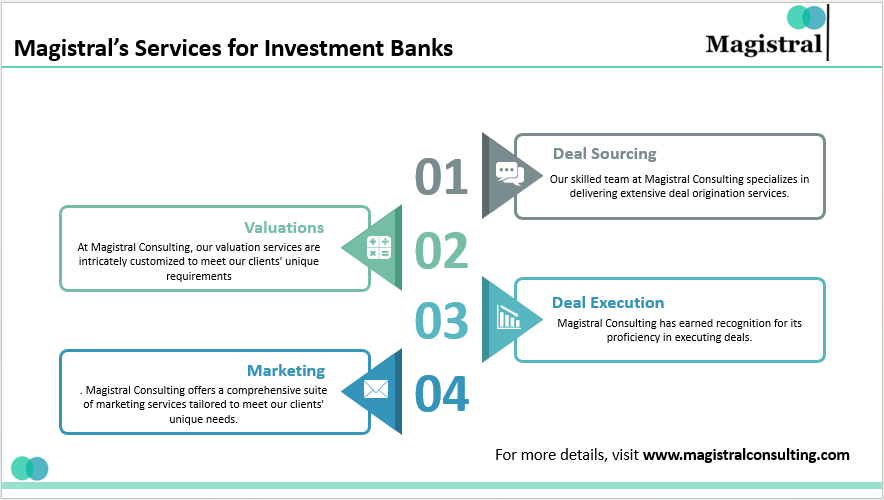
Magistral's services for Investment banks

Magistral’s services for Investment banks

Deal Sourcing

Our skilled team at Magistral Consulting specializes in delivering extensive deal origination services. Utilizing a strong network and deep market insights, we meticulously uncover lucrative investment prospects. Through thorough analyses of industries and markets, we identify emerging trends and opportunities, pinpointing potential investment targets. Our meticulously curated industry bulletins ensure our clients stay informed about the latest developments, empowering them to seize strategic opportunities and maintain a competitive edge.

Valuations

Our valuation services have been customized to match the specific needs of each of our clients. We use advanced techniques and cutting-edge analytics to produce precise and perceptive valuations, from performing LBO and DCF modelling to financial analysis and precedent transaction appraisals. Our main goal is to provide clients with the information they need to make informed investment decisions, whether they are analyzing current portfolios or potential buying decisions. We continue to be relentless in our commitment to provide unparalleled valuation knowledge.

Deal Execution

Magistral Consulting has been recognized for its ability to close transactions. Our signature is efficiently and precisely guiding clients through every stage of the transaction process. We create smooth deal execution methods with the goal of maximizing value and lowering risk, from creating captivating teasers and investment letters to locating possible buyers and investors. Our proactive approach and thorough attention to detail guarantee perfect transaction execution, providing our valued clients with outstanding outcomes.

Marketing

Effective marketing is critical to raising awareness and creating interest in investment options in today’s intensely competitive industry. Magistral Consulting provides a full range of marketing services that are customized to each individual client’s requirements. Creating white papers, case studies, impact analysis reports, thought leadership articles, and insights into sustainable investing are all included in this. Our Perspectives (PoVs) offer industry-leading knowledge and experience, establishing our clients as leaders and drawing interest from possible partners and investors.

About Magistral Consulting

Magistral Consulting has helped multiple funds and companies in outsourcing operations activities. It has service offerings for Private Equity, Venture Capital, Family OfficesInvestment BanksAsset Managers, Hedge Funds, Financial Consultants, Real Estate, REITs, RE fundsCorporates, and Portfolio companies. Its functional expertise is around Deal originationDeal Execution, Due Diligence, Financial ModellingPortfolio Management, and Equity Research

For setting up an appointment with a Magistral representative visit www.magistralconsulting.com/contact

About the Author

The article is Authored by the Marketing Department of Magistral Consulting. For any business inquiries, you could reach out to prabhash.choudhary@magistralconsulting.com

In the last decade or so, almost all functions of investment banking have seen major disruption. An investment bank from pre dot com bust era is almost unrecognizable in the present scheme of things. Almost all banks are struggling to keep in tune with the historical profits that the industry is quite used to. It’s an era where factors like Technology, Outsourcing and Innovation are relaying the rules of the game for Investment Banks

Here are the major trends that are being observed in the industry:

Changes in the IPO business

Traditionally assisting corporates in accessing the public markets has been a major source of revenue for investment banks. Banks have typically charged around 3% to 7% of the money raised as their fees. Bigger and simple IPOs commanded less percentage while smaller IPOs and complex deals commanded higher fees percentage. The number of IPOs has gone down significantly, and the average size of the fund raised has increased. Also, most bigger IPOs have been from tech firms like Facebook, Uber, and Softbank. As the tech firms are already a household brand name even before the IPO, it does not necessitate a reputed Investment Bank underwriting its shares. That gives more bargaining power in the hands of these tech firms as compared to Investment Banks and hence the fees commanded by Investment Banks are under stress.

Apart from the major trend of lesser IPOs and more bargaining power to tech clients, here is what that is further making the industry more challenging:

The trend of staying Private

The last decade also saw the emergence of multiple Private Equity and Venture Capital firms, which formed an alternative to raising funds by going public for the companies. Firms like Softbank have mega-funds which have raised hundreds of billions of dollars to be invested in companies. Raising money from private investors is faster and attracts lesser scrutiny from regulatory authorities. Companies can also function independently in a much efficient way without the pressure of retorting to QoQ profits that public companies are subjected to. This has led to even fewer companies using the services of Investment Banks to go public.

Direct Public Offerings

This concept was first shown in practice by Spotify which went public without underwriting its equity. As tech firms have previous acceptability and brand established, It is easier for them to access money due to its own brand name, rather than a Goldman Sachs or a Morgan Stanley backing it up. Spotify has shown the way to other tech firms, who probably will use this route of public listing more and more in the future.

Alternative Exchanges

There have been multiple substitutes for traditional stock exchanges like NYSE that have cropped up. These exchanges like Investor Exchange or Long term Stock Exchange (LTSE) provide an alternative to list without many complications. All of this leads to a further reduction in the fees commanded by Investment Banks. There have also been multiple platforms that bring together investors and companies using technology. One such platform, Axial Network is now known to be the Tinder of M&A.

Initial Coin Offerings

Still at its infancy but ICO is expected to be used more and more in the future. Here a company offers its equity or right to equity in a blockchain or crypto-based coin. It is still facing too much suspicion from regulatory authorities to become mainstream anytime soon.

Changes in the M&A landscape

M&A activity saw a major boom in the 80s and 90s on the back of public companies looking to improve their EPS and hence improving their valuations. Investment Banks had a bigger role to play as M&A activity was driven more from a financial angle. Presently most of the M&A activity is on the back of the strategic vision of the management, rather than looking for a quick bump in the EPS. This has led to more active role play by the Management and less importance to the value that Investment Banks bring to the table.

Apart from these following are the underlying trends that are rewriting the rules of M&A

Boutique banks and Specialization

There are multiple boutique banks that have shown spectacular growth in their business on the back of specialization. Banks specializing in tech space have shown bigger increases when compared to bigger and more generalist banks. This is because boutique banks understand the industry well and are in a position to recommend vision, strategy, and synergy-based M&A targets.

Technology

There are multiple platforms that are aiding to DIY M&A. Axial network, which is known as Tinder of M&A, connects start-ups with investors, is showing tremendous growth regarding the transactions on its platform.

Changes in Asset Management landscape

Asset Management which still forms the major chunk of revenues for bigger Investment Banks is also going through multiple changes.

Although the major chunk of revenues of bigger investment banks comes from Asset Management, it seems Banks are losing to specialized asset management firms when it comes to traction and growth.

After Lehman brothers collapse, regulatory changes led to bigger investment banks to hold bigger percentage of funds as liquid. This took away the advantage that the banks had in terms of their scale. Specialized Asset Management firms turned out to be agile and relatively less susceptible to regulatory constrictions. Specialized ETFs have given better returns than the funds managed by Investment Banks.

Changes in Equity Research

Equity research for investment banks has been commoditized to a great extent. A huge chunk of information is available that is researched sometimes manually and sometimes using automated programs, but there is very little that is being absorbed. It meant less for the Banks and Clients and probably was not even being used in the way envisaged. Banks did not care much as the cost of the research was bundled along with the cost of a trade.

A recent European Commission’s directive called MiFIID II is set to change all this. Under this Banks are expected to bill the cost of research separately. This has led to banks across the globe, taking notice of their Equity Research operations. Now that the research would be paid separately, it makes sense to evaluate the value addition it brings to the table. Investors also are now more alert in consuming these reports given that they will be paying separately for this. All of this will lead to the elimination of useless repetitive and non-insightful equity research.

Changes in Sales and Trading

Of late after the Lehman Brothers episode, there have been multiple curbs on how much a Bank can trade in the market with its own and client’s money. This has led to curbs on the capital available for trading and thus killing another lucrative source of revenue for Investment Banks

How are banks countering all this?

Large banks have taken different strategies to counter the challenges I mentioned earlier. Here are the major types of strategies followed by them:

Offloading the loss-making verticals: Banks like Morgan Stanley are letting go business divisions that are not profitable and at the same time investing more and more in verticals like Asset Management, that is turning out to be increasingly profitable.

Investing in technology: Others like Goldman Sachs are investing heavily in Technology and Platforms. They are also outsourcing a lot of operations to Low-Cost countries like India. JP Morgan is coming up with Blockchain-based crypto called JPM coin.

Still in the world of Finance, the prestige of investment banks holds significant sway. Changes have arrived but still, the pace of change is expected to be slower as compared to other industries.

The Author Prabhash Choudhary. is the CEO of Magistral Consulting (www.magistralconsulting.com), a firm that helps Investment Banks in outsourcing their operations. He can be reached at prabhash.choudhary@magistralconsulting.com for any queries.

Keywords/ Tags: Investment Banking Outsourcing, Outsourcing, Investment Banking, Investment Bank, Bank, Financial Institution, Company, Service Provider, Outsourcing arrangement, banking, firm, financial firms, capital markets, operational risk, offshoring, client, regulatory compliance, investment, provider, business process, wealth management, outsourcing firm, business services, market, risk, cost savings, asset managers, metrics, analytics, private equity, regulatory requirements, technology, compliance, retail bank, asset management, asset class, outsourcing services, budget constraints, investment managers, jp morgan chase, financial sector, investment banker, value chain, operational costs, banking operations, cost reduction