Tag Archives: Investors profiling

In the current capital-centric ecosystem, managing investors’ relations is much more complicated than simply using spreadsheets and emails. The CRM software solutions for investors have come to play a vital role in facilitating businesses involved in the management of their investors’ data, communications, and deal pipelines. From private equity, venture capital, or hedge funds, investors use advanced systems for effective management of communications with their investors. As Deloitte predicts in its 2024 financial services outlook, more than 68% of investors will accelerate digitization in client and investor management. It shows that there is a general trend of becoming efficient, transparent, and personalized to satisfy investors.

Investors’ CRM in Modern Investment Ecosystems

An investors’ CRM system is essential for the effective organization of investors’ data and effective communication within different investment firms. It serves as a unified system whereby all the interaction processes, deal flows, and other aspects are managed.

Functionality of Investors’ CRM System in Managing Data

An investment firm deals with numerous amounts of data, including information on investor profiles and their transaction history. Investors’ CRM systems integrate these pieces of information into one place. Thus, the process of decision-making can be done effectively.
Furthermore, those investment firms that have a complex structure of operations, such as those operating with investments, may take advantage of the unified system to facilitate the investor commitment and capital call process.

Enhancing Investor Communication

One of the main purposes of any relationship with investors is to communicate effectively. In the context of investors’ CRM, it means sending out automatic updates, messages, and communicating with the client on a regular basis using consistent approaches.

Improving Deal Flow Visibility

The CRM solution for investors gives a complete picture of the deal flow, helping companies manage the entire process of deals from sourcing to closing. It makes sure that nothing is missed along the way, allowing them to focus on important deals.

Integration with Financial Tools

Contemporary investors’ CRM solutions also connect investor information with financial measures, making it easier for investors to forecast.

Investors’ CRM Features Driving Efficiency

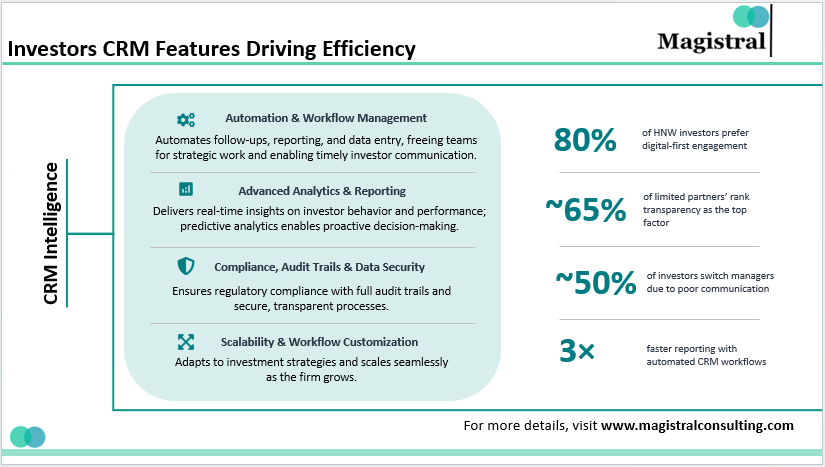
There are multiple features associated with investors’ CRM, which help make operations more efficient. They address the specific needs and challenges that arise within the realm of investment, particularly at a time when customer expectations are changing quickly. For example, it is reported that nearly 70% of investors demand personal communication with fund managers.

Automation and Workflow Management

Automation eliminates unnecessary manual efforts and decreases risks related to errors. Investors’ CRM allows automating activities, such as follow-ups, report generation, and other routine tasks, so that people can be devoted to more strategic actions. It is particularly important given that over 80% of high-net-worth individuals now opt for a digital-first approach in communications, as reported by Capgemini 2024.

Workflow Customization

Depending on firms’ investment strategies, they can customize workflows. For instance, investors who have a venture strategy can adjust workflows to match the cycle of deals and evaluations, similarly to venture capital. However, flexible workflows will help address investor concerns. Over half of investors change their managers because of poor communication, McKinsey Wealth Report.

Advanced Analytics and Reporting

Being data-driven is one of the most crucial benefits offered by investors’ CRM systems. Investors’ CRM platforms offer valuable insights on how investors behave, engage, and perform.
Additionally, transparency is a crucial issue nowadays when it comes to investor relations. Transparency becomes an essential criterion for decision-making in 65 percent of cases for limited partners, as shown by the Preqin Global Investor Survey. The CRM system will allow your firm to generate high-quality reports that can increase transparency and credibility.

Predictive Analytics

Using predictive analytics allows your business to be aware of future opportunities or challenges. Using the historical data, you may predict trends and act based on them.
Using this feature will help you establish proactive engagement strategies. You will have the opportunity to contact investors and offer them something they need even before competing companies.

Compliance and Data Security

Meeting regulatory requirements is one of the primary concerns that come up when discussing investor relations. Your CRM solution should also have capabilities for maintaining data security and regulatory compliance in global jurisdictions.

Audit Trails

Audit trails provide a record of all interactions and transactions, ensuring transparency and accountability. This is particularly important in highly regulated environments where firms must demonstrate compliance at every stage.

Scalability and Customization

With growth comes change. The CRM system that investors provide is capable of scaling, giving organizations the opportunity to upgrade without changing everything.
In an environment where investors’ demands are ever-increasing, the ability to scale alongside being smart is key for companies.

Investors’ CRM Market Trends and Adoption

There has been an increase in the usage of investor CRMs due to advances in technology and rising demands from investors. In today’s world, it is important for investment firms to have sophisticated CRM systems in order to sustain their growth and remain competitive.
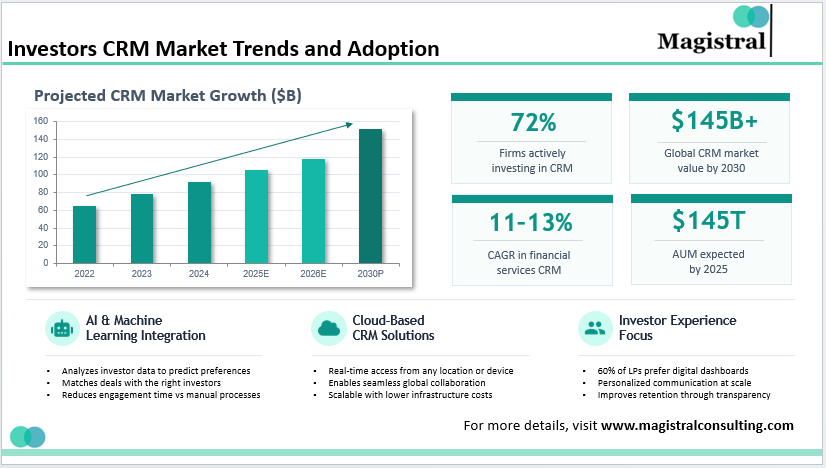
Investors CRM Market Trends and Adoption

Investors CRM Market Trends and Adoption

Growth in CRM Adoption

PwC’s 2025 asset management outlook reveals that 72% of companies are now spending on CRM technologies in order to improve their operational capabilities. The increasing adoption of CRM systems also corresponds to an increase in the overall CRM industry, which is expected to achieve a market value of around $145-160 billion by 2030, as suggested by Precedence Research and Fortune Business Insights. reference

In particular, the financial services segment is predicted to be one of the fast-growing segments, with a CAGR of around 11-13%, from 2024 to 2030. This rise can be attributed to the importance of data management and customer life-cycle analysis for investment firms. Simultaneously, the asset management industry is growing rapidly; PwC predicts that the industry will grow to exceed $145 trillion by 2025.

AI and Machine Learning Integration

Artificial intelligence has been revolutionizing the ability of firms to have advanced CRM in terms of understanding investor preferences. AI has the capability of analyzing previous communications between firms and investors and predicting future expectations based on those patterns.

AI in Deal Origination

In addition, AI has revolutionized deal origination, whereby potential deals can be identified through technology and subsequently matched to potential investors. This is in line with current developments in technology that focus on improving efficiency in sourcing potential deals. With investors’ CRM, this process becomes easier since it involves less time finding and communicating with the best investors.

Cloud-Based CRM Solutions

With cloud computing, CRM solutions for investors become more efficient due to real-time updates, regardless of where one is located. Cloud solutions make it possible for one to have real-time updates about the performance of the CRM system.

Focus on Investor Experience

The expectations of the investors have changed a lot, focusing on the principles of transparency, promptness, and customization. Based on the results of the survey conducted by Preqin in 2024, almost 60% of limited partners would like to receive their reports through the digital dashboard, rather than through the traditional PDF format.
Through CRM, investors provide an opportunity for investment firms to respond to those requirements, offering personalized communication and reporting possibilities. Thus, investors become happier, and their loyalty increases.

Investors’ CRM Implementation Strategies

The implementation of a CRM system for investors is essential for the firm’s proper functioning. It needs to take into account the needs of the company and integrate it with its goals.
Investors CRM Features Driving Efficiency

Investors CRM Features Driving Efficiency

Assessing Business Requirements

It is crucial to determine what needs exist in order to select an appropriate CRM platform. It will allow you to match the needs with the capabilities of the CRM system.

Data Migration and Integration

When transferring data to a new CRM system, it is important to provide high-quality and consistent information in the process. Integration with other tools is also required.

Training and Adoption

The success of the project is directly related to the effective training of users. Without it, it is unlikely that the company will be able to benefit from the system.

Change Management

Often, such projects require a change in culture within the organization. Effective strategies can help you achieve these goals more easily.

Continuous Optimization

CRM systems for investors must constantly improve in response to changing business needs. They are updated regularly and receive new features.

Investors’ CRM and How Magistral Supports Investment Firms

Investors’ CRM has become an essential tool for investment firms aiming to enhance efficiency, improve investor relationships, and drive growth. However, implementing and optimizing these systems requires expertise and strategic guidance.

Tailored CRM Solutions for Investment Firms

Magistral consulting firm proposes tailored CRM services that correspond to each client’s needs. Understanding client needs and problems helps the consulting firm to propose an adequate and efficient strategy that will increase CRM performance and effectiveness.

Data Management and Analytics Support

In order to work efficiently, data management becomes important. In this regard, Magistral proposes effective data management services, as well as analytics services.

Enhancing Fundraising and Investor Relations

A CRM system used by investors may greatly increase opportunities to raise funds. In particular, Magistral will assist you in using CRM effectively in order to raise money.

Operational Excellence and Outsourcing

Outsourcing services proposed by Magistral include operations outsourcing that involves professional knowledge and skills of the company to provide services of CRM and investment operations. Thus, investors’ CRM becomes important when dealing with many operations associated with managing relations with clients and fundraising.

About Magistral Consulting

Magistral Consulting has helped multiple funds and companies in outsourcing operations activities. It has service offerings for Private Equity, Venture Capital, Family Offices, Investment Banks, Asset Managers, Hedge Funds, Financial Consultants, Real Estate, REITs, RE funds, Corporates, and Portfolio companies. Its functional expertise is around Deal origination, Deal Execution, Due Diligence, Financial Modelling, Portfolio Management, and Equity Research

For setting up an appointment with a Magistral representative visit www.magistralconsulting.com/contact

About the Author

Tanya is an investment-research specialist with 6 + years advising venture-capital, private-equity and lending clients worldwide. A Stanford Seed alumnus with an MBA and an Economics (Hons) degree, she heads project teams at Magistral Consulting, delivering financial modelling, due-diligence and deal support on 3,000 + mandates. Her blend of rigorous analytics, sharp project management and clear client communication turns complex data into actionable investment insight.

FAQs

What is an investor's CRM

An investor's CRM is a specialized system designed to manage investor relationships, track interactions, and streamline investment processes within firms.

Why is Investors’ CRM important for investment firms?

It improves efficiency, enhances communication, and provides data-driven insights that support better decision-making and investor engagement.

How does Investors’ CRM support fundraising?

It helps track investor preferences, manage outreach campaigns, and monitor engagement, making fundraising efforts more targeted and effective.

Can Investors’ CRM integrate with other tools?

Yes, most investors' CRM platforms integrate with financial, analytics, and reporting tools to provide a comprehensive view of operations.

What are the key features of Investors’ CRM?

Key features include automation, analytics, compliance tools, data centralization, and customizable workflows.


Introduction          

An Investor Profiling summarizes an investor’s financial goals, situation, time horizon, and risk tolerance. It can assist individuals in making appropriate investment decisions. How much risk one should be willing to assume is determined by an investor profile. For example, a more conservative portfolio may be suitable if someone needs to preserve their money and have a short time horizon. If someone wants to expand their monetary liquid asset (cash) and has a longer time horizon, a more aggressive equity-based portfolio may be appropriate. The most essential quality of an investor is temperament, not intellect quoted to Warren Buffett.

The first step in creating a wealth plan is to analyze the ability to take financial risks. Risk tolerance is determined by duties, objectives, personality, and various other factors. A risk profile is created to accurately understand an individual’s ability to assume financial risk as part of their investment portfolio. There are two crucial components of an investor’s profile:  risk appetite and risk tolerance. Risk tolerance is the amount of risk that a person’s finances can endure, whereas risk appetite is the amount of risk that a person is willing to take.

Importance of Investor Profiling

Risk Profiling is vital for an investor. Before investing in the market, one thing which usually troubles every investor is risk. People are concerned about losing their investment capital or receiving less than expected returns; nevertheless, the risk is generally a mathematical figure, such as volatility, that can directly impact your investment capital.

Each investor’s tolerance for market volatility will be different. This disparity is caused by various variables such as income, obligations, age, etc. The quantification of investor profiling is risk-carrying capability and capacity.

Investment decisions are made on the risk-reward trade-off that an investor is prepared to make in the face of precarious financial markets. It is critical to assess your financial position before making an investment. Take into account your financial goals, risk tolerance, and time horizon to help you determine the investments that are best for you.

Risk factors involved in Investor Profiling

The three major risk factors involved in investor profiling consist of Risk need, Risk-taking ability, and Behavioral loss tolerance.

Risk factors involved in Investor Profiling

Risk factors involved in Investor Profiling

Risk need

The amount of financial risk that someone, as an investor, can safely accept depends on their circumstances. An investor who may be short on funds during retirement and wants to sustain their monthly cash flow may need to take certain risks to achieve their end goal. As a result, risk requirement is about how much risk you “need to take” as an investor. This capability varies depending on their age and other things. For obvious reasons, the risk-taking capacity decreases as age increases. If someone has a target goal and can save according to that, then he will need an annual return. The rate of return will define how much risk one can need to achieve their target. During investor profiling, financial advisers must calculate realistic potential returns and market risk environment for all assets based on historical growth rates and the current market situation. Failure to accomplish a goal should motivate you to save more money or work for extended periods.

Risk-Taking ability

Risk Capacity refers to an investor’s ability to take risks given his existing and ongoing financial status. That is; his or her net worth in relation to liabilities, financial ambitions, and time horizon for investing. It has the potential to reduce exposure to growth assets. One such sub-factor is the investment horizon. For instance, if someone has five years to reach their objectives, one must invest in safer assets because growth assets have high short-term volatility. Risk capacity, or dealing with financial loss, might also influence risk-taking. In terms of liquidity, if the need for liquidity is low in the stage of capital accumulation, then the risk-taking ability is high and vice versa.

For example, if someone is receiving a pension or has a future income or assets to sustain, and their objective is not fulfilled, they have a higher risk-taking capacity than otherwise.

Behavioral Loss Tolerance

Behavioral Loss Tolerance defines an investor’s psychological capacity to cope with market swings. This covers the reactions and responses to various market conditions, such as a correction phase. Behavioral loss tolerance is measured by exams, interviews, and questionnaires and specifies the utmost uncertainty one can accept. The amount of awareness regarding items and their experience over market cycles is determined by financial knowledge and investor experience.

Higher ratings on these criteria imply that investors can progress to growth assets. Risk composure shows the likelihood of acting irrationally in response to a perceived crisis, leading to losses. A trigger-happy investor sells stocks at the first hint of a market drop, whereas the patient investor holds on.

A better investor profiling strategy is feasible when all three components are reconciled and linked together. The investor’s risk appetite cannot exceed the risk tolerance of the aim. Higher risk-taking capacity may be ignored when both the need and the behavioral loss tolerance are low. When risk-taking capacity and behavioral loss tolerance are Higher, a lesser risk needs may be dismissed.

Combining all of these factors yields a genuine risk profile, which should be used to establish a suitable asset allocation mix or strategy, which may require the assistance of a professional financial adviser.

Types of Investor Risk Profile

Conservative

The protection of capital is the main priority of the investor, and they are ready to take minimal risks in exchange for limited or poor profits. The possible asset allocation is equity of 0-10%.

Types of Investor Risk Profile

Types of Investor Risk Profile

Moderately conservative

The moderately conservative investors are ready to take on a little amount of risk in exchange for the possibility of long-term gains. The possible asset allocation is equity of 10 – 30%.

Moderate

Investors are willing to accept a moderate amount of risk in exchange for potentially larger long-term rewards. This type of risk profile is most secure for the investor. The possible asset allocation is equity of 40 – 60%.

Moderately aggressive

To maximize prospective profits over the medium to long term, investors are willing to take on a high level of risk. The probable asset allocation is equity of 70 – 90%. 

Aggressive

The investor is willing to take significant risks to maximize long-term prospective returns and is aware that a major portion of their cash may be lost. The possible asset allocation is equity of 90 – 100%.

Magistral’s Process for Investor Profiling

A risk profile indicates the level of risk that an individual is capable and willing to tolerate and accept. The risk profiling process usually starts with analyzing and discussing the investor’s circumstances and the goals the investments or portfolio should achieve.

Standard Process for Risk Profiling

Standard Process for Risk Profiling

Investors may have various purposes, they may never have thought about or stated their aims in this way before, and they may not be able to capture encapsulate in terms of quantity or time.

Magistral makes sure to entail and enumerate each and every detail related to the client’s needs, and risk considerations during the investor profiling. The process for investor profiling is as follows:

Define Goals

Here we understand what the goals of clients are, in both the short term and long term. Moreover, we also focus on the goals aligned with the current financial status. By having a broad picture, we can then pave the correct way in order to maneuver in the right direction.

Risk Profile Questionnaire

In order to understand the risk-bearing capacity and the willingness of the client to take risks, it is imperative to know the levels of risk exposure of the client. This is done by sending a “Risk profile Questionnaire” to the client. After, filling it out, our team of experts analyzes the questionnaire in order to ascertain the optimum risk exposure of the client.

Scoring the Questionnaire

By having the requisite filter channels, within each category of questions and taking into consideration of various factors, we score each level of questions in tandem with the client’s requirements.

Analyzing and Examining

Careful Scrutiny and analysis of the answers with respective weightage to the client’s needs. We make sure to understand the various needs of the client needs in order to make an optimum risk profile.

Summary Close

Careful Scrutiny and analysis of the answers with respective weightage to the client’s needs. We make sure to understand. While onboarding the client we also deliver a summary of the procedure and the rules of engagement with clients.

Conclusion

Investor profiling is required for determining the optimal investment asset allocation for a portfolio. Because risk appetite is influenced by psychological characteristics, loss-bearing ability, investor age, income and costs, and other factors, each person has a unique risk profile.

Magistral consulting can help you complete a quick risk assessment to determine which risk group you belong to. We can perform the entire investor profiling process and then use this information to determine what percentage of your portfolio should be invested in which asset class.

Why Magistral consulting?

-We provide an exhaustive investor database which is helpful in finding the right kind of investor and beneficial in filtering out the information in concurrence with the existing market scenario and also providing tailor-made support in tandem with client requirements.

-Magistral consulting ensures analyst support at every step of Investor profiling. We have a dedicated team of experts for handling respective operations. In accordance to the client’s demands and specifications, we offer customized services. Considering various stakeholders’ concerns and implementing their diverse proposals.

-We provide a service of target company profiling. It is crucial for us to meet the specific  expectations of our customers by recognizing their requirements.

-It also provides Marketing and Communication support. We have a proficient team having experience in a variety of sectors and indeed the ability to handle different tasks effectively. We make sure to understand each and every client’s needs in a comprehensive manner and provide tailor-made services in an efficient manner.

About Magistral consulting

Magistral Consulting has helped multiple funds and companies in outsourcing operations activities. It has service offerings for Private Equity, Venture Capital, Family OfficesInvestment BanksAsset Managers, Hedge Funds, Financial Consultants, Real Estate, REITs, RE fundsCorporates and Portfolio companies. Its functional expertise is around Deal originationDeal Execution, Due Diligence, Financial ModelingPortfolio Management and Equity Research.

For setting up an appointment with a Magistral representative visit www.magistralconsulting.com/contact

About the Author

The article is Authored by Marketing Department of Magistral Consulting. For any business inquiries, you could reach out to prabhash.choudhary@magistralconsulting.com