Tag Archives: investor profiling

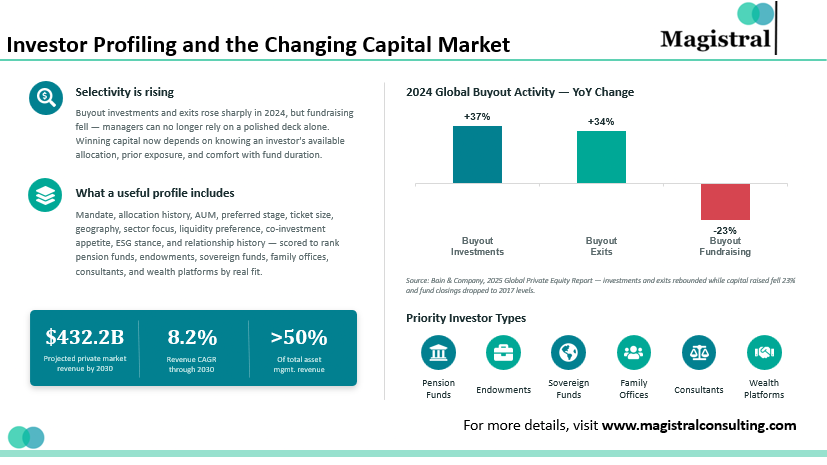
In private markets, raising capital is no longer a game of sending the same story to a long list of names and hoping a few meetings appear. Allocators have become more selective, fundraising cycles have stretched, and managers face tougher scrutiny on fees, reporting depth, and strategic differentiation. That is exactly why Investor Profiling has moved from a useful research exercise to a core commercial capability. When done well, it helps firms identify who is most likely to invest, what those investors care about, and how the message should be framed for each audience. The result is not just more conversations. It is better conversations, shorter learning cycles, and a far more disciplined route to capital.

Why Investor Profiling Matters in a Crowded Capital Market

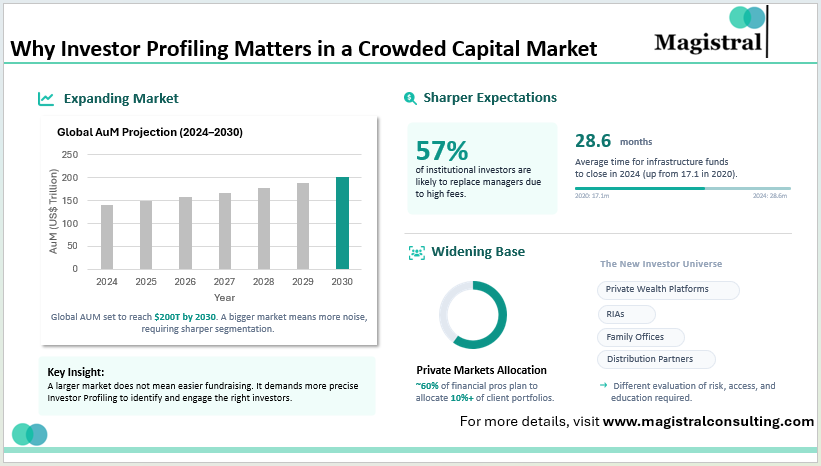
Investor profiling is important as it recognizes that the capital pool is increasing, yet the route to it is becoming more crowded and more challenging. No longer does a larger capital pool automatically imply that fundraising will get easier.

Why Investor Profiling Matters in a Crowded Capital Market

Why Investor Profiling Matters in a Crowded Capital Market

Bigger markets do not automatically mean easier fundraising

PwC forecasts that global assets under management are expected to increase from US$139 trillion in 2024 to US$200 trillion in 2030. Meanwhile, private markets revenues are expected to surpass US$432 billion, with more than half of that revenue coming from private markets by the end of the decade. That is a huge capital pool to access, yet it also represents a larger number of managers, a wider variety of products, and a more competitive environment. In this environment, it is no longer about building the biggest possible list of investors to approach; it is about having a sharper profile of investors. Firms that are currently engaged in capital raising need to have a sharper profile of investors long before they send out their first email.

Investors are demanding more value for every basis point

It’s increasingly difficult to ignore fee sensitivity. In fact, PwC found that 57% of institutional investors are likely or very likely to switch managers based on high fees. That’s a game-changer. The pitch no longer just hinges on a manager’s reputation, brand, or relationships. It’s no longer sufficient for a pitch to be well-received unless there’s a strong connection to a prospect’s mandate, liquidity, return, portfolio gaps, and reporting. Investor profiling is no longer demographic-based; it’s investable-based.

Private wealth is widening the opportunity set

The universe of investors is expanding, too. Hamilton Lane found that almost 60% of financial professionals planned to invest at least 10% of their clients’ portfolios in private markets in 2025, with 30% planning allocations of at least 20%. Why does this matter? The universe of investor profiling has changed. RIAs, private wealth platforms, family offices, and distribution partners are now part of the universe alongside pensions and endowments. Each segment has its own approach to risk, access, education, and communication. Therefore, the approach to communicating with investors must change.

The cost of getting it wrong is usually hidden

A poor target list does not often crash and burn in an explosive moment of truth. Rather, it stagnates over months because of low response rates, sluggish feedback, and a series of messaging resets, not to mention internal confusion about where the real demand is. Sometimes, a team might think it has a storytelling issue when it really has a matching issue. And this is important. Because if the wrong allocators are in the funnel, no amount of great presentation or an excellent track record will help.
Even a sector-specific fundraiser, such as infrastructure funds closed in 2024, highlights how deliberate the market is becoming. Infrastructure funds closed in 2024 took an average of 28.6 months on the road, up from 17.1 months in 2020. Although this is sector-specific, it is telling nonetheless. Managers need better qualifications, better prioritization, and better timing if they want the fundraising process to be purposeful.

Building an Investor Profiling Framework That Actually Works

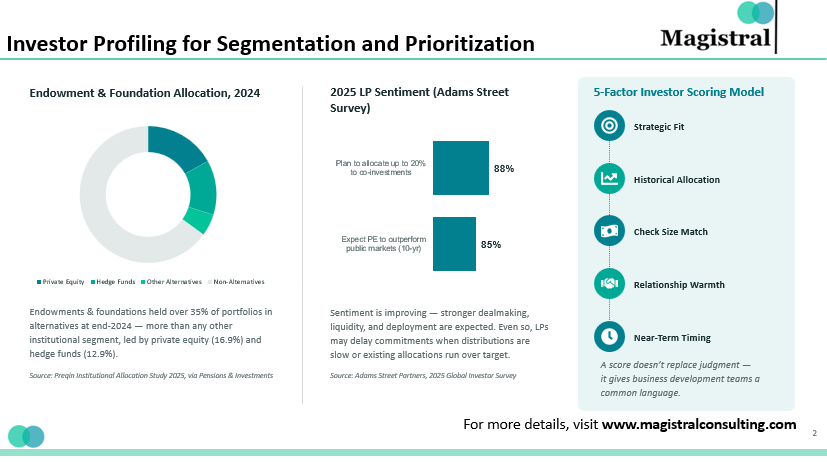
Investor profiling should be viewed as a dynamic investment process rather than a one-time data collection effort. It begins with assessing objective criteria like strategy preferences and ticket sizes to focus on a smaller, higher-quality pool of potential investors. Incorporating behavioral insights, such as past commitments and engagement patterns, helps distinguish active investors from passive ones. A well-defined group of investors often yields better outcomes than a larger, less understood one. While technology can aid in data analysis, it cannot replace the need for interpreting investor alignment and intent. Continuous feedback should be utilized to refine the investor universe and narrative, creating a more adaptive fundraising model.

The real edge comes from the context, not the size. A smaller but well-understood universe of investors may often be more beneficial in terms of outcomes compared to a large but undefined universe of investors. Although technology and artificial intelligence can speed up data analysis and pattern detection, they are still not a replacement for interpreting alignment and intent. Most organizations are using technology in a very basic sense, which again brings us back to interpreting.

It is also very important to note that the investor profiling should be a dynamic system. Each touchpoint, whether it be feedback on ticket size, strategy fit, or messaging, should be used to continually enhance both the universe of investors and the narrative around investors. This will, in effect, build a much more adaptive and intelligent model of fundraising.

Managers with large ticket capacity should not receive the same approach as a family office exploring niche co-investment opportunities. At this stage, the goal is to reduce noise. A smaller list with high-probability names is usually worth more than a massive database with weak alignment.

Investor Profiling Across Different Investor Segments

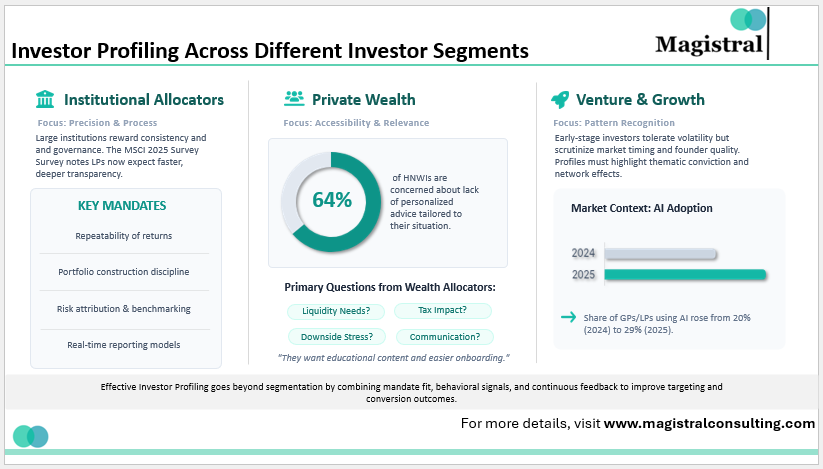
Investor Profiling is most valuable when firms recognize that capital is not necessarily homogeneous in behavior. Different investor classes have different investment narratives, different risk profiles, and different investment timeframes.

Investor Profiling Across Different Investor Segments

Investor Profiling Across Different Investor Segments

Institutional allocators want precision and process

For example, the MSCI 2025 General Partner Survey found that LPs are allocating more capital, but also expect faster and deeper transparency, with increasing demands for benchmarking, risk attribution, and real-time reporting. For example, for a manager looking to reach pension or sovereign wealth institutions, it is not just about demonstrating a track record; it is about demonstrating repeatability, portfolio management discipline, and a reporting structure that can withstand scrutiny

Family offices and wealth channels want accessibility and relevance

For instance, Capgemini found that more than 64% of HNWIs expressed concern about a lack of personalized advice tailored to their financial situation.
It is not just about making their messaging more friendly or approachable; it is about creating context for their investment strategy.
It is about creating context for their investment strategy and explaining to them how this investment strategy can help them meet their liquidity needs, tax concerns, portfolio concentration, and long-term family goals.

What these investors often ask first

Some private wealth allocators tend to start with basic yet insightful questions. How much capital is likely to be drawn down, and when? What does the downside look like in a stressful scenario? How concentrated is this manager’s portfolio? How regular will updates be? And are those updates likely to be understandable to non-specialist stakeholders? A good target profile should answer these questions in advance of the first meeting, which makes for a more relevant conversation than a rehearsed one.

Venture and growth investors respond to pattern recognition

For venture and growth investors, their assessment of opportunities is likely to be different from that of those in other asset classes. A manager who is familiar with venture capital culture is likely to have to demonstrate their preference for stage, geography, sector, cash reserves, and even network effects. A name that sounds good on paper is not necessarily good in practice if this investor prefers direct deals, dislikes crowded spaces, or is overinvested in a similar space to begin with.

Sector context can reshape the target map

Managers often overlook the reality that investors’ interests will be shaped by what is going on in the market. 2025 will see an expansion of alternative strategies and the integration of AI in sales and distribution for companies. It’s reported that in 2025, 29% of GPs and LPs using AI in their processes increased from 20% in 2024. This further indicates how strategies are becoming more nuanced, which will impact how investors who are comfortable with innovation, those who prefer traditional categories, and those who need further education will be considered.

How Magistral Strengthens Investor Profiling for Fundraisers

Investor profiling is most effective when research, structured data, and execution are combined, with operational support aiding lean teams in achieving institutional-quality coverage. Magistral enhances this process by creating a targeted investor universe through mandate mapping, strategy alignment, ticket sizing, and prioritization, enabling firms to focus on high-potential prospects. Segmentation of investor lists facilitates effective outreach strategies, while ongoing support in meeting preparation, tracking, and feedback analysis fosters continuous improvement. This comprehensive approach strengthens the connection between strategy, message, and execution, ultimately leading to better investor relationships.

About Magistral Consulting

Magistral Consulting has helped multiple funds and companies in outsourcing operations activities. It has service offerings for Private Equity, Venture Capital, Family Offices, Investment Banks, Asset Managers, Hedge Funds, Financial Consultants, Real Estate, REITs, RE funds, Corporates, and Portfolio companies. Its functional expertise is around Deal origination, Deal Execution, Due Diligence, Financial Modelling, Portfolio Management, and Equity Research

For setting up an appointment with a Magistral representative visit www.magistralconsulting.com/contact

About the Author

Tanya is an investment-research specialist with 6 + years advising venture-capital, private-equity and lending clients worldwide. A Stanford Seed alumnus with an MBA and an Economics (Hons) degree, she heads project teams at Magistral Consulting, delivering financial modelling, due-diligence and deal support on 3,000 + mandates. Her blend of rigorous analytics, sharp project management and clear client communication turns complex data into actionable investment insight.

FAQs

What is the main purpose of investor targeting in fundraising?

Its purpose is to identify the investors most likely to match a strategy, ticket size, geography, and return profile so outreach becomes more relevant and efficient.

How is a strong investor profile different from a contact list?

A contact list gives names and details. A strong profile adds mandate fit, behavioral signals, likely objections, and communication preferences.

Why are behavioral signals important?

Recent commitments, allocation shifts, and response patterns often reveal intent more clearly than static data points such as size or location.

Can smaller fund managers benefit from structured profiling?

Yes. In fact, smaller managers often benefit the most because focused targeting helps them use time and resources more efficiently.

Where does technology help the most in this process?

It helps with data cleaning, pattern detection, prioritization, and workflow tracking. Human judgment is still essential when interpreting fit and deciding outreach strategy.

Introduction          

An Investor Profiling summarizes an investor’s financial goals, situation, time horizon, and risk tolerance. It can assist individuals in making appropriate investment decisions. How much risk one should be willing to assume is determined by an investor profile. For example, a more conservative portfolio may be suitable if someone needs to preserve their money and have a short time horizon. If someone wants to expand their monetary liquid asset (cash) and has a longer time horizon, a more aggressive equity-based portfolio may be appropriate. The most essential quality of an investor is temperament, not intellect quoted to Warren Buffett.

The first step in creating a wealth plan is to analyze the ability to take financial risks. Risk tolerance is determined by duties, objectives, personality, and various other factors. A risk profile is created to accurately understand an individual’s ability to assume financial risk as part of their investment portfolio. There are two crucial components of an investor’s profile:  risk appetite and risk tolerance. Risk tolerance is the amount of risk that a person’s finances can endure, whereas risk appetite is the amount of risk that a person is willing to take.

Importance of Investor Profiling

Risk Profiling is vital for an investor. Before investing in the market, one thing which usually troubles every investor is risk. People are concerned about losing their investment capital or receiving less than expected returns; nevertheless, the risk is generally a mathematical figure, such as volatility, that can directly impact your investment capital.

Each investor’s tolerance for market volatility will be different. This disparity is caused by various variables such as income, obligations, age, etc. The quantification of investor profiling is risk-carrying capability and capacity.

Investment decisions are made on the risk-reward trade-off that an investor is prepared to make in the face of precarious financial markets. It is critical to assess your financial position before making an investment. Take into account your financial goals, risk tolerance, and time horizon to help you determine the investments that are best for you.

Risk factors involved in Investor Profiling

The three major risk factors involved in investor profiling consist of Risk need, Risk-taking ability, and Behavioral loss tolerance.

Risk factors involved in Investor Profiling

Risk factors involved in Investor Profiling

Risk need

The amount of financial risk that someone, as an investor, can safely accept depends on their circumstances. An investor who may be short on funds during retirement and wants to sustain their monthly cash flow may need to take certain risks to achieve their end goal. As a result, risk requirement is about how much risk you “need to take” as an investor. This capability varies depending on their age and other things. For obvious reasons, the risk-taking capacity decreases as age increases. If someone has a target goal and can save according to that, then he will need an annual return. The rate of return will define how much risk one can need to achieve their target. During investor profiling, financial advisers must calculate realistic potential returns and market risk environment for all assets based on historical growth rates and the current market situation. Failure to accomplish a goal should motivate you to save more money or work for extended periods.

Risk-Taking ability

Risk Capacity refers to an investor’s ability to take risks given his existing and ongoing financial status. That is; his or her net worth in relation to liabilities, financial ambitions, and time horizon for investing. It has the potential to reduce exposure to growth assets. One such sub-factor is the investment horizon. For instance, if someone has five years to reach their objectives, one must invest in safer assets because growth assets have high short-term volatility. Risk capacity, or dealing with financial loss, might also influence risk-taking. In terms of liquidity, if the need for liquidity is low in the stage of capital accumulation, then the risk-taking ability is high and vice versa.

For example, if someone is receiving a pension or has a future income or assets to sustain, and their objective is not fulfilled, they have a higher risk-taking capacity than otherwise.

Behavioral Loss Tolerance

Behavioral Loss Tolerance defines an investor’s psychological capacity to cope with market swings. This covers the reactions and responses to various market conditions, such as a correction phase. Behavioral loss tolerance is measured by exams, interviews, and questionnaires and specifies the utmost uncertainty one can accept. The amount of awareness regarding items and their experience over market cycles is determined by financial knowledge and investor experience.

Higher ratings on these criteria imply that investors can progress to growth assets. Risk composure shows the likelihood of acting irrationally in response to a perceived crisis, leading to losses. A trigger-happy investor sells stocks at the first hint of a market drop, whereas the patient investor holds on.

A better investor profiling strategy is feasible when all three components are reconciled and linked together. The investor’s risk appetite cannot exceed the risk tolerance of the aim. Higher risk-taking capacity may be ignored when both the need and the behavioral loss tolerance are low. When risk-taking capacity and behavioral loss tolerance are Higher, a lesser risk needs may be dismissed.

Combining all of these factors yields a genuine risk profile, which should be used to establish a suitable asset allocation mix or strategy, which may require the assistance of a professional financial adviser.

Types of Investor Risk Profile

Conservative

The protection of capital is the main priority of the investor, and they are ready to take minimal risks in exchange for limited or poor profits. The possible asset allocation is equity of 0-10%.

Types of Investor Risk Profile

Types of Investor Risk Profile

Moderately conservative

The moderately conservative investors are ready to take on a little amount of risk in exchange for the possibility of long-term gains. The possible asset allocation is equity of 10 – 30%.

Moderate

Investors are willing to accept a moderate amount of risk in exchange for potentially larger long-term rewards. This type of risk profile is most secure for the investor. The possible asset allocation is equity of 40 – 60%.

Moderately aggressive

To maximize prospective profits over the medium to long term, investors are willing to take on a high level of risk. The probable asset allocation is equity of 70 – 90%. 

Aggressive

The investor is willing to take significant risks to maximize long-term prospective returns and is aware that a major portion of their cash may be lost. The possible asset allocation is equity of 90 – 100%.

Magistral’s Process for Investor Profiling

A risk profile indicates the level of risk that an individual is capable and willing to tolerate and accept. The risk profiling process usually starts with analyzing and discussing the investor’s circumstances and the goals the investments or portfolio should achieve.

Standard Process for Risk Profiling

Standard Process for Risk Profiling

Investors may have various purposes, they may never have thought about or stated their aims in this way before, and they may not be able to capture encapsulate in terms of quantity or time.

Magistral makes sure to entail and enumerate each and every detail related to the client’s needs, and risk considerations during the investor profiling. The process for investor profiling is as follows:

Define Goals

Here we understand what the goals of clients are, in both the short term and long term. Moreover, we also focus on the goals aligned with the current financial status. By having a broad picture, we can then pave the correct way in order to maneuver in the right direction.

Risk Profile Questionnaire

In order to understand the risk-bearing capacity and the willingness of the client to take risks, it is imperative to know the levels of risk exposure of the client. This is done by sending a “Risk profile Questionnaire” to the client. After, filling it out, our team of experts analyzes the questionnaire in order to ascertain the optimum risk exposure of the client.

Scoring the Questionnaire

By having the requisite filter channels, within each category of questions and taking into consideration of various factors, we score each level of questions in tandem with the client’s requirements.

Analyzing and Examining

Careful Scrutiny and analysis of the answers with respective weightage to the client’s needs. We make sure to understand the various needs of the client needs in order to make an optimum risk profile.

Summary Close

Careful Scrutiny and analysis of the answers with respective weightage to the client’s needs. We make sure to understand. While onboarding the client we also deliver a summary of the procedure and the rules of engagement with clients.

Conclusion

Investor profiling is required for determining the optimal investment asset allocation for a portfolio. Because risk appetite is influenced by psychological characteristics, loss-bearing ability, investor age, income and costs, and other factors, each person has a unique risk profile.

Magistral consulting can help you complete a quick risk assessment to determine which risk group you belong to. We can perform the entire investor profiling process and then use this information to determine what percentage of your portfolio should be invested in which asset class.

Why Magistral consulting?

-We provide an exhaustive investor database which is helpful in finding the right kind of investor and beneficial in filtering out the information in concurrence with the existing market scenario and also providing tailor-made support in tandem with client requirements.

-Magistral consulting ensures analyst support at every step of Investor profiling. We have a dedicated team of experts for handling respective operations. In accordance to the client’s demands and specifications, we offer customized services. Considering various stakeholders’ concerns and implementing their diverse proposals.

-We provide a service of target company profiling. It is crucial for us to meet the specific  expectations of our customers by recognizing their requirements.

-It also provides Marketing and Communication support. We have a proficient team having experience in a variety of sectors and indeed the ability to handle different tasks effectively. We make sure to understand each and every client’s needs in a comprehensive manner and provide tailor-made services in an efficient manner.

About Magistral consulting

Magistral Consulting has helped multiple funds and companies in outsourcing operations activities. It has service offerings for Private Equity, Venture Capital, Family OfficesInvestment BanksAsset Managers, Hedge Funds, Financial Consultants, Real Estate, REITs, RE fundsCorporates and Portfolio companies. Its functional expertise is around Deal originationDeal Execution, Due Diligence, Financial ModelingPortfolio Management and Equity Research.

For setting up an appointment with a Magistral representative visit www.magistralconsulting.com/contact

About the Author

The article is Authored by Marketing Department of Magistral Consulting. For any business inquiries, you could reach out to prabhash.choudhary@magistralconsulting.com