Tag Archives: Financial process outsourcing to India

Financial Process Outsourcing is becoming a strategic finance solution as organisations face rising reporting demands, regulatory complexity, talent shortages, and rapid AI adoption. This article examines the market’s growth, key adoption drivers, regional shifts, investment activity, and emerging opportunities shaping the FPO landscape in 2026 and beyond.

Why Financial Process Outsourcing Is Scaling Fast in 2026

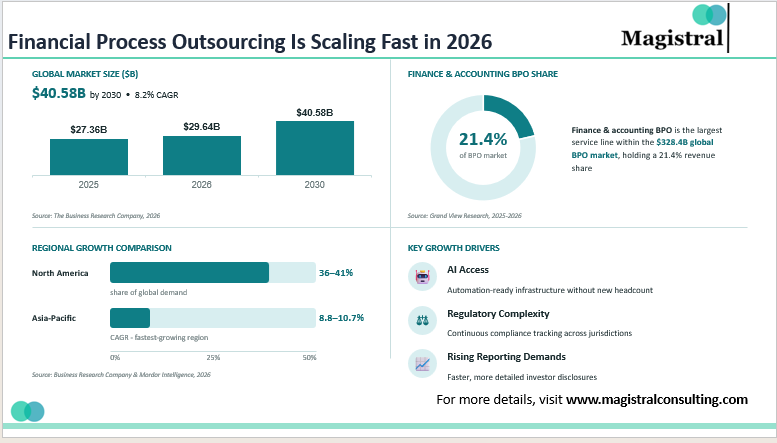
Financial Process Outsourcing is shifting from a cost-saving tactic to a core finance strategy worldwide. The global market reached $29.64B in 2026, up from $27.36B in 2025, growing at an 8.3% CAGR, and is expected to approach $40.58B by 2030. Growth is increasingly driven by AI access, regulatory complexity, and rising reporting demands. Alternative investment managers are outsourcing fund accounting, NAV calculation, and investor reporting to build institutional-grade infrastructure without adding permanent headcount.
Financial Process Outsourcing

Financial Process Outsourcing Is Scaling Fast in 2026

Financial Process Outsourcing Market Size and Growth Outlook

The financial process outsourcing market has moved past early-stage niche status into a multi-billion-dollar global category. Independent research houses differ on exact figures, but every major estimate points towards consistent, high-single-digit growth through the end of the decade.

Global Market Valuation and Compound Growth

The Business Research Company sizes the market at $29.64B in 2026, up 8.3% from $27.36B in 2025. The market is projected to grow at an 8.2% CAGR through 2030, reaching $40.58B. This growth signals structural rather than cyclical demand.

Finance and Accounting BPO as the Anchor Segment

Grand View Research values finance and accounting BPO at $70.2B in 2025, rising to $76.5B in 2026, with a 9.3% CAGR through 2033. Within the $328.4B global BPO market, it is the largest service line, holding a 21.4% revenue share.

Regional Growth Differentials

North America holds the largest share of financial process outsourcing, at 36%–41% of global demand. Asia-Pacific is growing fastest, with CAGRs of 8.8%–10.7%, as regional enterprises adopt outsourcing more aggressively.

Forecast Through 2030 and Beyond

Beyond the $40.58 billion 2030 estimate, Mordor Intelligence projects the wider finance and accounting outsourcing category reaching $85.92 billion by 2031. The spread reflects differing scope definitions, but the direction is unambiguous: the sector is compounding faster than professional services at large.

Key Drivers Behind Financial Process Outsourcing Adoption

AI adoption, mounting regulatory complexity, and thinly staffed internal finance teams are pushing more organisations towards providers that can supply both delivery scale and specialised technology.

AI and Automation Inside Finance Functions

Deloitte’s Q4 2025 CFO Signals survey found that 87% of CFOs expect AI to be extremely or very important to finance operations in 2026, while 63% of finance departments already use AI. 81% are adopting AI through outsourced providers, as specialised AI talent remains scarce internally.

Rising Regulatory and Reporting Complexity

The EU Corporate Sustainability Reporting Directive requires disclosure of ~1,100 data points across 50,000+ entities from 2026. With limited internal capacity, finance teams are increasingly relying on providers for compliance-adjacent services.

Rising Regulatory and Reporting Complexity

Forecasts for 2026–2030 highlight rising adoption among small and mid-sized enterprises, driven by cloud-based finance platforms. Lower entry costs are making outsourced finance accessible beyond large enterprises to leaner organisations.

Rising Regulatory and Reporting Complexity

Lean finance teams often face capacity gaps as fund structures become more complex. Side letters, waterfalls, and multi-currency vehicles are driving greater use of outsourced NAV calculation and financial process outsourcing to meet investor expectations.

Geographic Shifts Reshaping Financial Process Outsourcing Delivery

Delivery is consolidating around a small number of global hubs, with India extending its lead as capability centres move from transactional processing towards strategic ownership.
Financial Process Outsourcing

Geographic Shifts Reshaping FPO Delivery

India’s Expanding Global Capability Centre Footprint

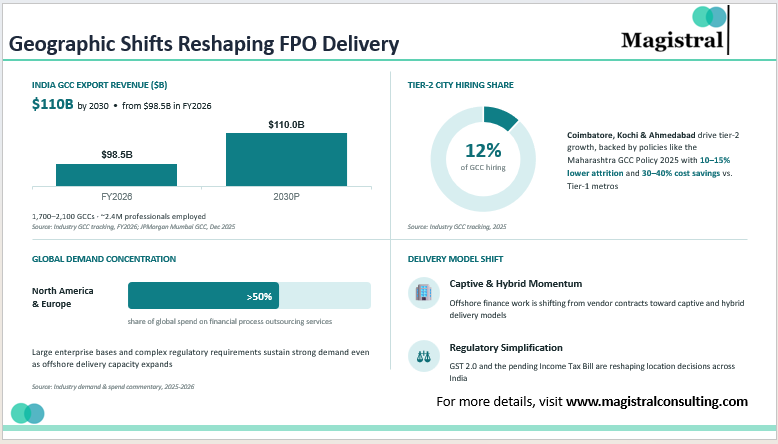
Industry tracking counts 1,700–2,100 GCCs in India, employing ~2.4M professionals and generating ~$98.5B in FY2026 exports, projected to reach $110B by 2030. JPMorgan Chase’s December 2025 plans for Asia’s largest GCC in Mumbai highlights India’s shift towards strategic infrastructure, beyond cost-driven back offices.

Tier-2 City Expansion

Coimbatore, Kochi, and Ahmedabad account for ~12% of GCC hiring, supported by policies like the Maharashtra GCC Policy 2025. Attrition is 10%–15% lower than Tier-1 metros, with 30%–40% talent-cost savings.

North America and Europe as Demand Centres

North America and Europe account for well over half of global spend on these services. Their large enterprise bases and complex regulatory requirements sustain strong demand. This remains true even as offshore delivery capacity expands.

Captive GCCs Versus Third-Party Vendors

Offshore finance work is shifting from vendor contracts to captive and hybrid models.
India’s regulatory simplification is supporting this transition.
GST 2.0 and the pending Income Tax Bill are influencing location decisions.

Investment and Deal Activity in Financial Process Outsourcing

Private capital is consolidating financial process outsourcing providers, favouring scale and AI-enabled delivery capability over simple headcount growth.

Private Equity Appetite for Services Platforms

Global M&A value reached $4.9T in 2025, up 37% YoY, with private-equity-backed transactions totaling ~$1.8T. This capital is increasingly flowing into business services and technology-enabled platforms. Finance and accounting providers with recurring revenue are benefiting from this trend.

Platform Buyouts and Scale as a Deal Thesis

PitchBook expects platform buyouts to reach at least 25% of private equity deals in 2026, with larger funds gaining share. In FPO, sponsors are consolidating smaller providers into scalable platforms to support AI investment and cross-selling.

Strategic Reviews Among Established Providers

Consolidation pressure is visible across established BPO players. Conduent explored a potential sale in early 2025 after attracting takeover interest, signalling continued strategic repositioning across the broader sector.

Emerging Opportunities and the Road Ahead for Financial Process Outsourcing

The next phase will be defined by ESG reporting demand, agentic AI, and closer integration with fund operations for alternative asset managers.

ESG and Sustainability Reporting Services

Providers are expanding financial close services into materiality assessment and carbon-footprint tracking as disclosure requirements grow. This turns compliance needs into a new outsourced service opportunity.

Agentic AI and Touchless Finance Operations

Providers are moving from AI copilots to agentic systems that automate complex finance workflows with limited human oversight. Deloitte is already applying these capabilities to tasks such as month-end close and vendor validation.

Institutional-Grade Reporting for Alternative Managers

Alternative investment managers are among the fastest adopters as reporting complexity outpaces internal capacity. Private credit, real estate, and venture funds increasingly use outsourced NAV calculation, fund administration, accounting, and financial modelling to deliver institutional-quality reporting without expanding permanent staff.

What This Means for CFOs and COOs

Financial process outsourcing is becoming a strategic infrastructure choice, enabling faster scaling, regulatory readiness, and AI adoption. Firms treating finance functions as core infrastructure can better compete for capital and talent.

Services Offered by Magistral Consulting for Financial Process Outsourcing

General Ledger & Accounting

End-to-end management of accounting activities, reconciliations, journal entries, and financial close processes to ensure accurate and timely books.

Financial Reporting & MIS

Preparation of financial reports, dashboards, and MIS to deliver clear, timely, and actionable insights for management.

Financial Planning & Analysis (FP&A)

Budgeting, forecasting, financial modelling, and variance analysis to support strategic planning and informed business decisions.

Cash Flow & Treasury Management

Cash-flow forecasting, liquidity monitoring, payment management, and treasury support to optimise working capital and cash utilisation.

Payroll & Expense Processing

Accurate processing of payroll, employee expenses, reimbursements, and related financial reconciliations while maintaining compliance.

Tax & Compliance Support

Preparation of financial data, tax reports, compliance documentation, and regulatory requirements to minimize financial and compliance risks.

Financial Data Management & Analytics

Collection, validation, analysis, and reporting of financial data to improve data quality, visibility, and decision-making.

Financial Controls & Quality Assurance

Implementation of financial controls, validation processes, and quality checks to enhance accuracy, consistency, and governance.


About Magistral Consulting

Magistral Consulting has helped multiple funds and companies in outsourcing operations activities. It has service offerings for Private Equity, Venture Capital, Family Offices, Investment Banks, Asset Managers, Hedge Funds, Financial Consultants, Real Estate, REITs, RE funds, Corporates, and Portfolio companies. Its functional expertise is around Deal origination, Deal Execution, Due Diligence, Financial Modelling, Portfolio Management, and Equity Research

For setting up an appointment with a Magistral representative visit www.magistralconsulting.com/contact

About the Author

Nitin is a Partner and Co-Founder at Magistral Consulting. He is a Stanford Seed MBA (Marketing) and electronics engineer with 19 + years at S&P Global and Evalueserve, leading research, analytics, and inside‑sales teams. An investment‑ and financial‑research specialist, he has delivered due‑diligence, fund‑administration, and market‑entry projects for clients worldwide. He now shapes Magistral Consulting’s strategic direction, oversees global operations, and drives business‑development support.


FAQs

What is financial process outsourcing?

Delegating finance and accounting functions such as bookkeeping, reconciliations, NAV calculation, and reporting to external specialists.

How large is the financial process outsourcing market in 2026?

The market is $29.64 billion in 2026, growing at 8.3% CAGR and projected to reach ~$40.58 billion by 2030, according to The Business Research Company.

Which regions lead financial process outsourcing delivery?

North America leads consumption at 36%–41% of global demand, while India leads delivery capacity and Asia-Pacific is the fastest-growing consumption region.

How is AI changing financial process outsourcing?

AI is shifting delivery towards automated workflows, with ~81% of finance functions adopting AI through outsourced providers.

Which functions benefit most from financial process outsourcing?

Fund accounting, NAV calculation, investor reporting, financial modelling, and compliance reporting, especially among alternative asset managers.


Introduction

Financial process outsourcing has been on the horizon of businesses for over a decade now. But there are a few trends that are making this process all the more strategic. It is not only about cutting costs, but having the right partner who could improve the processes, change culture, bring in the new talent and technology and make finance more predictive and proactive.

When it comes to Financial Process Outsourcing, the following trends are changing the landscape of the industry

Smaller and niche clients

Bigger players with a headcount of hundreds of thousands started taking advantage of outsourcing around a decade back. They are increasing it in terms of scale and complexity, however, the major volume is now going to come from smaller players as small as 1 or 2 men companies. Niche processes that are difficult to deliver on a turnkey basis also show promise.

Technology

Technology impacts all industries all the time. Financial process outsourcing is no exception. It has now moved from process outsourcing to process reengineering to automate steps and bring down the costs further and improve the operational efficiencies

Outcome-based offerings

Outcome-based offerings are still to take off but are on the horizon. It makes the vendor, your business partner where they are accountable for business results and not only delivering on the processes. Metrics related to a reduction in sales outstanding, operations costs, cycle time reductions, liquidity improvements, forecast accuracy are a few related to advisable business outcomes

Strategic importance

Outsourcing started as a low-cost low-value add jobs outsourcing. It still is to some extent. Firms are now outsourcing more strategic and high-value tasks. They actively outsource processes like budgeting, fundraising, and investor communications, in addition to routine accounting jobs.

Advantages of Financial Process Outsourcing

There are multiple reasons why outsourcing the financial processes is the best way of doing it. The reasons not only involve cost savings but a host of others that raise the operational standards of the client, whatever business they are in.

Magistral's Financial Process Outsourcing Advantages

Financial Process Outsourcing Advantages that Magistral Consulting Offers

These advantages are:

Cost

Of course, cost considerations here are tangible and very obvious. One dollar saved is a dollar earned. That is a saving that starts showing in the P&L as soon as you decide to outsource. You can normally expect to save 50–80%, depending on your location and the specific process you choose to outsource.

Flexibility

Apart from the absolute cost savings, there is a further scope of savings due to fractional resources. Fractional resources mean that you are not hiring anyone permanently but are tapping into the skill and experience of the resources only as and when required.

CFO outsourcing

CFO outsourcing or substantial outsourcing of strategic tasks is an emerging trend. This is all the more important for start-ups or funds that are small and can’t afford a full-time CFO.

Focus on core tasks

Outsourcing frees up the management and workforce bandwidth to focus on more strategic aspects of business and operations

Technology

Since the vendor has experience outsourcing similar processes for other clients, it can better recommend and implement technologies that reduce effort or improve turnaround time. The vendor achieves this by automating several tasks using Artificial Intelligence and machine learning algorithms.

Operational efficiency improvements

Outsourcing to an expert improves the operational efficiency of a process by multiple notches. Something like an increase in efficiency due to touchless processing, reductions in operations cost, and reduction in Day Sales Outstanding (DSOs) are very typical operational outcomes of outsourcing

Improved plan compliance and making finance more predictive

With tools like dynamic real-time scenario planning, dashboards, visualization tools, data science and analytics, and on-demand reporting, it’s possible to make the finance function more predictive

Financial Process Outsourcing: What could be outsourced?

Financial processes that are low value add and not strategic could of course be outsourced. Now added onto transactional outsourcing is the strategic outsourcing elements that require specialist interventions. The activities that could be successfully outsourced are:

Bookkeeping and back-office support

Organizations have consistently used activities like account reconciliations, deferred revenues, customer billing and payments, expense processing, managing the general ledger, financial and tax reporting, currency consolidation, payroll services, and vendor invoicing to reduce costs and enhance operational quality.

Controller services

The services like audit reports, auditor facilitation, compliances, MIS, dashboards, etc form the backbone of outsourcing here

Financial Planning and Analysis (FP&A)

This is the bulk of the planning and analysis aspects of the Finance function. This includes acquisition integration support, board reporting, financial data analysis, ratio analysis, comparative analysis with competition, financial research, along with planning, budgeting, and forecasting

Fundraising

This aspect requires a very specialist intervention. Here the offerings include pitch deck content and design support, investor reach-out, modeling and valuation, and investment bank’s selection

Mortgage process outsourcing

This is a specialist process of a lender whose critical elements could be successfully outsourced. These elements are marketing, loan origination data entry and analysis, underwriting documentation, background investigation, property assessment, accounting, financial checking, documentation checking, mortgage underwriting, and every other micro sub-steps required for the evaluation, underwriting, and approval of loans.

Magistral’s tried and tested process for outsourcing

Magistral has helped scores of clients in the financial industry and elsewhere in outsourcing operations. Magistral follows a customized and low-risk process for a smooth transition. The process puts business continuity and risk minimization at the center. Here are the major steps in offshoring that is proprietary and unique to Magistral:

Magistral's Financial Process Outsourcing Steps

The approach followed by Magistral Consulting for outsourcing financial processes

Project Kick-Off

There is a call with all the client stakeholders to understand their challenges and expectations from offshoring a process. Once the business imperative of offshoring is understood, a proposal for services is prepared. The proposal carries in detail the commercials, methodologies, KRAs and KPIs, project plans, and other details required for client management to take a call. Once the proposal is signed off the action begins.

SOP preparation

Before taking any project for delivery Magistral invests a great deal of time and expertise in preparing Standard Operating Procedure documents. For preparing SOP a trained analyst gets in touch with the client SPOC (Single Point of Contact) and by his skills in business analysis brings all the knowledge of people onto a process document. We call this “bringing what is between the ears onto the paper”. Every fine detail is captured. A Magistral SOP document would carry lots of process diagrams, tips for analysts, swim-lanes, along with audio and video recording of meetings and training. The whole of this process is done without any cost to the client. Clients first-hand see the expertise that Magistral brings to the table without any investment on their part. Once the SOP document is ready, the signoff about its accuracy is taken from the relevant personnel in management. Till this point client does not spend even a single penny and we are fine about it.

Business Reengineering

Once the detailed SOP is ready, business reengineering opportunities make themselves evident. We identify processes where Artificial Intelligence, Automation, and Machine Learning can reduce costs or improve turnaround time, and we share and validate these opportunities with the client.

Pilot Projects

Our proposals are always signed based on the projects or milestones that we deliver. It is never based on the number of people (FTEs) that we employ to deliver services. Normally vendors will charge for FTEs and then they will sit and undergo process training at the client’s expense. With Magistral, you only pay when we deliver the project or processes that meet your quality standards. We start with low volumes. Trainers get trained in the process. Coordination with the client is very close and done almost daily to fill any gaps in delivery and expectations. For bigger projects, an onsite analyst sits with the client for weeks and is responsible for business analysis and knowledge transfer.

SLA finalization

Many times, there are no Service Level Agreements decided for internal teams. We make sure we are accountable for everything we deliver and decide the SLAs of every process. These SLAs can be in terms of improvement in quality, turnaround time, analyst’s availability, prompt acknowledgment of requests, etc. With Magistral, if you have internal SLAs, we promise to beat that further with at least 20% improvements.

Process Stabilization

With SLA compliances meeting standards, we increase the scope and volume of work offshored.

The phased approach ensures the client is never too invested to back off. The process is also designed to give enough confidence to the clients to trust the expertise of Magistral.

About Magistral

Magistral Consulting has helped multiple funds and companies in outsourcing operations activities. It has service offerings for Private Equity, Venture Capital, Family Offices, Investment Banks, Asset Managers, Hedge Funds, Financial Consultants, Real Estate, REITs, RE funds, Corporates and Portfolio companies. Its functional expertise is around Deal origination, Deal Execution, Due Diligence, Financial Modeling, Portfolio Management and Equity Research

For setting up an appointment with a Magistral representative visit www.magistralconsulting.com/contact

About the Author

The Author, Prabhash Choudhary is the CEO of Magistral Consulting and can be reached at Prabhash.choudhary@magistralconsutling.com for any queries or business inquiries.