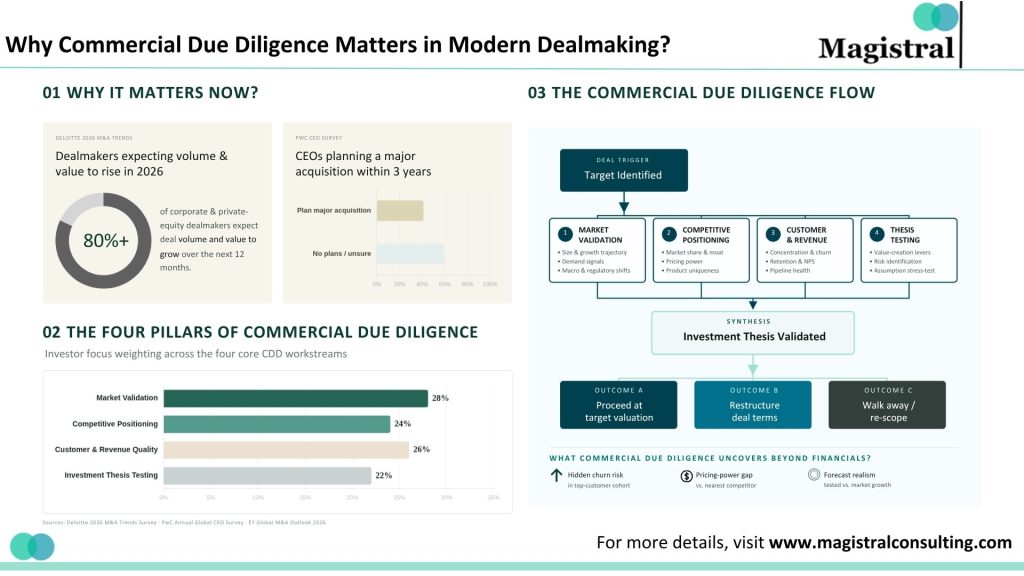
Commercial due diligence is a market-focused assessment that helps investors determine whether a deal is realistic, investable, and sustainable. It evaluates market size, customer demand, competition, pricing power, and growth potential beyond reported financial performance. Its importance has increased in 2026 as deal activity accelerates. According to Deloitte’s 2026 M&A Trends Survey, over 80% of corporate and private equity dealmakers expect deal volume and value to increase over the next year, while 41% of CEOs surveyed by PwC plan to pursue a major acquisition within the next three years. As a result, market validation, customer insights, and competitive analysis have become critical to investment decisions.
Thank you for reading this post, don't forget to subscribe!Why Commercial Due Diligence Matters in Modern Dealmaking?
Commercial due diligence validates whether a target company’s growth plans are supported by real market conditions. It helps investors assess if customer demand, competition, regulatory factors, and industry trends can realistically support the company’s projections.
Why Commercial Due Diligence Matters in Modern Dealmaking?
Market Validation
Commercial due diligence verifies whether a target’s growth projections are supported by actual market demand. Although EY estimates the global M&A value could reach US$3.8 trillion in 2026, strong deal activity alone does not guarantee a target’s success. Investors assess customer demand, market growth, and competitive dynamics to determine whether forecasts are achievable.
Competitive Positioning
A bigger market does not automatically mean winning. Investors look at market share, customer stickiness, pricing power, product uniqueness, and other strategic advantages. The goal is to see whether the company can hold its ground, or even strengthen it, inside the market.
Customer and Revenue Quality
Buyers evaluate how durable revenue is by looking at customer concentration, retention performance, churn patterns, satisfaction signals, and the pipeline’s health. This surfaces risks that may stay hidden when you only read financial statements, and it often changes valuation views, plus how the deal is structured.
Investment Thesis Testing
Each acquisition rests on beliefs about what comes next and how value will be created. Commercial due diligence tests those beliefs, helping investors confirm the opportunity, spot weak spots, and refine deal assumptions. It’s basically where an idea gets put under a sharper lens, before the transaction moves forward.
Key components of commercial due diligence
It combines market research, customer analysis, competitor benchmarking, business plan review, and scenario modeling to support valuation, negotiation, and value creation decisions.
Market attractiveness
Market attractiveness reviews market size, growth outlook, regulation, cyclicality, and profit pools. PwC’s 2026 M&A outlook reported that global deal values rose 36% in 2025, showing why buyers need sharper market screening before paying premium valuations.
Business plan assessment
Business plan assessment tests whether management forecasts are realistic. Buyers review revenue growth, pricing assumptions, customer acquisition costs, margin targets, and capital needs, then connect those findings with DCF modeling and downside scenarios.
Competitive benchmarking
Competitive benchmarking compares the target against direct and indirect competitors across pricing, product quality, brand strength, technology, and customer service. Bain’s 2026 M&A report highlights shifting profit pools, making competitor positioning a key diligence priority.
Risk identification
Risk identification covers customer concentration, pricing pressure, regulation, execution risk, and market volatility. Reuters reported that private equity firms held about US$1 trillion in unsold assets in 2025, which shows why buyers must avoid overpaying for growth that may not materialize.
How commercial due diligence helps both investors and companies
Commercial due diligence helps a lot, sort of before and after the deal, it strengthens decision-making by giving buyers a more solid picture of market risk, upside chances, and what matters most for growth.
For private equity investors
Private equity investors lean on it to choose, like, proceed, renegotiate, or step away, based on market scale, pricing leverage, and what value can realistically be created.
For strategic acquirers
Strategic acquirers use it to check the synergy story they are assuming, also customer pull, channel compatibility, brand overlap, and even integration risks, before they lock in capital.
For growth companies
Growth companies rely on it to uncover the hidden issues in pricing, audience segmentation, competitive behavior, and expansion plans, before they raise funds or before they enter a transaction.
For lenders and credit teams
Lenders apply it to judge demand steadiness, how concentrated the customer base is, how strong the competitive pressure really is, and which downside cases could hurt repayment capacity.
Commercial Due Diligence Best Practices for Stronger Outcomes
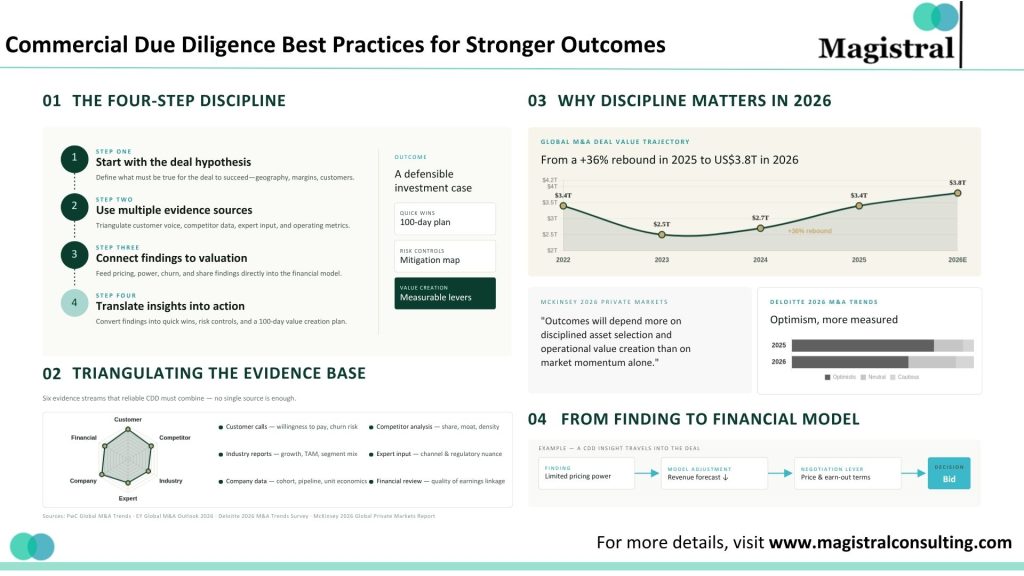
Commercial due diligence works best when teams begin with a clear deal hypothesis, then test it through customer evidence, competitor research, market reports, operating data, and valuation scenarios. In 2026, this discipline is especially important because PwC reported that global deal values rose 36% in 2025, driven by roughly 600 transactions above US$1 billion, while EY expects global M&A value to reach about US$3.8 trillion by the end of 2026. Deloitte’s 2026 M&A Trends Survey also shows that dealmakers remain optimistic, although expectations are more measured than in the previous year. Strong teams, therefore, focus less on broad market excitement and more on whether the target can win customers, protect pricing, grow profitably, and support the valuation case.
Commercial due diligence best practices for stronger outcomes
Start with the deal hypothesis
A focused process starts by defining what must be true for the deal to succeed. If the thesis depends on geographic expansion, the team should test local demand, competitor density, channel readiness, and pricing norms. If the thesis depends on margin improvement, it should test customer willingness to accept price increases, churn risk, and sales productivity.
Use multiple evidence sources
Reliable diligence should combine industry reports, customer calls, competitor analysis, expert input, company data, and financial review. McKinsey’s 2026 Global Private Markets Report states that outcomes will depend more on disciplined asset selection, operational value creation, AI adoption, liquidity, and risk management than on market momentum alone. That makes evidence-led diligence essential for avoiding weak assumptions.
Connect findings to valuation
Diligence findings should flow directly into the financial model. If customer research shows limited pricing power, the revenue forecast should be adjusted. If competitor analysis confirms a defensible niche, the valuation may support a stronger case. This link helps investment banking teams prepare better transaction materials, buyer responses, and negotiation arguments.
Translate insights into action
The final output should define what the buyer should do next. EY expects 2026 deal activity to remain supported by corporate growth strategies and private equity exit needs, so investors need reports that convert market findings into quick wins, risk controls, post-deal priorities, and measurable value creation plans.
How Magistral supports commercial due diligence
Magistral supports due diligence by merging market research, competitor mapping, customer intel, business plan validation, and financial analysis into one kind of workable decision framework, not too rigid. Our team helps investors size up the market, examine growth drivers, understand customer segments, review pricing trends, track regulatory developments, and gauge competitive intensity. It ties all that back to valuation through revenue bridge analysis, market share scenarios, sensitivity testing, downside case building, and deal-ready reporting. So, decision makers can translate what they found during diligence into investment committee materials, management questions, and post-deal priorities, with a more grounded sense of whether the target is a durable opportunity or just an attractive narrative.
About Magistral Consulting
Magistral Consulting has helped multiple funds and companies in outsourcing operations activities. It has service offerings for Private Equity, Venture Capital, Family Offices, Investment Banks, Asset Managers, Hedge Funds, Financial Consultants, Real Estate, REITs, RE funds, Corporates, and Portfolio companies. Its functional expertise is around Deal origination, Deal Execution, Due Diligence, Financial Modelling, Portfolio Management, and Equity Research
For setting up an appointment with a Magistral representative visit www.magistralconsulting.com/contact
About the Author

Aman is an investment-research specialist with 5+ years of experience across business and investment research, including 2+ years with Big Four firms like KPMG. A Stanford Seed alumnus with an MBA in Finance and a Bachelor of Commerce (Hons) from University of Delhi, he focuses on private equity, venture capital, and renewable energy sectors. He leads project teams at Magistral Consulting, delivering financial research, due diligence, deal sourcing, and M&A support, while driving strong process management and analytics. His blend of attention to detail, strategic thinking, and dynamic execution enables him to turn complex data into actionable investment insights.
FAQs
What is the main purpose of commercial due diligence?
How is it different from financial due diligence?
Who uses this process?
When should it be conducted?
What should a good report include?