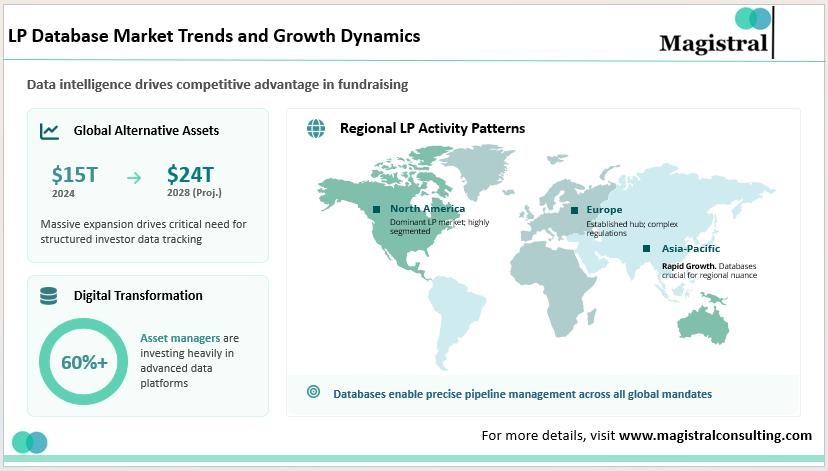
The LP Database has become an essential resource for investment firms that operate in a highly competitive fundraising environment. Structured data has become the primary tool through which firms discover and connect with their investors because capital markets grow and investor preferences shift. According to industry insights from Deloitte and Precedence Research, global alternative assets crossed $15 trillion in 2024, which expanded the investor universe. The Database evolved from a basic contact database into a vital business resource that enables firms to connect with investors based on their specific investment requirements, geographic location, and risk tolerance, which leads to better fundraising results.
Thank you for reading this post, don't forget to subscribe!LP Database Market Trends and Growth Dynamics
The market expands because alternative investments grow, which increases the requirement for improved investor intelligence capabilities. reference
LP Database Market Trends and Growth Dynamics
Expansion of Alternative Investments and LP Demand
The expansion of alternative investments leads to increased demand for LP services. The demand for structured investor data increases because private equity and venture capital businesses expand their operations. PwC projects that alternative assets will reach nearly $24 trillion by 2028, which creates essential requirements for the database solutions that track global investor activities.
Digital Transformation in Investor Data Management
The Database transforms into a predictive and strategic tool through the continuous implementation of analytics and AI tools by firms, which Deloitte researchers found to show that 60 percent of asset managers dedicate resources toward data platform development.
Regional Growth Patterns in LP Activity
The LP activity in North America and Europe shows dominance, but Asia Pacific experiences rapid growth, which an LP Database enables companies to use for the successful management of regional investor customs and regulatory requirements.
Integration with Fundraising Strategies
The Database provides firms with tools for capital raising, which lets them track and manage their development process through different stages.
LP Database Role in Investor Targeting and Capital Allocation
It improves investor identification and enables better capital distribution through its organized analytical findings.
Understanding Investor Preferences
The database captures ticket size and sector focus as fundamental variables that enable firms to identify suitable investors and enhance their chances of success.
Enhancing Relationship Management
The system consolidates all investor contact details together with their complete interaction records, which helps organizations develop strong partnerships that last over time.
Data-Driven Capital Allocation Decisions
Fundraising success rates increase when organizations use data to drive their fundraising efforts, according to McKinsey research, which shows that this database provides current investor data for this purpose.
Improving Fundraising Efficiency
The Database uses automation to reduce manual tasks while enabling companies to dedicate their resources to essential activities, such as building connections with investors throughout their fundraising periods.
LP Database Technology and Data Analytics Evolution
Technological advancements have transformed the Database into a dynamic platform powered by analytics and automation.
Adoption of Artificial Intelligence in Databases
The process of using Artificial Intelligence with database systems has become an established practice. AI enables predictive insights by analysing investor behaviour, helping firms prioritize outreach and improve fundraising efficiency.
Automation and Workflow Integration
The process of automation, together with workflow automation, creates efficient business operations that enhance productivity through automated processes.
Data Quality and Accuracy Challenges
Organizations face difficulties in maintaining data quality because they need to keep their information accurate while their data systems require regular updates.
Cybersecurity and Compliance Considerations
Companies guard their investor information through heightened security measures because they need to protect confidential data, which results in 70 percent of financial institutions adopting cybersecurity solutions, according to Deloitte.
LP Database Strategies and Best Practices for Firms
The strategic implementation of a database will deliver maximum advantages through enhanced data quality and improved investor segmentation, which supports the organization’s fundraising objectives.
Building a Comprehensive Database Framework
The use of a structured database system that includes standardized fields will enhance system accessibility while maintaining uniformity in investor data handling across multiple departments.
Leveraging Data for Strategic Insights
Analytics tools help convert data into actionable insights, which enable firms to refine their fundraising strategies while achieving better targeting results.
Aligning Database Use with Fundraising Goals
The organization can improve its operational success through LP Database implementation when business objectives are established.
Continuous Data Maintenance and Updates
The database maintains its accuracy through regular updates, which include data validation processes that ensure current market conditions are properly reflected in the database.
What Emerging Managers Really Need from an LP Database?
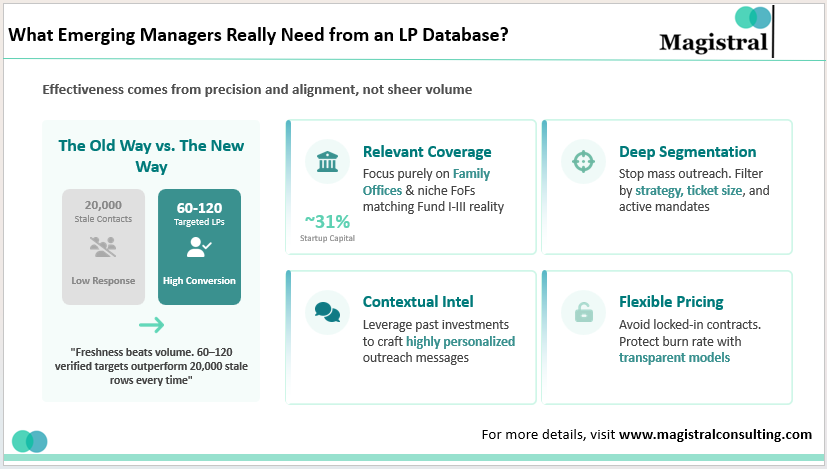
The common belief among emerging fund managers states that their fundraising success will improve when they access larger databases. The industry proves that successful fundraising requires organizations to focus on specific objectives rather than increasing their database size. The research conducted by Altss and PitchBook shows that investor outreach to 60 to 120 qualified investors produces better results than contacting 20,000 unfiltered contacts. The research shows that focused LP Database strategies produce better and quicker fundraising outcomes.
What Emerging Managers Really Need from an LP Database?
Coverage That Matches Fund Reality
The Database needs to show actual funding patterns because early funds receive their primary funding from family offices and smaller institutions, which provide 31 percent of their total capital.
Freshness Over Volume of Data
Organizations value current, accurate information more than extensive data collections because outdated contact information leads to lower response rates, while smaller verified datasets deliver better fundraising outcomes.
Segmentation Instead of Mass Outreach
Investor targeting becomes more efficient when organizations filter investors according to their investment strategy, geographic location, and preferred ticket size because targeted lists perform better than unsegmented outreach methods.
Context that Strengthens Investor Communication
The evaluation of historical investments together with current market positioning enables the creation of custom communication methods, which result in better investor interaction than standard outreach methods.
Transparent and Flexible Pricing Models
Emerging managers face strict budget limits, which force them to select tools based on their pricing details because hidden costs, together with inflexible contracts, will restrict their ability to operate freely. Industry guidance highlights that flexible and transparent pricing models help managers control burn while still accessing high-quality Database capabilities.
LP Database Support from Magistral Consulting
Magistral Consulting assists firms in developing and sustaining high-quality LP Databases through its unified approach, which combines data research with verification and analytics to enhance investor targeting and capital raising processes.
About Magistral Consulting
Magistral Consulting has helped multiple funds and companies in outsourcing operations activities. It has service offerings for Private Equity, Venture Capital, Family Offices, Investment Banks, Asset Managers, Hedge Funds, Financial Consultants, Real Estate, REITs, RE funds, Corporates, and Portfolio companies. Its functional expertise is around Deal origination, Deal Execution, Due Diligence, Financial Modelling, Portfolio Management, and Equity Research
For setting up an appointment with a Magistral representative visit www.magistralconsulting.com/contact
About the Author

Tanya is an investment-research specialist with 6 + years advising venture-capital, private-equity and lending clients worldwide. A Stanford Seed alumnus with an MBA and an Economics (Hons) degree, she heads project teams at Magistral Consulting, delivering financial modelling, due-diligence and deal support on 3,000 + mandates. Her blend of rigorous analytics, sharp project management and clear client communication turns complex data into actionable investment insight.
FAQs
Why is an LP Database important?
How does technology impact the LP Database?
What challenges exist in LP Database management?
How can firms improve LP Database performance?