Sell-side research has maintained a critical position in the dynamics of financial markets, acting as an intermediary tool that connects companies, investors, and capital markets. Fundamentally, it is associated with providing equity reports, forecasts, and recommendations that will serve as a basis for making investment decisions. Today, when everything works at high speed, and there is always real-time information available, research for the sell-side becomes an essential component for any company. For instance, Deloitte estimates that most institutional investors depend on external research. In modern conditions, firms seek a combination of human work and technological solutions to deliver relevant results to clients.
Thank you for reading this post, don't forget to subscribe!Sell-Side Research: Market Size & Growth Drivers
A market for research is constantly growing, together with general capital markets, owing to an increased number of investments, cross-border trades, and the need to have real-time data. Although it forms part of a wider financial analytics industry and capital markets, it develops similarly to these areas. In addition, the last ten years were significant in terms of regulatory and technological changes.
Global Financial Analytics Market Expansion
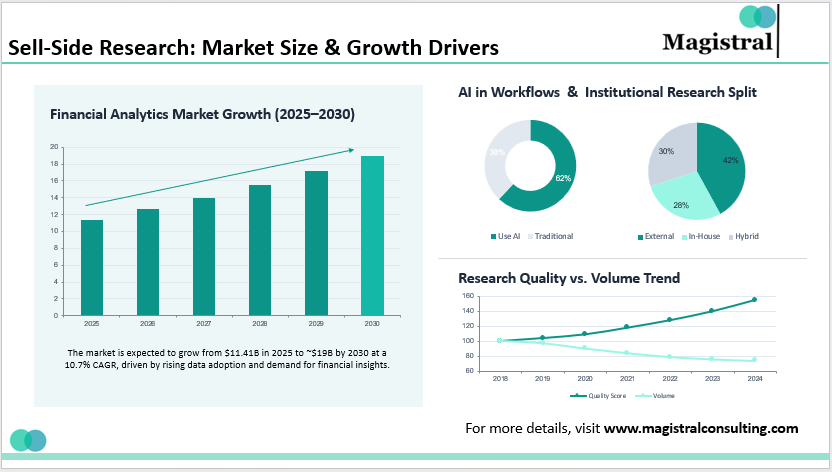
The financial analytics market, which drives the operations of research, has witnessed steady growth for the last several years. The market is expected to grow from $11.41B in 2025 to approximately $19B by 2030 at a 10.7% CAGR, driven by rising data adoption and demand for financial insights. The growth rate stems from the increased focus on data-driven decisions across investment banks.
With an increasing amount of both structured and unstructured data being processed, research organizations are increasingly enhancing their ability to conduct analytics. In this regard, macroeconomic, company, and alternative data are increasingly incorporated in research products generated by research companies(sell-side). Artificial intelligence and automation processes continue to fuel the trend, as evidenced by the findings that over 60% of financial institutions now leverage artificial intelligence in research.
Growth in Global Capital Markets Activity
The demand for sell-side research is directly tied to market activities. Insights from MSCI indicate that the level of activity in the global financial markets in terms of equity and bond trading is strong in spite of volatility in the macroeconomic environment.
As more capital is channeled into the global financial markets through the institutional route, there will be an increase in demand for it. Investors require constant analysis in different sectors, regions, and asset classes in order to ensure diversification of their investment portfolio.
Institutional Dependence on External Research
The development of in-house research departments does not decrease the demand for the external research on the sell-side. In fact, according to research, 70 percent of institutional investors still use research firms for their investments.
There are several reasons why institutions cannot fully rely on internal resources. First, third-party research gives the opportunity to study more markets globally. Second, it provides independent insights and ideas. Third, it allows for the scaling of the department without spending much on additional employees. It should be mentioned that the regulations of the financial industry, such as MiFID II made it necessary for firms to provide insights and valuable information.
Impact of Emerging Markets on Research Demand
Emerging markets become the key driver for the development of the sell-side research market segment. Investors tend to pay more attention to the Asia Pacific and the Middle East due to the higher growth rates of these countries. Reports show that emerging markets make up a larger share of investments than before. According to the MSCI report, the number of emerging market stocks has increased.
Shift Toward Specialized and Premium Research
A critical factor influencing the growth rate is the move towards premium research from volume-based research. In light of the MiFID II regulations, research expenditure budgets have turned restrictive, leading to an overall reduction in the number of research firms that are contracted for research purposes.
Sell-side research firms are now being compelled to provide premium research insights based on unique perspectives. There has been a growing emphasis on providing client-oriented insights due to the increasing expectation for customized research products on the part of institutional clients. While the number of research reports may be lower, the level of insight provided is considerably greater.
Key Components of Effective Sell-Side Research
For sell-side research to be effective, it requires an organized framework that includes financial modeling, industry experience, and clear communication. Each of these elements helps in building trust for the investors.
Sell-Side Research: Market Size & Growth Drivers
Financial Modeling and Valuation Techniques
Financial modeling plays an important role in calculating how a company performs and its intrinsic value. Models like discounted cash flow valuation and comparable analysis are used in research. Investors use the information from the models to gauge risk and return on investment.
Sector and Industry Analysis
An understanding of industries is key. Analysts analyze competition, regulations, and the macroeconomic environment. The information proves more useful in industries such as private equity. Here, transaction terms and cycles play a big part in determining results.
Company Specific Insights
Research on the sell-side goes deeper into understanding companies. Some of the areas analyzed include revenue, costs, and growth plans. In addition, sell-side research analyzes management capability and strategy.
Communication and Investor Engagement
Proper communication is essential. Research papers should convert information into useful findings. Also, analysts may involve themselves in direct communication with investors, which is of great help to sell-side research.
Role of Sell-Side Research in Investment Decision Making
The importance of sell-side research lies in its ability to shape investment decisions for both institutional and individual investors.
Supporting Institutional Investment Strategies
Institutions find sell-side research very helpful in designing their investment plans. Market insights can contribute greatly to proper decisions on asset allocation and other aspects. The relevance of this research to venture capital companies is notable.
Enhancing Market Efficiency
Market efficiency is improved through sell-side research due to the dissemination of information. The insights provided by the research help improve the price efficiency of securities.
Risk Assessment and Mitigation
There are several risks identified in research. These may include volatility risks, regulatory risks, and other risks that affect the firms. Through this, investors can make decisions to protect their investment.
Driving Capital Allocation Decisions
Research on the sell-side influences capital allocation decisions. This is because investors are motivated to invest in the securities that have been recommended. As such, this is closely related to capital raising in finance.
Technology & AI Adoption Data in Sell-Side Research
Technology is changing the way research is being done, shared, and used. Innovation and technology are transforming the research environment to enable fast and precise insights. reference
Technology & AI Adoption in Sell-Side Research
Rising Adoption of Artificial Intelligence
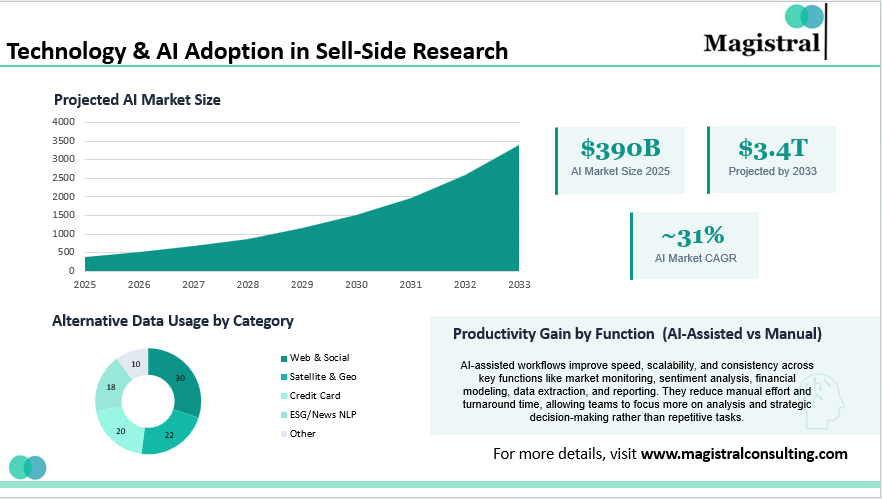
AI has become an integral part of research on the sell-side. According to an analysis of the financial services industry by 2025, over 60 percent of the financial services companies are utilizing AI in their research and analytics activities. The AI market is set for exponential expansion, growing from $390.91 billion in 2025 to over $3.4 trillion by 2033 at a CAGR of ~31%. This rapid growth is driven by widespread enterprise adoption, advancements in generative AI, and increasing integration of AI across industries. The trajectory highlights AI’s transition from an emerging technology to a core driver of global economic transformation.
AI systems are now able to analyze earnings calls, news sentiment, and other financial documents instantly. Analysts will be able to spend their time interpreting data and formulating strategies rather than gathering the data manually.
Productivity Gains from Automation
Automation has greatly increased analyst productivity. The McKinsey analysis suggests that advanced analytics and AI can increase productivity in research by 30 to 40 percent.
It allows sell-side research departments to have greater coverage of companies and sectors while maintaining the same level of personnel. In addition, it minimizes turnaround time and makes it possible for companies to offer their clients their insights within an extremely volatile environment.
Use of Alternative Data Sources
The sell-side research process is no longer confined to conventional methods of data collection. Alternative data sources, such as geolocation information, social media activity, and online behavior data, are increasingly used by researchers.
For instance, using satellite information to monitor the number of people visiting retailers offers valuable insights into a company’s operations. As per Deloitte, there has been an exponential increase in the use of alternative data in making investments by researchers.
Natural Language Processing and Sentiment Analysis
One of the significant benefits of natural language processing technology is its ability to analyze qualitative information. Machine learning algorithms can sift through thousands of pieces of information, including earnings reports and news articles, to determine sentiment.
The analysis enables researchers to find signals of what might happen in the future through qualitative data.
Cloud Computing and Data Infrastructure
The introduction of cloud computing has revolutionized the way research teams collect and analyze data. Through the use of cloud-based systems, organizations can easily store huge amounts of data and conduct sophisticated analysis.
There has been a significant increase in the use of cloud computing technology in the financial industry. This is because it enables companies to carry out their research efficiently when there is large-scale data processing involved.
Integration of AI with Human Expertise
In today’s world of advanced technology, human input is still crucial. The best research involves the combination of AI and human knowledge.
While technology assists in identifying patterns and trends, there is a need for people’s input to understand the outcome and develop strategies from there.
How Magistral Supports Sell-Side Research Excellence
Magistral supports the process of research by making use of analysis, expertise in different fields, and outsourcing services. Through the use of data analytics software, Magistral will make an analysis of the data to help researchers come up with insightful conclusions in a short while without any quality compromise. With affordable assistance provided, companies are able to improve their research skills without necessarily increasing their manpower, thus integrating them into their systems easily.
Magistral’s broad scope of expertise makes it possible for them to conduct thorough research, hence providing better perspectives regarding investments. Lastly, artificial intelligence and automation make sure that the delivery of research conclusions is made faster.
About Magistral Consulting
Magistral Consulting has helped multiple funds and companies in outsourcing operations activities. It has service offerings for Private Equity, Venture Capital, Family Offices, Investment Banks, Asset Managers, Hedge Funds, Financial Consultants, Real Estate, REITs, RE funds, Corporates, and Portfolio companies. Its functional expertise is around Deal origination, Deal Execution, Due Diligence, Financial Modelling, Portfolio Management, and Equity Research
For setting up an appointment with a Magistral representative visit www.magistralconsulting.com/contact
About the Author

Himank is an investment and financial analysis specialist with experience across private equity, investment banking, and research-driven engagements. An MBA (Tech) in Finance and BTech in Computer Science graduate from Narsee Monjee Institute of Management Studies, he focuses on financial modeling, valuation, and investment research. He supports project teams at Magistral Consulting, delivering LBO and DCF models, due diligence, investment memorandums, and deal origination support. His blend of analytical thinking, problem-solving ability, and structured approach enables him to translate complex financial data into actionable insights.
FAQs
What is Sell-Side Research?
Why is Sell-Side Research important?
How does Sell-Side Research differ from Buy-Side Research?
What tools are used in Sell-Side Research?
Can Sell-Side Research be outsourced?