Tag Archives: AI in equity research

Equity Research AI is transforming how financial analysts evaluate company performance and investment opportunities. Traditionally, equity research involved time-intensive analysis of financial statements, earnings transcripts, and market reports. Today, AI-powered systems automate much of this process, allowing analysts to focus more on strategic interpretation and decision-making. As financial markets become more complex and data-intensive, firms are increasingly adopting AI to improve efficiency and analytical depth. According to recent studies by McKinsey & Company and Deloitte, AI adoption across financial services accelerated significantly between 2023 and 2025, making AI a core component of modern equity research operations.

Equity Research AI Market Size and Growth

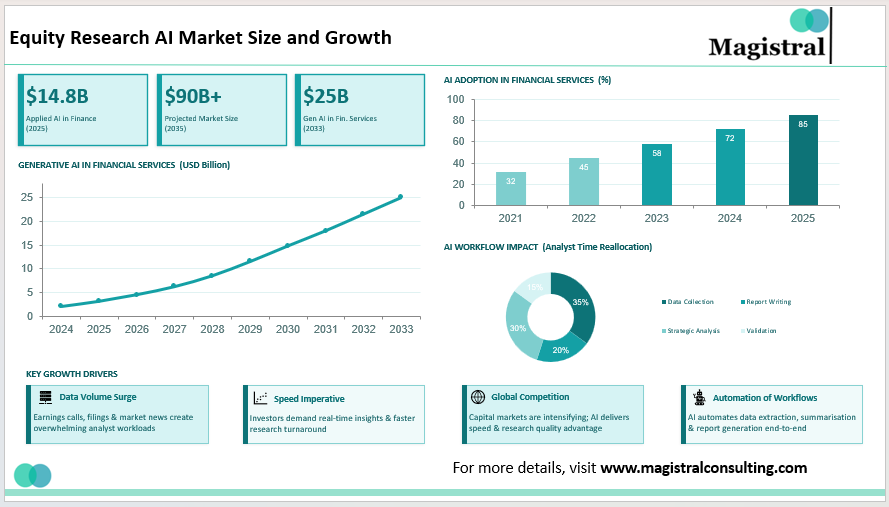
The entire market for Equity Research AI operates as a segment within the broader financial services artificial intelligence market, which has shown substantial progress in recent years. AI in the finance market was valued at around USD 14.8 billion in 2025, according to Precedence Research, and will continue to grow, surpassing USD 90 billion by 2035, corresponding to a compound annual growth rate of about 20 percent. The financial services industry is expected to experience annual growth rates above 30 percent for its generative AI technology, which will achieve a market value of approximately USD 25 billion by 2033, according to Grand View Research.
Equity Research AI Market Size and Growth

Equity Research AI Market Size and Growth

Drivers of Market Expansion

The primary driver behind this growth is the increasing volume of financial data that analysts must process. The combination of earnings calls and regulatory filings, together with market news, creates an overwhelming information load. The application of AI technology enables organizations to improve their workflows through automated data extraction and summary creation. The efficiencies provided by these systems enable large portfolio and funds management companies to track multiple assets throughout the day without interruption.

Role of Investment Demand

The Investment Demand functions at its core through the expectation that investors maintain toward market performance. The implementation of Equity Research AI technology by investment companies results from investor requirements for immediate access to market information, together with continuous market developments. The adoption of technologies that improve research capabilities will create a competitive edge for companies because global capital markets are becoming increasingly competitive.

Equity Research AI Adoption Across Financial Institutions

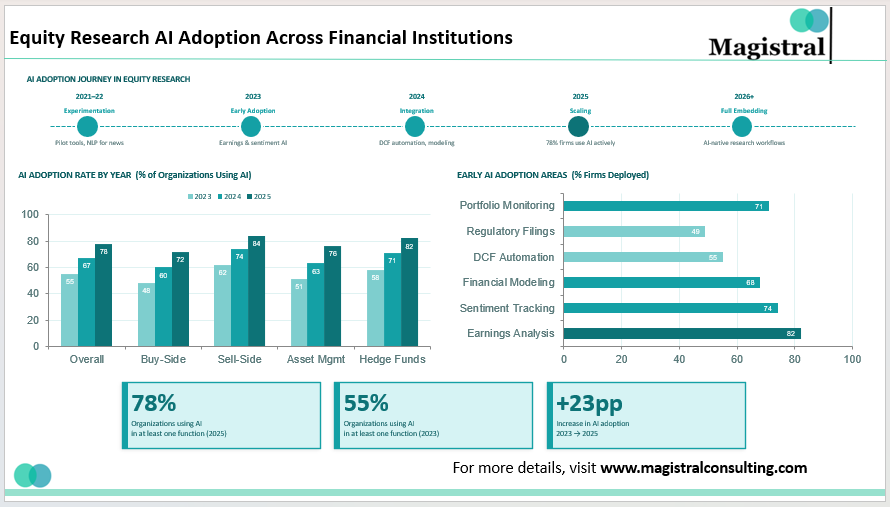
Equity Research AI is transforming how financial institutions analyze data, evaluate companies, and generate investment insights. The adoption journey began with basic automation tools for reviewing filings and earnings transcripts, but advances in machine learning and generative AI have turned these systems into intelligent research platforms. Initially adopted cautiously, AI usage expanded rapidly as firms faced growing data volumes and the need for faster analysis. According to McKinsey’s 2025 report, nearly 78 percent of organizations now use AI in at least one business function, compared with 55 percent in 2023, highlighting how AI has evolved from an experimental technology into a core capability for modern equity research. reference
Equity Research AI Adoption Across Financial Institutions

Equity Research AI Adoption Across Financial Institutions

Early Adoption Areas

The initial fields that saw widespread artificial intelligence adoption include earnings analysis, sentiment tracking, and financial modeling. AI tools can quickly analyze large volumes of earnings transcripts and highlight key insights such as revenue growth trends, margin pressures, and management outlook.

Integration with Valuation Models

AI also plays a role in improving valuation techniques, such as DCF. By automating data collection and forecasting inputs, AI enables analysts to concentrate on developing their assumptions and performing scenario analysis work instead of constructing new models from the beginning.

Challenges in Adoption

The process of adopting new technologies becomes difficult because it brings advantages to organizations yet requires them to deal with various implementation obstacles. Organizations need to solve three main problems, which include establishing data privacy standards, maintaining model accuracy, and making their systems work together with current platforms. Organizations need to train their analysts on how to use AI tools because this training helps them understand the results they produce.

Equity Research AI Use Cases and Applications

The implementation of this technology changes both research work and investment results. The technology can be used in various operational areas throughout financial organizations.

Earnings Call Analysis

AI tools can analyze earnings calls in real time to identify main topics and track shifts in public sentiment. This process enables analysts to rapidly comprehend management viewpoints, which they can use to modify their investment strategies.

Peer Comparison and Benchmarking

AI enables companies to assess their performance against competitors through various financial indicators, which include revenue growth, profitability, and valuation multiple metrics. The method proves essential for private equity companies because they require comparative assessments to make their investment choices.

Risk Monitoring and Compliance

AI systems monitor three main categories, which include regulatory updates, ESG factors, and geopolitical risk information to help organizations maintain compliance and stay updated. The capabilities function as vital components because agencies in charge of regulatory enforcement keep changing their requirements.

Portfolio Management Support

AI helps portfolio management by discovering market data trends and unusual patterns. The system enables investors to enhance their portfolio results through better decision-making processes.

Equity Research AI Benefits and Strategic Importance

There are many benefits to using AI for equity research, which allows researchers to perform their job more effectively and efficiently. Researchers will be able to produce more accurate research results promptly, thereby allowing better stock recommendations. Additionally, researchers will have the ability to better support and execute informed investment strategies through unbiased decision-making when using AI.

Increased Efficiency

By eliminating the amount of time it takes to gather and analyze financial data, AI allows equity research analysts to spend more time on higher-value activities.

Better Investor Communication

AI helps transform complex data into clear and concise insights, improving communication with investor stakeholders. This is essential for maintaining transparency and trust.

Equity Research AI Future Outlook and Industry Evolution

Equity Research AI will become a core component of financial research activities throughout the next decade. Financial institutions will benefit from expanded technological capabilities, which will emerge through ongoing technological advancements.

Emerging Trends

The main trends of the industry show how research teams will use three technologies, which include generative AI, real-time data analytics, and advanced predictive modeling. Research teams will gain better research capabilities through these technologies, which will help them achieve better investment results.

Best Practices for Implementation

Firms should adopt a phased approach to implementing AI, starting with basic applications and gradually expanding to more complex use cases. The method creates a secure process that helps organizations to protect their operations.

Role of Specialized Support

Magistral Consulting provides essential support to organizations that develop AI-powered research tools. Companies achieve maximum AI benefits through their financial analysis expertise and outsourcing services, which preserve accuracy and compliance standards. The research shows how equity research AI technology will change the current industry standards.

The evolution of Equity Research AI will create new methods for conducting financial analysis. Organizations that implement this technology will develop better skills to manage current financial market challenges while achieving long-term business development.

About Magistral Consulting

Magistral Consulting has helped multiple funds and companies in outsourcing operations activities. It has service offerings for Private Equity, Venture Capital, Family Offices, Investment Banks, Asset Managers, Hedge Funds, Financial Consultants, Real Estate, REITs, RE funds, Corporates, and Portfolio companies. Its functional expertise is around Deal origination, Deal Execution, Due Diligence, Financial Modelling, Portfolio Management, and Equity Research

For setting up an appointment with a Magistral representative visit www.magistralconsulting.com/contact

About the Author

Nitin is a Partner and Co-Founder at Magistral Consulting. He is a Stanford Seed MBA (Marketing) and electronics engineer with 19 + years at S&P Global and Evalueserve, leading research, analytics, and inside‑sales teams. An investment‑ and financial‑research specialist, he has delivered due‑diligence, fund‑administration, and market‑entry projects for clients worldwide. He now shapes Magistral Consulting’s strategic direction, oversees global operations, and drives business‑development support.
FAQs

How fast is the Equity Research AI market growing?

The market is growing rapidly, with projections indicating a CAGR of over 20% in the broader AI in finance sector and over 30% in generative AI applications.

What are the main use cases of Equity Research AI?

Key use cases include earnings analysis, peer comparison, risk monitoring, and portfolio management support.

Can Equity Research AI replace human analysts?

No, AI complements human analysts by automating repetitive tasks, but human judgment remains essential for decision-making.

What challenges are associated with Equity Research AI?

Challenges include data privacy concerns, model accuracy, integration with existing systems, and the need for skilled professionals to interpret AI outputs.

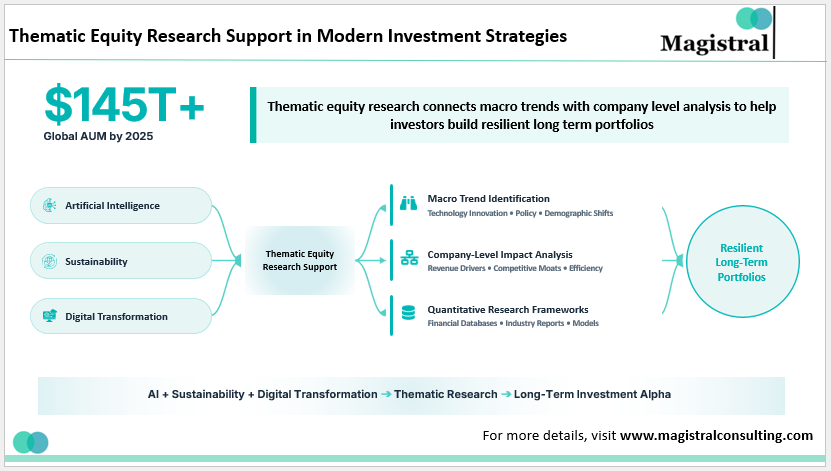
The global financial markets are undergoing major shifts driven by three structural trends: the rise of artificial intelligence, the push for sustainability, and rapid digital transformation. As a result, investors are moving beyond traditional sector‑based analysis and focusing instead on long‑horizon themes that shape industrial evolution and economic growth. This shift has increased the need for thematic equity research support, which helps asset managers interpret macroeconomic forces and convert them into actionable investment insights. According to PwC’s asset management outlook, global assets under management are expected to exceed $145 trillion by 2025, intensifying the demand for advanced research capabilities. Thematic research typically integrates three core approaches – industry analysis, financial modeling, and data‑driven analytics, to help investors identify emerging opportunities and build resilient long‑term portfolios.

Thematic Equity Research Support in Modern Investment Strategies

The financial markets require more detailed analysis, which goes beyond standard sector examination. Thematic equity research support helps investors identify structural trends and translate them into equity investment opportunities. Portfolio managers can use this method to match their investment choices with shifts that will occur over extended periods, enhancing their strategic outcomes through Thematic Equity Research Support.

Thematic Equity Research Support in Modern Investment Strategies

Thematic Equity Research Support in Modern Investment Strategies

Identifying structural market trends

Thematic investing begins with identifying macro trends that reshape industries. Analysts evaluate technological innovation, policy developments, and demographic changes to determine which themes could influence markets over the next decade. The insights help investors create their long-term investment plans.

Linking macro insights with company performance

Analysts link macroeconomic data to evaluate how it affects company performance. The process requires analysts to study how themes affect every individual company. Revenue drivers, competitive advantages, and operational efficiency need to be assessed through this process. Equity research AI serves as an advanced tool that enables analysts to handle extensive datasets while discovering patterns throughout different industries.

Data-driven research frameworks

Thematic analysis in modern research relies on quantitative data. Research teams evaluate companies through their financial databases, industry reports, and predictive models to identify organizations that will gain from upcoming trends. The structured method helps to establish more precise investment decisions.

Core Components of Thematic Equity Research Support

Thematic equity research needs effective research support because it requires research methods that use macroeconomic data together with company-specific information. The analysts create industry maps while they study market trends and build financial models to determine investment value.

Theme identification and market mapping

The first stage of this process requires analysts to identify the fundamental industry changes that create market direction. The analysts assess how technological progress, new regulations, and shifts in consumer preferences affect their research work. The research findings enable investors to identify which sectors will achieve sustainable development throughout the next few years.

Financial modeling and valuation analysis

The financial modeling process, together with the valuation analysis process the analysts create financial models for their selected companies, which they use to predict upcoming business results. Investors use DCF analysis together with other techniques to assess an asset’s value based on estimated future cash flow.

Competitive landscape assessment

Thematic investing requires investors to understand the complete scope of competitive market dynamics. The analysts assess market distribution and innovative development abilities, together with market entry obstacles, to identify organizations that maintain long-lasting market dominance.

Technology is transforming Thematic Equity Research Support

Thematic equity research support uses advanced analytics and artificial intelligence and alternative data sources to deliver better insights that researchers can obtain at a faster rate. The tools enable analysts to assess complex themes that exist in different industries through more effective evaluation methods. The existing research workflow of academic institutions employs artificial intelligence technology for their research processes.

Role of artificial intelligence in research workflows

Artificial intelligence tools help analysts process remarkable volumes of financial data and earnings transcripts, and macroeconomic indicators, which traditional research methods require multiple studies to complete. AI-driven platforms have now become standard in investment firms because these systems help discover connections among different industries that display emerging market patterns. Equity research AI technologies provide evidence that machine learning models can process market sentiment data to forecast revenue changes and identify possible investment opportunities.

Use of alternative data in thematic analysis

Thematic analysis researchers increasingly implement alternative datasets that include satellite imagery, supply chain data, and consumer transaction records. These datasets provide early signals about industry developments and demand patterns. The research team achieves a better understanding of emerging investment themes through their usage of alternative data together with standard financial assessment methods.

Automation and research efficiency

Automation tools help researchers complete financial data gathering, model revision, and report creation through automated systems that handle their repetitive needs. The system enables analysts to devote their time to understanding research findings instead of spending time on data collection. Thematic equity research support allows asset managers, hedge funds, and institutional investors to research that academic institutions can complete at a faster rate.

Benefits of Thematic Equity Research Support for Investment Firms

Thematic Equity Research Support provides numerous advantages to investment firms, which use this research to make better investment decisions and improve portfolio results. Thematic equity research support helps investment firms to improve their investment performance because it provides them with better information for making investment decisions.

Benefits of Thematic Equity Research Support for Investment Firms

Benefits of Thematic Equity Research Support for Investment Firms

Stronger idea generation

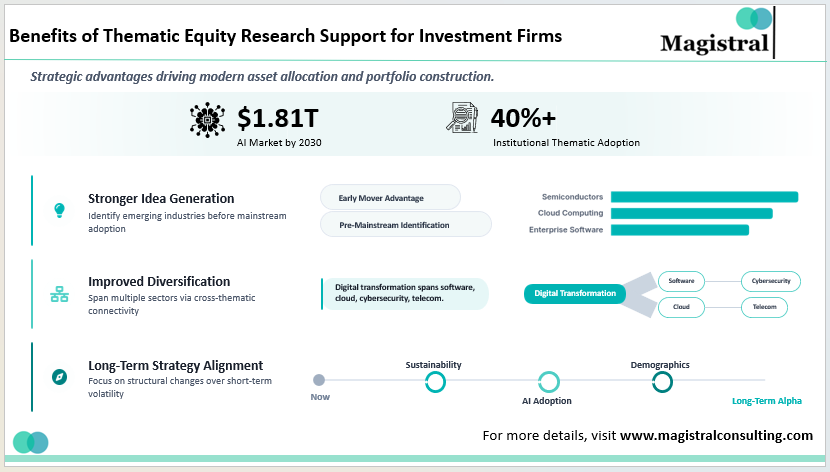
Analysts can use thematic research to discover upcoming industries that will eventually gain mainstream recognition. The worldwide artificial intelligence market is expected to achieve a value of $1.81 trillion by 2030, which will generate new business opportunities in semiconductors, cloud computing, and enterprise software. Grand View Research reports that this expansion will lead to major technological advancements and increased investments. The study found that investors who successfully identify early technology and sustainability trends will achieve higher growth potential.

Improved portfolio diversification

Thematic research improves portfolio diversification because it links investment prospects which exist in different industrial sectors and geographical areas. Themes that connect multiple sectors allow investors to create diversified portfolios while they still maintain investment in one major market trend. According to the Deloitte Investment Management Industry Outlook, more than 40% of institutional investors now incorporate thematic strategies into portfolio construction, which shows the transition from traditional sector allocation to cross-sectors investing.

Alignment with long-term investment strategies

Investors who study structural trends will discover market entry points that enable them to invest in multiple industries. Thematic research serves as a foundation for institutional investors who use thematic research to determine which sectors will experience strong growth during extended investment periods.

How Magistral Delivers Thematic Equity Research Support

Thematic equity research support from experienced research partners helps investors analyze industries, build financial models, and identify investment opportunities. Organizations need analytical skills to study new market patterns that they want to explore.

Industry research and data analysis

Research teams use industry reports together with macroeconomic data and corporate information to discover new market trends that will influence international markets.

Financial modeling and benchmarking

With comprehensive financial models, investors can assess companies that will gain advantages from market development trends. Industry comparison benchmarking enables organizations to obtain a better understanding of their market competition.

Supporting institutional investors

Magistral Consulting provides research support to asset managers, hedge funds, and institutional funds, as well as venture capital firms seeking deeper insights into evolving markets.

About Magistral Consulting

Magistral Consulting has helped multiple funds and companies in outsourcing operations activities. It has service offerings for Private Equity, Venture Capital, Family Offices, Investment Banks, Asset Managers, Hedge Funds, Financial Consultants, Real Estate, REITs, RE funds, Corporates, and Portfolio companies. Its functional expertise is around Deal origination, Deal Execution, Due Diligence, Financial Modelling, Portfolio Management, and Equity Research

For setting up an appointment with a Magistral representative visit www.magistralconsulting.com/contact

About the Author

Tanya is an investment-research specialist with 6 + years advising venture-capital, private-equity and lending clients worldwide. A Stanford Seed alumnus with an MBA and an Economics (Hons) degree, she heads project teams at Magistral Consulting, delivering financial modelling, due-diligence and deal support on 3,000 + mandates. Her blend of rigorous analytics, sharp project management and clear client communication turns complex data into actionable investment insight.

FAQs

Why is thematic investing important?

Thematic investing allows investors to capture long-term growth opportunities driven by macroeconomic and technological trends.

How does thematic research differ from traditional research?

Traditional equity research focuses on sectors or companies individually, while thematic research examines broader trends affecting multiple industries.

Who uses thematic equity research support?

Asset managers, hedge funds, private equity firms, and venture capital investors frequently rely on thematic research to guide investment decisions.

Can outsourced research improve thematic analysis?

Yes, outsourced research teams provide specialized expertise, industry analysis, and financial modeling support that enhances investment decision-making.