Tag Archives: AI in Hedge Funds

Picture a hedge fund that deals with very dynamic markets, unceasing regulatory pressure, and an influx of alternative data. In this scenario, the outsourced hedge fund analytics has become one of the most tactical moves for the enhancement of speed, precision, and investment confidence. This change is encouraged by the growing cost pressures and the desire for more quantitative insight. While the managers encounter thinner spreads and heavy scrutiny, outsourcing enables them to concentrate their internal skills on high-value areas. At the same time, leverage specialized models, alternative datasets, and scalable analytical power that organizations usually invest heavily in for internal use.

With the use of more advanced models similar to those used in real estate financial modeling, hedge funds have started to outsource as a way of acquiring specific modeling expertise in the sector without the long hiring cycles. This results in smoother deal screenings and quicker portfolio decisions.


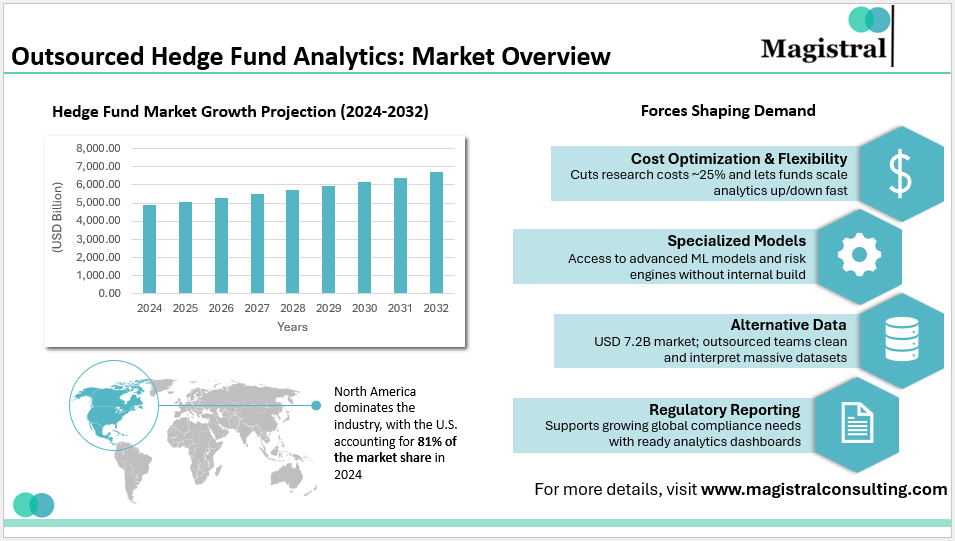
Outsourced Hedge Fund Analytics: Market Overview

The global hedge fund industry is large and growing. The hedge fund market was valued at USD 4,879.6 billion in 2024. It is projected to grow to USD 6,396.4 billion by 2032, at a compound annual growth rate (CAGR) of ~4.0%. Geographically, North America dominates the industry, with the U.S. accounting for 81% of the market share in 2024. By investor type, institutional investors (such as pensions, endowments, and insurers) are the largest segment, followed by high-net-worth individuals, family offices, funds of funds, and retail investors. This concentration reflects how allocators continue to lean on hedge funds for diversification, risk-adjusted returns, and alternative strategies. The demand for outsourced hedge fund analytics is accelerating because asset managers need to operate leaner while analyzing more data exponentially.

Outsourced Hedge Fund Analytics: Market Overview

Outsourced Hedge Fund Analytics: Market Overview

This section explores the forces shaping demand, including cost optimization, alternative data growth, and regulatory expectations.

Cost Optimization and Operational Flexibility

Hedge funds are under pressure to deliver alpha while keeping management fees competitive. Outsourced hedge fund analytics reduces fixed costs by converting analytics functions into variable expenses. A recent PwC operational benchmarking study noted that funds using external analytics partners experience up to twenty-five percent lower research-related cost burdens. The flexibility to scale up or scale down quickly is especially valuable in volatile markets, allowing funds to avoid large internal teams during quieter macro cycles.

Access to Specialized Analytical Models

External analytics teams bring niche capabilities that many funds cannot build internally. These include machine-learning-based factor modeling, risk decomposition engines, and automated screening systems. Many hedge funds now rely on outsourced quantitative modeling similar in structure to what private equity teams use for portfolio analytics. The result is a stronger ability to evaluate new asset classes, back-test ideas, and deploy capital faster.

Surge of Alternative Data

The market for alternative data was valued at USD 7.20 billion in 2023. It is projected to continue its rapid expansion at a compound annual growth rate (CAGR) of 50.6% through 2030. Hedge funds now integrate credit card data, satellite imagery, social sentiment, and supply chain feeds. Outsourcing accelerates ingestion, cleaning, and interpretation of these huge datasets. External partners frequently operate with advanced data engineering stacks, which hedge funds utilize to derive signals with higher precision. The raw data stream has rendered contracted personnel particularly crucial in tasks like venture capital market research. It is characterized by a mixture of structured and unstructured datasets used in predictive modeling.

Regulatory Pressures Driving Better Reporting

Regulators in the U.S., Europe, and Asia now require very detailed portfolio analytics, scenario modeling, and liquidity stress tests. Outsourced hedge fund analytics gives access to standardized reporting dashboards, helping them stay compliant without expanding internal compliance teams.


How Outsourced Hedge Fund Analytics Enhances Investment Decision-Making

Outsourced hedge fund analytics is an innovation that dramatically transforms investment workflows by making signal generation, risk management, portfolio attribution, and decision-making faster and easier.

Sharper Alpha Generation through Quant-Led Research

Outsourced modelers help create factor screens, produce hypothesis-driven datasets, and signal comparisons across different regions. Multi-factor strategies now account for more than one-third of global equity flows managed by quants, indicating that there is a demand for more in-depth analytical foundations.

Faster Idea Validation and Back-Testing

External analytics teams cut down the time required for the validation of ideas. Rather than waiting for internal quant teams to conduct comprehensive back-tests, outsourced professionals can provide model simulations in just one overnight session. This speed-up in the cycle makes the market more competitive, where execution gaps of milliseconds influence the results.

Risk Decomposition and Exposure Management

The application of sophisticated risk modeling remains the most significant reason for outsourcing. Funds use partners to quantify factor-based exposures, track systematic and idiosyncratic risks, and understand sectoral bifurcations. The capability of performing fast scenario analysis is yet another point attracting investors in capital raising conversations. Because the demand for risk transparency is getting deeper.

Portfolio Attribution and Performance Diagnostics

Attribution analytics is how managers get to know the actual sources of alpha. Outsourced teams can analyze daily P&L contributions, factor premiums, and execution analytics. This is to make a small adjustment to the strategy, thereby creating a stronger alignment between the investment vision and performance.

Automation and AI-Driven Efficiency

Automated insights cut down on manual spreadsheet work and boost the reliability of results. This trend coincides with the progress made in DCF valuation and financial modeling.


Operational Advantages of Outsourced Hedge Fund Analytics

Outsourced hedge fund analytics not only enhance the performance of investments but also the very foundation of hedge funds, consisting of operations.

Scalable Analytics Without Long Hiring Cycles

Hiring senior quants, data engineers, or econometricians is expensive and slow. Outsourced analytics teams provide instant access to talent without compromising work quality.

Higher Accuracy and Reduced Human Error

Utilization of a structured analytic pipeline brings about the elimination of human error and inaccuracies in reports. External recruiting firms enforce consistent practices for their auditing and thereby enhance accuracy for the entire research, risk, and valuation process.

Faster Turnaround for Research and Reporting

Hedge fund analytics teams that are hired from outside often work in different time zones. This means that hedge funds can have a workflow that is almost continuous. This leads to quicker reporting, faster and desk-ready model creations, and improved execution strategies.

Improved Business Continuity and Redundancy

Analytics production might be held up because of disturbances like fluctuating markets, changes in staff, and regulations. However, outsourcing partners through their globally spread teams add redundancy to the process, thus ensuring an uninterrupted and continuous flow of analytics and reporting cycles.


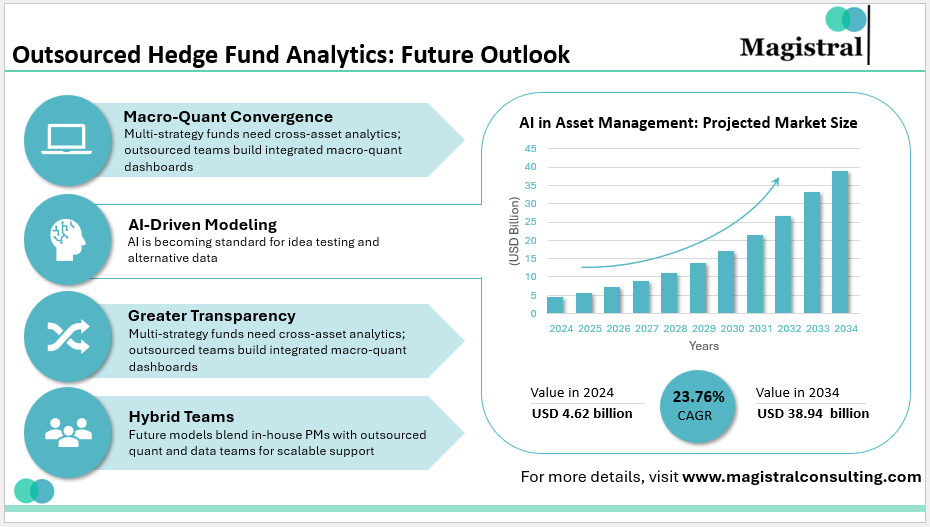
Outsourced Hedge Fund Analytics: Future Outlook

This section elucidates the future projection of outsourced hedge fund analytics concerning large datasets, cross-asset strategies, and advanced AI models.

Outsourced Hedge Fund Analytics: Future Outlook

Outsourced Hedge Fund Analytics: Future Outlook

AI-Driven Modeling Will Become Standard

Generative AI is changing the scenario of hedge funds for the better by providing them with new ways of thinking, analyzing alternative data, and drawing conclusions. By 2028, AI-supported research is expected to be standard across most asset managers. Analysts value the AI in asset management market at USD 4.62 billion in 2024 and predict it will reach USD 38.94 billion by 2034, growing at 23.76% annually.

Multi-Asset and Macro-Quant Convergence

As multi-strategy funds expand into commodities, credit, and macro, outsourced analytics teams will support cross-asset research by building integrated macro-quant dashboards. AI has also started changing the way of doing investment banking analytics because of the removal of partners who are excellent at working with capital-intensive modeling.

Increasing Institutional Demand for Transparency

The generation of investors is expecting nothing less than full disclosure and ESG metrics along with real-time reporting. Analytics done by the outsourced groups make this possible since they create pipelines for reporting that are standardized across the globe, thus enabling real-time reporting.

Hybrid Teams as the New Normal

Outsourcing will not replace internal analysts but will create hybrid working models where external quant teams will be directly collaborating with portfolio managers and risk officers.


How Magistral Consulting Supports Outsourced Hedge Fund Analytics

Magistral provides a wide range of outsourced hedge fund analytics services. It includes support for risk modeling, compliance reporting, and operational scalability. Its cross-functional teams of quants, analysts, research specialists, and data engineers handle everything from screening and back-testing to factor modeling and portfolio diagnostics.
>Magistral’s outsourced hedge fund analytics services align with industry needs by offering standardized research frameworks, customized quant models, and alternative data processing capabilities. The firm assists hedge funds in adopting AI-enabled analytics so they can enhance trading signals and portfolio intelligence. Using the same disciplined approach found in its investor intelligence solutions, Magistral ensures that hedge funds receive predictive models, automated dashboards, and actionable scenario analyses. The company’s expertise includes AI-assisted deal analysis and portfolio surveillance systems, thereby solidifying its position as a strategic ally for funds that need large-scale analytical support.


About Magistral Consulting

Magistral Consulting has helped multiple funds and companies in outsourcing operations activities. It has service offerings for Private Equity, Venture Capital, Family Offices, Investment Banks, Asset Managers, Hedge Funds, Financial Consultants, Real Estate, REITs, RE funds, Corporates, and Portfolio companies. Its functional expertise is around Deal origination, Deal Execution, Due Diligence, Financial Modelling, Portfolio Management, and Equity Research

For setting up an appointment with a Magistral representative visit www.magistralconsulting.com/contact

About the Author

Nitin is a Partner and Co-Founder at Magistral Consulting. He is a Stanford Seed MBA (Marketing) and electronics engineer with 19 + years at S&P Global and Evalueserve, leading research, analytics, and inside‑sales teams. An investment‑ and financial‑research specialist, he has delivered due‑diligence, fund‑administration, and market‑entry projects for clients worldwide. He now shapes Magistral Consulting’s strategic direction, oversees global operations, and drives business‑development support.

FAQs

What tasks can be outsourced in hedge fund analytics?

Funds commonly outsource quantitative modeling, factor analysis, alternative data processing, back-testing, portfolio attribution, risk modeling, and compliance reporting.

Is outsourcing analytics secure for hedge funds?

Yes, leading providers follow strict data governance protocols, access controls, and compliance standards to ensure secure handling of sensitive financial information.

How does outsourcing improve investment decisions?

Outsourcing provides access to specialized models, advanced analytical tools, and faster turnaround times, helping managers test ideas and manage risk with greater accuracy.

Why is alternative data central to outsourced analytics?

The scale and complexity of alternative data require specialized engineering, cleaning, and modeling workflows that outsourced teams can provide efficiently.

Are outsourced analytics suitable for small hedge funds?

Absolutely. Smaller funds benefit most because outsourcing allows them to access institutional-grade analytics without building expensive internal teams.


Artificial intelligence is defying AI in hedge funds industry in 2025. From deep learning models in trading to proprietary data and the global race for AI investments, they use AI in hedge funds to create a competitive edge in an increasingly complex and volatile market. This article provides a full data-analytical approach to analyzing how AI in hedge funds is affecting hedge funds: with current trends, opportunities, and regional perspectives.

AI in Hedge Funds: Overview of the Market

The adoption of AI in hedge funds domain has witnessed rapid growth over the past five years. The 2024 International Data Corporation (IDC) CIO Survey reported 78% of companies said they used AI. It is as against 55% earlier than 8%. It would seem to be another layer, as it goes further in making leading firms apply AI in hedge funds. They are in every operational phase-from predictive analytics and real-time trading to risk management.

AI in Hedge Funds: Overview of the Market

AI in Hedge Funds: Overview of the Market

Key Data Points

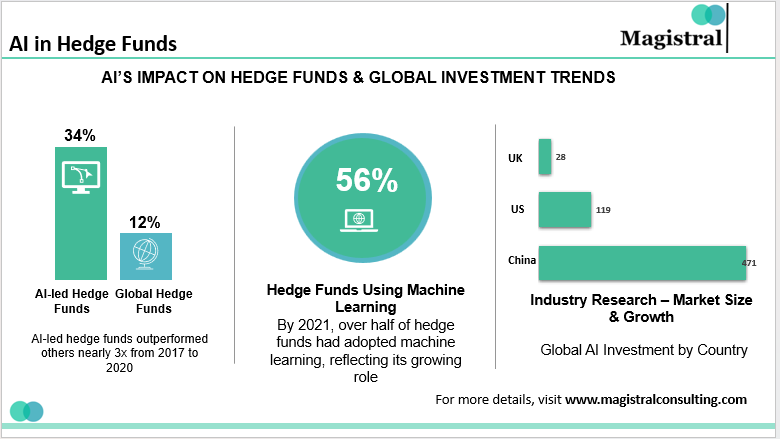
As compared with about 12% of returns of global hedge funds, those of the growth in AI in hedge funds produced a return of 34% between May 2017 and May 2020.

By 2021, 56% of hedge funds were already using machine learning in their trading processes, a figure that has steadily grown since then.

In the U.S., AI investment crushes its competition, raising $471 billion between 2013 and 2024, far beyond China ($119B) and the UK ($28B).

Current Adoption Trends for AI

Today’s Trends in Hedge Fund AI Adoption:

The AI Revolution in Hedge Funds

The AI Revolution in Hedge Funds

Investment Strategies Driven by AI

Hedge funds are increasingly integrating AI into their investment decision processes. Companies such as High-Flyer have implemented AI end-to-end within their trading strategy by using deep-learning models. It is for the analysis of market data and the automatic placing of trades. Ubiquity, the reputed Chinese quant fund, has set up a dedicated AI lab. It is to develop trading strategy through machine learning and big data.

Key Features:

Pattern Recognition Using AI

These systems analyze many terabytes of structured and unstructured data to develop trading signals that manual human analysts may not discern.

Algorithmic Trading

Machine learning algorithms trade at speed and volume impossible for a human, thus optimizing the trade-offs between speed and accuracy.

Sentiment Analysis

Use large language models (LLMs) for sentiment extraction with respect to markets on news and social media and policy announcements to convert qualitative data into actionable investment insights.

Predictive Analytics and Real-Time Decision Making

Through predictive analytics based on AI, hedge funds forecast markets and position assets in the best manner while trying to better analyze the risk. With real-time processing of data streams, funds can seize very short-lived opportunities and position themselves in an instant.

High-Frequency Trading (HFT)

Price exploits are sought by AI-powered HFT algorithms wherever millisecond time delays exist from one market to another.

Streaming Analytics

Prior to the competitive phase, continuous evaluation of the incoming market data streams is done so that the funds might react upon any market signal.

Complex Event Processing

AI correlates and examines events from different sources for any unusual phenomena or activities that could be significant for an investment decision.

Proprietary Data Tools and Infrastructure

Among the world’s mega hedge funds, Man Group has treated Arctic DB as a database tool of the highest caliber for the analysis of huge historical price data sets. It does not operate like a spreadsheet; rather, Arctic DB operates through code to enable fast, scalable, and integrated time-series analysis. Its adoption by Bloomberg and other giants of the financial world exemplifies the growing importance of proprietary data infrastructure in AI-driven finance.

Emergence of AI Startups and Ecosystem Growth

Startups and AI-driven approaches are progressively shaping the hedge fund world. DeepSeek, spun out from High-Flyer, is inventing large-scale AI models that can contend with global tech giants. There are implications for both tech development and financial markets. The rise of AI startups is fulfilling a role that pushes innovation and lends new tools to hedge funds. It is for data analysis, trading, and risk management.

Opportunities for AI in Hedge Funds

By leveraging AI in Hedge funds, efficiency may boost.

Enhanced Alpha Generation

Given AI’s ability to ingest and learn from gigantic datasets, hedge funds could identify interesting new alpha opportunities. For instance, BlackRock’s Systematic Equities Macro group employs LLMs to test market sentiments on securities, regions, and macroeconomic outcomes and combines these insights into quant models for more accurate alpha generation.

Risk Management and Portfolio Optimization

Predictive analytics prevails in granting funds foresight on market volatility or systemic risks, along with the ability to rebalance port dynamically for better risk similar returns.

Operational Efficiency

The automation of mundane tasks such as data cleaning, compliance-checking, and reporting can allow human analysts to concentrate on more high-value tasks, thereby improving efficiency and reducing operational costs.

Alternative Data Utilization

AI-based tools allow AI in hedge funds to extract investment insights from alternative data sources, such as satellite imagery, web traffic, and social media. This increases the opportunity set and reinforces diversification support.

Regional Insights: Global AI Investment and Hedge Fund Activity

United States

Dominance in AI Investment

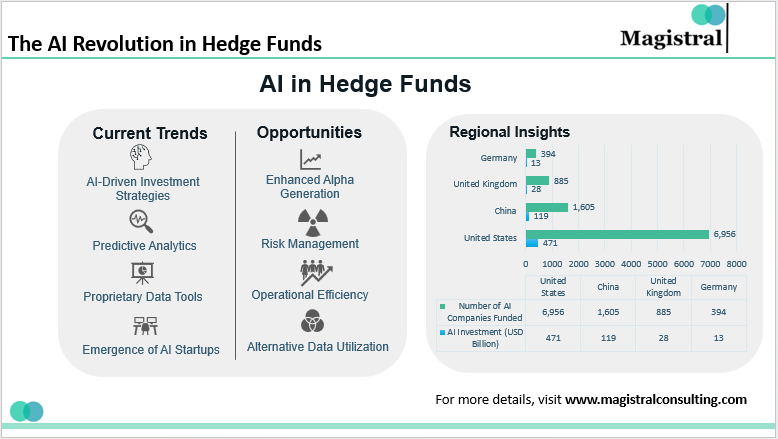
The U.S. has raised nearly $500 billion in private AI investment since 2013, supporting a very healthy ecosystem of AI startups and hedge fund innovation.

Ecosystem Strength

Between 2013 and 2024, the U.S. gave funding to practically 6,956 AI companies and stands second to none for AI research and implementation into finance.

Hedge Fund Innovation

Because of their access to top-grade talent and cutting-edge research, funds based in the U.S. and using AI in trading, risk management, and client services are, to date, the most innovative.

China

Rapid Growth

China has raised $119 billion in AI investment and set up 1,605 AI companies since 2013 to establish itself as a recognized AI powerhouse.

United Kingdom and Europe

Innovation Hubs

UK ($28B AI investment, 885 new AI companies) and Germany ($13B, 394 companies) are leading European centers for AI in finance.

Asia-Pacific

Singapore, South Korea, and Japan are emerging as regional AI leaders, investing heavily in fintech and alternative data analytics for hedge funds.

Services offered by Magistral Consulting for AI in Hedge Funds

Magistral offers the following services for Hedge Funds:

AI-Powered Deal Sourcing & Market Scanning

We use natural language processing (NLP) and machine learning tools to continuously parse global data sources. It is from news feeds, filings, earnings calls, and alternative datasets-to enable hedge funds to recognize high-potential investment options in the early stages systematically.

Predictive Modeling & Quantitative Research Support

Our team builds and backrests machine learning models for price prediction, alpha generation, and other factor-based strategies. Systematic funds assist in building robust feature sets, developing trading signals, and refining model performance in preparation for real-world deployment.

Portfolio Monitoring & Risk Analytics

Based on data from the portfolio, AI is used to aggregate and analyze in such a way that any risk is detected in real time, can be planned for in different scenarios, and stress tested. Our tools can identify hidden exposures that can then be acted upon by funds to intervene in risk.

AI-Driven Sentiment Analysis & News Intelligence

Using artificial intelligence with our proprietary techniques makes it possible to stratify and identify LPs. It is based on geography, fund strategy, prior allocation behavior, or interest signals. Hence anything from outreach to engagement may get catered by personalized marketing channels. It is to give a better fundraising edge.

Operational Workflow Automation

Using AI in hedge funds and RPA tools, middle- and back-office functions are automated and streamlined. They are reconciliations, compliance reviews, trade validation, investor reporting, etc., minimizing human intervention and improving accuracy.

Alternative Data Integration & Analysis

We assist hedge funds in sourcing, cleaning, and analyzing alternative data such as web traffic, satellite images, and credit card transactions. It is through AI pipelines that convert raw inputs into investment insights.

AI-Based Fundraising & Investor Targeting

Our proprietary AI capabilities allow for the possible stratification and identification of LPs. It is based on their geography, fund strategy, prior allocation behavior, and interest signals. We might also personalize outreach and engagement across marketing channels, giving a better edge to fundraising.

Custom AI Dashboards and Visualizations

We develop interactive dashboards and visualizations that present AI-derived insights regarding portfolio performance, risk metrics, operational KPIs, and market intelligence. Integrations span Power BI and Tableau platforms.

Due Diligence Automation for Investments

We automate several aspects of due diligence processes, guided by AI data collection and screening tools. These tools analyze legal records, financial statements, ESG factors, and news to yield faster, more thorough evaluations.

About Magistral Consulting

Magistral Consulting has helped multiple funds and companies in outsourcing operations activities. It has service offerings for Private Equity, Venture Capital, Family Offices, Investment Banks, Asset Managers, Hedge Funds, Financial Consultants, Real Estate, REITs, RE funds, Corporates, and Portfolio companies. Its functional expertise is around Deal origination, Deal Execution, Due Diligence, Financial Modelling, Portfolio Management, and Equity Research

For setting up an appointment with a Magistral representative visit www.magistralconsulting.com/contact

About the Author

The article is authored by the Marketing Department of Magistral Consulting. For any business inquiries, you can reach out to prabhash.choudhary@magistralconsulting.com

Generates alpha, manages risk, improves efficiencies, and analyses alternative data.

The U.S.A. emerges first, followed by China, U.K., Germany, Israel, and Singapore.

Supervised learning, Unsupervised learning, Reinforcement learning, and Deep learning are wide applications of AI in hedge funds.

Yes, startups have evolved technologies that give hedge funds the trades with an advantage.